Clearing Into Panama…Break Out Your Wallet!

After tying into our slip the marina staff promptly called the various officials to come clear us in, and we were told that it would be at least an hour before they arrived. However, just thirty minutes later, they were knocking on our door(Luckily, we managed to put fresh, dry clothes on. Tying up in the heat has us soaked through)!

Four officials boarded the boat, and representatives from the port captain’s office, immigration, customs and agriculture took a seat in our saloon. The port captain spoke the best (really, the only) English, and was primarily there to inform us as to what the rest needed.

He began by saying that they were offering us the “service” of coming out to our boat. Hmmm, “service.” The only two who actually needed to come on board were the customs and agriculture officials. We were still expected to visit the port captain and immigration offices to register the boat, so they saved us no time by coming aboard. It smelled of a way to get some extra cash (ie, a tip), but this didn’t surprise us and we weren’t up for arguing.

As soon as they were settled, Howard came to greet them. He jumped onto the table and right into the face of the woman from immigration, who was obviously not a cat person (why do animals always seem to sniff these people out??). She recoiled and froze, as if someone had thrown a rattlesnake in front of her. The men from customs and immigration, however, were fascinated with Howard, and tried to coax him closer for some petting. Of course, he wasn’t interested in them, only in agitating the immigration woman, who was already not a friendly person.

The port captain didn’t do anything while aboard but translate, which was definitely useful. For this, he handed us a receipt for $20.00; “overtime” service for coming to the boat. It was 11:30 am on a Monday, in who’s world is that overtime??

Madam Friendly stamped our passports, with a written expiration date of 48 hours. We were expected to see her at the immigration office within that time, to pay $105.00 each for 90 days in the country. So what exactly was the $25.00 service fee for??

She conveniently didn’t have a receipt on hand, for the $25.00 “fee.” The port captain relayed that we’d get the receipt at her office. This excuse seemed sketchy, but since we still had to deal with her, we held our tongues.

The agricultural official was hardly interested in the food we had onboard, unlike the close scrutiny we’d had in Mexico. He barely glanced in the refrigerator, waved off looking in the freezer (Scott’s biggest worry area), and briefly looked into one galley cabinet, before declaring us good.

This man was also responsible for clearing Howard. He watched Howard’s agitating antics toward Madam Friendly, and deemed him healthy and fine (maybe as an “atta boy!”). We were handed a receipt of his “services,” in the amount $35.00.

The customs agent was the most thorough, walking through the entire boat with Scott. He opened all drawers and closets, and inquired about liquor. Scott replied that we had “a few bottles” on board, and quickly shifted the man’s attention elsewhere. Unlike Mexico, where there was a thorough investigation of our engine room and motor, this man didn’t go below, or check any compartments under the floor. When through, he handed us a receipt for his $20.00 service.

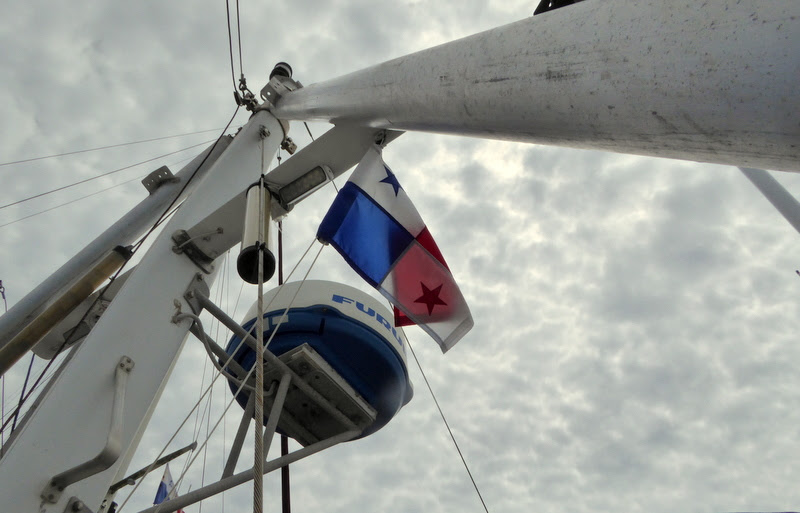
So now we, Howard and the boat’s contents were cleared in, that just left the boat itself. We were now allowed to raise the Panamanian flag.
The next day, we headed to the port captain’s office in town, to register Sea Life. We dealt with a different port captain, who had us fill out the same form Scott had completed the day before..arrgh! The man was very friendly and helpful, as the two worked together to complete the form. The captain assisted Scott with filling in the Spanish blanks, and Scott helped him with the details of our boat information.

The subject of how to categorize our boat took some time, which seemed strange. As we travel farther south, most everyone assumes that we are on a sailboat. Sea Life is a powerboat, but  compared to those found in the U.S., she leans more toward a sailboat in speed and seaworthiness. However, the port captain didn’t know any of this, and seemed confused by us being on a powerboat, especially one that had come from so far away.

Scott  handed him our boat card, with a photo of Sea Life, thinking it would help. After much hemming and hawing, and discussion with others in the office, we were classified as a sailboat on some of the paper work, and a yacht on other areas. When all was said and done, we handed over $185.00 , and Sea Life was registered for one year.

Next, we made our way to the airport, in the pouring rain, to see Madame Friendly. The port captain had called ahead for us, to make sure that she’d be there, and not away for lunch. We were told that she was waiting, but when we arrived, soaked from our ten minute walk in the rain, she was leaving her office. Pointing to her watch, we were told to be back at 2:00; it was just after 1:30.

Instead of walking back to town to kill time, in the rain, we decided to settle in and wait for her return. At 2:15, we wondered how much longer she’d be, and discussed leaving. She finally showed just before 2:30, and we waited another 15 minutes before she called Scott into her office.

After filling out more paperwork, Scott  handed over $210.00, which cleared us for 90 days. However, I will be traveling home to Baltimore for a visit (I am thrilled to spend time with family and friends. I’m a people person, and miss my people!), which puts a wrench in the works…so she says.

She claimed that once I leave Panama, the $105.00 fee will have to be paid again on my return, even though I’ll be traveling within our 90 days. This rule really smelled bad to us, and I hope that when I actually fly back, that it isn’t the case. Everyone we’ve talked to about our experiences with Madame Friendly confirms my nickname for her…and then some.

After a full day of offices and officials, and a running total of $495.00, we were officially temporary Panamanian citizens. Our travels in Panama will include the San Blas Islands, where we understand that there will be more fees to pay. Welcome to Panama, please open your wallet!

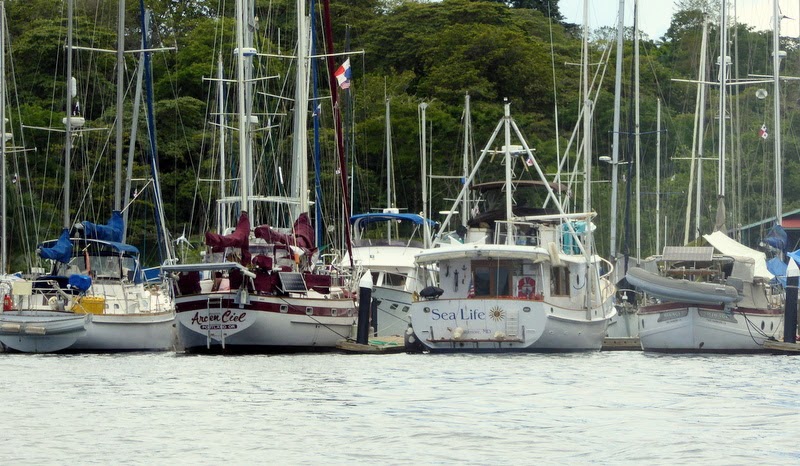
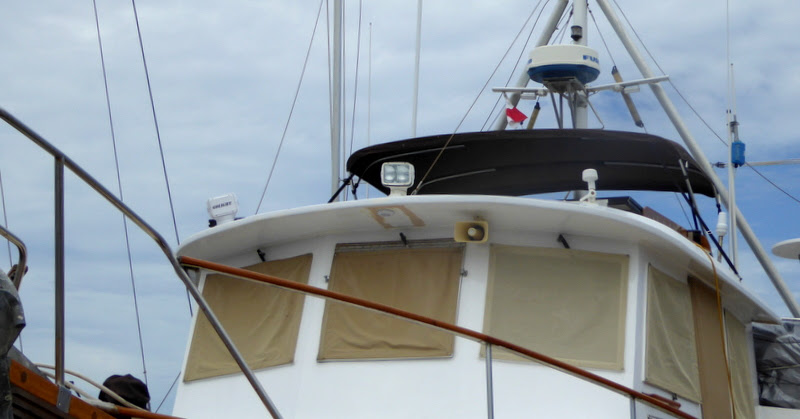
We’ve settled in at Bocas Marina, with the Panamanian courtesy flag flying in our rigging,  dwarfed by the gaggle of sail boat masts around us. We’re short, fat, different and proud!
“Shells Sink, Dreams Float. Life’s Good On Our Boat!”

Our Final Push To Panama

Our passage to Panama was, in a word, terrific! We raised anchor at 7am, and followed both the way points and our track coming into the Albuquerques, traveling right through the reef, stress-free this time.

(If you were following our track on the Delorme link, the Albuquerque Cays are not visible on Google Earth, so it appeared that we were just dead in the water for five days or so. Our zig-zag track leading to it was our path through the coral.)

Scott estimated that the trip would take 28-30 hours, based on us traveling at an average speed of 6 knots. We actually averaged closer to 7 knots, and spent much of the trip at 7.1 and 7.2, with the current in our favor for a change. Considering that our paravanes cost us a half knot of speed when they’re in the water, traveling 7+ knots was fantastic!

The winds were at 13-15 knots as we left, and they dropped to nothing by the late afternoon; the seas followed suit. For much of the late afternoon and evening, our wind gauge read 0, a beautiful sight. Our trip went so smoothly that I was able to catch a nap in our bed, versus the couch. Howard got restful sleep, and was alert and mobile later, begging us for food.

Scott put his lines in the water, with fingers crossed that we’d catch something to fill the freezer with. Almost immediately, one of the lines began to whiz. It was a sizeable sailfish, that we weren’t interested in eating or taking the time to catch. However, that fish had our lure, so Scott began to reel him in. Unfortunately, the line snapped and the sailfish swam of….with our lure. Skunked again.

Just after dawn the next morning, the coastline of Panama came into view.

As the sun rose and we came closer to the coastline, the air smelled clean and fresh coming off of the mountains, similar to the awesome pine smell that greeted us in Guanaja.

As we approached the Bay of Almirante, several small hotels appeared along the shoreline. A large barge replacing navigational buoys passed by us, and those things are much bigger out of the water. We took turns venturing out onto the bow, admiring the coastline, breathing in the terrific smelling air and enjoying the sunshine.

We couldn’t stop looking at the mountains, with their peaks disappearing in the clouds. Later, Scott realized that the lower hills are in Panama, and the higher ones we were seeing are actually in Costa Rica, as the country’s border is very close.

Once inside the bay, the water turned glassy calm.

The color here was more green and didn’t appear to be too clear, until we saw two dolphins headed our way. As they approached the boat and dove down, we could clearly see them at least 20 feet down. We expected them to hang around our bow for a bit, but they went right by us, and I thought they’d gone. I turned to see them doing Sea World-type flips some distance behind us, and wished I hadn’t left my camera inside.

Soon Isla Colon, and Bocas Town, came into sight. Our marina is off of the west end of Boca Town, so we had to make our way around to the other side of the island.

By this time, Howard was more than ready to be there.

An hour or so later we made our final turn, taking us past more of Bocas Town, and heading toward Bocas Marina.

Panama was our destination for hurricane season this year, and the goal for end of year one. The original plan was to be here in Bocas del Toro by late June, and make our way toward the Eastern Caribbean in late October.

After being delayed so long in getting here, and not wanting to rush through the country. we’ve decided to linger here until spring. We’ll stay in Bocas del Toro until mid-November, and then move on to explore more of the eastern coast, and the San Blas Islands (sorry, so canal crossing for us). Here are more photos of our final leg to Panama.

“Shells Sink, Dreams Float. Life’s Good On Our Boat!”

Exploring Bocas del Toro By Water

The country of Panama is an isthmus (a narrow strip of land with sea on either side, forming a link between two larger areas of land), bordered by the Caribbean Sea to the north and the Pacific Ocean to the south. Bocas del Toro is located at the northwest end of Panama, near the border of Costa Rico.

Image result for location of bocas del toro

Bocas del Toro Province is made up of an island chain off the Caribbean coast, and a section of nearby mainland. The archipelago separates Almirante Bay from the Caribbean Sea, and is made up of 10 islands. It was originally dubbed “the Galapagos of Panama” for its scores of biologically unique islands and islets. Our marina is on the main island of Isla Colon, where the capital, Bcocas Town is also located. The archipelago also includes 50 cays and some 200 tiny islets.

Not surprisingly, during the 17th century, the archipelago became a haven for pirates. They repaired ships on the islands, built others with wood from the forests and fed upon the many sea turtles in the area.

Gold was not plentiful in Bocas del Toro, so the Spaniards did not colonize the region with the same ruthlessness that was seen in other parts of Panama and the Caribbean.

From the 16th century to the mid-1800s, Bocas was little more than an uncharted frontier. Blazing sun, torrential rain, floods, bugs, landslides, and a plenty of feverish diseases made it pretty inhospitable (hmmm, aside from the landslides and diseases, sounds pretty familiar to us!). Later on, a little fishing village settled where Bocas Town is today.

Bocas town

In 1899, the United Fruit Company planted itself in Bocas town and over the next century that followed, it established vast plantations that stretched across the entire peninsula. Based in Bocas del Toro, the company rapidly expanded through Central and South America, constructing elaborate networks of roads, bridges and canals as well as entire towns and cities to house their workers.

However, one by one, plantations began to fall to a mysterious and deadly infection. “Panama disease” was a fungus that incubated in the soil and spread by floodwaters. By the 1920s, the banana plantations had died out.

During World War II, the Japanese cut off the world’s supply of abaca, which is used to make Manila hemp, the raw fiber in rope. Unable to tie their warships, the U.S. government enlisted the United Fruit Compnay to grow abaca on an industrial scale, and  Bocas del Toro was suddenly booming again.

Today, United Fruit is part of Chiquita Brands (based in Cincinnati), and their workers in Bocas del Toro Province grow and export three-quarters of a million tons of bananas annually.

Chiquita

Alright, enough historical tidbits….Now that the Aluminum Princess was in the water, and we’d made a dent in the to-do list, it was time for some exploring. Our first run was an hour-long ride along the shoreline of Bocas Town, just before sunset. Restaurants, hotels and homes in all conditions are crammed together, many  built entirely over the water.

Carenero Island is just off of Isla Colon, and Bocas Town, so we took a spin past that shoreline next.

While perusing the piers of Marina Carenero (because Scott never tires of looking at boats), we noticed this interesting tenting over a boat having work done. It strapped right to the pier, providing a sturdy structure for the work being done inside.

On the other side of the island, as we motored close to some over-water houses, Scott caught sight of a Maryland registration sticker on a small sailboat that has seen better days; neglected boats make him sad.

A few days later we took a longer ride, heading around the corner from the marina and over to the small settlement of Saigon, which backs up to the far side of Bocas Town. Most all of these houses sit over the water, in all shapes and sizes.

Next it was on to Starfish Beach. We actually didn’t see any starfish, just several interesting, low-key restaurants. We made a mental note for a future visit.

On our way back to the marina, we enjoyed views of the gorgeous clouds over the mountains of nearby Costa Rica.

Scott was concerned about leaving the Aluminum Princess in the water for days at a time, and set about devising a way to allow the bottom to dry. His answer? Tie off the bow of the Aluminum Princess to Sea Life’s windlass, lifting it out of the water and up toward the pier. From there, Scott gave it a good heave, and hauled her out. It’s quite a sight, but it works.

I’ll be traveling back to the U.S., for a five week stay. While I am visiting friends and family at home, Scott has plans for several day-long excursions in the area. Here are many more photos of our first days exploring the waters of Bocas del Toro.

“Shells Sink, Dreams Float. Life’s Good On Our Boat!”

Fishing And Relaxing In The Albuquerque Cays

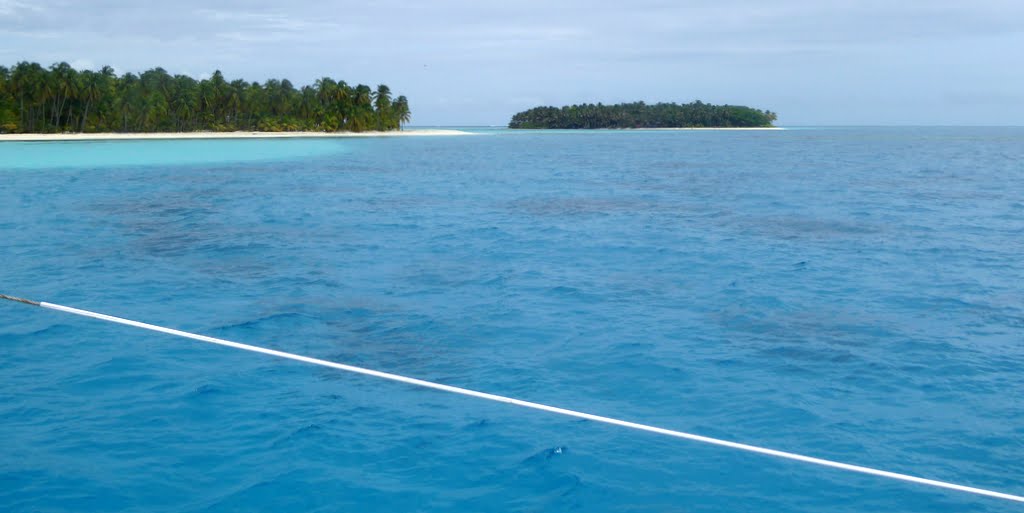
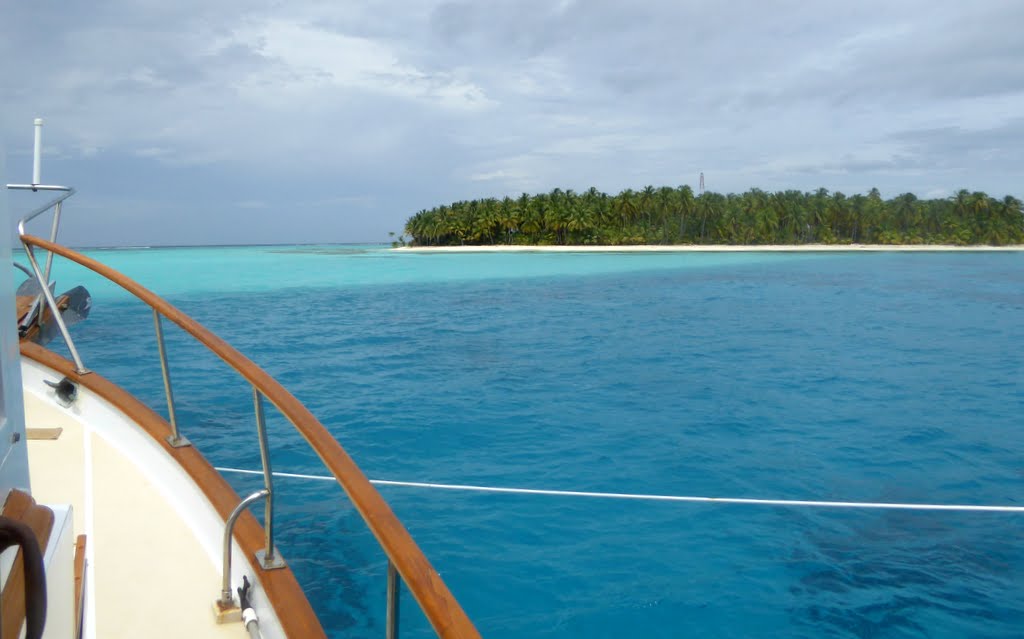
The water surrounding the Albuquerque Cays was gorgeous! 

Clear, Bahama-blue water reflecting off of shallow white sand bottom, framed by green and brown of the surrounding reefs. The whole area is encircled by darker shades of deeper blue water, with the bottom easily visible 30 feet straight down below us, and 80 feet out at an angle.

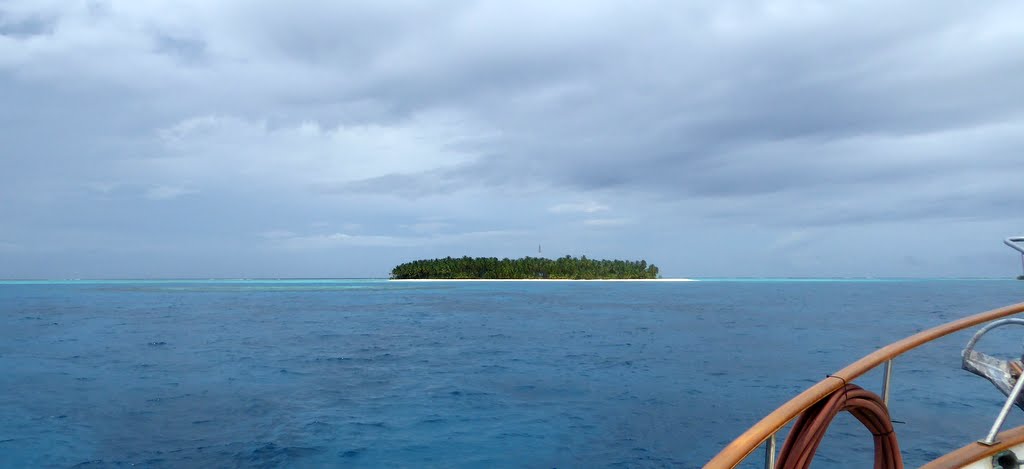
We anchored in front of the larger cay, where the military “Flies” base is located. The island is so thick with palm trees of all sizes, shapes and shades of green that you cannot see any sign of life or shelter on it, until a small glow of light appears after dark. We never tired of admiring the view, it was straight off of a calendar page.

Of course, Scott got right to fishing. On his first venture out he caught a glass eyed snapper (which we enjoyed several times in Providencia) and a decent sized mangrove snapper.

The reefs weren’t terrifically colorful, but they were very, very healthy. Scott commented on how big the fragile, larger coral was (elk horn, stag horn, etc.). Some of the monstrous brain coral was so large that it broke the surface in places. Unfortunately, there weren’t too many fish, and lobster were non existent. We assume that the commercial fisherman on one of the two cays here have depleted the supply.

However, Scott was not discouraged, and ventured out nearly every day. I tagged along one morning, to get some photos and enjoy some bug-free sun, and reading, while he searched the waters below.

After an hour or so, Scott came back empty handed. He’d noticed the head of a large snapper peeking out of a hole, and waited for it to exit. When the fish made a move into open water, Scott shot it through the back. Unfortunately, the tip of his spear broke off, rendering it useless for another shot as the wounded fish swam away.

Scott came up into the dinghy angry and frustrated, wanting restitution for his tip. That fish was going to be dinner, come hell or high water! We headed back to Sea Life, where a new tip was put on, and a mission was set. I skipped this go-round, preferring to stay clear of the battle ahead.

Back at the scene of the crime, Scott found the large snapper again in his hole and fired another shot. This stunned the fish, and it came out of the hole swimming aimlessly. Scott seized his opportunity, and took a final shot that went through the snapper’s gills.

With his restitution in tow, Scott swam hard for the surface, not wanting to share his kill with any lurking sharks or barracuda. He was glad that the snapper wasn’t at it’s full strength, because the fish fought hard on the spear all the way to the surface.

Meanwhile, back at the ranch, I was quietly enjoying a book. When I rose to close the shades against the hot afternoon sun, I heard the dinghy motor and saw Scott approaching. He triumphantly raised his kill (too large to fit in the five gallon bucket) for a photo.

Here is his first snapper…

And the trophy snapper…

The fish was fat, heavy and long. At 23″, it was more than enough for several dinners, starting with yummy fried fish sandwiches (on my homemade ciabatta bread!).

Now that the fridge was full of fish, and his hand was feeling the pain of battle (bruising between the thumb and forefinger), Scott took a day off. We both relaxed, watched movies, napped and admired our surroundings.

Aside from the occasional lap against the hull and the sound of waves crashing on the outer reef, our days were dead quiet at anchor here. The Flies only ventured into sight in the late afternoon, when they spent time line fishing from the beach. Except for the glow of a nightly campfire, we didn’t see or hear the commercial fisherman either.

The sun light on the small cays at dusk was beautiful, and for the first time since we were in Key West, in January, we had an open view to the horizon for sunset.

Scott enjoyed hours of stargazing each night. Even with light pollution visible from San Andres, 40 miles away, the stars were thick and brilliant. The Milky Way wound clearly through the sky above us, like someone up there had spilled their morning glass of full-fat.

We could have stayed for weeks, but it’ was time to move on and continue the journey to Panama, our most southern location to date. Here are more photos of our beautiful anchorage in the Albuquerque Cays.

“Shells Sink, Dreams Float. Life’s Good On Our Boat!”

Traveling To The Albuquerque Cays And Meeting The Colombian Military

The Albuquerque Cays lie 36 miles south, southwest of San Andres. It’s a 5-6 hour trip for us, and a nice way to break up our journey to Panama. The two small cays, surrounded by many reefs, are also owned by Colombia. One is used by commercial fisherman, and the other is a small base for the Colombian military.

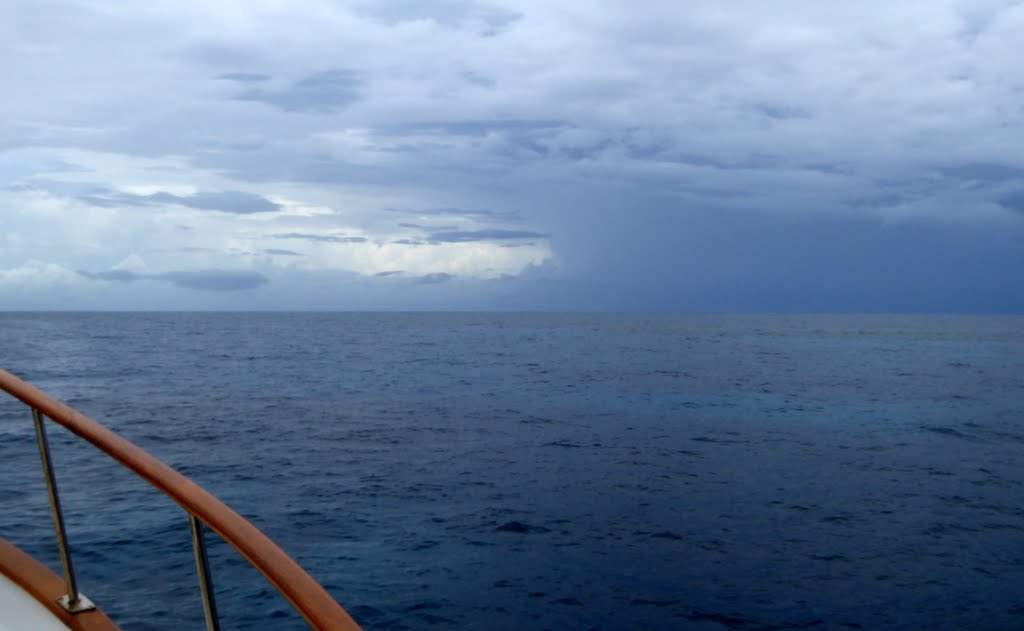
The forecast called for little chance of squalls, low wind and relatively decent size swells. As we prepared to raise anchor, Scott noticed the skies ahead were a bit ominous. For the last few months, we’ve had multiple, instant downpours each day. Out of nowhere the wind will whip up, with sheets of rain right behind it. The downpours lasts for 1-3 minutes, and then the skies clear as fast as they darkened, so Scott wasn’t concerned as we raised anchor and headed toward the channel.

Of course, this rain decided to linger. For the next 30 minutes, as we maneuvered through the channel, staying to one side to allow room for an incoming freighter, the rain poured so hard we could no longer see the anchorage behind us or the horizon in front of us. The winds kicked up to almost 30 knots, filling the harbor with white caps and giving us a good roll. This made putting the paravanes out challenging, as the winds threatened to push us into shallow water (we come to idle to put the birds in).

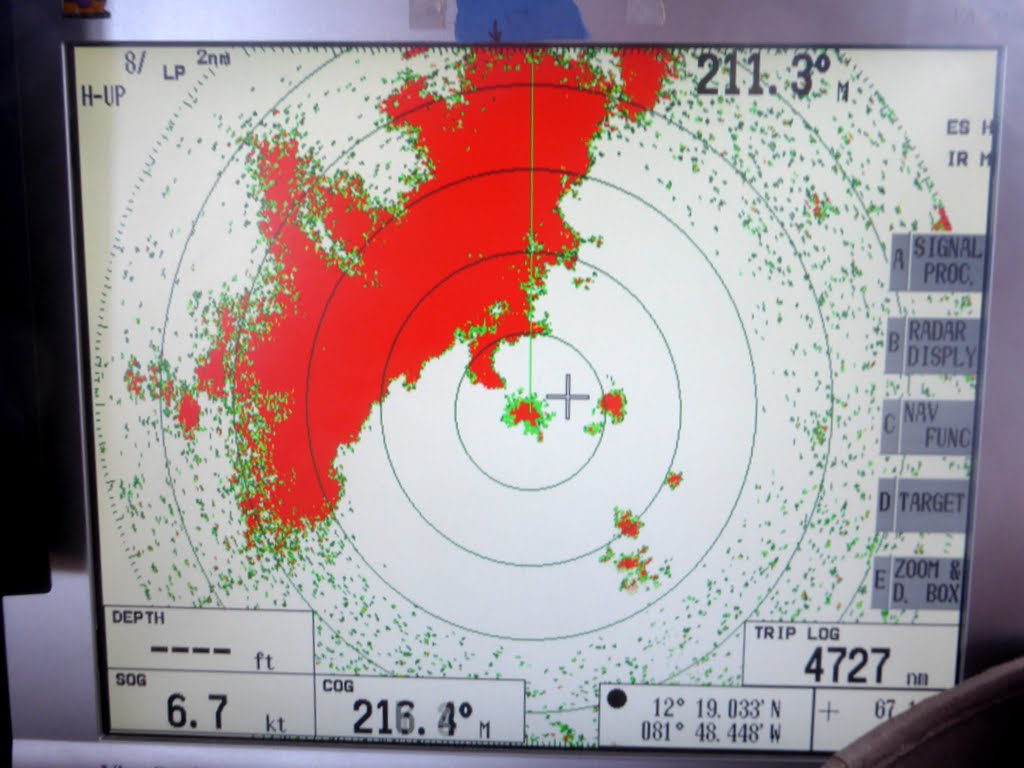
We entertained the idea of throwing out the anchor, and waiting for the weather to pass, but decided just to slog on. The winds eventually slowed, but the rain continued at a steady pace; thanks for the send off, San Andres! By the look of our radar screen, we worried that there was a squall headed our way, but fortunately the big red blob broke up as it approached us, and we were just in for a lot of steady rain.

Photo: Luckily, this giant mass of red broke up before hitting us full force.

Photo: Instead, we just had steady rainfall.

After the heavy rain ended and the swells calmed, it remained cloudy all the way to the Albuquerques. We’d planned to arrive in the early afternoon, with the sun high overhead to help see any coral below the surface. The completely overcast skies made navigating through the reef more challenging than normal.

Scott has literally thousands of hours on the water, and is excellent at reading it. Me….nada. He’s had similar time and experience behind the wheel, and can make decisions on course adjustment in a blink. Again, me…not so much. If the sun had been shining, the plan was for me to be out on the bow as we approached the reef, so Scott could steer (Sea Life doesn’t turn instantly, so there’s a learning curve that I’m still working on).

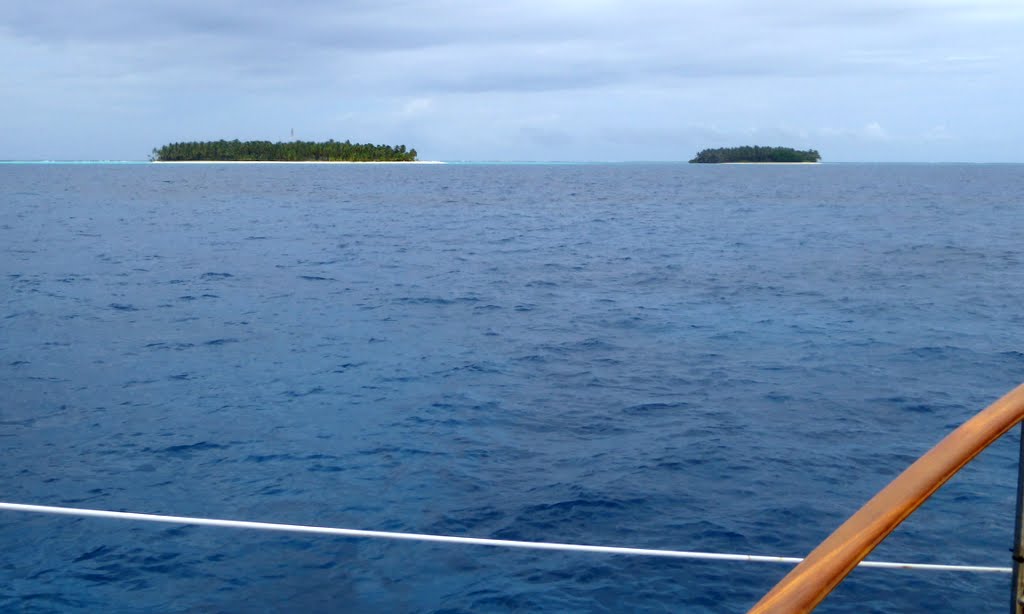
As we approached, the skies brightened a bit, but the sun just wouldn’t pop out. The cloudy skies made it much harder for either of us to see possible coral heads, especially when we couldn’t agree on what was dark blue, or dark blue-green. Luckily, Scott had some way points from our friend Kevin, who’d come through the week before (charts for the area are terribly inaccurate), and we used them to feel our way through the reef. Once safely inside, we could admire the beautiful view!

Photo: The Albuquerque Cays come into view

Photo:

As we were deciding where to drop anchor, the military hailed us on the vhf…in Spanish. Scott replied in English, which usually clues someone to reply the same (most port captains, military, etc. speak enough English to get their point across), but they came back in Spanish again. Scott then replied that he didn’t understand…more Spanish.

Luckily, the only other boat anchored in the area was Kalea, who’d been near us in the Providencia anchorage. Iris speaks Spanish, thank goodness, and relayed that we were being asked to anchor closer to the island. Once anchored, we were expected to come ashore with our passports and paperwork from San Andres.

This was different from what we’d heard about the Albequerque Cays. People have told us the military doesn’t really “check” you in, at most they may swim over to your boat just to make contact. However, we weren’t interested in making enemies with any part of the Colombian military, so if they were requesting us to go ashore, that’s what we would do (We’re not really sure why there is a military presence here, there’s certainly no “threat” of any kind. It’s more likely a pride thing, rubbing the fact that these cays are Colombian owned into nearby Nicaragua’s face).

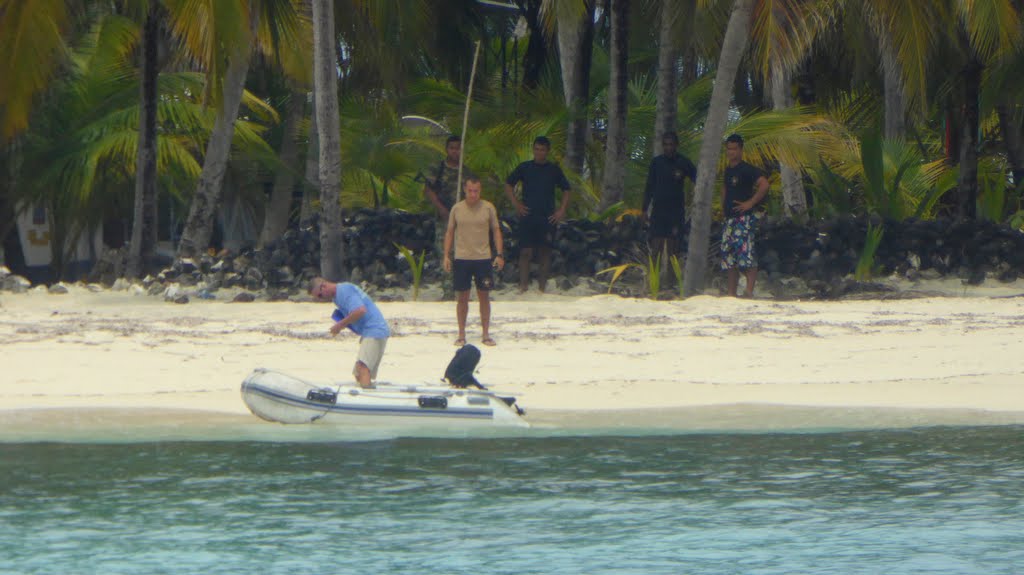
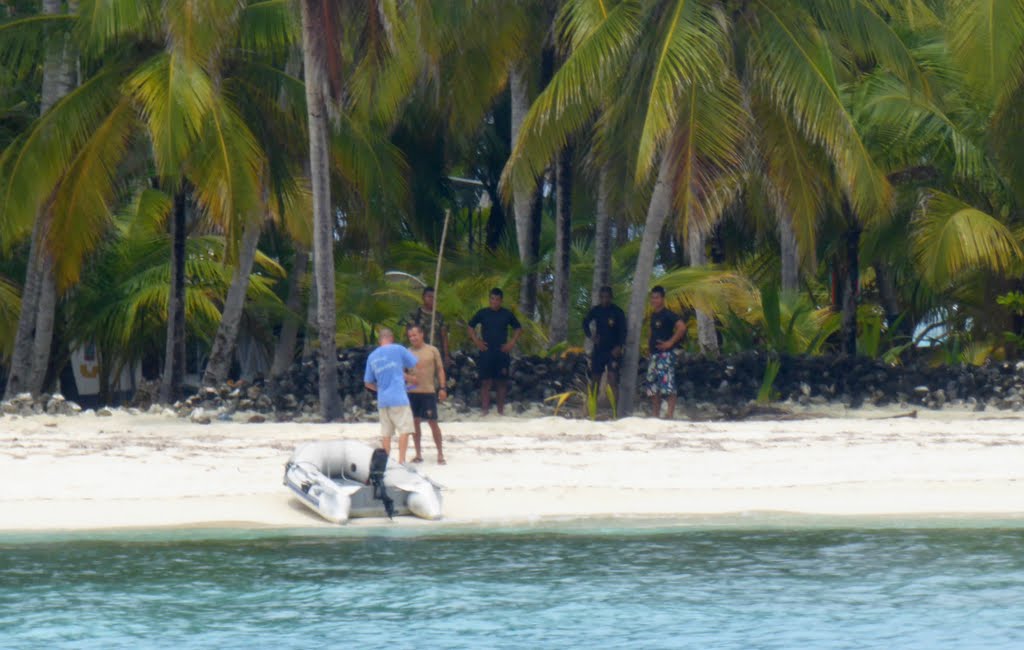
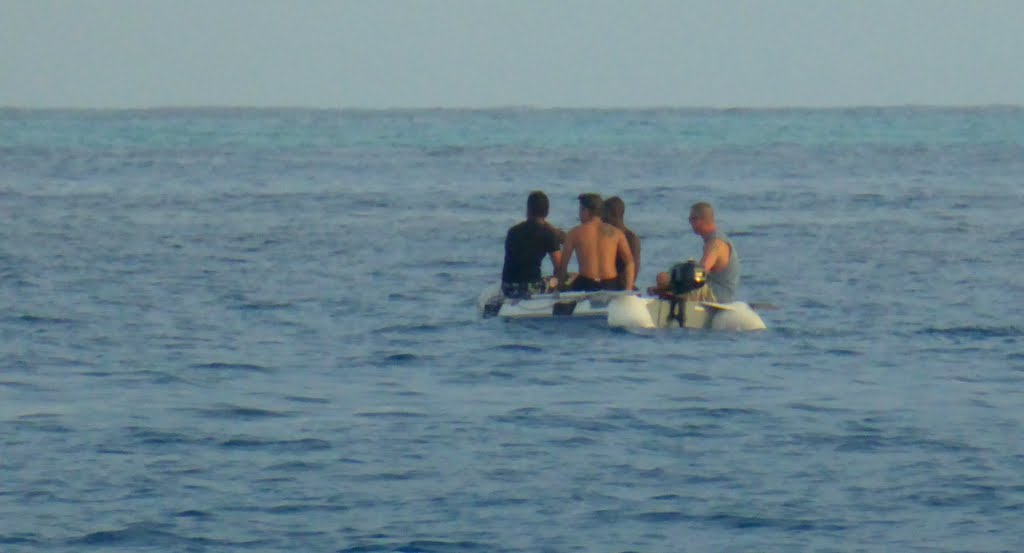
The entire time we anchored and Scott made sure we were set, and then put the dingy in the water, we were being watched by five men standing amide the palm trees at the edge of the beach. One was dressed in camouflage, and carried an AK-47 assault rifle, while the rest wore t-shirts and shorts. The men appeared to be in their mid twenties, at most, and the whole scene gave off a weird “Lord of the Flies” vibe.

Scott made his way to shore and beached the dinghy (with no help from said five “Flies” men).

Photo:

Photo:

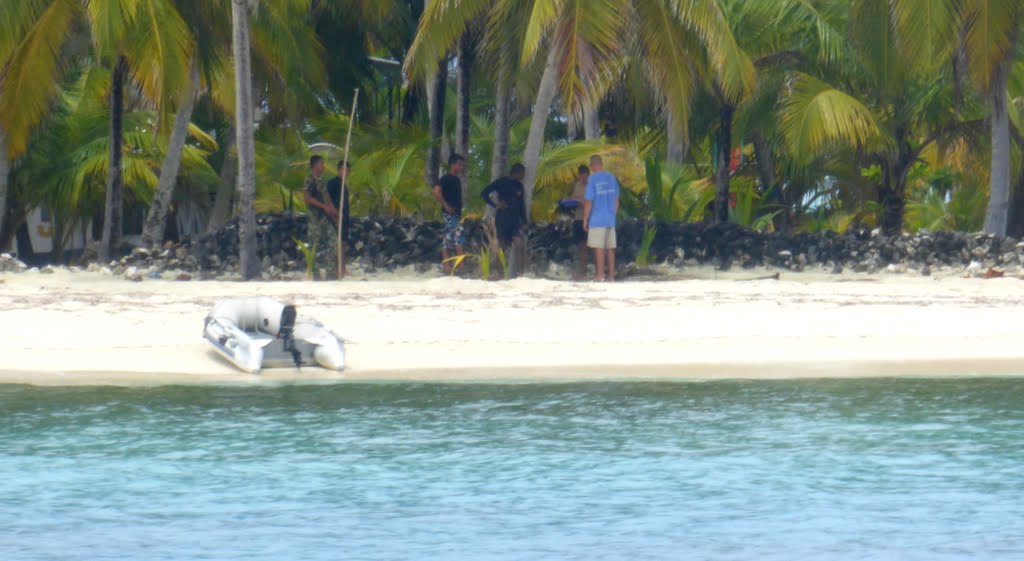
Anderson, who seemed to be the “commandant” of the group, and the oldest (Fly), pulled out a crumpled piece of scrap paper and copied down information from our passports and paperwork. They asked how long we were staying, and Scott wanted to tell them maybe four days, maybe a week, but with his limited Spanish and their complete lack of English, communication was difficult.

Photo:

Photo:

Just to make sure all was clearly understood. Scott later took a letter back, that he’d written using our English/Spanish dictionary (thank you John and Lela, s/v Yachtsman’s Dream!). I’m sure it read like something written by a five year old, but the intent was understood.

Now that we were anchored, and “cleared in,” Scott got right to exploring in the rubber dinghy, putting together his plan of attack for fishing in the coming days. As he was getting comfortable on the bow, with his evening “sun-downer” in hand, he noticed the “Flies” waving him over. Having no idea what this was about, he again made his way to shore. He left his drink behind, but sadly, I couldn’t convince him to change into a shirt with sleeves.

After almost 30 minutes I looked to shore, and could see no sight of Scott, our dingy or the Flies. I began to panic, envisioning Scott being beaten to death, in typical Lord of the Flies style. I scanned the horizon with binoculars, with no luck. Finally, as I scanned behind us, I caught sight of this:

Photo:

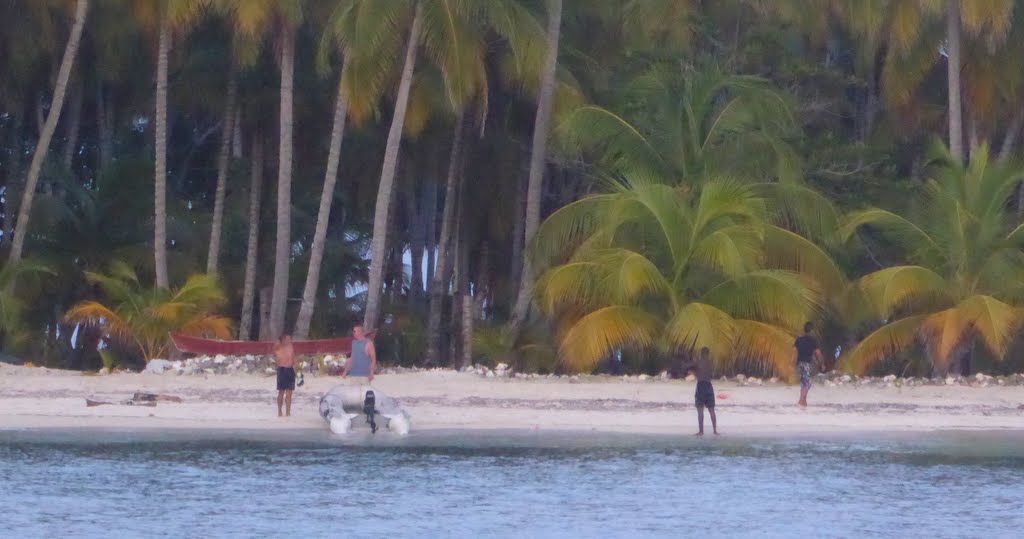
Once Scott had arrived onshore the Flies handed him their own translated letter. It seems they wanted to borrow our dinghy and Scott’s spear, to go fishing. Scott told them that if they wanted to fish, he’d be happy to take them, but they’d have to use their own means of catching the fish. The men agreed, and off they went.

Photo:

There were many one word and hand-signaled conversations. At one point, Scott was asked to go faster. He explained to them that our little two horsepower motor could go no faster, and to try would result in them rowing back to shore. The Flies then pointed toward the Aluminum Princess, asking how fast it went. Scott acted like he didn’t understand that one.

They made a stop at the island which is used by the commercial fisherman. Scott noticed a five gallon bucket, full of large lobster tails. He’d relayed to the Flies earlier, that he wanted to catch lobster while here in the cays, and was sure that they understood.

As they now smiled and pointed to the contents of the bucket, Scott hoped that he might get one or two as a thank you….no dice. The Flies chatted with the fisherman a bit, one of whom spoke very good English (Scott wondered why Anderson didn’t use this man as an interpreter…or a teacher), before climbing back in the dinghy.

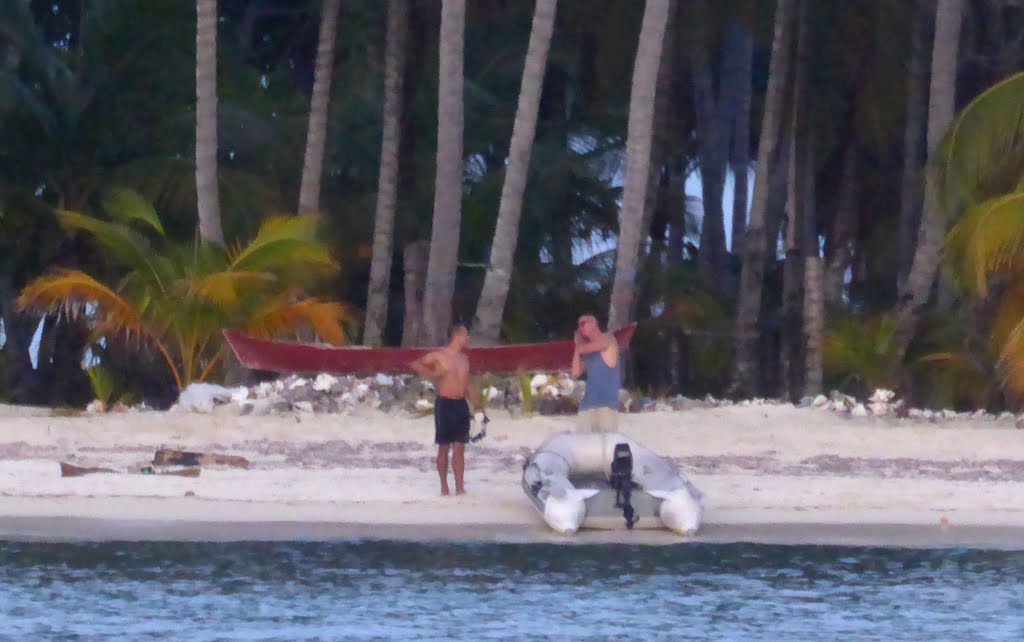
Eventually, the Flies asked to return to the island, where they continued to line fish from the beach.

Photo:

Anderson asked Scott to stay awhile. He replied, using his best hand gestures, that it was time to eat with his wife and then go to bed.

Photo:

After Scott’s little adventure, we felt that it was safe to say the Flies approved of us. It was time to relax and enjoy our beautiful surroundings.

Photo:

Photo:

“Shells Sink, Dreams Float. Life’s Good On Our Boat!”

Scenes From San Andres

There has been much to see and do during our stay here in San Andres. Shortly after we arrived, the island celebrated independence day (July 20th), complete with a parade and week-long festival. Scott and I planned to watch the parade from the flybridge, but the crowds were too thick to see through.

The parade lasted five hours, and that crowd stayed put for the entire thing (I never would have made it). Our friends Jack and Monique (s/v Aloha) ventured in for an up close and personal view. Here are a few of their photos:

As Providencia did for their carnival, San Andres held a beauty contest during the independence festival. Of course, that required a parade as well, and the contestants rode through the streets on decorated golf carts.

We’ve gotten to know our way around the busy downtown streets, and are constantly amazed by the number of motorcycles and scooters here (notice the clever sun covers). The flow and noise of traffic in the small area is amazing.

Benches along the mains streets are very unique, and make for great photo opportunities (unbeknownst to this local girl).

San Andres is full of beautiful tile work, murals, etc., as we saw throughout Providencia. The colors and patterns jump out at you, as you travel throughout the island.

We land our dinghy at nearby Nene’s Marina, and have spent much time at the little bar there, enjoying the breeze that goes through . The ladies who run it are very friendly, and the beer is cold.

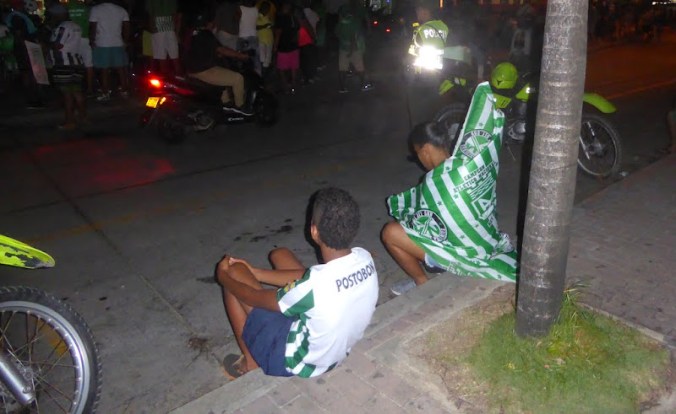
Like everywhere else in the world (except for the U.S.), soccer is insanely popular here. We came out of dinner one night to find the streets jammed with people watching a game, obviously a very important one. They were gathered in front of every bar, restaurant and convenience store, eyes glued to the tvs inside.

Putting the pieces together as best we could, it seemed to be a collegiate national championship. When the game ended, the local team must have won. The crowds climbed onto their motorcycles and scooters, and into cars, and began an impromptu parade in and around the downtown area. Luckily, we crossed through it easily on our way back to the anchorage. As we climbed back aboard Sea Life, the lights of the auto parade, with horns blaring, stretched as far as you could see.

The water in and around our anchorage here is very clear. We’ve taken the Aluminum Princess out to the shallow, Bahama blue water for some bobbing, and have also made use of our water loungers, just off of the swim platform.

After a very enjoyable two weeks and change, we’re moving on today. We’ll raise anchor as soon as I post this, and make a six hour run to the Albuquerque Cays. It’s a remote anchorage, with only commercial fisherman and a navy post. No land to speak of, no stores, shops, restaurants, parades, festivals..or tour boats! It’ll be a nice break, before we continue on to Panama.

There is a tropical system forming to our north, that will most likely become a category 1 or 2 hurricane for either Mexico or Belize. We are far south of any danger, but it’s strength is sucking out all of the wind and squalls for the next week..terrific! The weather forecaster we listen to on the SSB radio says that it’s a good week to travel if you’re motoring, so we’re off. We are undecided if we’ll stay in the Albuquerques a week or more, or continue south after a few days, while the weather is still quiet.

Be sure to check in on us, using the link on our Where Are We Now page, as we make our final push to Panama! In the meantime, here are some more scenes of our time in San Andres.

“Shells Sink, Dreams Float. Life’s Good On Our Boat!”


Eating And Shopping On San Andres

We’ve had a chance to eat at several restaurants during our stay here, and most are very affordably priced. After noticing La Regatta on my morning walks, Scott and I treated ourselves to a nice dinner out.

A colorful path leads to the restaurant, lined with quirky decor.

We were seated at a table on a pier out over the water, giving us a great breeze.

One of our neighbors here in the anchorage recommended Breadfruit, and it’s become a regular stop for us. They have a great assortment of fresh bread and pastries. I was reluctant to try their cakes, having that bar set very high from my beloved Sugarbakers Cakes back home (if you live within a 50 mile radius of their location…GO!) .

We ordered two orders of scrambled eggs with toast, fresh juice, water and a large pastry for 10.00 (includes tax and a tip), not too shabby!

Scott discovered El Corral, along the promenade. It has been a welcome answer to his McDonald’s cravings. I passed on the burger, but the fries were pretty darned good. There’s also a Subway across the street from the marina where we land the dinghy. That’s been great as well!

As far as day-to-day groceries, there are two large stores with a great selection of fresh produce. We’ve been able to get broccoli, mushrooms, green leaf lettuce and fresh basil! Many fruit vendors with carts of all sizes can be found throughout the downtown area, selling avocados, mangoes, bananas, and some stuff we’ve never seen.

There are many small markets on the island as well. One in particular sells things imported from the U.S, and we’ve enjoyed finding familiar items, like Philadelphia cream cheese (we have found nothing similar to cream cheese in either Mexico or Central America).

Prices here are pretty cheap for soda, and even cheaper for beer. Scott wanted to stock up on Coke for his evening cocktails, so we did a big “can run.” He humped 102 cans back to the boat on his back….a man on a mission.

His months-long search for stainless steel chain finally came to an end on San Andres. After scouring several hardware stores in town (all of which have a great overall selection), we arrived at this one. Orders are placed at the counter, similar to an auto parts store in the U.S.

The man who waited on us spoke great English, and when the exact thickness of chain that we wanted wasn’t available, he told Scott to go across the street to the warehouse, and see if what they did have in stock would work.

The warehouse was a two story building packed full of stuff. The men inside showed Scott the chain, which worked just fine, and they cut it and carried it back across the street for payment. Quest complete!

Shopping “for fun” is big business here. If you’re looking for perfume, scented body lotion, linens, electronics, athletic shoes and clothing, liquor, luggage or candy, you’re on the right island! Everything is duty free, and some stores carry all of these items. La Riviera is one of the largest, and has locations all over downtown (and downtown ain’t that big!), with their “flagship” store along the promenade.

And, Under Armor is in the house! For those who don’t know, this world wide athletic clothing company is based out of my hometown of Baltimore, Maryland! (read how they got started – early history)

In the midst of the larger stores are many small stall-type shops, selling the usual beach-type clothing, woven bags and trinkets.

So there seems to be something for everyone here on San Andres. The many places to eat and shop have definitely kept us entertained. Here are more photos.

“Shells Sink, Dreams Float. Life’s Good On Our Boat!”


Morning Walks On The Promenade

San Andres has a beautiful oceanfront promenade that runs for almost a mile along the north side of the island. I’ve been taking early morning walks here (before the heat gets too beastly), enjoying the easy access to a walk-able path around town. The promenade offers great breezes and much to look at.

Many hotels and restaurants line the promenade, as well as the usual beach town shops and carts full of colorful items for sale.

At the far end, buildings give way to more quiet beaches, benches and fishing boats.

As the promenade ends into the tourist hub, the sidewalk continues past small cottage-style lodging, and eventually to high rise resorts at the far east end of the island.

In addition to my morning walks, Scott and I have spent a day on the beach here, and Scott’s also found a great fill-in for his McDonald’s cravings at El Corral!

We’ve enjoyed the promenade in the evenings as well. There is a movie theater inside one of the hotels, and there is a showing in English, with Spanish subtitles, at 9:30 every night. For $17.50, we bought two tickets to the 3-D show, a large popcorn and two drinks….less than the price of just two tickets in the U.S.! The theater was wonderfully air conditioned, and we enjoyed the new Tarzan movie in our assigned seats (a great idea that I think they should adopt back home). It was a real treat!

When the temperatures cool and the breezes feel even better, locals gather along the promenade’s brightly tiled walls, enjoying music, drinks and each other’s company. It’s quite a focal point for both locals and tourists. Here are some more photos of sights along my morning walks.

“Shells Sink, Dreams Float. Life’s Good On Our Boat!”

A Golf Cart Day On San Andres

So we’re on a new island, and you guessed it, another golf cart day! We traveled to San Andres with our Aussie friends Brian and Sue in tow, and they joined us for a day of island exploring. First up, getting our golf cart out of the busy downtown area. Thankfully, all of the inner streets are one way, so we just had to focus on dodging the weaving motorcycles, trucks, cars and scooters.  The intersections are especially tricky, as there are no stop signs, and very few traffic lights.

As we made our way out of town, and around to the west end of the island, the views from the shoreline were beautiful.

We passed a small drink shack, and turned around to make a stop. Paul welcomed us, and made quick work of cutting coconut “cups” for our drinks.

We made note of the time, our earliest start yet! Oh well, it was hot enough to be noon…so close enough! Scott enjoyed the water views, while drinking from his coconut cup.

Scott and I like to see the sights, and if possible, take tours on each island that we visit. It’s a good way to get a feel for local history, and also gives a little boost to the economy.

Our first stop on San Andres was Captain Morgan’s cave. The buildings were made of stone, coral and shell, and there were several rooms displaying many things that coconuts are used for (baskets, carvings, food, etc). One room also acted as a gallery for local artists.

We made our way to the cave, which reminded me of the cenote that we visited in Mexico, with much less inviting water. The uneven, steep coral steps made it challenging to get down to the bottom.

Next stop, First Baptist Church. Located atop the highest hill on San Andres, it was established in 1847, with lumber brought from Alabama (I’m not sure why).

It’s bell tower is the highest point on the island, and offered great views. At the door, they asked 5,000 pesos from each person, to climb up ($1.60). Brian and Sue chose to stay outside, so I waited with them as Scott made the climb (I was disappointed to find out later that we could’ve also gotten some history on the church, included in $1.60, as I’ve had a hard time finding information on it).

Inside, Scott made his way up to the balcony, which has a slanted floor, and then climbed a steep ladder to some scary spiral stairs.

Next, there were some tiny, scary steps, leading to a small hole that Scott crawled through to the tower above. This process would have terrified me, and I was glad that I chose not to do this!

Even though some clouds and rain had moved in, the view was still good for a photo. You can see the downtown area at the top, spreading along the peninsula to the right.

On to the Big Pond, a freshwater lake located in the center of the island. We paid another $1.60 each, and a man walked us down to the lake. Our timing was a bit off, as it started to pour rain, making it a muddy go.

We got to meet the resident alligators, who come to eat bread that’s tossed to them. They were small in size, and Scott thought them to be decoys, diverting our attention so that larger ones could come in for the kill.

Leaving our creepy friends behind, we continued on to see a blow hole. As we approached, a man waved us down and explained that there was no charge to see the hole, but asked that we buy a drink from his stand to support his business. Fair enough…we parked our cart and ordered some drinks. Unfortunately, they weren’t the best libations, but the bar was quite a cheery place, with pretty views.

We walked a few steps over to the blow hole, which was surrounded by people and tourists shops, selling food, clothes, hats and trinkets. The ground around the hole was jagged coral, and it was hard to keep our footing. Scott and Sue made their way closer to get a better view. Strong winds would regularly gush out of the hole, but being so far from the shoreline there was never a strong enough wave force to move water up through it while we were there.

The breezes as we drove along the southeast, windward side of the island were quite strong.  The tops of many of the palm trees along the road here were just stumps.

Here, small sandy beaches met coral at the water’s edge.

We were starving, so it was time to find some lunch. After passing several places, stopping at one that was closed and not being able to find another, we finally stopped at Hotel Cocoplum. Our food was pretty good, and we left rested and recharged.

With full bellies, we back-tracked to a place that I’d noticed earlier; it’s upper deck looked inviting.

We never made it up, after discovering the large deck out back that extended over waves crashing on the coral.

There were two more blow holes here, that we had all to ourselves. Scott and Sue investigated up close again, and Sue received a refreshing “facial.” We had a drink, watched the blow holes and hung with the residents.

Our rental car was due back soon, so we headed to town on a route that took us back up the highest hill and past the First Baptist Church. Now that the sun was out, we stopped for some final photos of the view below.

By the time we dropped the cart off, I was spent. The noise of our cart, other carts, cars, motorcycles and buses had worn me out, and the 93 degree sun had taken its toll. However, I always enjoy golf cart days. They’re a great way to get a good overview of an island, and we usually have friends along for the ride. Here are more photos of our golf cart day on San Andres.

“Shells Sink, Dreams Float. Life’s Good On Our Boat!”


On To San Andres

We raised our anchor at 5am on Friday, and traveled ten hours south to San Andres Island. The forecast was for 15-20 knot winds, and sea swells of 5-7 feet. They got the wind part right, but the swells were more like 7-9 feet, with breakers on them…..and some really large ones thrown in once in awhile, just to keep it interesting.

The boat was completely fine with all of this, but as usual, me…not so much. I just cannot get used to seeing big waves come at me. Several started to break as they approached us, but Sea Life just “rolled” with it, sliding down them and then getting back on track. Thank God for paravanes, I cannot imagine the degree of roll without them.

Howard fared much better than me. I started him off tucked into his triangle of safety on the couch in the saloon, but he soon appeared on the bench in the pilot house with us. He hasn’t liked the noise of the waves outside the open pilot house doors recently (we keep the top halves open while traveling), but I guess he wanted to join the party this time. I reset the triangle around him, and he settled in.

As we came out of the protection of the reef around Providencia, and into the open ocean, a huge pod of dolphins headed our way. We’ve never had this many visit us at one time before. There were also several babies in the group, about the size of Howard! They stayed for almost 30 minutes, playing near the bow and jumping alongside us before breaking up and moving off. I guess they knew the seas were going to get large, and vacated.

Just after noon, San Andres came into sight. We had to navigate through a break in the reef to get into the harbor, while surfing  breaking waves, which was challenging. Scott was especially nervous to see many boats run aground and left for dead, and wrecked along the reef, as we approached.

Once inside the harbor, Scott hailed the port captain, who asked for some basic information before telling us to anchor in area A, which is designated for pleasure boats. Area B is for commercial and fishing boats, but unfortunately, we discovered that many of them had spread into area A. With the many fishing boats, other cruisers already at anchor and shallow spots in the area, it was challenging finding a spot for ourselves.

When we first dropped the anchor it didn’t hold, which is very unlike the Hulk (*). It was just as well, as the water in that spot was pretty deep. More scope of chain is required in deeper water, which would have put us very close to our neighbors when swinging with the shifting winds.

Luckily, our friends Jack and Monique (s/v Aloha) had made the trip from Providencia the day before, and were anchored nearby. Jack yelled over to Scott, and told him to drop our anchor right at his stern. As we let out our chain, he jumped in and dove on the Hulk, to make sure that it had grabbed the bottom. Jack signaled us that the anchor had set, so we backed down in reverse to dig it in. We were now settled in among the many, many fishing boats (a big thank you to Jack!)

(*) When Scott dove on our anchor the next day, to check that it was still set well, he noticed that the bottom here is covered with old fishing debris (San Andres dates back to 1700s). We think that the Hulk must have grabbed something down there on our first drop, and skipped along the bottom.)

Like Providencia, San Andres is also a Colombian owned island. Since we were still in the same country, we didn’t have to get our passports stamped again, but the boat did have to be cleared in with the port captain.

To do this, we’d contacted Julian Watson, an agent our friend Kevin suggested (you are required to use an agent when clearing into Colombia, you cannot do it yourself). He contacted us on the radio as soon as he heard us hail the port captain, and once we were anchored Scott went to nearby Nene’s Marina to meet him. Julian was very accommodating, and offered his help with anything we may need while visiting the island.

We haven’t done much exploring here yet. There have been several days of squalls, and most of the shops and restaurants close early on Sunday here, so we look forward to getting the lay of the land soon.

The internet here is atrociously slow (who’d have guessed that the free internet on quiet Providencia would be better than the paid data on busy and populated San Andres??), so getting posts updated will be a challenge, but stay tuned! Here are more photos of our trip here.

“Shells Sink, Dreams Float. Life’s Good On Our Boat!”