Howard’s Trip To Panama City

In late January, Howard began showing symptoms of a urinary issue; many trips to the litter box, leaving just dribbles behind. Before we left Baltimore, I’d visited our home vet, Dr. T., to stock up on various medications that Howard might need, so luckily there were antibiotics on board for him.

After a week, Howard showed no sign of improvement, so at Dr. T’s recommendation, we doubled his dose, meaning getting two eye droppers full of medicine in him instead one….fun for all!

Almost three weeks later, Howard was just marginally better. He then began throwing up, and I couldn’t get him to keep anything down. After three days with no water, we were very concerned, and began to make a plan to get Howard to a vet in Panama City.

The glitch was, that we had cleared out of Panama in December. There is a checkpoint stop on the road to Panama City, and if you do not have a valid stamp, off to jail you go. Our hope was to appeal to immigration on the island of Porvenier. Recent laws prohibit checking in and out of Panama in the San Blas. Boaters who are cleared into the country are only able to visit Porvenier to renew their stamp for an additional three month stay.

We left our anchorage in the Coco Bandero Cays, and traveled four hours to Porvenier, with fingers crossed that we could plead our case. Scott sent me in alone, to deal with the immigration officer, since only one of us needed to travel to the city, and we may have better luck with a female pleading the case.

“Joe” was a bit miffed that we’d checked out of the country 45 days earlier, bound for Cartagena, and were still in the San Blas (cruisers often do this with no problem…until there’s a problem). Because we both had “time” left in the country when checking out in December, Joe told me that if we traveled back to Portobelo (14 hours by boat), the immigration officer there would be able to cancel our exit stamps.

We didn’t have the extra days that it would take to do this, and then get to the vet. There was also the issue of getting back to the San Blas, with winds expected to pick up. I explained that we’d had steering trouble, and were unable to get back to the mainland by boat (a big fib on my part).

After two hours of back and forth, with few words understood between us, many pictures drawn and tears on my part, Joe told me to have Scott come to the office. When Scott arrived onshore in the dinghy, I told him to relay that he spoke no Spanish (when in fact, he can get by quite well now), and brought him up to speed on the story inside so far.

Once we were both back in the office, there was more of the same back and forth, before Joe finally consented to canceling our exit stamp, marking next to them in Spanish that seas were not good for us to make it to Cartagena. He told us to come back to see him for Scott’s renewal stamp (mine was due much later, as I was re-stamped when flying back in from the U.S. in October), and then again to get stamped out of Panama.

Thrilled that our pleas had worked, we raised anchor, and made a quick hour-long run to an anchorage near the docks at Carti, which is on the mainland. I’d contacted Emilio, who we’d planned to use for provisioning, and asked him to help me arrange transportation to get Howard and me to the vet, as I had no idea how to proceed.

Howard was loaded into his carried, and Scott took us to the dock in the dinghy, where we hopped into a running, air conditioned suv. It was a three hour ride across the mountains, through a checkpoint at the border of the Guna Yala region, into the city and to the vet. The driver maneuvered the road like the car was on fire, hitting the many curves and potholes at full speed. I was shocked that the car’s axles didn’t snap. Howard endured the “Mr. Toad’s Wild Ride” like a champ.

As we came down the mountain road, and headed toward the city, the driver pulled into a gas station…presumably for gas. He stopped the car, with the engine running, and proceeded to take a nap! When I realized what was going on, I was both irritated that we’d stopped for this, with my cat needing to get to the vet, and glad that he had the good sense not to fall asleep at the wheel.

Deciding  that a ten minute nap was fair, I watched the clock, preparing to wake him up. He popped up on his own, after seven minutes, declared, “Good! and we continued on. We made our way into town, and I was delivered right to the door of the vet.

I didn’t have an appointment, and thankfully a young  man waiting with his own cat helped me to speak with the woman behind the counter. After a very short wait, Howard and I were in a room with a vet, who thankfully spoke English. She took Howard away, to use gas to relax him for testing. Howard is not a good vet patient. At home, there is a “caution” sticker on his folder.

In the meantime, Emilio arrived to sit with me, in case I needed help with translation. The vet spoke very good English, but Emilio did help me arrange a hotel for the night. With the “Carti” road closed at 7pm, there was no way to get back to the boat in the same day.

Howard’s initial tests: blood, urine, xrays and sonograms all came back clear. Hmmm. I arranged for him to stay overnight, wanting him to receive fluids.

Emilio then took me shopping, stopping first at Riba Smith, a large grocery store with many American items. I was in heaven, and loaded up on cream cheese, butter and other goodies from home. We then went to a nearby mall, where I was able to buy some magazines printed in English! I arrived at the hotel later that evening, with some McDonalds food in tow.

After turning the air conditioning down to a chilly 68, and watching some English channels on tv, I happily fell asleep in the comfy hotel bed. At 3am, I woke in a sweat. When I tried to adjust the thermostat, it crackled and sparks came out…not good.

I called the front desk, and they sent someone to “check” the thermostat, most likely thinking that I couldn’t manage to set the temperature on my own. After getting his own set of crackles…and some smoke, the man cried “Oh!…Bad!,” and called back down to the front desk.

I was told that they were happy to move me to another room, but unfortunately it was on a different floor. That didn’t bother me in the least, as I was determined to absorb as much air conditioning as possible, so I loaded up my backpack, and made my way down two floors at 3:30 am, barefoot and in my pajamas. There I resumed sleep, in a freshly cooled room.

The next morning, after enjoying the complimentary breakfast buffet (I am told that all hotels/B-n-Bs/inn, etc. are required to provide a free breakfast to their guests), I met Emilio and his friend, Gil, who sped me off for more provision shopping.

Our first stop was to Pricesmart, a membership bulk store owned by Costco. I loaded my cart with soda, bacon, lunch meat, cheese, vinegar (used for monthly toilet deep cleaning, and laundry) and various other things. The next stop was to a local bulk store, which offered some of my wish list items at better prices than Pricesmart, such as wine, rum and sprite.

I checked in with the vet, who said that Howard hadn’t eaten, but she didn’t expect him to while in a strange and stressful place. He’d been given fluids, and a shot of both antibiotic and something for his stomach. She declared Howard ready to leave, so we planned one more stop before heading over to pick him up.

Our last stop was one more visit to Riba Smith, where I purchased more cold items, and some bags to keep them cool for the journey back to Sea Life.

Emilio said his goodbyes, as he had another client to meet. Gil would be taking me to collect Howard and then to meet my ride back across the mountain. Emilio’s help had been invaluable, knowing where the stores were, which ones had the items I wanted and at the best prices. The process would have taken far longer on my own.

Gil and I arrived at the vet, where Howard was growling at anyone who came near him. He calmed when he heard my voice and received some petting in his carrier. I paid my bill of 180.00, which included the vet visit, overnight stay, xrays and sonograms of stomach and bladder, blood and urine tests, two injections each of antibiotic and gastro meds, iv fluids and some cat food for urinary tract health…much cheaper than US prices!

Nacho, the driver who would take us back to the Carti docks, was waiting outside a small local restaurant at the start of the mountain road. We loaded all of my things, and Howard, into his car, filling all but the passenger seat (the area behind the back seats was piled high, and the floors under both Howard and me were packed full).

Along the way, we stopped for Nacho to relieve himself behind the car, a much faster delay than the previous driver’s nap. At the Guna Yala checkpoint, the official who came to the car windown to check my passport was intrigued with Howard, waving over the other guards to see him, calling, “Howard, Howard!”

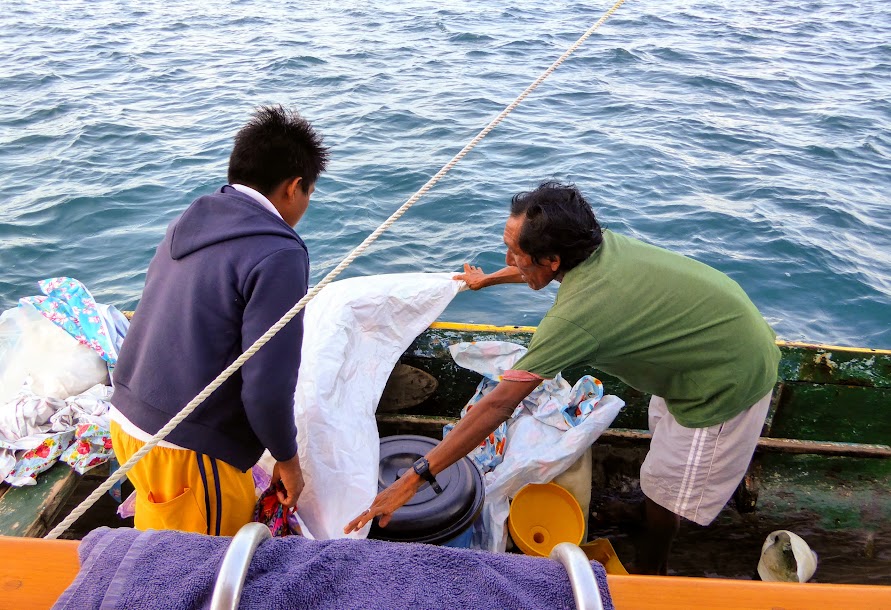
When we arrived at the Carti dock, I asked Nacho to help me get a panga ride back to the boat, as I hadn’t prearranged one. He loaded my things onto a panga, with several locals onboard waiting to depart. It took five trips of heavily loaded wheelbarrows to get my stuff onto the panga, and when I walked down the dock with Howard, to get on, the driver wasn’t happy. Apparently, Nacho had told him that I had only a few things. “Senora”, he said, “this is a supermarket!” In his defense, it was a huge amount of stuff.

After a short, five minute ride, we were back at Sea Life, where Scott was waiting to help unload my things. Howard was glad to be home, and seemed none the worse for wear. He immediately wanted food, ate plenty of it and then settled into a deep sleep in his taco, sporting his new haircut.
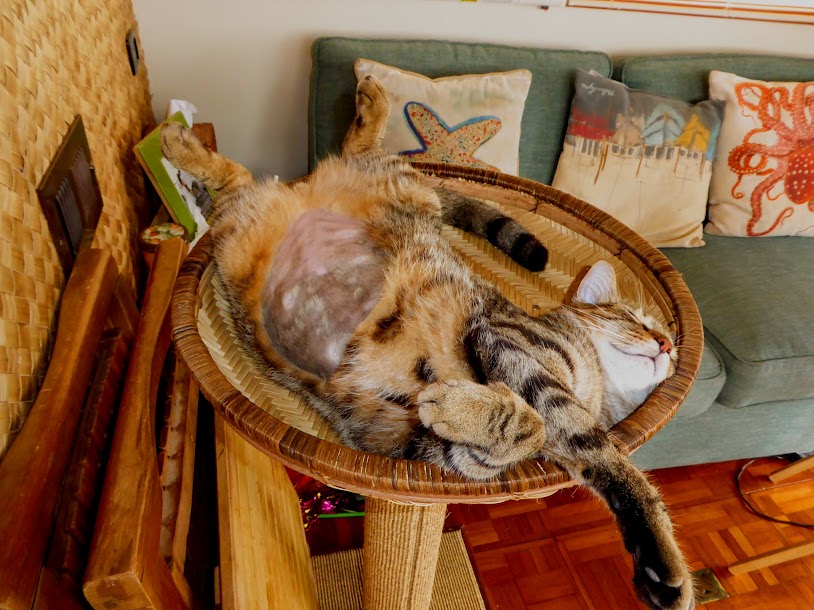
 

Scott was quite peeved that after the whole, logisticly-challenged ordeal, the vet had found nothing wrong with Howard. We think that his urinary issues were near done, and the gastro stuff had almost worked their way through; the injections may have also helped resolve both issues.

In the end, maybe Howard just wanted a few days away from the boat….and an adventure.

“Shells Sink, Dreams Float. Life’s Good On Our Boat!”
Exploring New Anchorages

After our stay in the eastern Holandes, anchored in the Swimming Pool and then Hot Tub, we were ready to explore more of the many anchorages here in the San Blas islands. Our friends, Dave and Sharda, (s/v Morgan) were anchored in Esnasdup, located in the southeast area of the San Blas, so we decided to head over and join them.

The Guna islands of the San Blas have very unique names. Many end in dup (pronounced “doop”)…Esnasdup, Miriadup, Salardup, etc. We’re told that “dup” means that there is a well located on the island.

More than one of these islands have the same name. There are several Banedups, Miriadups and Waisaladups, just to name a few. This can make trying to meet or locate friends challenging…”which Banedup are you anchored off of?” “Is that the Waisaladup in the western Holandes, or near Green Island?” Cruising is a constant state of learning and adjusting.

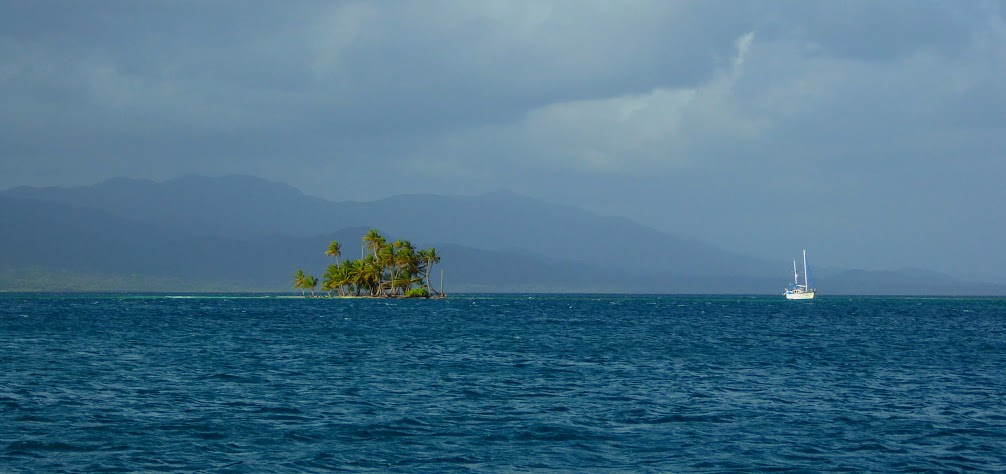
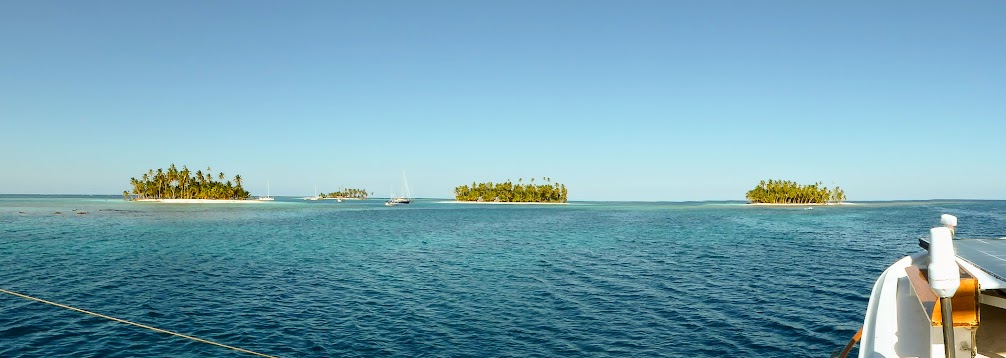
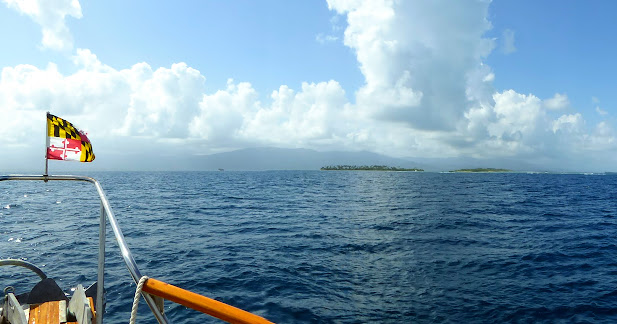
To get to the southeast islands, we had to come out from the protection of the reefs, and cross open water. We rolled across the large swells, and I was glad to have taken time to secure things for big water. Soon we were behind the protection of another reef, and in sight of Esnasdup. These islands are closer to the mainland of Panama, with views of the mountains in the distance.

In keeping with the multiple names theme, Esnasdup has a “pool” of it’s own, located between two islands, and just behind the reef. Dave and Sharda were anchored in the pool, and we dropped anchor there to join them. It was great to enjoy views of the reef off our bow, and still have the mountains in sight behind us.

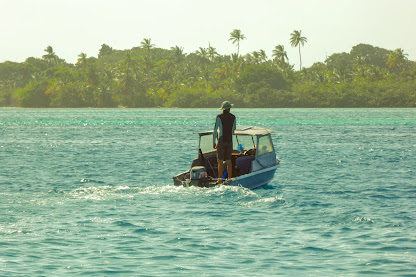
As usual, the islands surrounding us were beautifully scenic, and we often saw the locals in their ulus, fishing in the area.

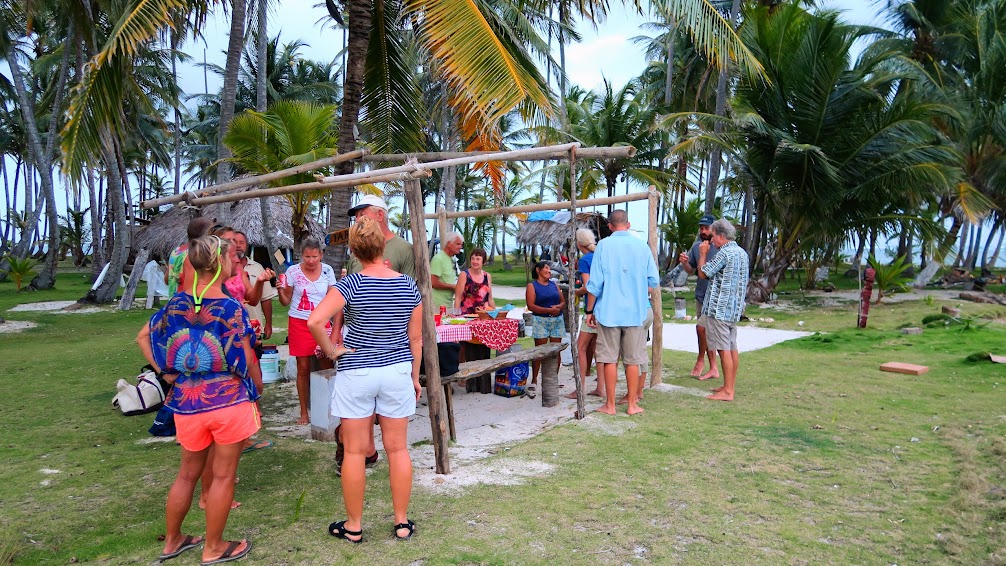
There was talk of a full moon trash burn on a nearby beach, so I spread the word to make it an appetizer pot luck as well. I wracked my brain to come up with some sort of table, because the alternative was for everyone to hold their dish in one hand and pass it around, drink in the other hand, while trying to eat at the same time (this has happened).

I came up with my own “MacGyver” idea, to fashion a table from items on board Sea Life: a piece of plywood we had under the couch cushions, and some milk crates that were being  used to store provisions…well done me!

As expected, Scott was less than thrilled to have to empty said milk crates of their contents, and to use his piece of plywood, but he helped me gather the stuff, and then hauled everything over to the beach. He also went over early in the day, to clear the sand of driftwood and other things, opening up more usable beach space.

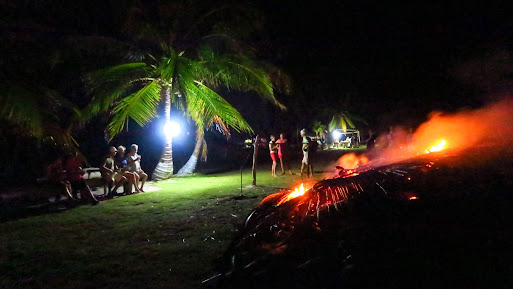
Everyone was very happy to have somewhere to put the food, and the night was great fun. All trash was burned, and the moon was beautiful. I was busy talking and eating, so unfortunately, no moon photos.

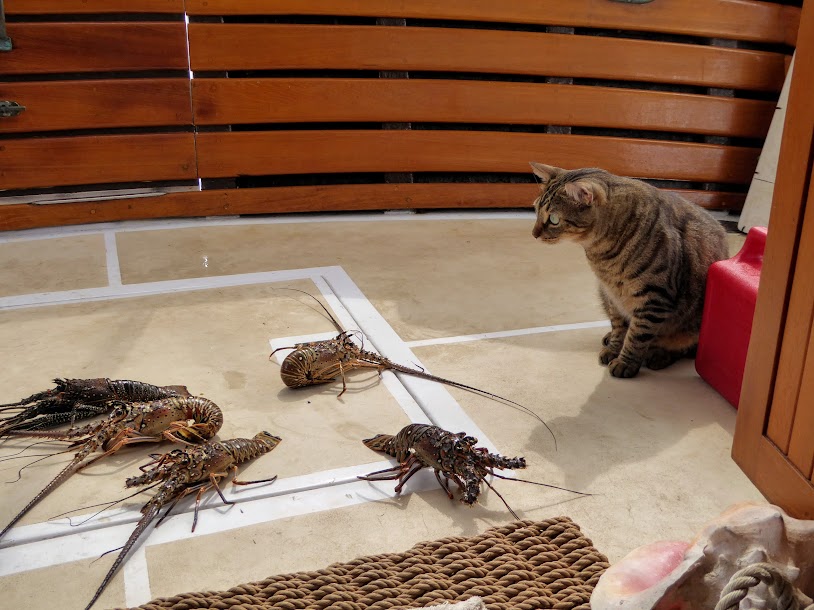
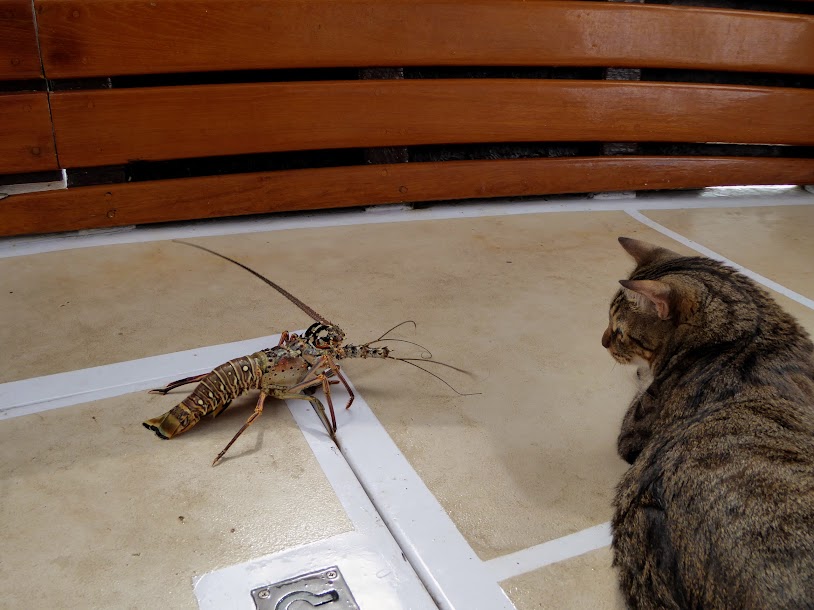
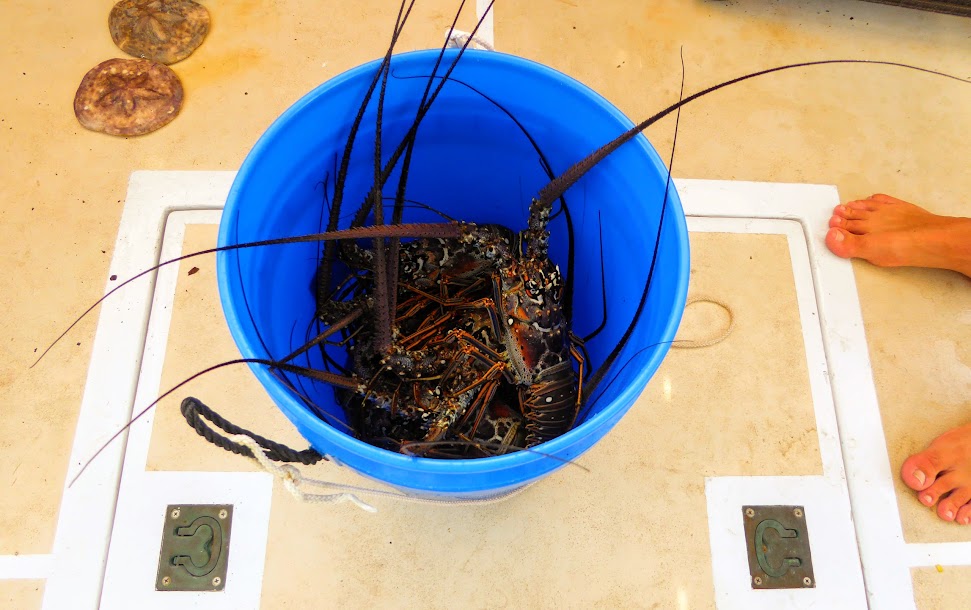
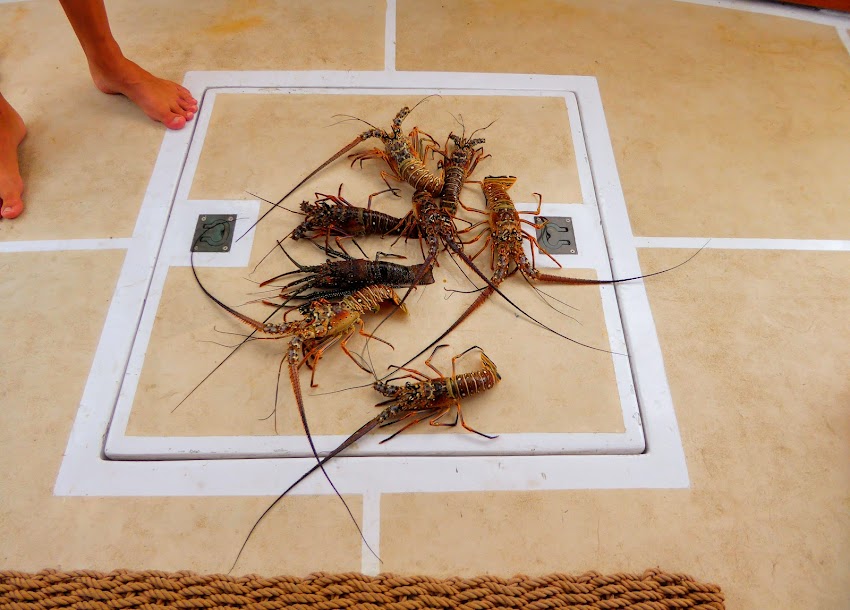
Scott came up empty for fish or lobster in the area around Esnasdup, so we purchased eight lobsters from a local fisherman…for 15.00! Howard has become very intrigued by lobsters, and he had quite a stare-down with one of this bunch.

With more windy days predicted, we decided to leave the exposed location we were in and head for an anchorage nearby, off of Green Island; there was also talk of very good internet there. We didn’t find the good internet (none at all, actually), but did find a scenic spot to anchor off of Kuigaladup (say that three times fast), near Green Island, still enjoying the mountain views behind us in the distance.

Scott took the dinghy over to Green Island, for a walkabout (not all of the islands are cleared well). It doesn’t take long to cover these small islands, but he had fun wandering around for a bit, and stretching his legs.

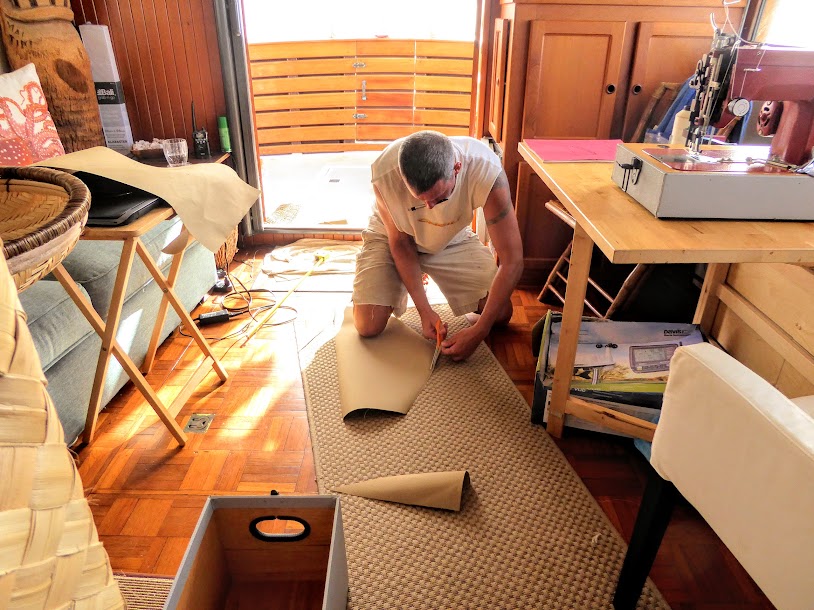
Scott burned our trash, and we took the time to sew up some canvass covers for our grill and the inflatable dingy motor; he cuts, I sew (Howard’s latest sleeping/fighting box is under the table).

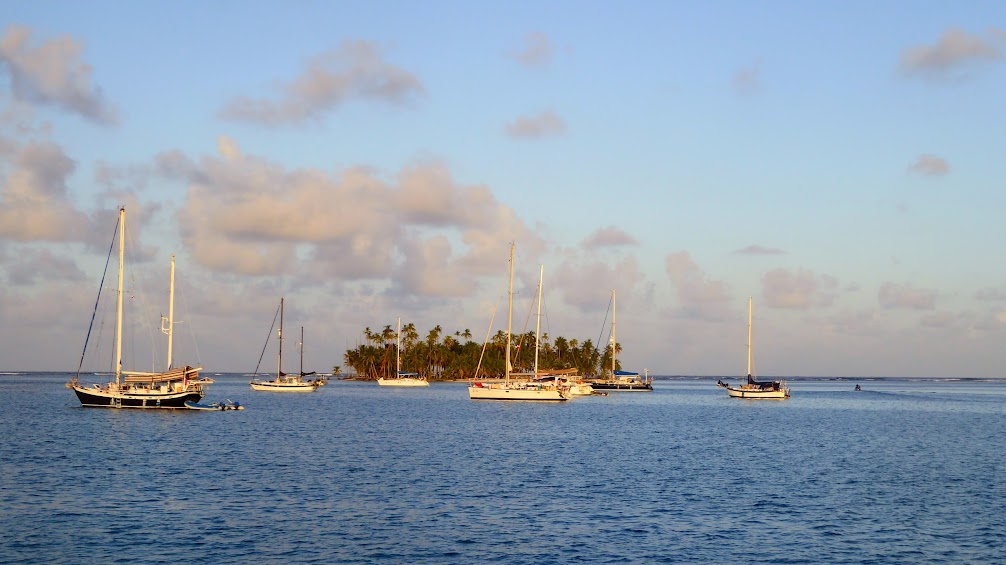
 After the winds subsided a bit, we headed back to our spot in the pool at Esnasdup. I talked up a gathering on nearby Gorgidup, a tiny little island with a gorgeous beach. Most everyone in the anchorage planned to go, this time sans food. Our friends Jack and Monique, on s/v Aloha, offered to take several of us on a short sail over to the island. It was a terrific way to arrive!
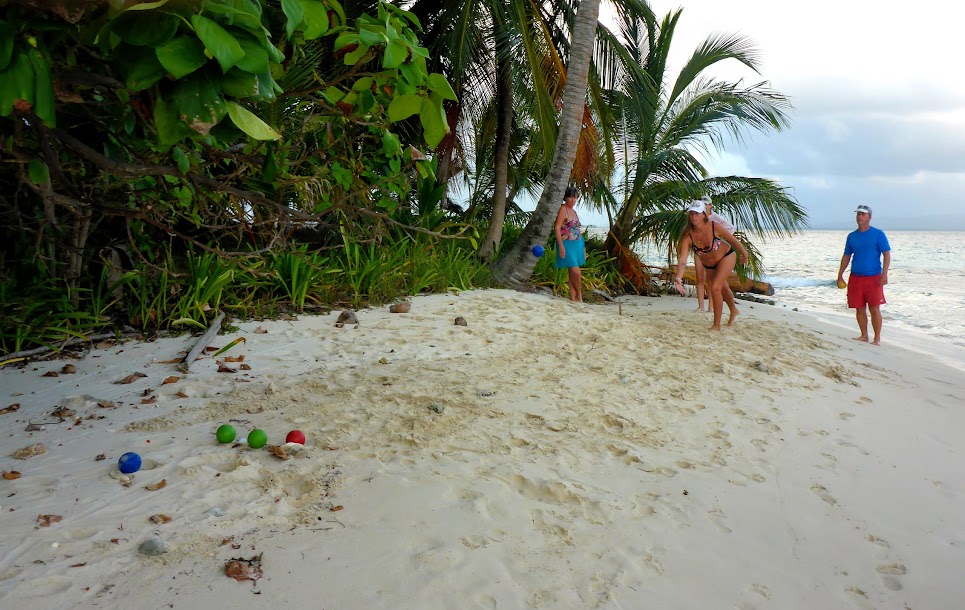
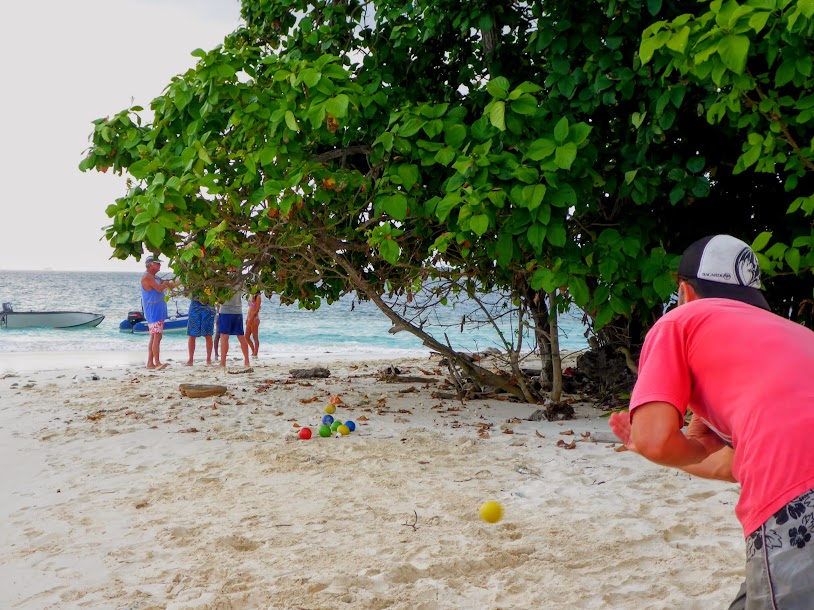
We enjoyed the afternoon on this beautiful island, and also had a pretty serious sand bocci tournament!
As the sun set, Aloha was waiting, to sail us back to our boats. It was a great day with our San Blas friends.
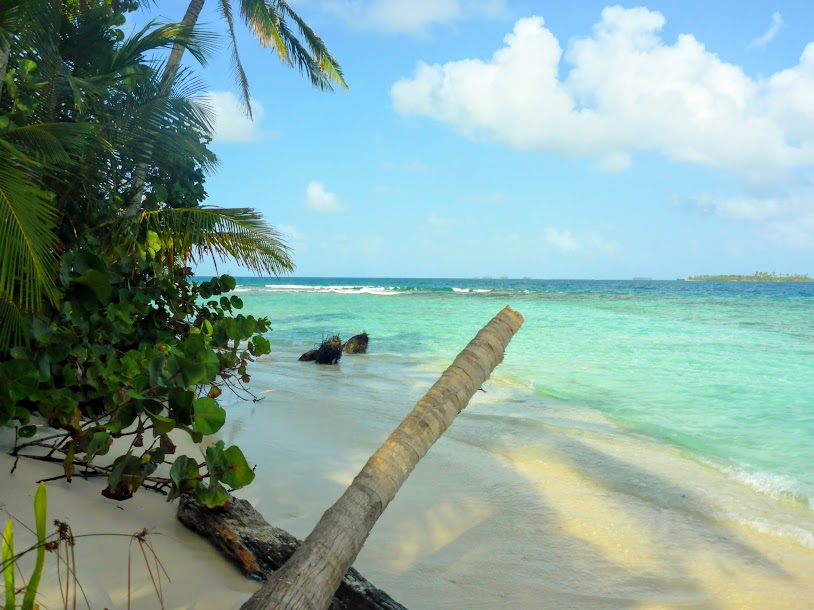
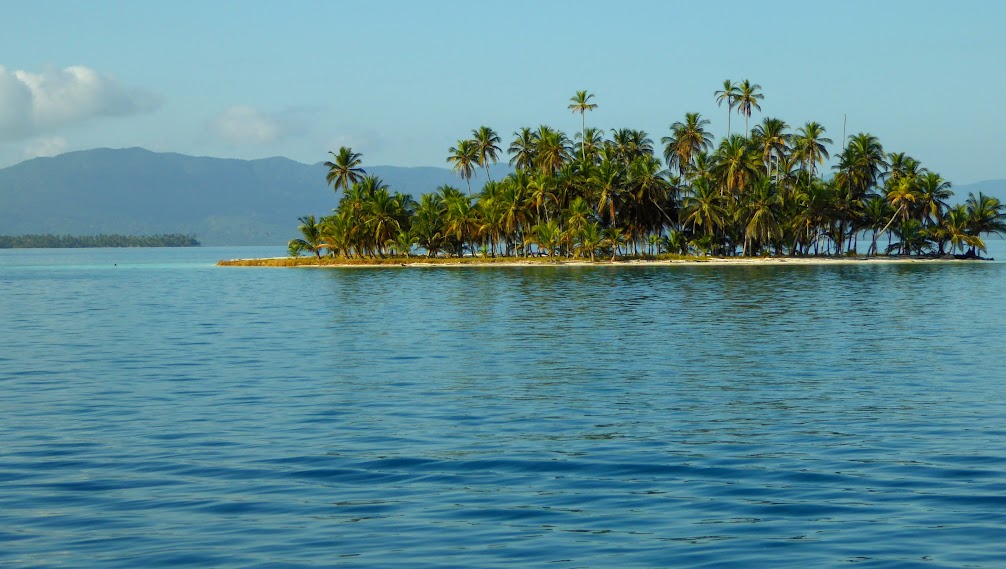
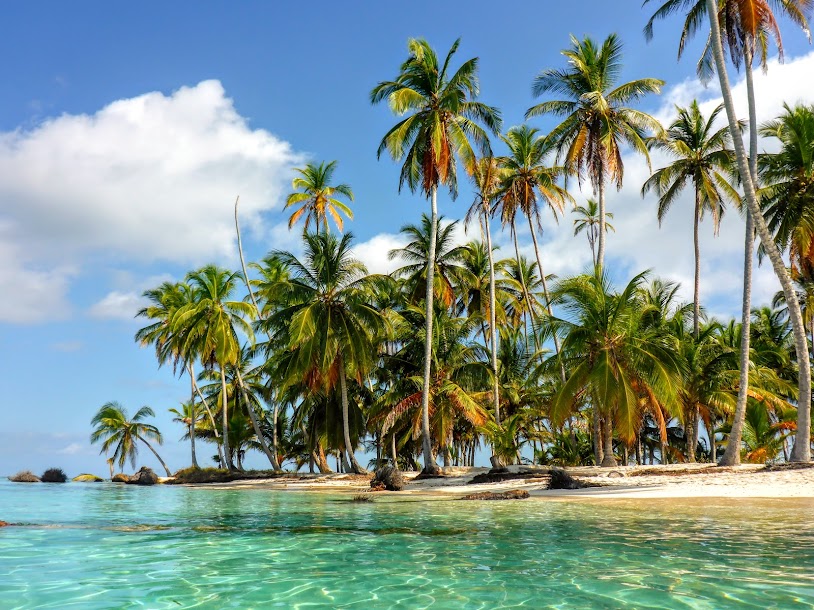
The coming forecast was for winds to nearly die off for at least four days, so we set our sights on the Coco Bandero Cays. The anchorage is pretty bumpy in most any wind, so with calm conditions coming, it seemed the perfect time to visit the islands. We approached the Cocos, and were immediately excited about them…what a beautiful sight!
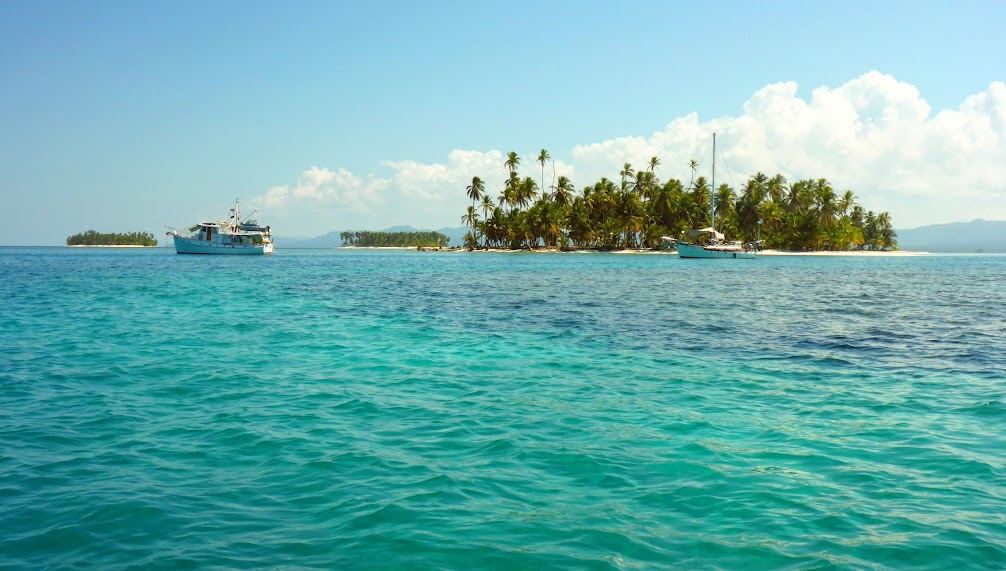
There are five islands that make up the Coco Bandero Cays, and we anchored close to one with a “resort” on it. Overnight visitors were dropped off and picked up several times during our stay, which initially worried us. Thankfully, we hardly noticed or heard them.
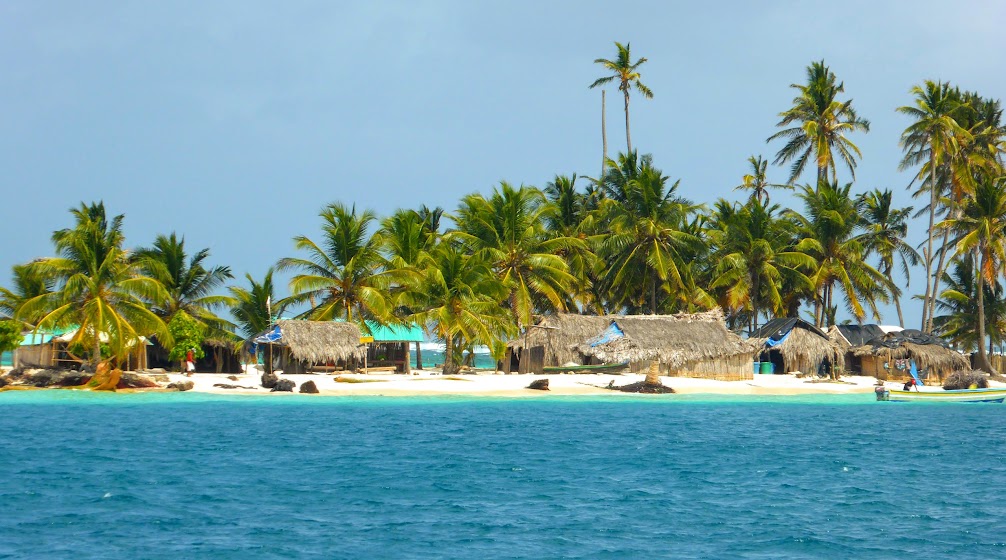
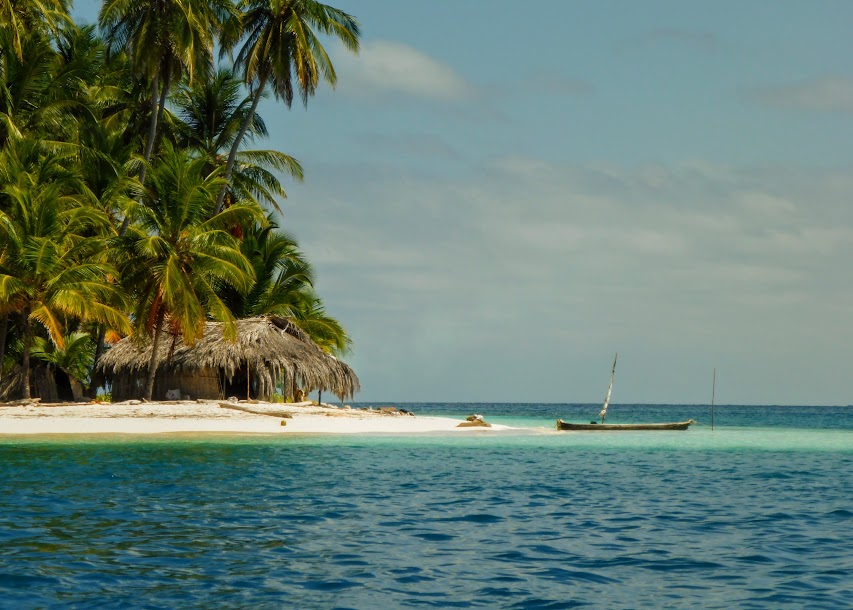
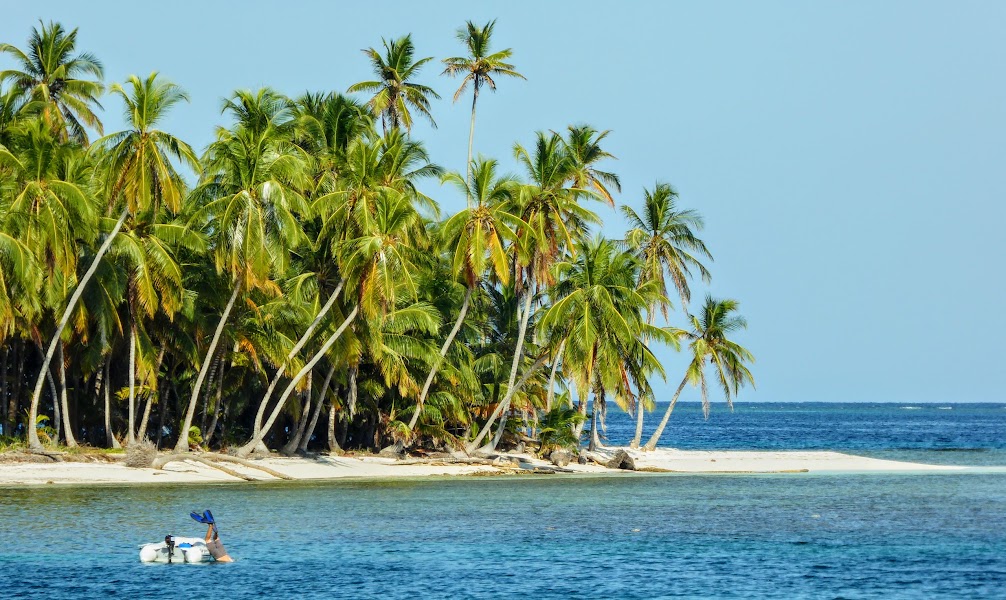
The rest of the beautiful islands were uninhabited, except for a modest fishing shack used by local fisherman traveling through the area.
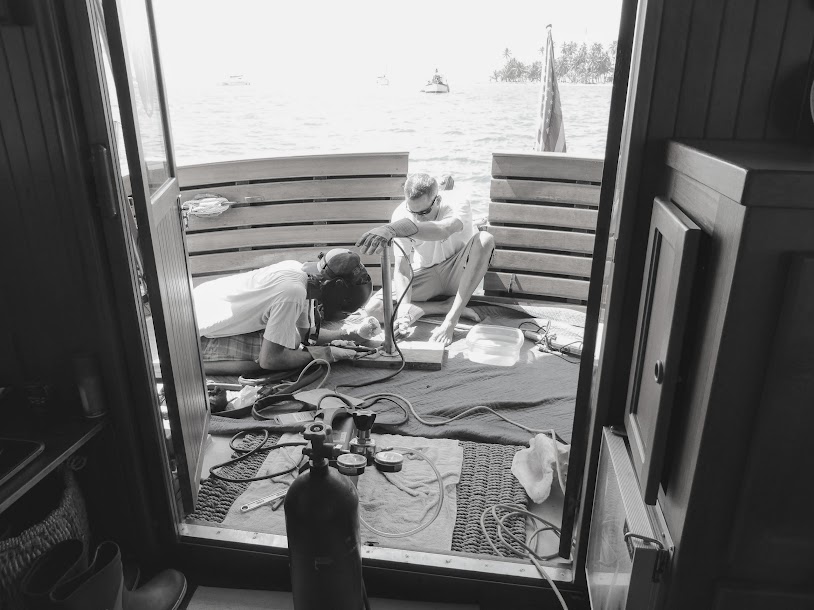
Our friends Jon and Shannon (s/v Prism) were anchored behind us, and Jon “shared” our generator power, to do a welding project for his wind generator. It’s definitely not the first time our cockpit has been used as a workshop!

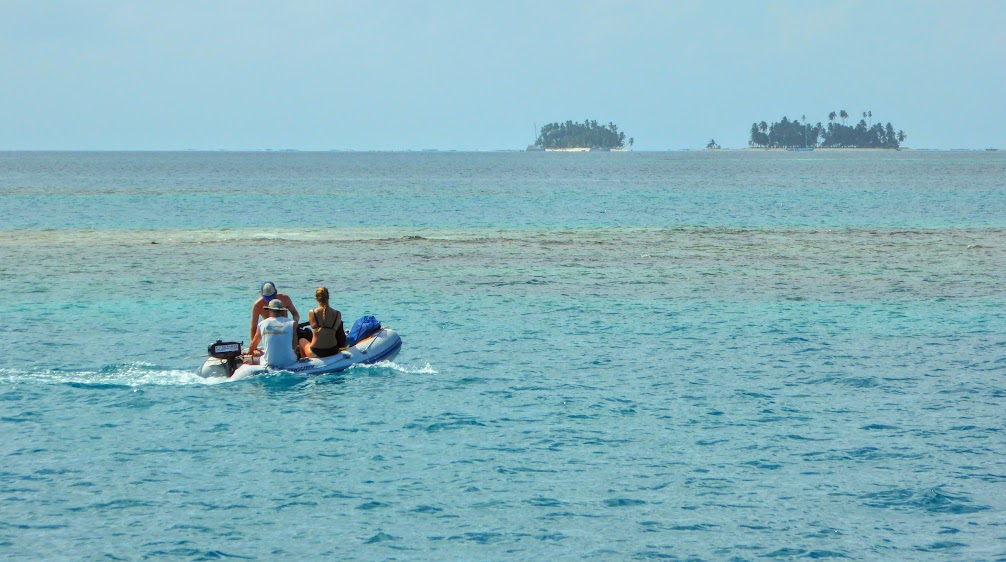
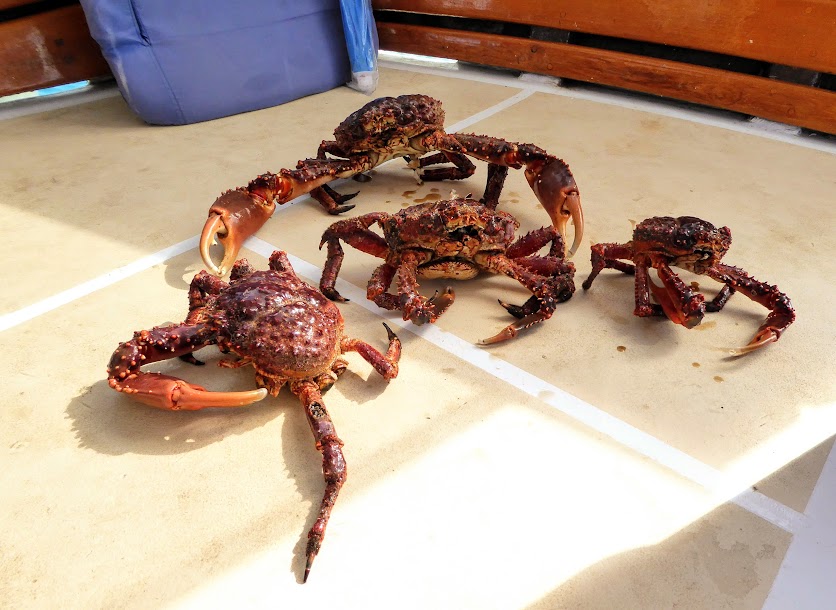
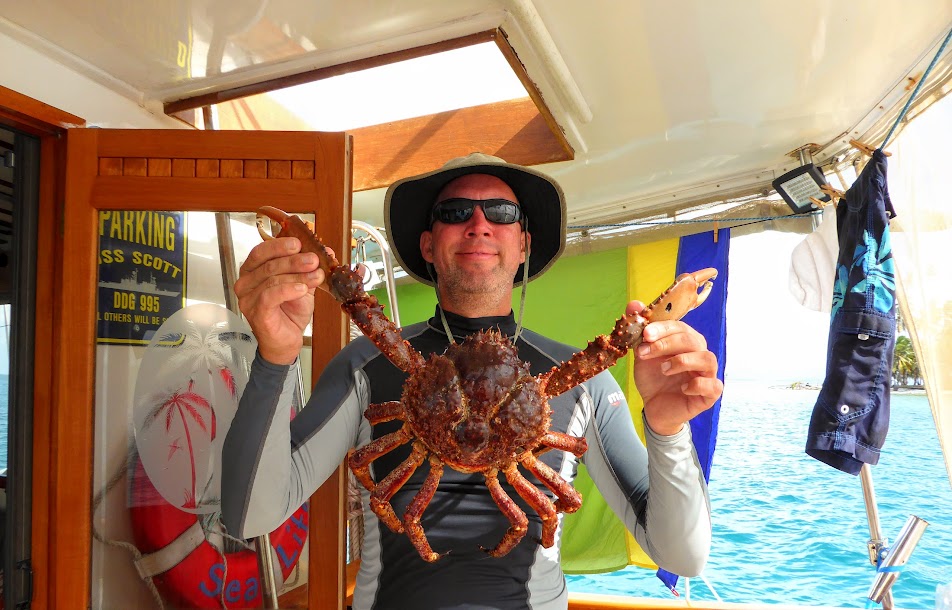
As usual here, after a few hours of work is done, it’s time for play, so Scott, Jon and Shannon headed out to the reef on a fishing mission. Shannon came back with a crab and a huge lobster, and Scott speared  more crab than we could eat!

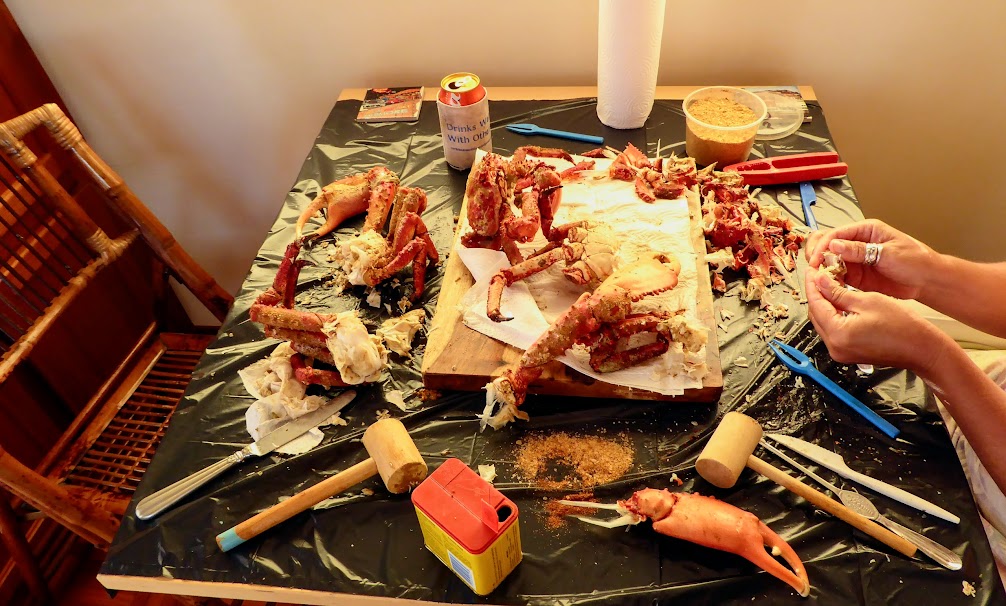
These big guys taste just like the blue crab that we get from the Chesapeake Bay back home, so of course, we ate them Baltimore-style! (fyi, the wooden mallets were not enough, so we had to break out the hammer from Scott’s tool box)

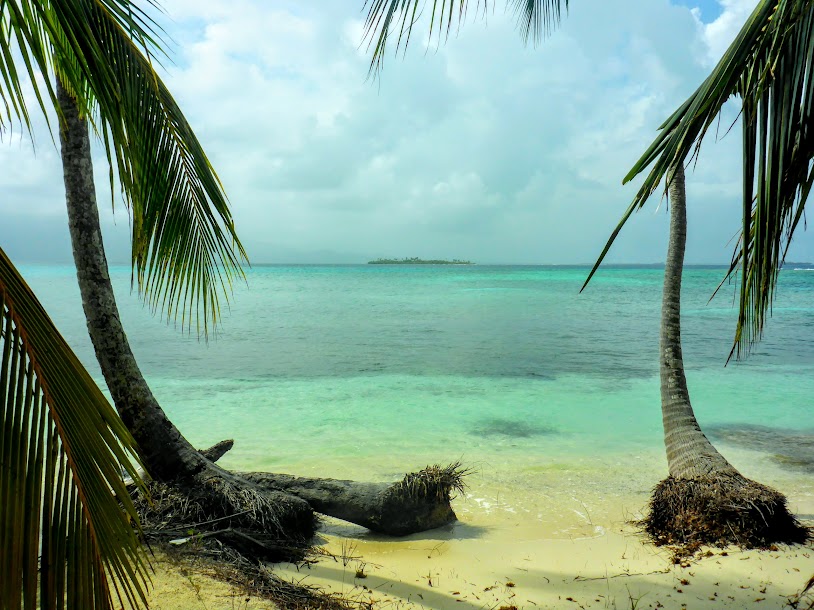
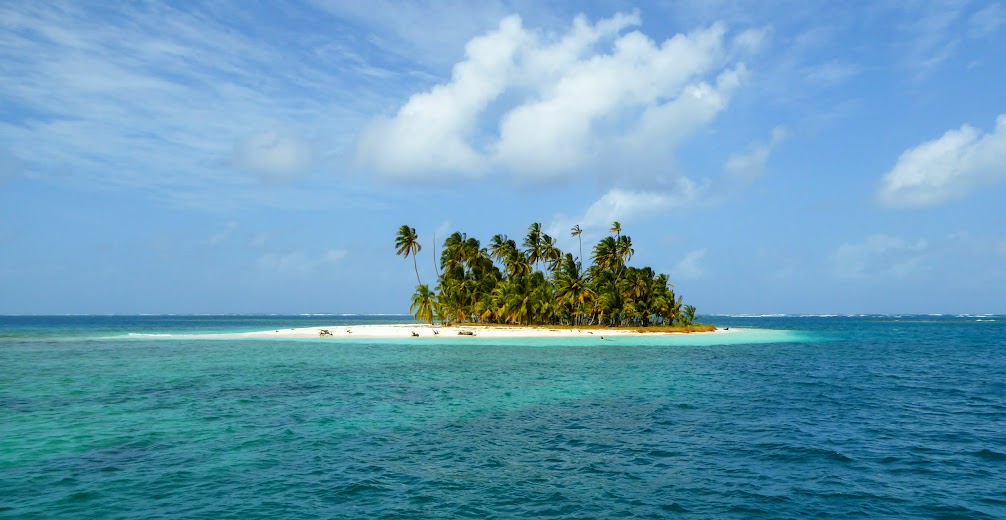
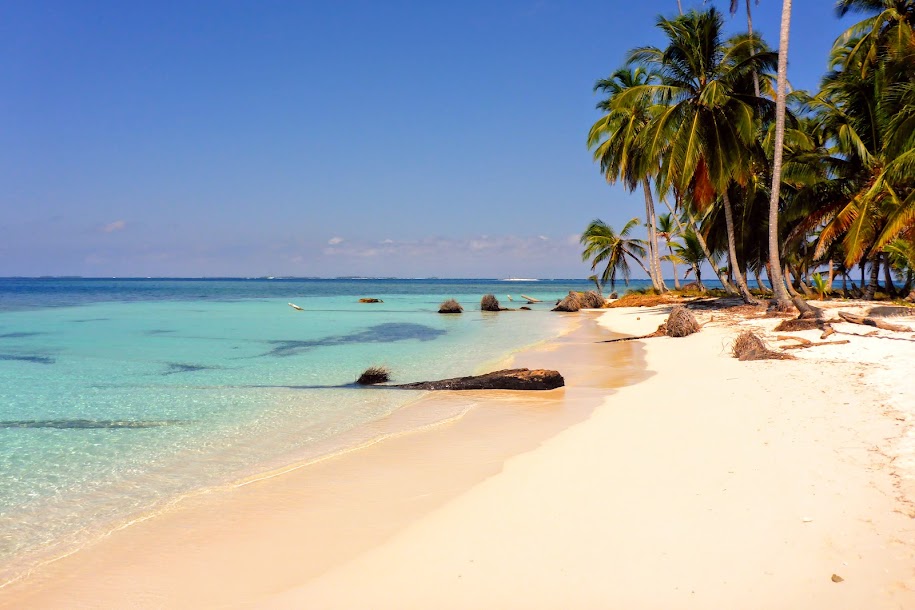
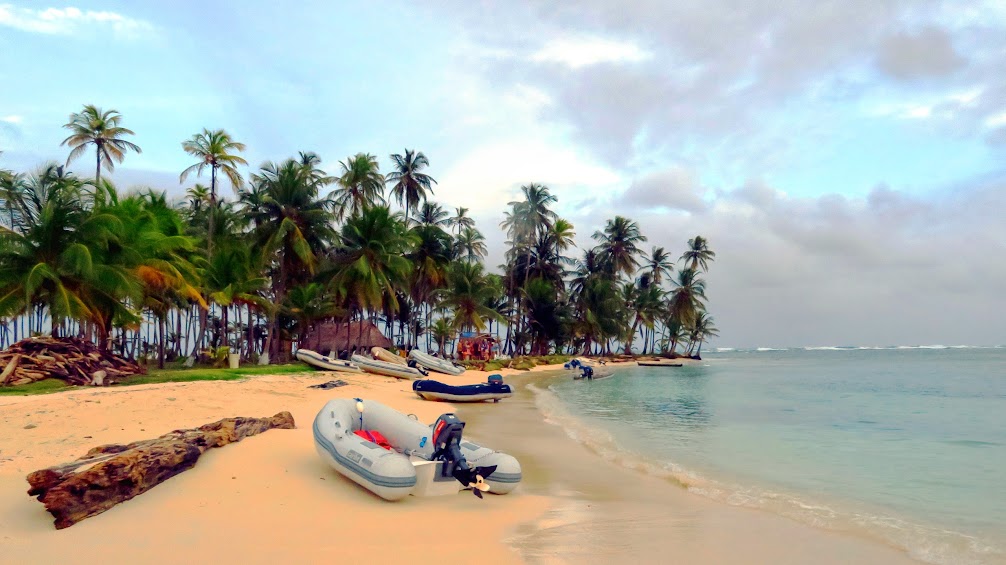
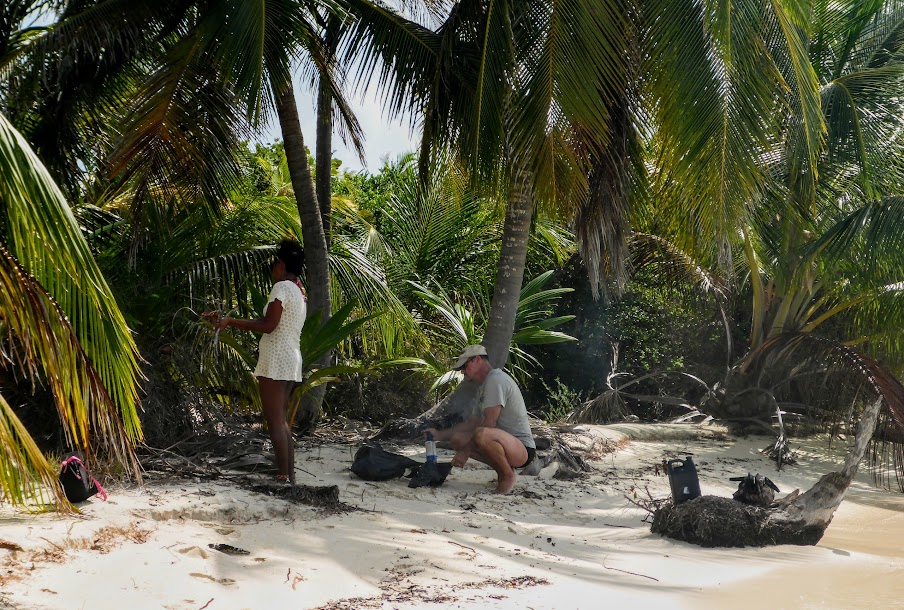
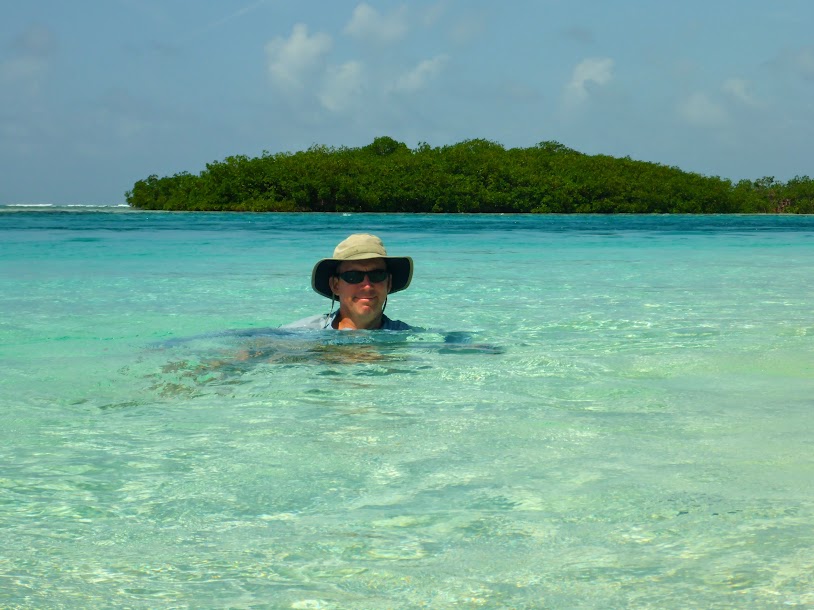
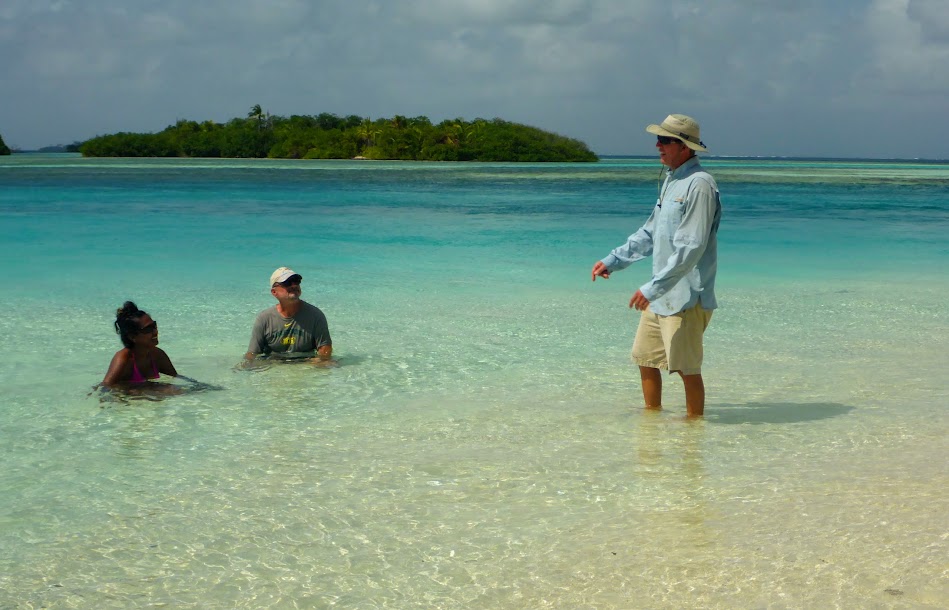
I spent two days on the beach of my favorite cay, while Scott explored the reef. The calm winds made it brutally hot, but the views were worth it; and, cooling off in that gorgeous, clear water was heaven.

I’m the first to say that our trip is much more of an adventure, than “living the dream,” but on days like this, with a beach all to myself, and the only sounds from nearby birds and gentle waves lapping at the shore, I definitely feel “dream” vibe.

We had another trash burn gathering on the beach with our friends, and then moved toward the back of the anchorage, allowing us to leave early the next morning, without having to worry about traveling through coral in the low light as we left the area.

Our overnight spot was just as scenic, and Scott enjoyed a snorkel on some nearby patch coral.

We loved our time in the Cocos, and are so grateful for the stretch of near flat wind while we were there, something very, very rare this time of year in the San Blas. Here are more photos.

“Shells Sink, Dreams Float. Life’s Good On Our Boat!”
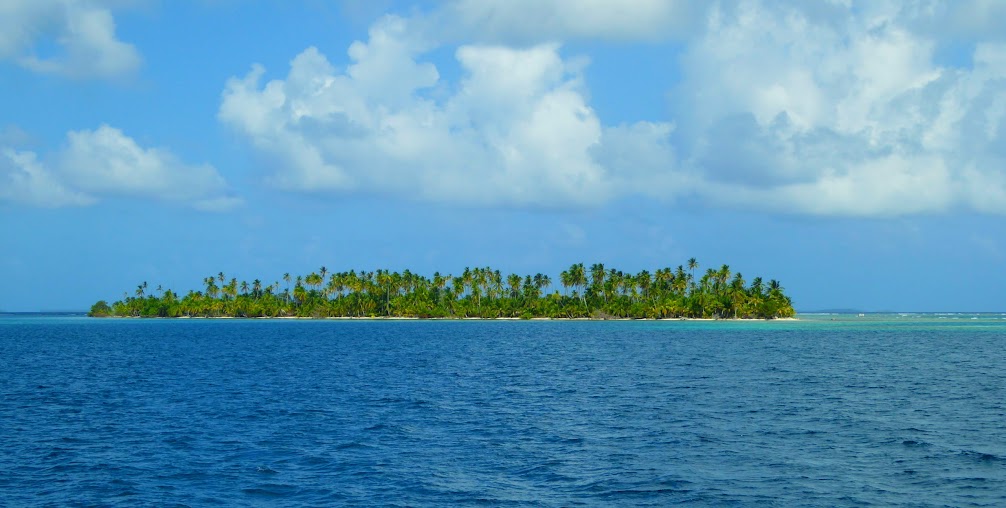
Christmas And New Year’s Eve. In The San Blas Islands

We’re alive and kickin’, here in the San Blas islands! Internet service is more available than expected, but usually requires precise placement of a cell phone (used as an internet hot spot) at the highest outside point possible. It’s a familiar sight here, to see phones encased in plastic bags, hanging from, or being hoisted up a mast. At best, the service comes and goes, making uploading challenging, with the strongest hours coming in the middle of the night…oy! Some people have boosters installed on board, to up the strength of the signal. Others travel to anchorages that may have better service.

We do not have a booster, and are trying not to spend our time chasing the internet, so getting a signal worth doing anything, for any amount of time, is basically a crap shoot.

I’ve finally caved, and have spent several all-nighters (with nap breaks during weak service periods) while we’re in a location with decent service, to catch up a bit, and share what we’ve been up to for the past two months. Yes, I guess I could have written a post without photos attached, but that would just be mean.

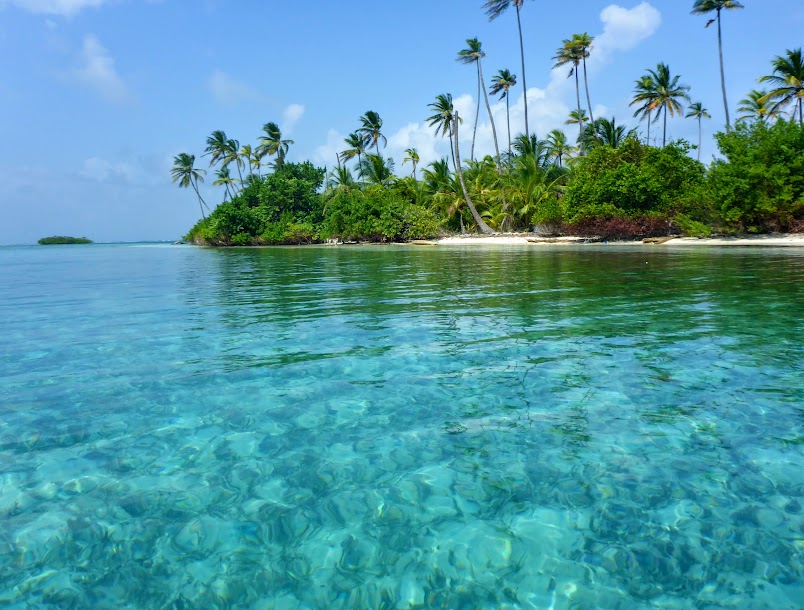
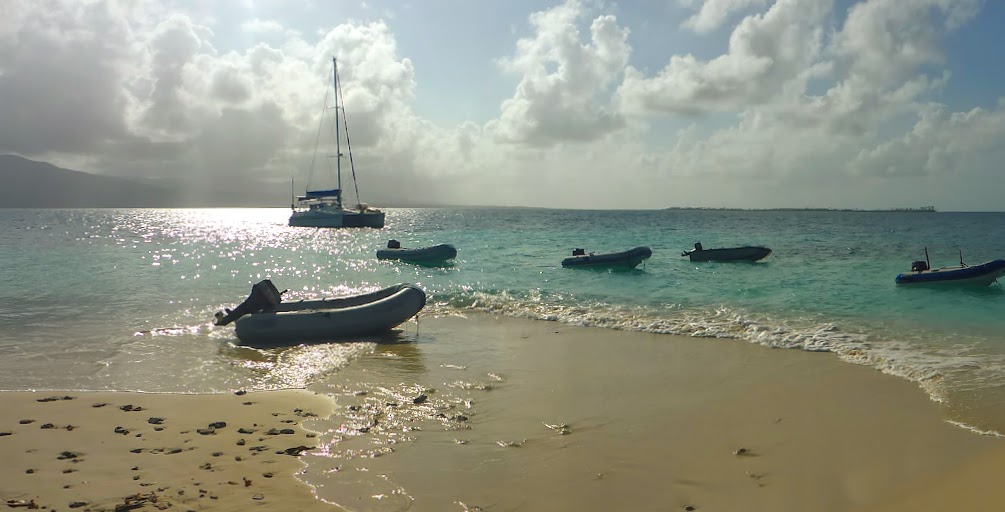
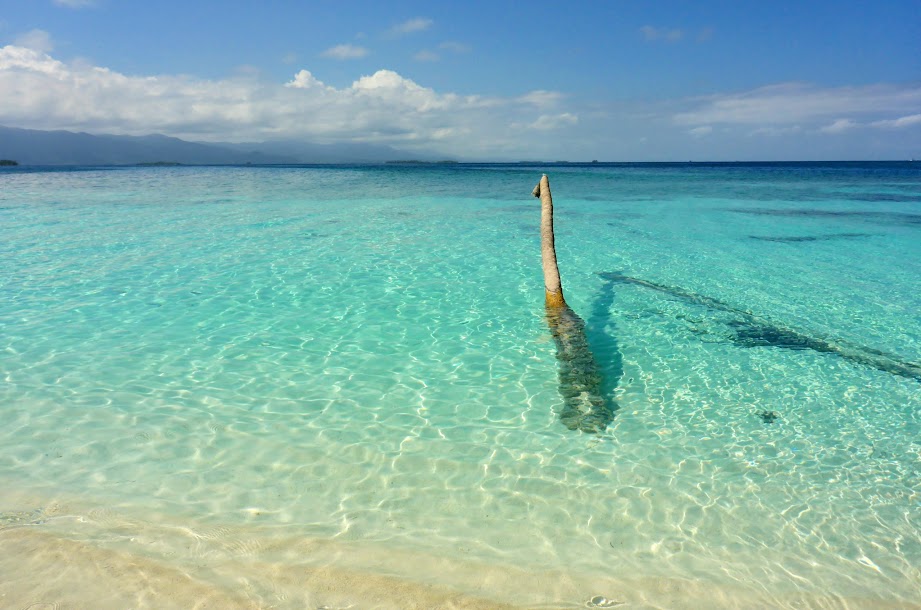
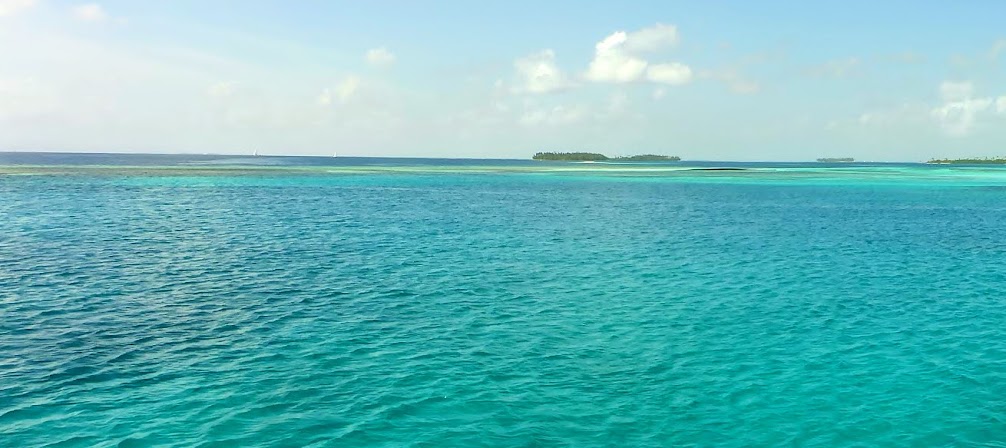
We made our way from Linton Bay, on Panama’s mainland, to the eastern Holandes Cays in the San Blas islands, where we anchored in the Swimming Pool. Named for it’s shallow, clear blue water, the pool lives up to it’s name. The anchorage provides an nearly 180 degree view of the surrounding reef, and the breaking waves are easily heard day and night.

The views behind us were just as beautiful, with the colors of patch coral in the distance.

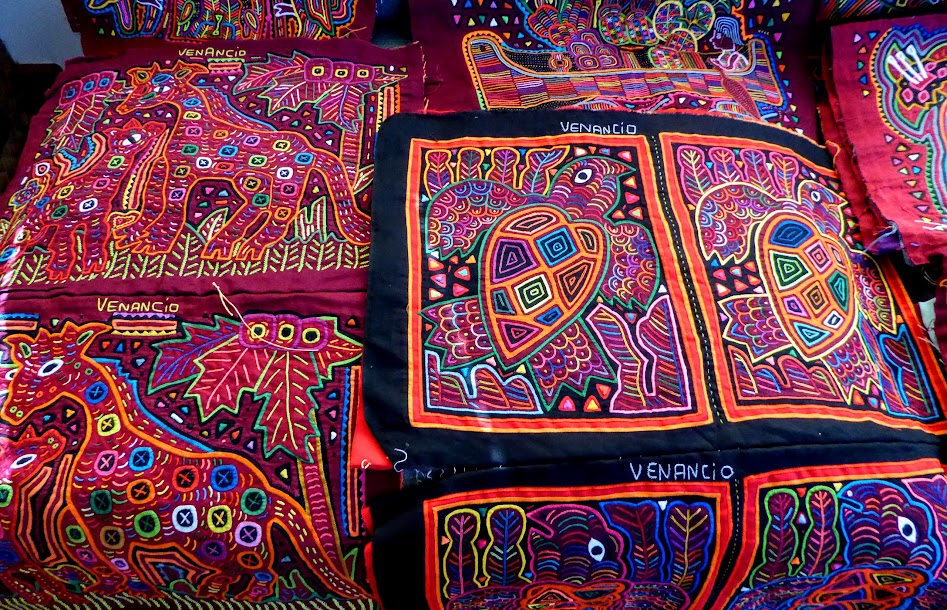
On our first morning at anchor in “the pool,”  we had a visit from Venancio, one of just a few master mola makers in the San Blas. We’d been told to keep an eye out for him, and were surprised to see him so far east.  Venancio told us that he makes the eight hour round trip to the eastern Holandes from the island where he lives, just once a week, so we were lucky to catch him.

Venancio came aboard with a trash can full of molas, and some beaded bracelets. He took each mola out, and explained it’s design as he laid them out for us to see. They were beautiful; full of color, and all hand stitched.

We chose several of our favorites, and then Venancio packed up his trash can, loaded it aboard the ulu (wooden canoe) and covered it well, protecting the molas from the salt air and spray.  Mola purchase in San Blas..check.

The week before Christmas, we heard a general announcement on the vhf that there was going to be a cruiser gathering on Barbecue Island, located at the front of the anchorage, just behind the reef. We were excited to meet the other cruisers in the anchorage, and arrived with an appetizer to share with the group. The weather was perfect, and we met many new friends. (photo courtesy of s/v Sundowner)

Once the sun set, locals on the island, who run a small “resort” (I use that term very loosely) lit a bonfire for us. Their fire starting was far from skilled, as we watched them spray the huge pile of wood and palm fronds with gasoline! (photo courtesy of s/v Sundowner)

As expected, Scott spent many hours in the Aluminum Princess, exploring the anchorage and the area around the expansive reef.

He always has his pole spear handy, as his snorkeling outing often turn into hunting expeditions…many times successful ones!

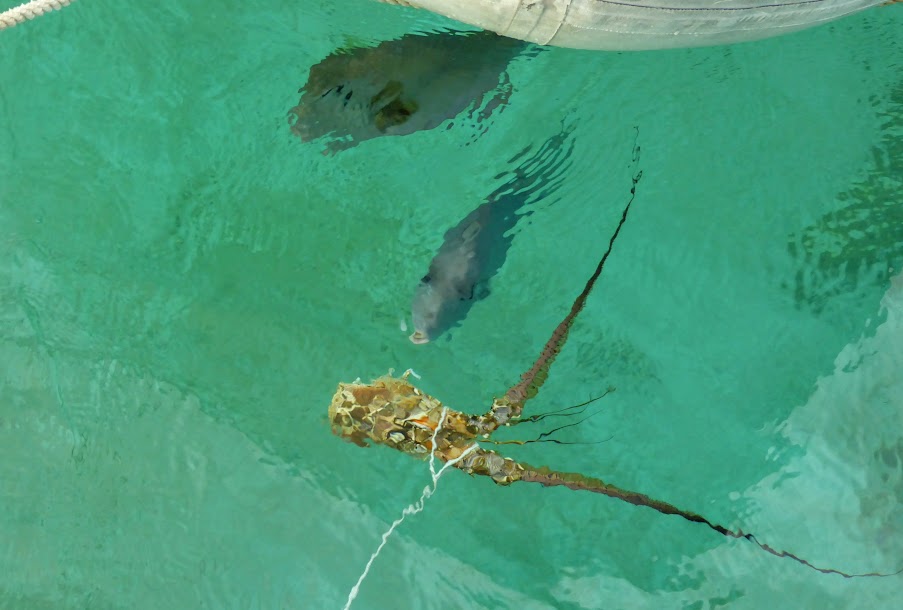
Scott dropped a lobster head into the water behind the boat, to see what might bite. It seems that Triggerfish find them pretty tasty. Regulars here in the San Blas refer to Triggerfish as “Bob.” Maybe because there are many in the waters here…not sure. Bob likes lobster.

On windy days, current would run through the anchorage at close to four knots, making swimming very challenging. Scott’s solution was to take the Princess to one end of the anchorage, tie himself to it with a 30 foot line, and drift along behind it, as the boat made it’s way back through the anchorage in the current.

He  caught quite a few very large conch like this, having just enough time to get to the bottom and grab them before being pulled along. Neither of us were up for the job of cleaning conch (eewww), so we shared them with some of our new friends in the anchorage…and joined them for some fresh ceviche as a thank you!

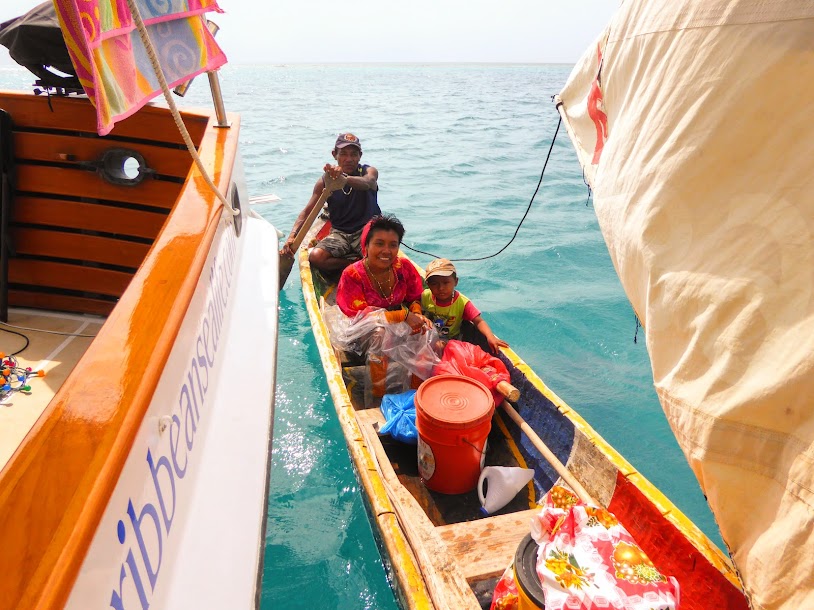
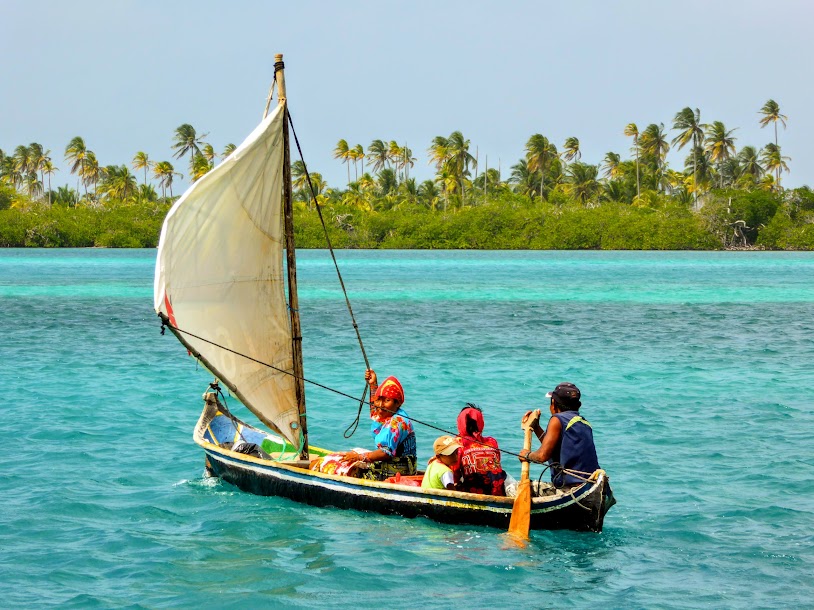
We would get regular visits from the Gunas, in their ulas (dugout canoes). They usually had molas and jewelry for sale. We already had more molas than needed, but were happy to fill their water jugs with fresh water, and occasionally a juice for small children. They also took our aluminum cans, to sell to the Colombian trader boats who recycle them.They both row and sail the ulas, and the women’s traditional dress is beautiful.

There is no trash removal service here in the San Blas. Bottles are broken into pieces (the theory is that the pieces will eventually turn into sea glass) and dropped overboard when in deep water (at least 150 feet), along with steel cans (anything that will rust away). This isn’t just practice reserved for the San Blas islands, the U.S Coast Guard has similar requirements for trash removal offshore.

All other trash here is burned. Being new to the San Blas, we weren’t sure which beaches were acceptable for this, as all of the islands here are owned by Guna families, whether they are inhabited or not. Until we learned the rules of trash burning etiquette, Scott improvised.

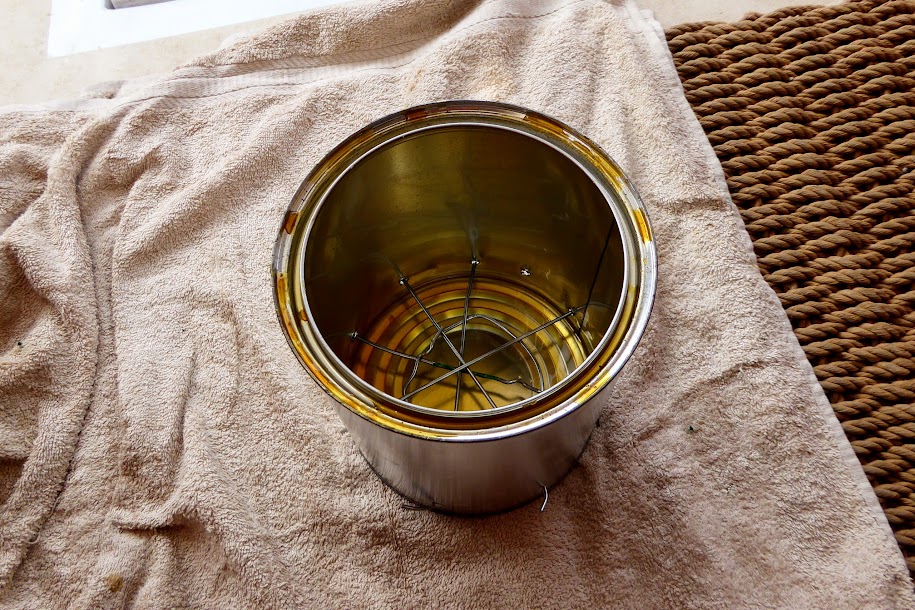
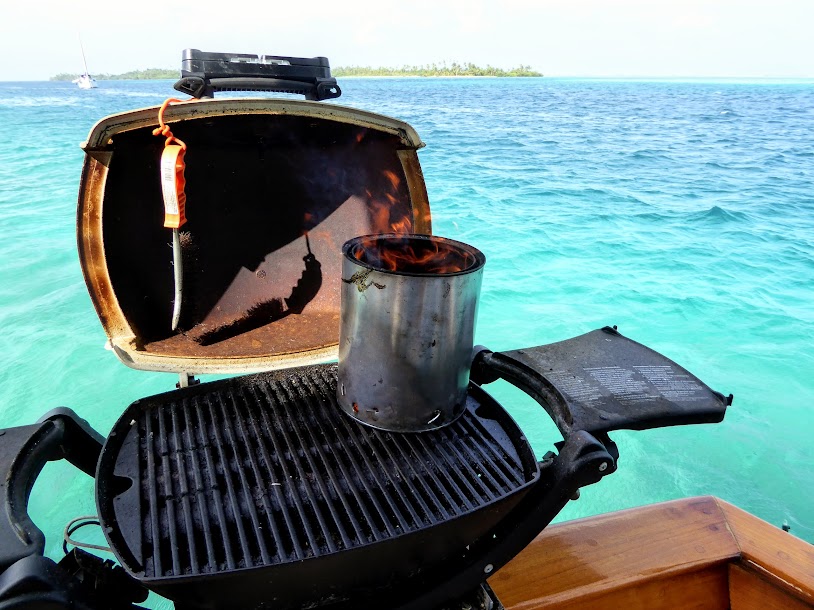
Channeling his inner “MacGyver,” Scott fashioned a rack from a wire coat hanger (I’m shocked that we had one on board, although he probably had it squirreled away for just such an occasion),and placed it in the bottom of an old varnish can. He punched holes in the bottom for air, and voila!, a burn can for the grill was born.

This would have been the perfect solution if we burned every day, or made less trash, but we do neither of these things. Instead, Scott would spent two hours or more burning everything from paper to an old pair of shorts.

Positive…our trash burned down to a tiny pile of  ash. Negatives..it took hours, and we had to close up the saloon, to avoid being choked out from the smoke.

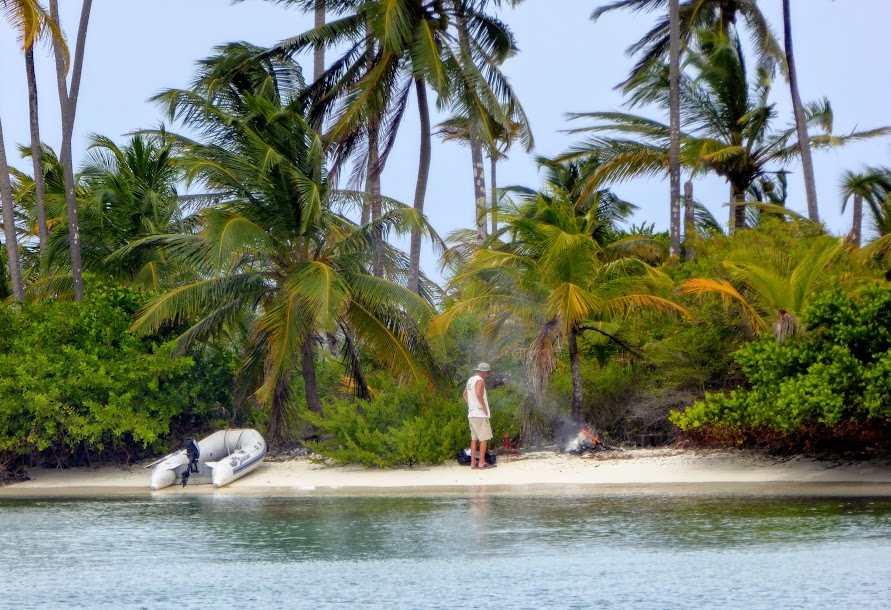
Luckily, or new-found cruiser friends invited us to join them for a trash burn run. We followed them about 20 minutes from the pool, to a beautiful spot, where they meet to burn trash. Fires are made near the waterline, so that high tide will wash away the leftover ash.

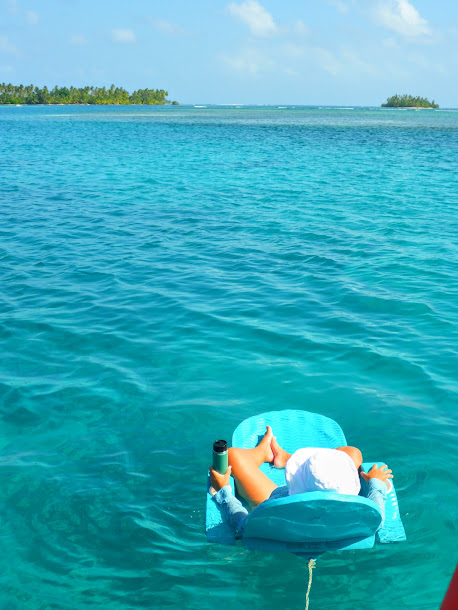
We soon realized that trash burning here is a social event. Once the trash has burned, and while we wait for the ashes to smolder and cool, it’s time for bobbing with drinks in the clear blue water; now that’s my idea of a day’s work!

By the way, wearing some kind of shirt is a must in the water here  (unless you’re our friend, Sharda, who is blessed with skin from Trinidad!). I learned this the hard way, frying my shoulders and back from the reflection of the hot sun off of the water.

When we first arrived, there were few boats in the anchorage  here, but during  the weeks of Christmas and New Year’s Eve. the numbers grew.

We enjoyed Christmas Day in two shifts. First, with dinner aboard s/v Sirena, and then dessert with friends on s/v Gris Gris. And of course, Christmas would not be complete without lights! We lugged along our holiday lights, and Sea Life was quite a festive sight in the anchorage (photo courtesy of s/v Sundowner).

Knowing no boat offered enough room for a group to gather for New Year’s Eve., I put out the word for all cruisers interested to gather on a nearby beach, to ring in 2017. As luck would have it, the location was in perfect view of a fireworks display, set off by a nearby superyacht for their charter guests.

After enduring a stretch of windy weather in the pool, with the accompanying currents and insane salt spray, we decided to change locations for the next go-round. After the new year, we headed around the corner to the Hot Tub (yes, from the pool, to the hot tub..tough times).

With more protection from the winds, the water in “the tub” is much calmer, and the current much less strong. In addition to more beautiful views, the water is supposed to be warmer than in the pool, hence the name. However, we found it to be much cooler…ahhhh, refreshing.

Scott found a great honey hole around the corner, for catching lobster and Lionfish. They are invasive, so he tries to kill them whenever he can. Lionfish are also good eating, but challenging to clean, due to their poisonous dorsal fins.

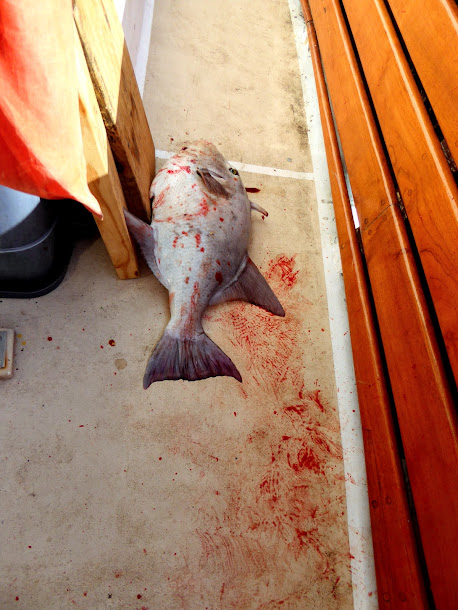
Once again, Scott used lobster tails for bait, and attracted a huge Bob! He grabbed his pole spear, and shot it right from the cockpit, without even getting wet. Unfortunately, Big Bob did not go down without a fight, flopping and bleeding all over the cockpit when Scott removed the spear tip.

Scott delivered this massive fish to our friends, Jon and Shannon, on s/v Prism. They were waiting for a new dinghy motor, requiring them to row everywhere.

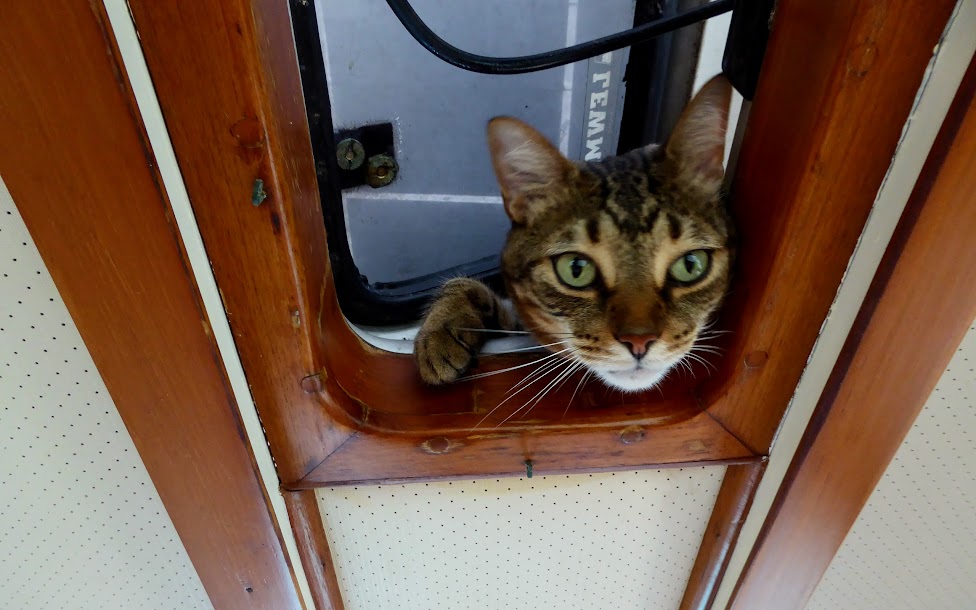
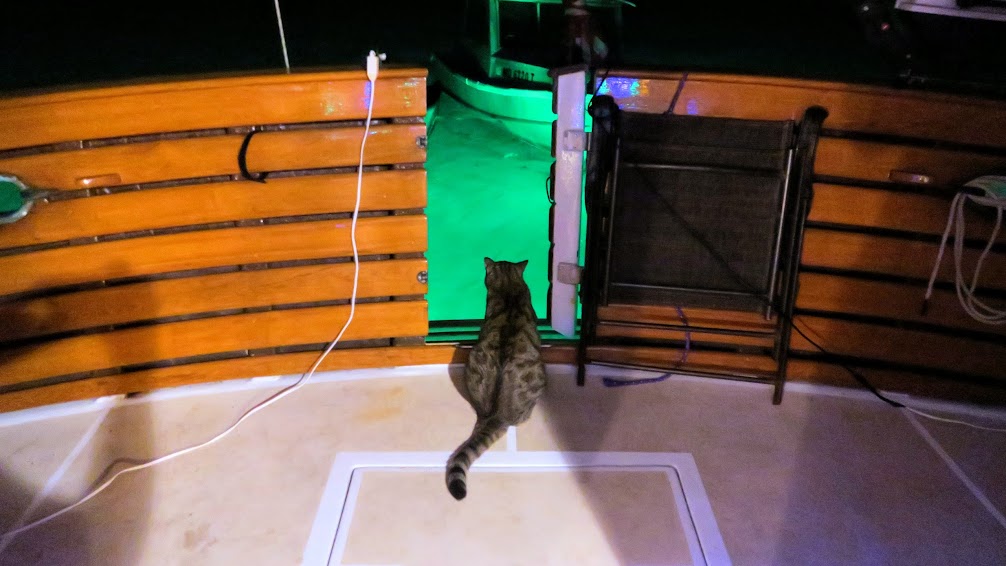
In case you’re wondering, Howard is enjoying life in the San Blas. He keeps an eye on us from one of his favorite perches, up under the solar panels, and loves when the fish light goes in the water each night.

So our first few weeks in the San Blas were off to a great start. We made many new friends, and enjoyed the beautiful views. More to come, as we explore new anchorages. Here are more photos.

“Shells Sink, Dreams Float. Life’s Good On Our Boat!”


Coming Into The San Blas Islands

We’ve picked up a decent cell signal, coming into the outskirts of the San Blas Islands, so I’m sending out a quick hello.

Trip has gone well, big swells, but spread far apart enough that we’re not getting tossed around badly. Scott fought queasiness until we tucked behind the first islands. Howard has traveled like a champ, choosing to just sleep through it and I’ve watched several movies.

The first islands we’re coming up on are popular for charters and such, and as you may expect, there are many boats here. Our plan is to keep going, and anchor farther out, in what’s called the Hollandaise area, where we’ll be at anchor until after the new year.

Just a few quick photos!

“Shells Sink, Dreams Float. Life’s Good On Our Boat!”
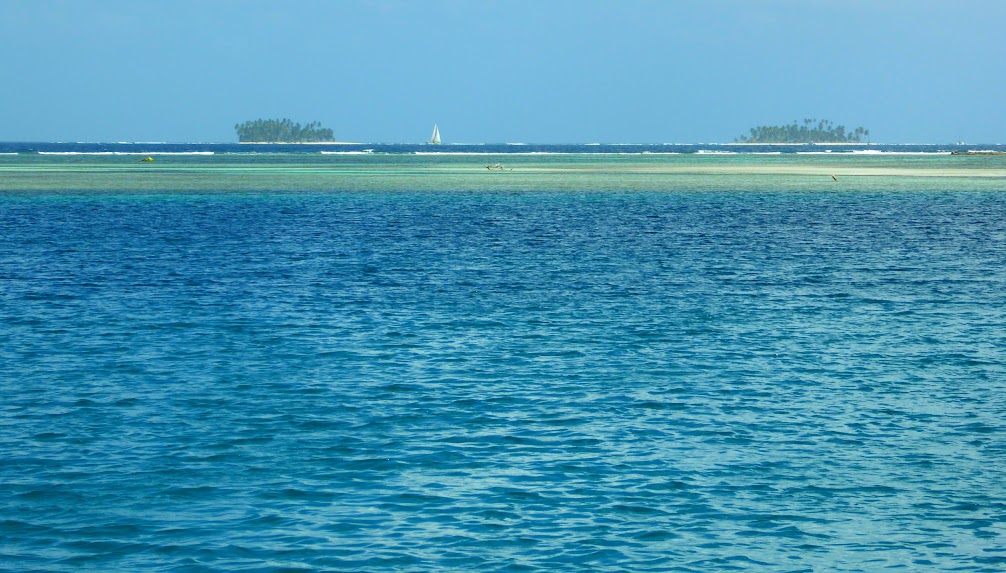
The San Blas Islands, Our Winter Home

This morning, we’ll make our way toward the San Blas Islands, where we plan to stay until early April. As usual, we expected to be settled there already, but Mother Nature again intervened.

After Otto passed by, the Christmas winds that regularly build in the Eastern Caribbean began to blow. While we don’t get the wind speed down here, it does drive large swells our way. As a result, our 8-10 hour ride should be interesting.

We expect swells of eight feet or so, which won’t be so bad if they are timed well and winds stay light and variable, as forecasted; the big word here is IF. Either way, the seas won’t get any better this time of  year, so it’s off we go.

As I mentioned previously, the San Blas Islands are a remote area is located on the northwest coast of Panama, in the Caribbean Sea.

Image result for map of the san blas islands

There are conflicting numbers, but between 365 and 400 islands make up the archipelago, only 49 or so of which are inhabited (not the best detailed map, but the best I could find online).

Image result for map of the san blas islands

The 100 square mile area is home to an indigenous group known as the Gunas, and the islands are also referred to as the Guna Yala region. Internet will be sparse for us this winter, so I thought I’d share what I’ve learned so far, about the Guna people..

The approximate 50,000 Gunas in the San Blas have their own language, but also speak Spanish, and more recently, English.

They have a matriarchal society, in which inheritance passes down to the women. A young man, after marriage, must move in with his in-laws, and work for several years under the apprenticeship of his father-in-law. Daughters of the Guna are prized, because they will eventually bring additional manpower to the family.

Divorce is rare, although all that is required is for the husband, should it happen, is to gather his clothes and move out of the house (too bad it doesn’t usually work out this nicely elsewhere).

There is a division of labor within families. The husband gathers coconuts, cultivates food, provides firewood, repairs the house, makes his and his son’s clothes, weaves baskets and carves wooden utensils. The wife prepares the food, collects fresh water from the mainland rivers, unloads the boats, sews female garments, washes clothes and cleans the house.

Before the arrival of Europeans, the Guna wore few clothes, and decorated their bodies with colorful designs. When encouraged to wear clothes by the missionaries, they copied these designs in molas, which were then worn as clothing.

The Gunas are now famous for their molas, which are handmade using a reverse applique technique. Several layers (usually two to seven) of different color cloth (usually cotton) are sewn together; the design is then formed by cutting away parts of each layer.

The edges of the layers are then turned under and sewn down. Often, the stitches are nearly invisible. The finest molas have extremely fine stitching, made using tiny needles. (I borrowed this description from Wikipedia, where there is much more interesting mola information).

Image result for kuna yala

Mola means “clothing” in the Guna language, and the panels are used to make blouses, worn daily by most Guna women (men wear western dress). We’re told that looks like this are the norm on the islands of the Guna Yala region, and it seems the women also enjoy pipe smoking.

Image result for kuna yala

Image result for kuna yala

The economy of the Guna Yala is based on agriculture and fishing. Plantains, coconuts and fish is their core diet, supplemented by simple imported foods, a few domestic animals and wild game. Coconuts and lobsters are widely exported products, and migrant labor and the sale of molas provide other sources of income.

Image result for fish in the kuna yala region

Image result for coconuts in the san blas

In 1925, there was a revolution between the Guna Indians and the ruling Panamanian authorities, who attempted to force the Guna to adopt Hispanic culture by military action. During this revolution, the Guna Yala territory seceded, and operated as the short-lived Republic of Tule.

Following mediation with the United States, the Guna re-united with Panama. With the support of the Panamanian government, the Gunas created a self-governing territory, named the Guna Yala district, where they would rule themselves.

Relations are still strained between mainland Panama and the Guna Yala region. Most recently, both customs and immigration have moved out of the area, and cruisers now have to clear in and out of the country on the mainland. Going to one town for customs, and another for immigration; frustrating!

We’re looking forward to visiting this area for the winter months, and will look for a window of weather in late March, to travel to Cartagena, Colombia, before continuing on to the Eastern Caribbean.

As usual, you can track us on the Where Are We Now page, where you can also send an email through our Delorme satellite tracker.  We look forward to a winter of views like this!

Image result for photos of the san blas islands panama

“Shells Sink, Dreams Float. Life’s Good On Our Boat!”


Panama’s Insane Rain!

They say that Panama has two seasons, the dry season from December to mid March, and the wet, or “green”, season from mid March to mid December. As you might deduce from their names, the dry season means little or no rainfall, while the green season can mean rain almost every day.

However, in Bocas del Toro, it rains consistently nearly every month, except for September and October. Fortunately, the wet stuff usually comes overnight or in the early am, giving way to the brutal, hot sun. November is a different animal altogether; a rainy season unto itself.

At last check, when we left Red Frog after Thanksgiving, the monthly rain total was over seventeen inches for the month! The rain during November was often biblical. Heavy, driving rain would pour straight down for hours, and the sound was unnerving. Roads flooded almost instantly, and any grass-like surface turned to muck.

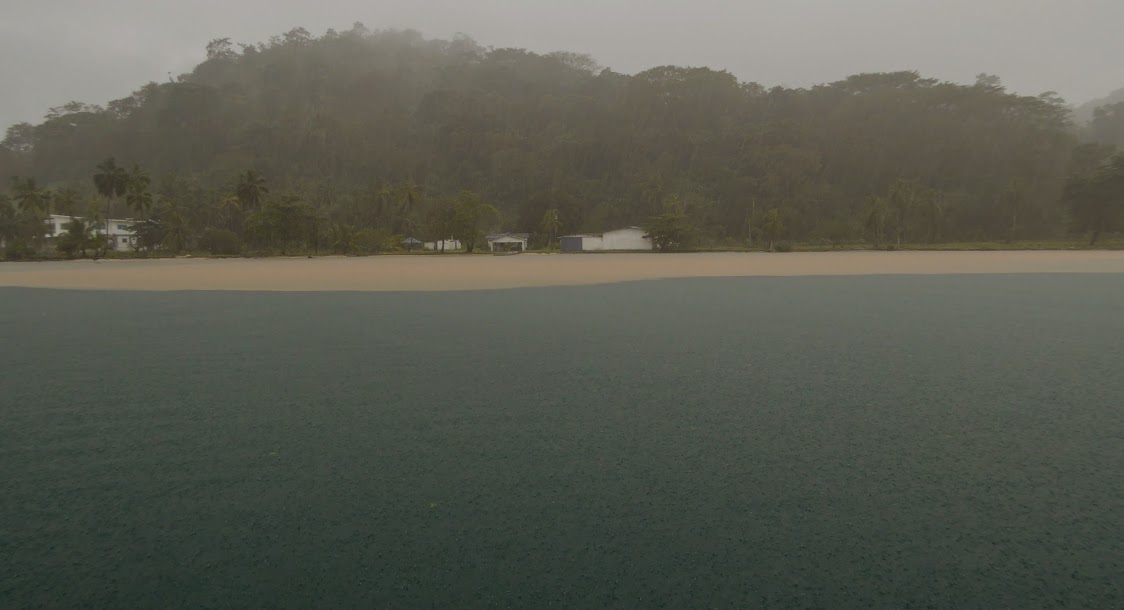
Visibility disappears in an instant, and the water turns to mud. For example, now you see it:

Now you don’t:

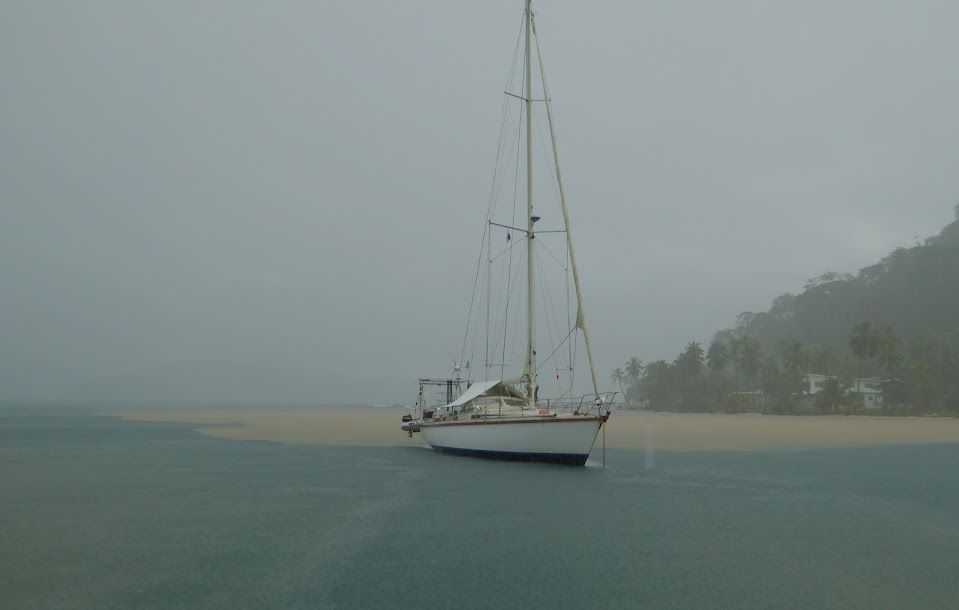
This nasty brown line floated our way during a recent deluge:

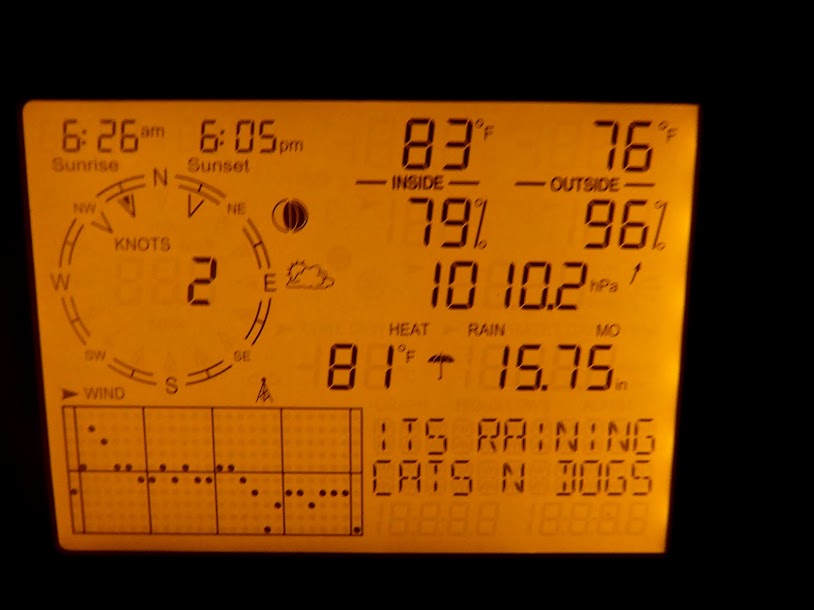
Scott installed a new weather station in November, after our old one gave up the goat. The new one has many more bells and whistles, and greatly appeals to Scott’s inner weather geek. For example, note how it describes a November deluge, using the most weather specific terms (bottom right corner):

To be fair, it definitely was raining cats and dogs, so kudos weather station!

This crazy rain has extended into December, and in the first ten days of the month, we’d already received close to twelve inches! Recently, just in the morning hours alone we had 3.18 inches, and at one point, the rain rate listed on the weather station was 6.86 inches an hour….biblical I tell ya!

It’s definitely the wettest area we’ve ever been to, including any travel by land, car, air or boat before this cruising adventure. As you can imagine, the humidity matches the wetness, turning our decks and lines green, and making daily tasks a challenge. Thank goodness we spent the time plugged in, and able to keep the interior humidity in check with air conditioning.

On the bright side, everything here is beautifully lush and green. Trees and foliage grow thick and tall, and brightly colored plants and flowers spring up from the ground.

We were surprised not to see more fresh, local produce grown in the area, but suspect that too much of a good thing may hinder good veggie growth.

All in all, we’ve become accustomed to traveling with an umbrella at the ready (it’s far too warm and humid for rain jackets, as they become your own personal sauna, despite the best ventilation), and push on, despite the wetness. It beats a 45 degree rain that the northeast can get this time of year, so we try to embrace Panama’s “liquid sunshine”!

“Shells Sink, Dreams Float. Life’s Good On Our Boat!”
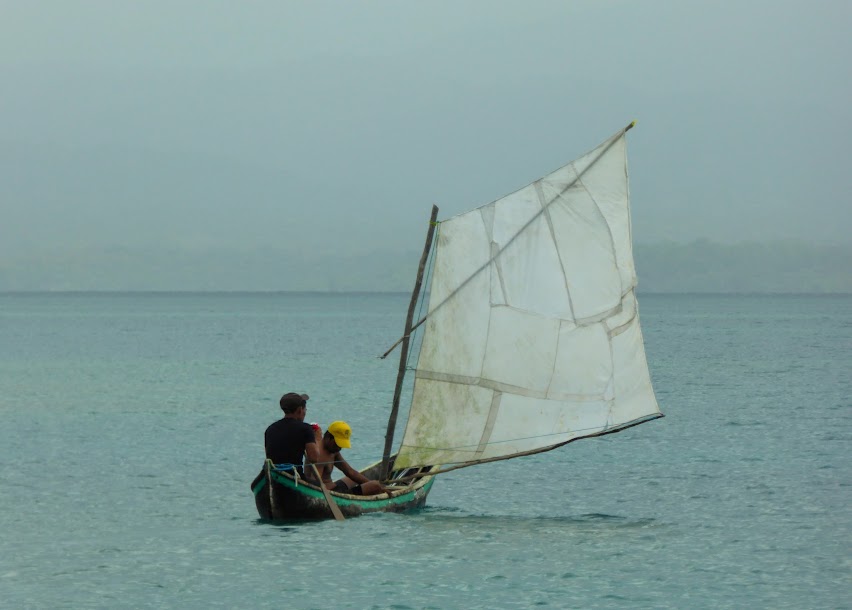


The rain here in Panama is insane. When we arrived, uring the “rainy” season, but November in particular really gave us a dousing. Heavy rain lasts for hours at a time, flooding streets, and turning grassy areas into muck.

Our Cross Country Train Ride

After our overnight in Panama City, we planned a train ride back to the Caribbean coast. Instead of taking a cab all the way to Linton Bay, we decided to hop on the Panama Canal Railway to Colon, and take a cab back to Sea Life from there.

The Panama Canal Railway runs parallel to the Panama Canal, linking the Atlantic and Pacific Oceans. The route stretches 47.6 miles across the Isthmus of Panama, from Colon on the Atlantic side, to Balboa in Panama City. It was the most expensive railroad ever built, at a cost of eight million dollars, and at $295.00 a share, the Panama Railroad was at one time the highest stock listed on the New York Stock Exchange.

Image result for map of the panama canal railway

The primary reason for building the railroad was to increase traffic to California, due to the Gold Rush in 1849. Construction began in 1850, and the first money-making train ran over the full length of track in January of 1855. The Panama Railroad was referred to as an inter-oceanic railroad, and later a “transcontinental” railroad, despite the fact that it only spanned Panama’s narrow width.

As with the construction of the Panama canal, the area was not an ideal location to build a railroad. From June through December there were deluges of rain (which we can attest to) that often lasted as long as three days. The whole area was covered with dense jungle, thick with humidity, and there was no durable timber for construction. In addition, the native people were not used to physical labor, and were undependable. Men, materials and provisions all had to be imported from thousands of miles away.

Cholera, yellow fever and malaria took a severe, deadly toll on construction. Despite the fact that large numbers of new workers were constantly being brought in from the United States, the Caribbean Islands, and as far away as Ireland, India, China and Australia, there were times when work was stalled for simple lack of “live” or healthy workers. Disposing of the dead became such a problem, that the railroad started “pickling”  the bodies in barrels, and selling them to medical schools! The proceeds were used to build a hospital for the railroad (a hell of a fundraiser!).

In 1881, the French purchased controlling shares in the Panama Railroad Company, and employed the railroad in the excavation of the Panama Canal. In 1904, the United States purchased the railroad from the French, when they took over canal construction. The railroad closely paralleled the canal, and was moved and reconstructed where it interfered with canal work. New sections were built on higher ground, using heavier gauge line.

The use of the railroad was vital in construction of the Panama Canal. Two hundred train loads of dirt were removed every day from work sites, and the railroad also transported materials and labor. In addition, the trains served as sleeping quarters for workers.

Image result for images of workers sleeping in panama railway cars

PCMI009086_00001

Once complete, the railroad became one of the most profitable in the world, charging up to $25.00 per passenger to travel over the 47 miles of track. It was an engineering marvel of the era, until the opening of the Panama Canal, and carried the heaviest volume of freight per unit length of any railroad in the world. The existence of the railway was key in the selection of the canal site.

After World War II, few improvements were made to the railway, and it declined after the U.S. government handed over control to the government of Panama in 1979. In 1988, the government of Panama turned over control to the private, Panama Canal Railway Company, who launched a large renovation project. In 2001, the railway reopened, and began “coast to coast” passenger train service; container service soon followed.

Ok, back to our ride…

The main purpose of the train is as a commuter rail for people living in Panama City, working in Colon, but it has also become popular for tourists as well. Several of  our cruiser friends had taken the ride, and highly recommended it. Passenger service only runs twice a day, with a train leaving Panama City in the morning, and returning from Colon in the late afternoon. Since we only had one choice for departure, we arrived at the station early in the morning, purchased tickets and climbed aboard for the hour-long, cross country ride.Image result for panama canal railway station in panama city

Image result for panama canal railway station in panama city

Inside, the cars had the feel of the early 1900’s, with dark wood paneling and carpeted floors. Both booth and table seating lined either side of the aisle, offering clear views out of large windows.

Image result for interior photos of panama canal railway cars

We were given a breakfast snack box,  which was barely touched before Scott had ants in his pants to head out to the observation deck between cars.

Since the railway parallels the canal route, we were able to see boats transiting the canal’s waterways. Some we’d seen from out hotel balcony the night before…pretty neat!

We also passed by areas where old buoys, work boats and other canal maintenance equipment was kept, including dredging pipe and the huge machines used to keep the canal route clear.

The railway runs through the jungle, and across Lake Gatun. We spent the entire hour outside, taking in the scenery passing by.

Along the way, we also passed by the canal locks, and could see boats going through.

All to soon, we made our way closer to Colon, and approached the train yard where our ride would end.

We hopped off, and went to hail a cab. Our ride back to Linton Bay took us right past some large grocery stores, so we stoped for some final provisioning before heading to the San Blas Islands. Our driver waited for us to shop, which was great (I think he killed two birds with one stone, as I saw him getting lunch at the deli inside), as hailing a cab in the congested area may have been challenging. As we loaded in our groceries, I enjoyed the smell of Christmas trees for sale outside the store.

The drive from the grocery store to the marina was like an amusement park ride. It was clear that the driver wasn’t familiar with the roads, but that didn’t stop him from driving like crazy to get there, as he tested the limits of the cab’s brakes and steering. I was sure poor Scott was going to have permanent dents in his leg, from where I continually grabbed it in fear.

Thankfully, we arrived back at Linton Bay Marina in one piece. We unloaded our things, and told Howard all about our adventure. He was only interested in a full bowl of food, but we thought that train travel was pretty cool. Here are many, many more photos.

“Shells Sink, Dreams Float. Life’s Good On Our Boat!”
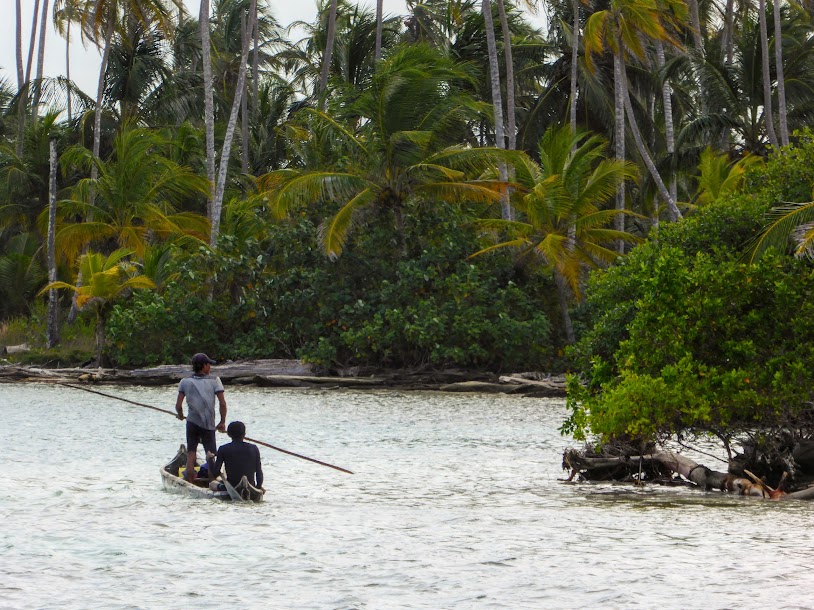


Our Trip To, Not Through, The Panama Canal

Jumping back several months, to catch you up on our canal adventure:

Our cruising plans do not include transiting the Panama Canal. It’s a substantial cost, and I have no interest in crossing the Pacific (after our passage to Puerto Rico, neither does Scott). However, being one of the seven modern wonders of the world, and Panama’s biggest tourist attraction, we were very interested to see the canal. Since our route from Bocas del Toro to the San Blas islands took us within a few hours of the canal’s visitor center, it seemed a shame not to visit.

But first, here’s some interesting history of the Panama Canal, and it’s construction (with some cool visual aides):

The idea of creating a water passage across the isthmus of Panama to connect the Atlantic and Pacific Oceans dates back to the 1500s, when Spain surveyed a possible route across Panama’s Chagres River. The idea seemed impossible at the time, but remained intriguing a potential shortcut from Europe to Eastern Asia.

Image result for map of the panama canal route

France was first to attempt the daunting task. They planned a sea-level canal, with Count Ferdinand de Lessep (builder of the Suez Canal in Egypt) in charge of the project. After breaking ground in 1880, the construction team soon realized the monumental challenge ahead of them.

They were plagued by yellow fever and malaria, and incessant rains caused heavy landslides. De Leeps realized that a sea-level canal was too difficult, and shifted his plan to a lock canal. However, it was too late; funding was pulled from the project in 1888, after nine years and a loss of approximately 20,000 lives.

Image result for yellow fever during the construction of the panama canal

Image result for photos of casualties of the panama canal construction

Image result for photos of french panama canal construction

Image result for photos of landslides during panama canal construction

With a push from President Theodore Roosevelt, the U.S. purchased the French assets in the canal zone for $40 million in 1902. After a proposed treaty over rights to build in Panama was rejected (at the time, it was a Colombian controlled territory), the U.S. threw its military weight behind Panama’s fight for independence from Colombia.

Image result for fumigating homes during the construction of the panama canal

In November of 1903, the U.S. negotiated a deal with the newly declared Republic of Panama, that gave them rights to the canal zone. In exchange for the ten mile stretch of land, the U.S made a one-time, $10 million dollar payment, annual payments of $250,000 and agreed to guarantee the independence of Panama.

The U.S. also had plans for a sea-level canal, but much of the French equipment was in need of repair, and the threat of malaria and yellow fever was frightening off the workforce.

A railroad specialist took over on July of 1905, and immediately recruited West Indian laborers to solve the workforce issues. He ordered new equipment, and came up with more efficient ways to speed up the work. In addition, he realized the difficulties that landslides posed, and convinced President Roosevelt that a lock canal would be best for the area’s terrain.

Image result for photos of west indian workers panama canal construction

Image result for photos of west indian workers panama canal construction

What helped the project immensely was the chief sanitary officer’s belief that mosquitoes carried the deadly diseases plaguing the area (who knew they had a chief  sanitary officer??). On a mission to wipe out the pesky mosquitoes, his team diligently fumigated homes, and cleansed pools of water. The last reported case of yellow fever in Panama was in 1905, and malaria cases dropped sharply over the following decade.

Image result for fumigating homes during the construction of the panama canal

In 1906, a new chief engineer took over, and he focused efforts on the Culebra Cut,  a nine mile stretch of mountain range along the canal route. Clearing this area became a 24-7 operation, with more than 6,000 men contributing at any one time. Despite the attention paid to this section of the project, the Culebra Cut was a notorious danger zone. There were many, many casualties from unpredictable landslides and dynamite explosions (Good grief, its a wonder this thing ever got built!).

Image result for photos of panama canal culebra cut construction

Image result for photos of panama canal culebra cut construction

Construction of the locks began in August 1909. Built in pairs, each lock chamber leveraged gravity to raise and lower water levels (there were/are no pumps used). Ultimately, the three locks along the canal route lifted ships 85 feet above sea level, to the man-made Gatun lock in the middle. The entire operation was powered by electricity, and run through a control board.

Image result for photos of panama canal locks construction

Image result for photos of french construction of the panama canal

Image result for photos of panama canal locks construction

The gates separating the chambers in each set of locks hold back a considerable weight of water, and had to be made both reliable and strong enough to withstand accidents, as their failure could unleash a catastrophic flood of water downstream (bad for business) .

Ranging in size from 47 to 82 ft high, depending on position,the gates are enormous, and are 7 ft thick; the hinges alone each weigh almost 17 tons! They can be opened during the operating cycle only when the water level on both sides is equal.

Image result for photos of panama canal locks construction

The original gates are still in use, but their mechanisms were replaced with hydraulic struts in January 1998, after 84 years of service. Much like the hull of a ship, the lock gates are hollow and buoyant. They are so well balanced that two 25 hp motors are enough to move each leaf. If one motor fails, the other can still operate the gate at reduced speed.

Image result for photos of panama canal construction

Image result for photos of panama canal construction

In October of 1913, President Roosevelt operated a telegraph at the White House that triggered an explosion of Gamboa dike, flooding the final stretch of dry passageway at Culebra Cut.

Image result for photos of explosion of gamboa dike

The Panama Canal officially opened on August 15, 1914, but a grand ceremony was downgraded, due to the start of WWI. The canal was completed at a cost of more than $350 million, and was the most expensive construction project in U.S. history at the time.

Image result for photos of the opening of the panama canal

Image result for photos of the opening of the panama canal

The canal was a vital part of expanding global trade routes in the 20th century. Transition of overseeing the canal, from the U.S. to Panama, began in 1977, with a treaty signed by President Carter, and the Panama Canal Authority assumed full control on December 31, 1999. In September 2010, the canal hosted its 1 millionth passing ship, and in 2016 a massive canal expansion opened, doubling the waterway’s capacity.

Image result for aerial view of the panama canal

Image result for photos of the panama canal expansion

Image result for photos of the panama canal expansion

Here endeth the lesson.

After our short stay in Portobelo, we headed to nearby Linton Bay, which is just over an hour car ride to the visitor’s center at the canal’s Mira Flores Locks. It was also a short ride to a grocery store for provisioning, and an easy jump off point to head for the San Blas. We decided to leave the boat at Linton Bay Marina. From there we could visit the canal, spend the night in Panama City and return the next morning, with Howard and Sea Life tucked into a slip for safe keeping.

We arranged for a cab to take us from the marina to the Miraflores Locks, traveling winding, hilly roads along the way, and arrived at the visitor’s center an hour or so later. The ticket office was not yet open, but there were already many people waiting to get in. We took our place in line, just beating a huge tour bus full of people..whew!

After purchasing our tickets and heading inside, we were told to make our way up to viewing area on the fourth floor, as there were ships entering the locks. Once off the elevator, we managed to get a front row spot on the rail, and settled in to watch the large ships “lock through.”

As ships approach from the Pacific side, two locks at the Mira Flores Locks raise them up into Mira Flores Lake. At the other end of the lake, a single lock at Pedro Miguel Lock raises them again, into Gatun Lake and then a triple set of locks at Gatun Locks lower the ships back down to sea level in the Caribbean sea.

Image result for map of the panama canal

Image result for aerial view of the panama canal

Though the channels in the locks seem large enough for ships to pass in both directions at the same time, the Culebra Cut makes this impossible. The area is far too narrow for the large ships to pass each other, so two “lanes” transit traffic from the Caribbean to the Pacific in the morning, and then the direction shifts, for those transiting from the Pacific to the Caribbean.

We were watching ships pass from north to south. They had transited from the Caribbean, and entered the locks from the Mira Flores lake. There were no private/pleasure boats coming through when we visited, only large ships and smaller commercial vessels.

Pleasure boats and small fishing boats usually transit very early in the morning, or after dark. They are tied together, or to a canal tug, as they move through. We have several friends who’ve transited the canal, and all have stories of things not going exactly as planned. Here are some photos. They also have great blogs!

s/v Prism (Jon & Shannon)

c0080-1

Pull faster Shannon!! AH

c0122-1

s/v Morpheous of London (Richard & Jan)

http://www.morpheusoflondon.co.uk/wp-content/uploads/2017/02/Going-up-at-night.jpg

http://www.morpheusoflondon.co.uk/wp-content/uploads/2017/02/Poor-Morphie.jpg

http://www.morpheusoflondon.co.uk/wp-content/uploads/2017/02/At-Miraflores.jpg

Mini towing locomotives, called mules, are used for side-to-side and braking control in the locks (Forward motion into and through the locks is actually provided by the ship’s engines). The mules  run on “rack tracks,” to which they are geared, and their traction is electric, supplied through a third rail that is laid below surface level on the land side of the channels.

Large ships have two mules on each side at the bow, and two each side at the stern—eight in total, allowing for precise control of the ship. Each mule has a powerful winch, operated by the driver; these are used to take two cables in and out as needed, in order to keep the ship centered in the lock while moving it from chamber to chamber. With the larger ships having very little clearance, the mule operators have to be pretty good at what they do!

All ship captains are required to yield control to a canal pilot while transiting, who are specially trained to guide vessels of all sizes safely through the locks. Some ships are so wide that they clear the concrete walls by mere inches. A lock master is in position on either side of the lock, and is in constant communication with the pilots and the control tower during the entire process.

An announcer narrates details about each ship passing through the two lanes, providing the country of origin, what type of cargo is on board and other details. Relayed in both Spanish and English, the information was both interesting and helpful as we watched the huge ships pass by us.

We saw some amusing sights as the ships passed by: a basketball court on the deck of a ship, crew members enjoying the ride in a shady spot and the amount of radar waves that we were exposed to at the observation deck level!

When the canal opened, a set of guidelines were put in place for the maximum requirements of ships transiting across. “Panamax” includes the width and length of the available lock chambers, the depth of water in the canal and the height of the bridges that span the it. A new set of locks opened in June of 2016, allowing larger, “New Panamax” ships to transit back and forth. From our spot on the viewing deck, we could see ships transiting those lanes as well.

There was so much see; we stayed on the viewing deck for hours, taking it all in. When all the ships has locked through, we headed downstairs to check out the rest of the visitors center. There was a short film on the history of the canal, and many rooms of exhibits, containing information about the canal’s construction. We ended our visit with a spin through the gift shop, and then went outside to catch a cab to our hotel, stopping on the way at McDonald’s, for Scott to get a fast food fix!

At the recommendation of one of our friends at Red Frog marina, in Bocas del Toro, I’d booked a room at the Comfort Inn and Suites, which sits right on the canal route. The balcony rooms look over the Balboa Yacht Club’s many boats at anchor, and ships on their way to and from the locks.

Scott kept watch online, in live time, to see when a ship was coming our way. We’d take a break from the air conditioning, and watching English television channels, to go out and watch them pass by (our balcony was in full sun until dusk, so small bursts of outside time were all we could handle).

Our water view all but disappeared during a late afternoon downpour, as the streets below quickly flooded.

Now you see it…

Now you don’t…

We ate a room service steak dinners on our king-size bed, enjoyed long, “roomy” showers, and kept a “ship watch” out the window until well after dark, and again at first light the next morning.

It was a great Christmas treat to ourselves! Here are many more photos.

“Shells Sink, Dreams Float. Life’s Good On Our Boat!”
Portobelo’s Spanish Forts

Because it was one of the most important ports on the route of their treasure fleet, the Spanish built several defensive forts in Portobelo. At one time, ten different fortifications were built on the hills behind the city’s port, making it the most heavily fortified Spanish coastal control point in the Americas.

Pirates destroyed them several times, but several of the fortresses still survive, and in 1980, their ruins were designated as a UNESCO World Heritage Site (criteria for World Heritage Sites).

We first visited Fort Santiago, which sits on the south side of the harbor.

Houses now sit among part of the fort’s waterfront walls, and it’s upper battery, across the main road, is completely over grown.

Men who built these forts were definitely shorter (and most Panamanians still are). Scott seemed giant, in front of a doorway.

Our next stop was the custom house, located just off of the square in town.

Built in 1630, it was the headquarters for all of the Spanish custom offices. Gold and silver from the Inca Empire was exported through this custom house, and countless African slaves were imported to the New World from here as well. This huge building was the scene of many large trade fairs, until it was bombed by English pirates.

There was a small museum inside, with photos of the custom house in it’s heyday, in disrepair and before and after it’s reconstruction in the 1990’s. A display of period weaponry caught Scott’s eye. He especially liked this gun/hatchet thing.

The next fort, San Jeronimo, is located just outside the custom house.

This fort is affected by high tide, and we had to slop through water and mud to get to the walls, and look out to the harbor.

Several wrecked boats were visible from San Jeronimo’s walls. The most recent, from Hurriane Otto’s swells, still had people aboard, living life at a 45 degree angle.

While wandering the grounds, we were entertained by a happy group of school children, who gathered just inside the fort to sing and dance for donations.

Lastly, Fort San Fernandino sits on the north side of the harbor,  just near where we were anchored.

We beached our dinghy, and trekked through tall grass to the first battery level. There was a wobbly, narrow wooden board across the dry moat. I ran to the other side, Scott took his time.

We traipsed around the lower battery level, wandering through stone doorways, around crumbling corners, and peeking through walls, back down at Sea Life below in the harbor.

Next, we climbed a steep hill to the upper battery. The tall grass was full of burrs, that covered my shoes and pants. There were some set-in steps for part of the climb, but the remainder was just a foot path.

The views looking back at town and down to the harbor were even better at this level.

Scott noticed this small house-like structure, and had a peek inside. House-like was right, as in outhouse…the seat looked less than comfy!

Further up the hill, there is another, smaller fort that was built to store gunpowder and oversee the battery. Scott climbed the path for a bit, but decided not to leave me waiting, and snapped some photos before coming back down.

By the end of the eighteenth century, Portobelo’s boom ended. The Spanish switched from large fleets using few ports, to small fleets trading at a wide variety of locations, making them less vulnerable to attack. Ships also began traveling around Cape horn, to trade directly at ports on the western coast.

The city’s population revived briefly, during the construction of the Panama Canal. Today, Portobelo’s population is less than 5,000 residents, who now make a living fishing, farming or raising livestock.

After conquering all three forts and touring the custom house, we declared victory and headed back down the hill. It was happy hour, and Sea Life was waiting below at anchor.

Here are many more fort photos.

“Shells Sink, Dreams Float. Life’s Good On Our Boat!”