A Dinghy Concert

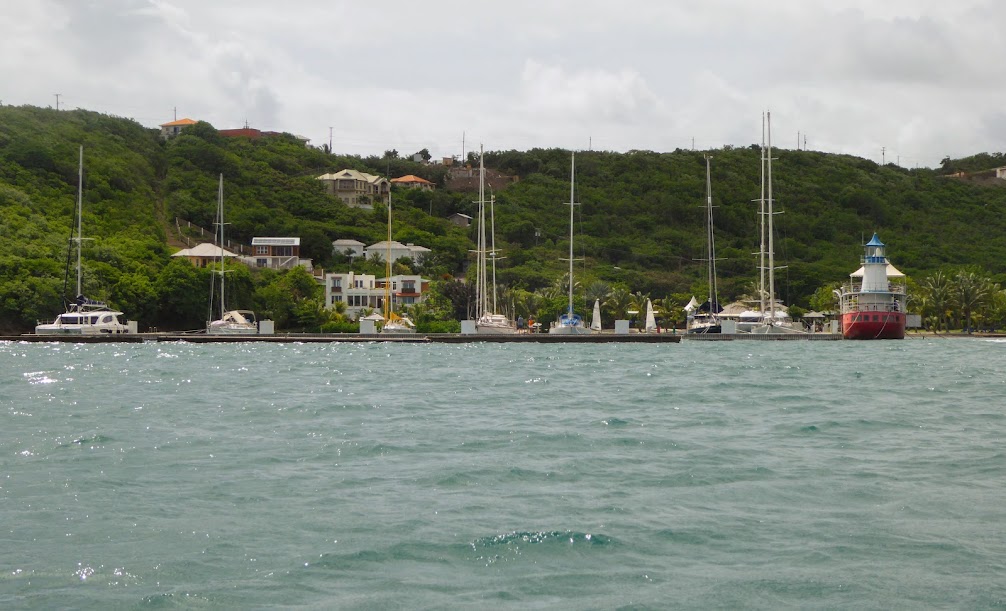
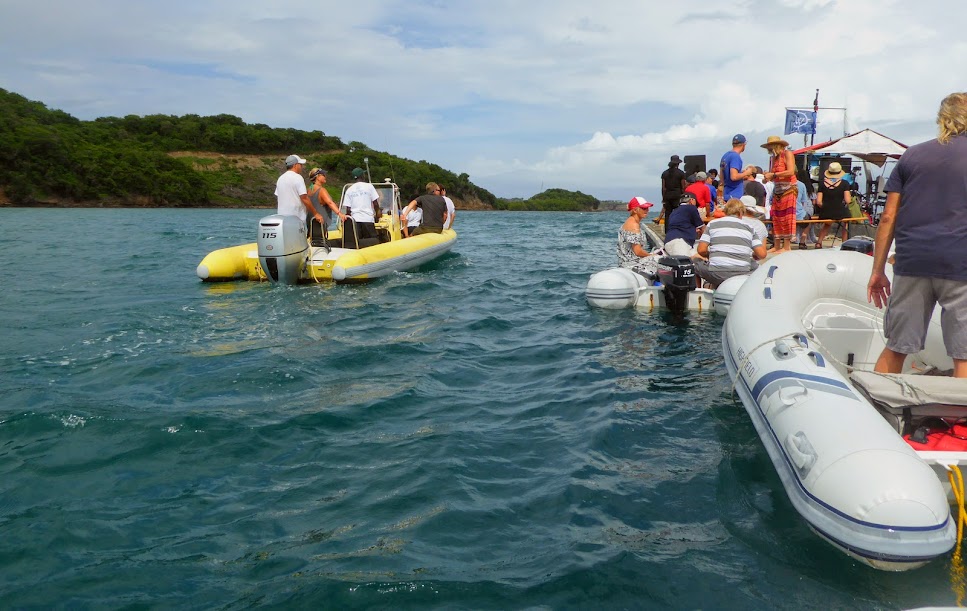
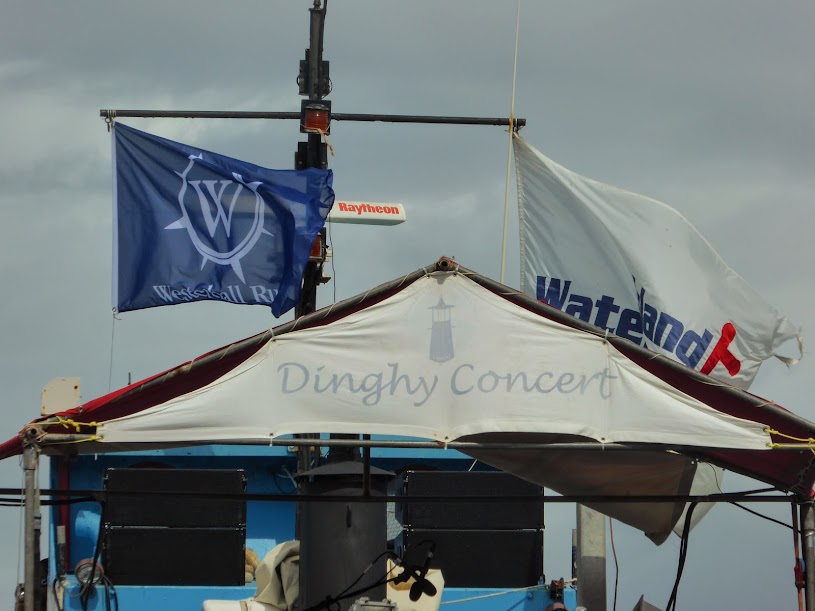
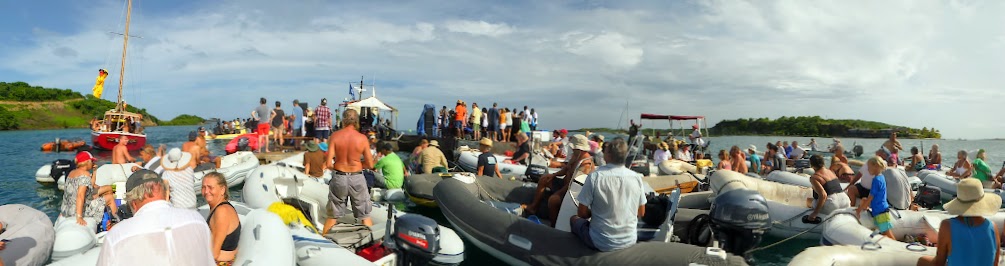
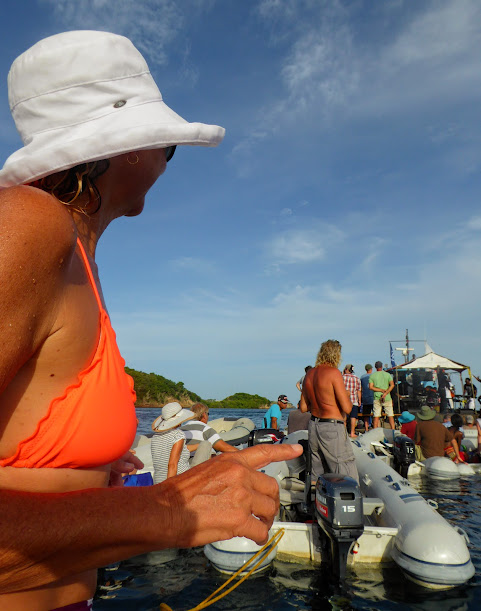
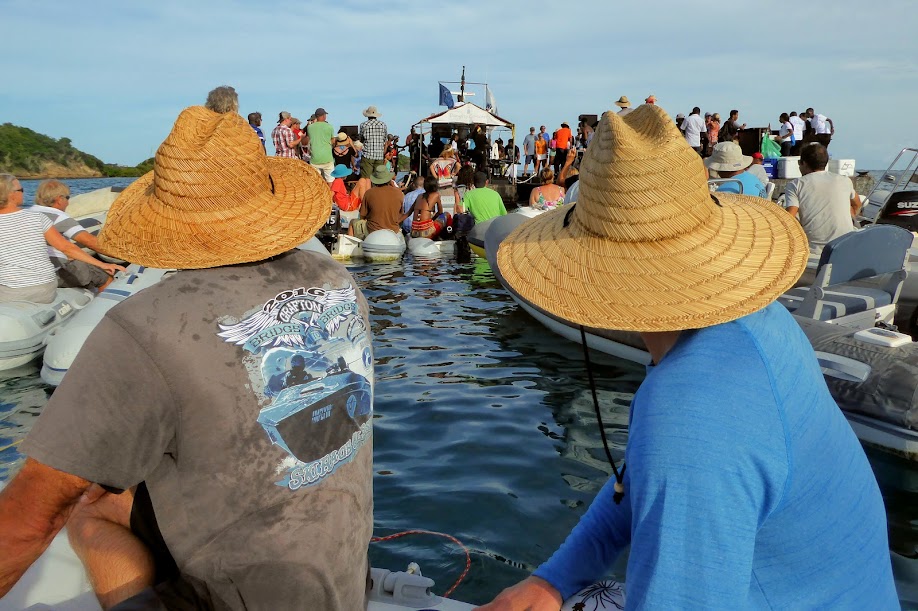
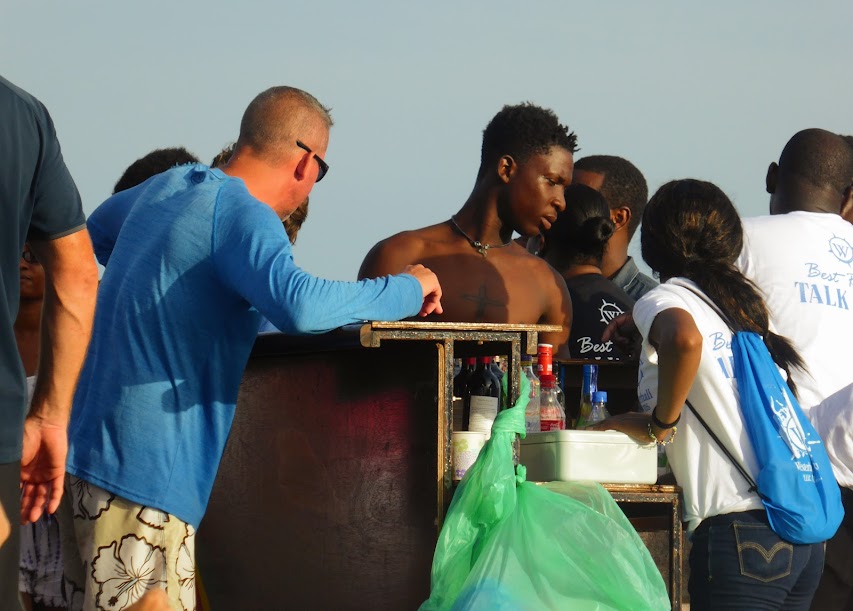
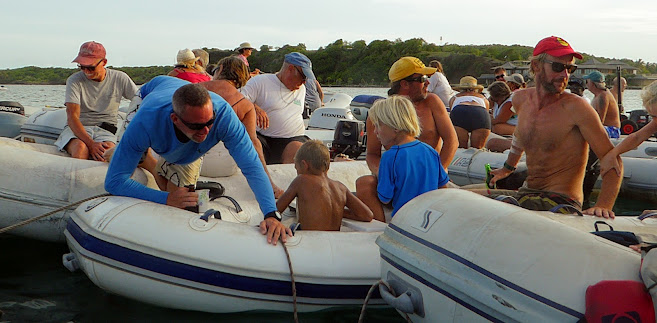
Not long after we settled into Prickly Bay, there was talk on the net of an upcoming dinghy concert. Apparently, Le Phare Bleu Hotel & The Lighthouse Bar sponsor a “dinghy concert” several times a year. A floating barge houses the stage, with two more flanked on either side, for seating and a bar. Cruisers and locals come by dinghy, tying to the barges, and each other, for an afternoon of music.

A dinghy concert you say??…awesome!! However, the concert was several bays over, and involved going out in open waters to round the bend. Our 3.5 horsepower dinghy motor would make for a slow, slogging go, and despite being inflatable-friendly, we feared the Aluminum Princess would not be well received in a large group of rubber dinghies; they just don’t understand her.

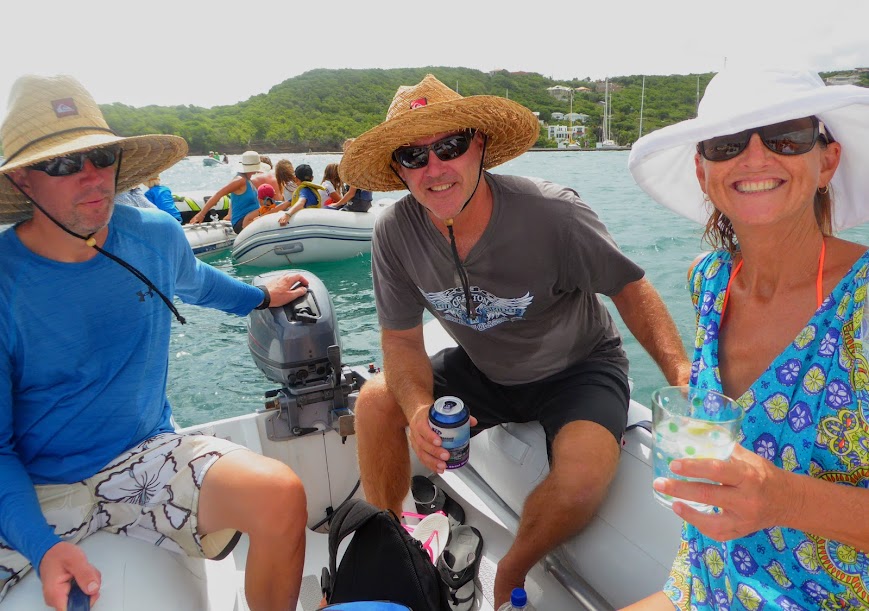
Luckily, our friends Mark and Deb, who we’d recently met in Martinique, offered to ferry us over on their dinghy; it was larger, with a more powerful motor. We gladly accepted, and the four of us were off on our way.

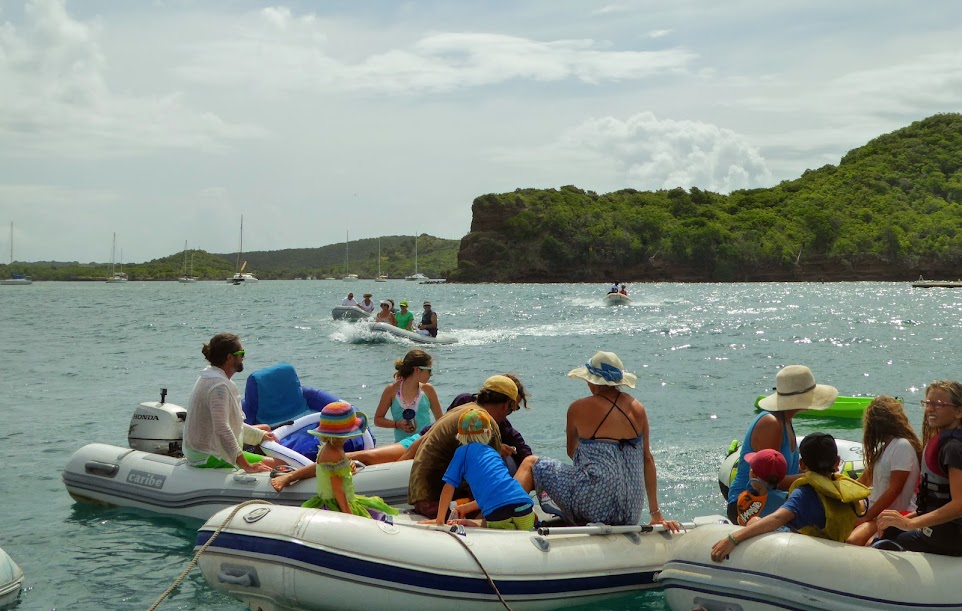
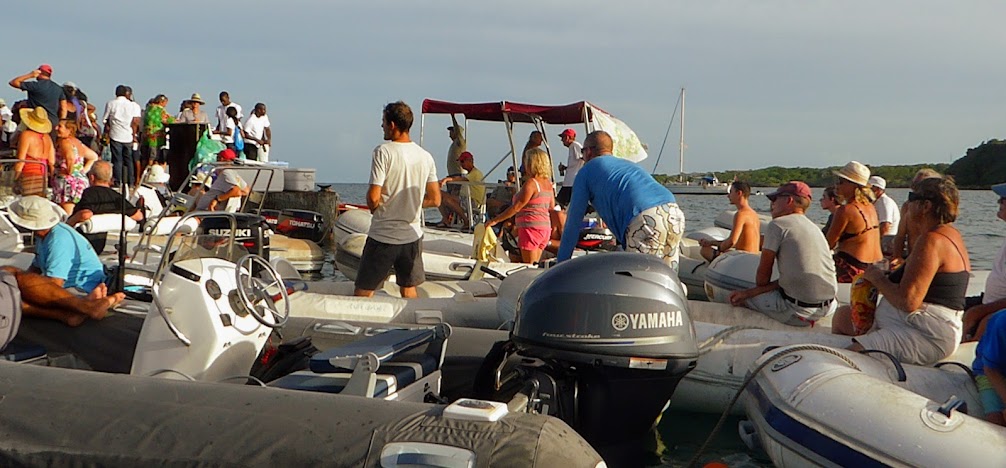
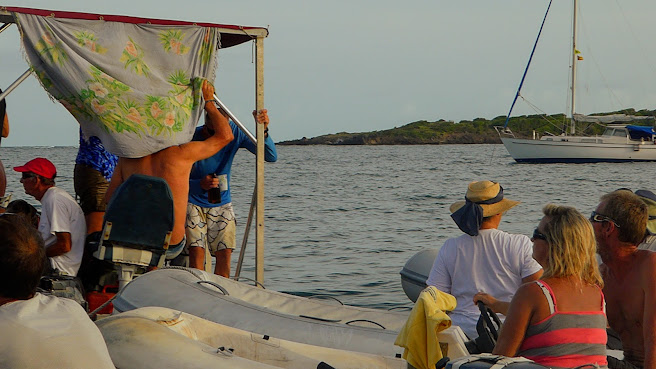
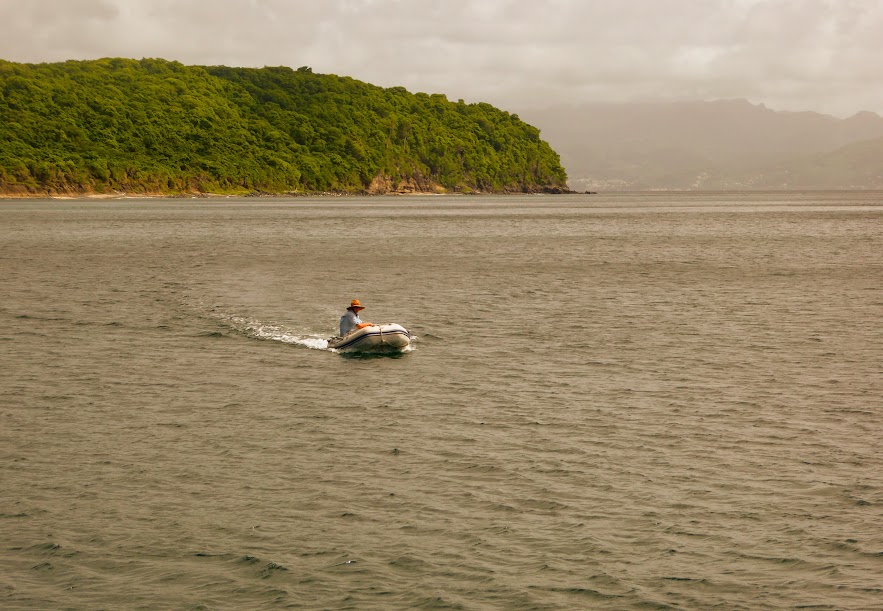
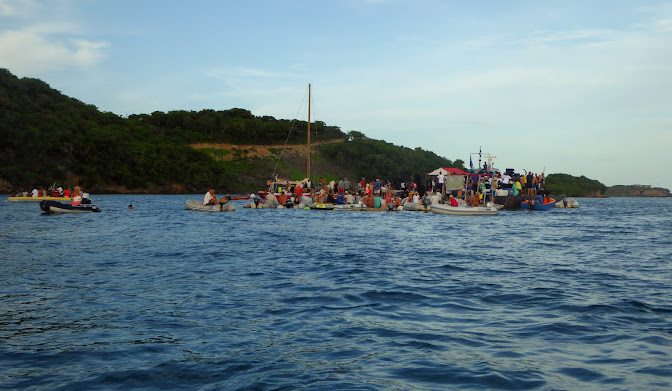
It was a lumpy ride, but we made good time and soon arrived at the bay near Le Phare Bleu. Many cruisers had arrived ahead of us,  and we tied on to the growing amoeba of dinghies.

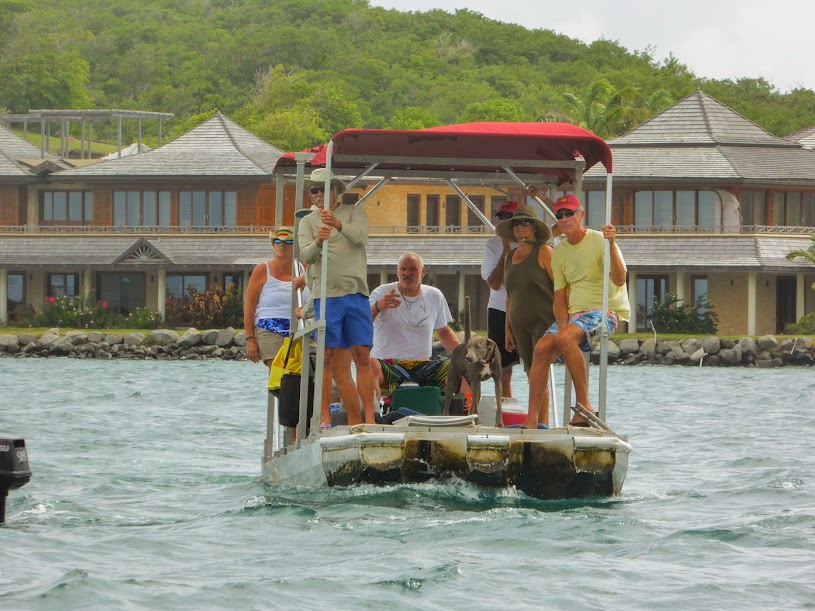
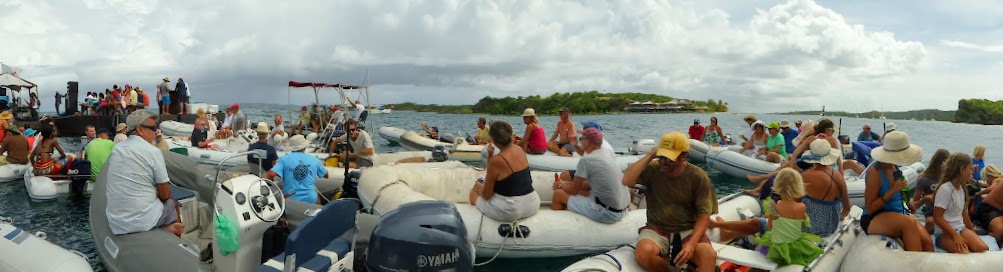
As dinghies of all sizes continued to arrived, the group grew in size. We spotted our friend, “Tall Mark,” (red baseball hat) coming in on a homemade pontoon boat!

Water taxis shuttled those without dinghies, as well as many locals, from Le Phare Bleu over to the barges.

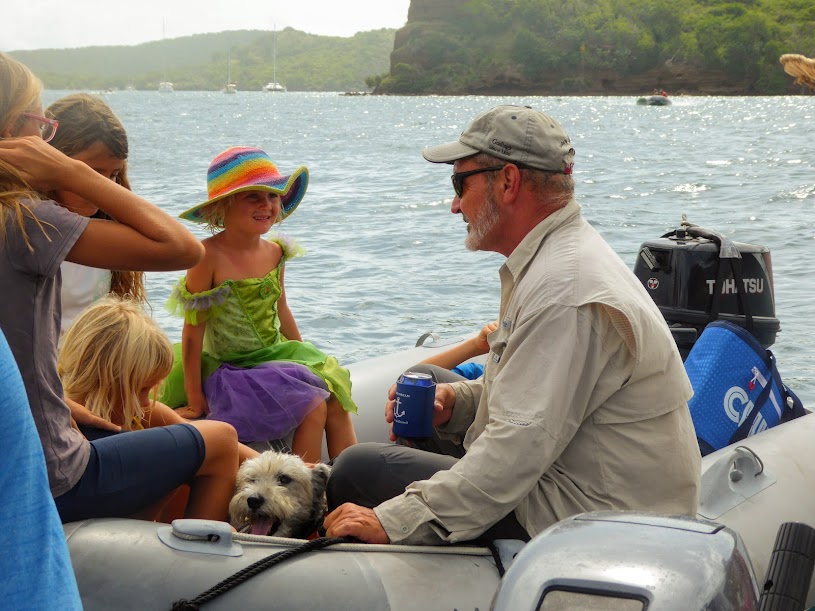
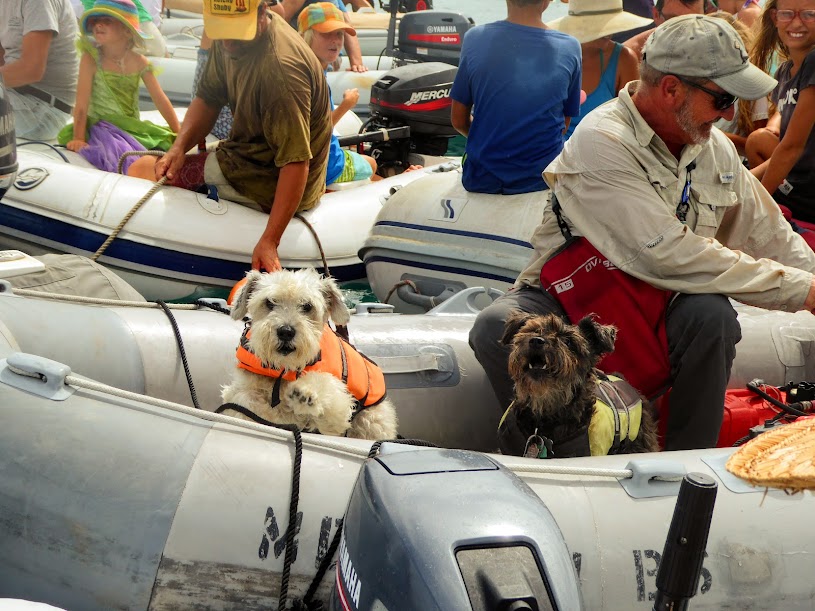
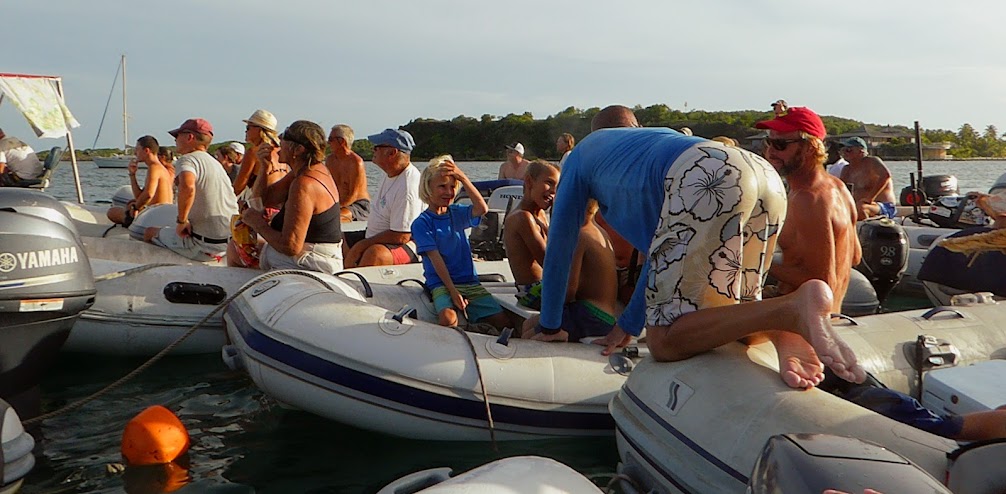
The ever-growing group included families with children, as well as pets.

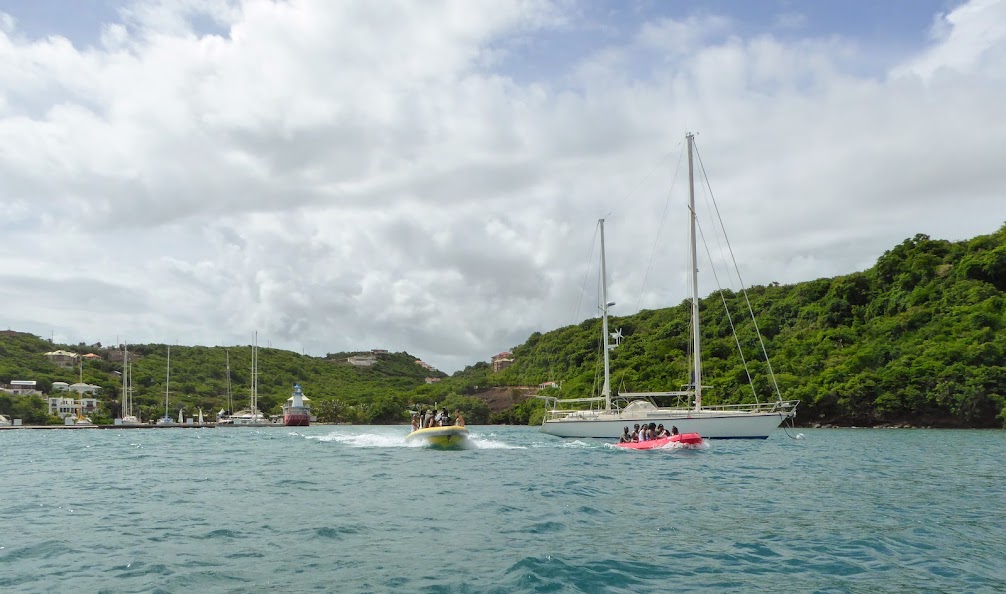
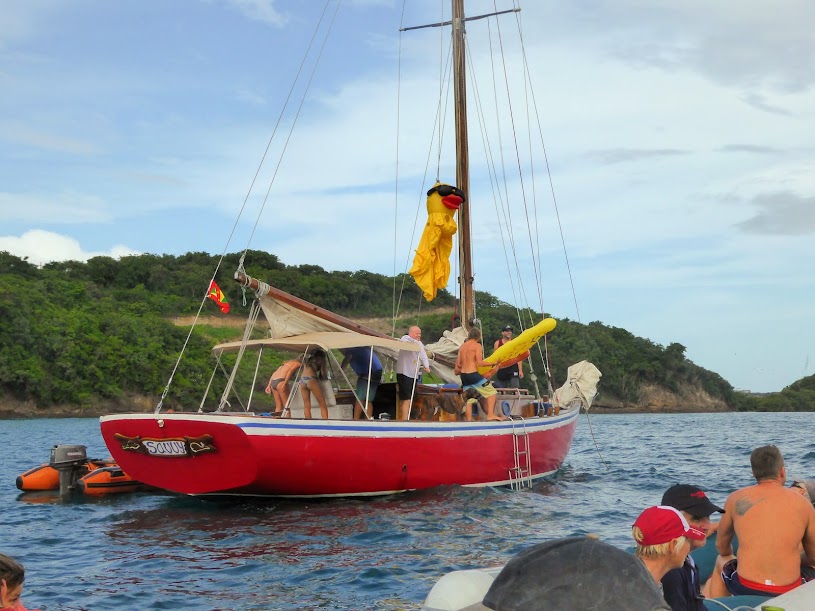
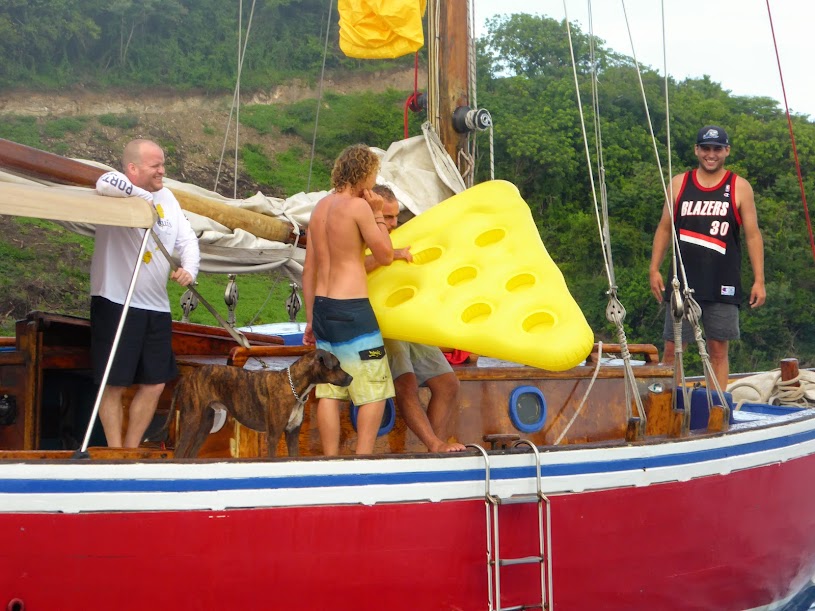
A sailboat arrived and anchored just off the barges, ready for the day, with several inflatables of their own.

We settled in, and waited for the live music to start.

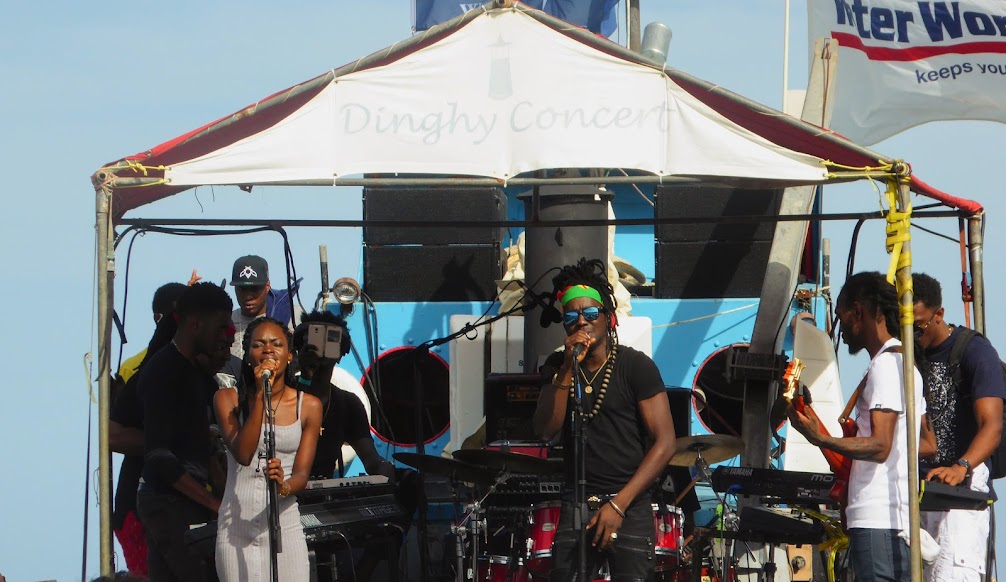
The band soon took the stage and began to play for the floating crowd.

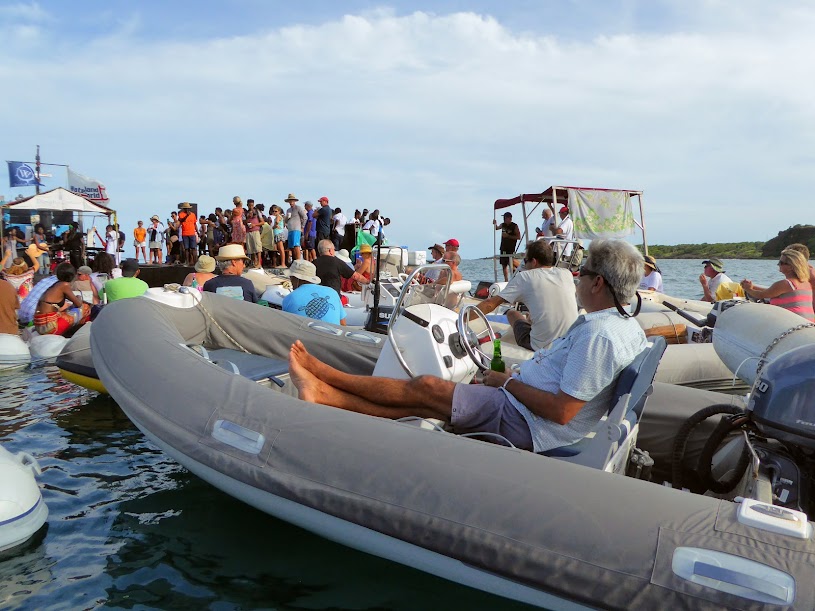
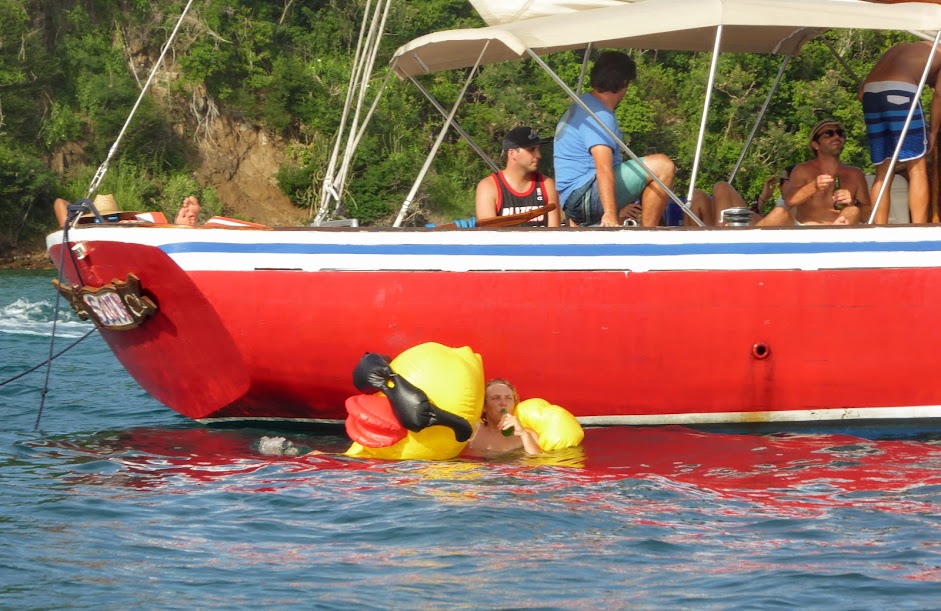
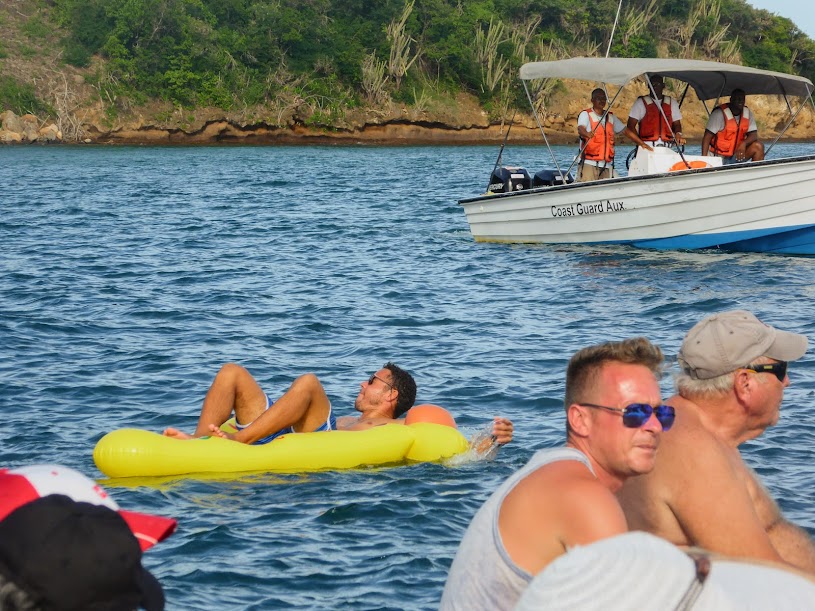
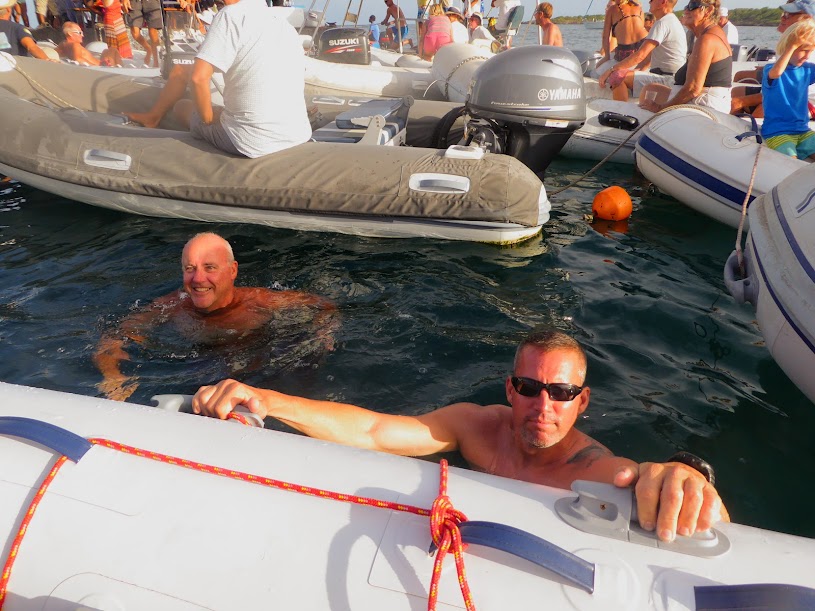
As the music played people lounged in their dinghies and on floats,  sought “relief” in the water and enjoyed the day.

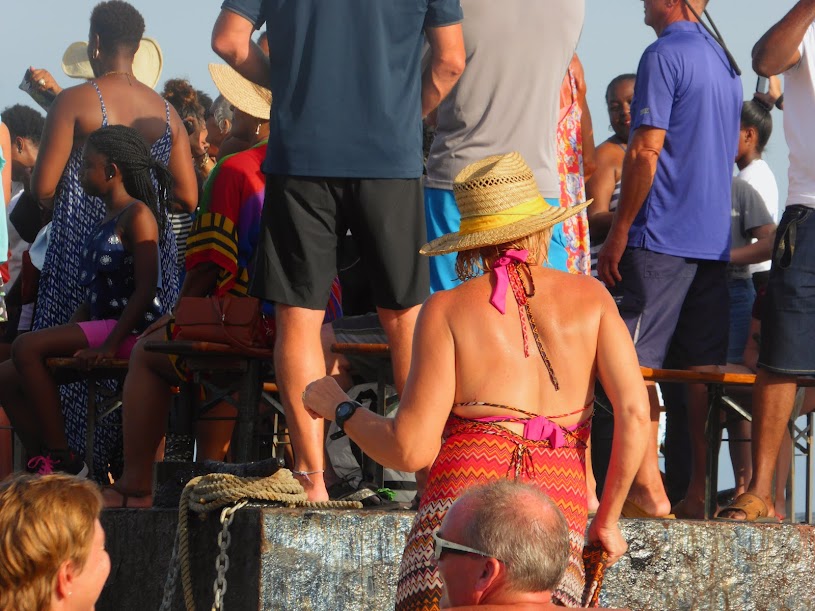
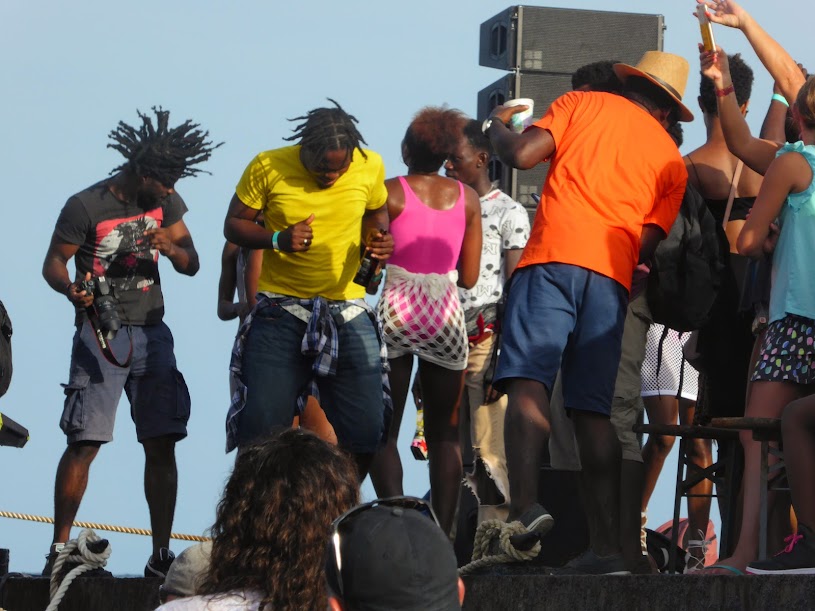
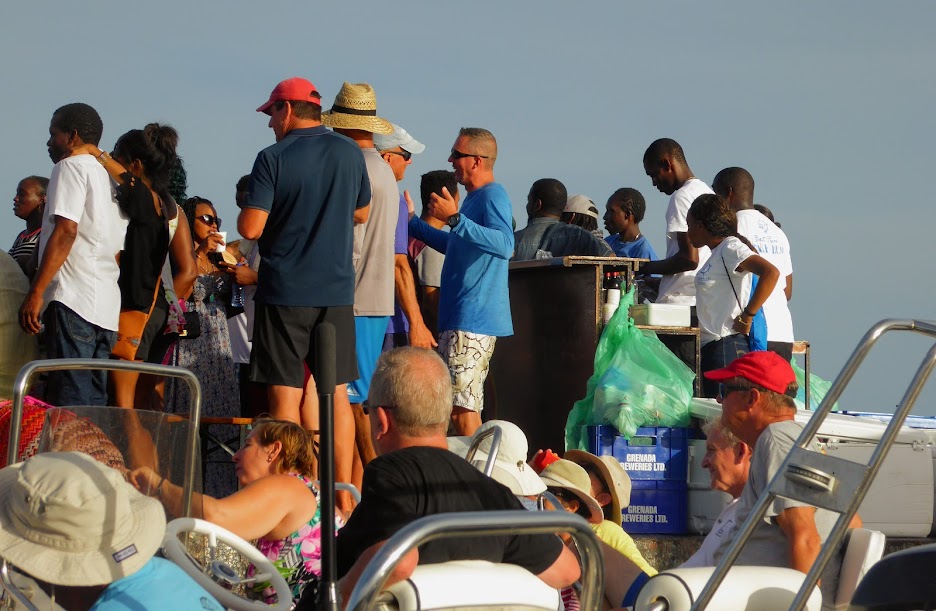
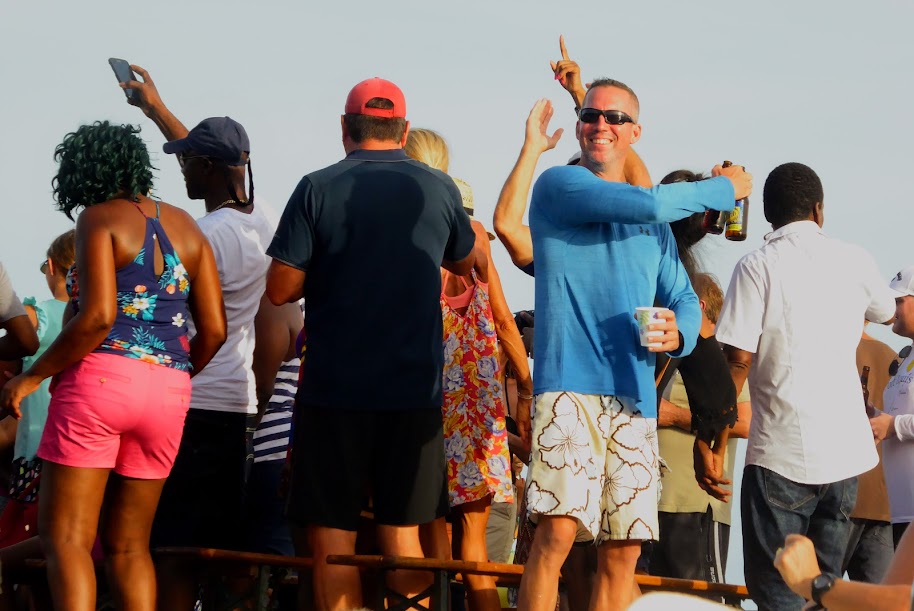
Cruisers swayed in their dinghies, and locals danced on the barges.

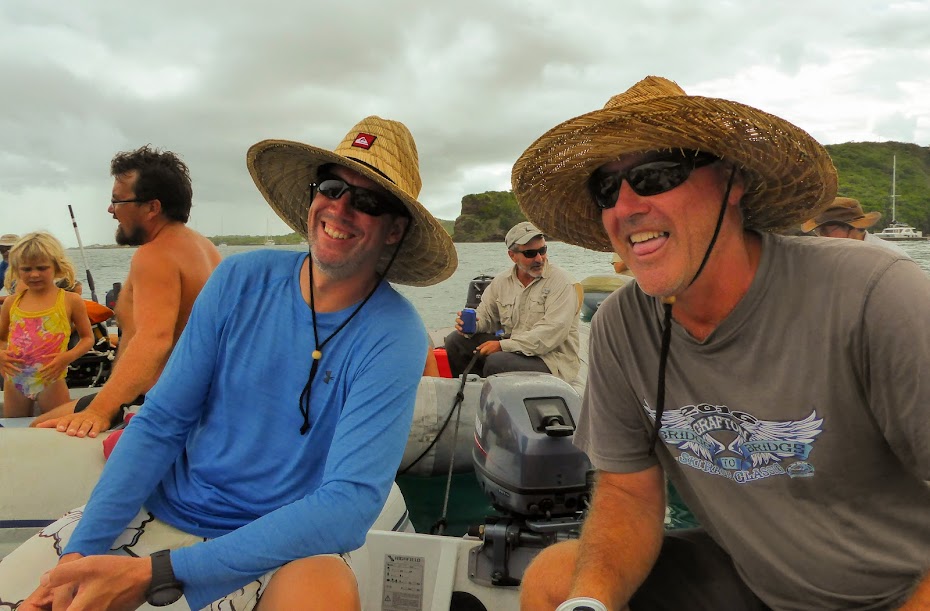
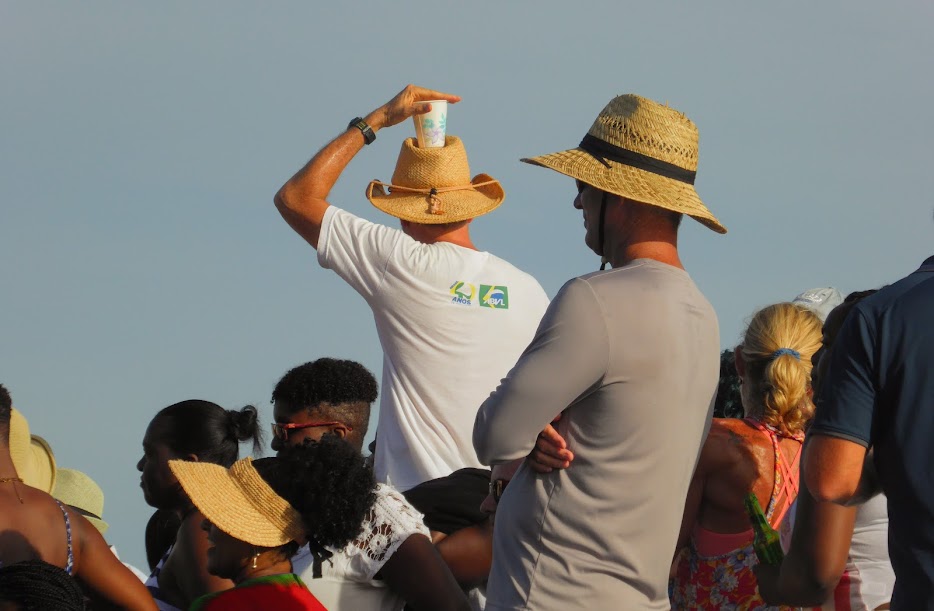
The hat twins took it all in..

Here’s a short video of the dinghy concert crowd, and the music:


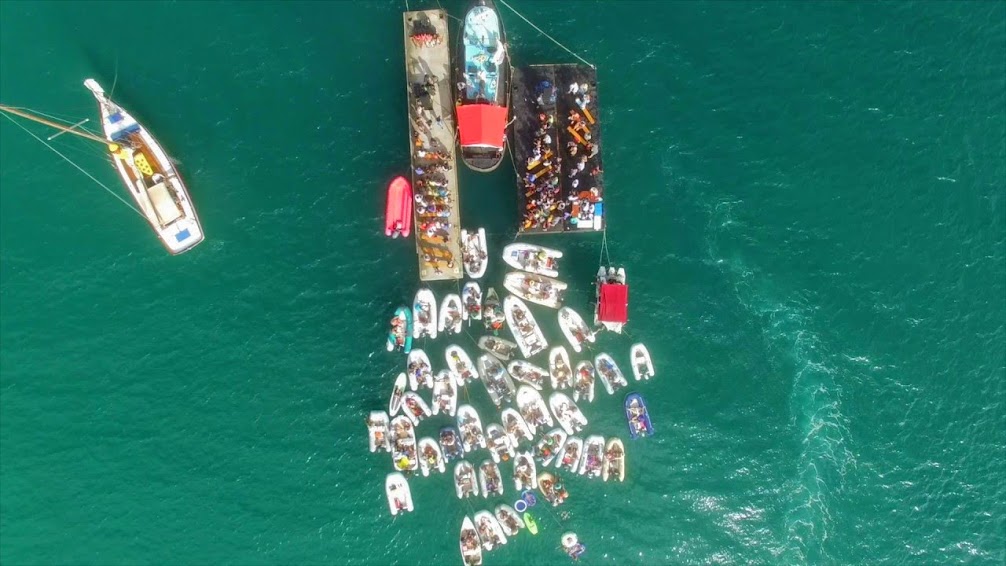
A man in the dinghy next to us flew his drone off and on during the afternoon. I later found this overhead photo he took. We are at the lower left of the group, in between the small, dark blue dinghy and the larger fiberglass dinghy.

As time passed, we ran out of drinks…quite a conundrum. Scott took it upon himself to make his way to the bar. He crawled over the mass of inflatables, asking to “play through” as he went.

As he made his way across the amoeba, Tall Mark signaled him to use the pontoon for his final leg. Once aboard, Scott pulled it over to the barge, and climbed up…success! Our Prickly Bay neighbor, David, was there to greet him.

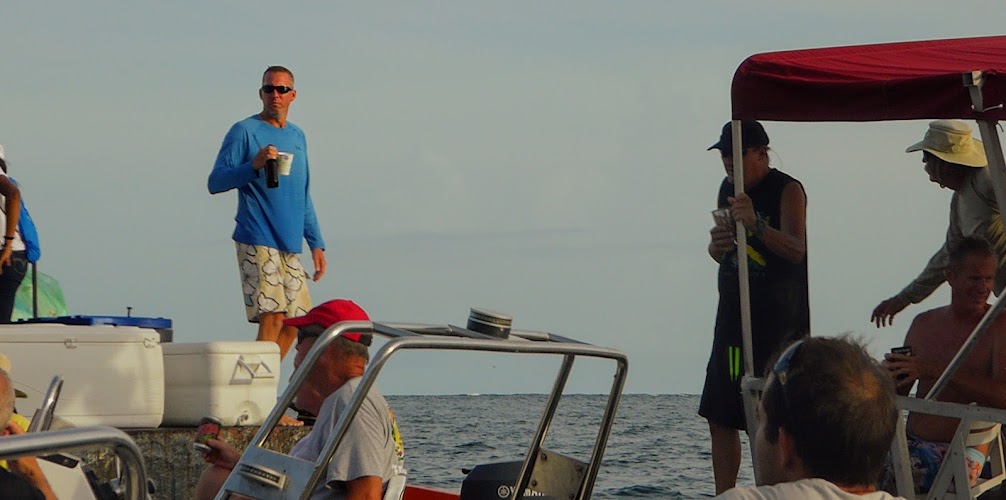
At the bar, Scott procured said drinks, and then surveyed his route back.

With two beers, and a cup of over-proof rum in hand, Scott made his way through the pontoon, across the dinghies and back to us, not letting anyone hold his precious cargo along the way.

While these photos capture the basic gist of Scott’s quest, here’s a video of the real-time journey, which I found hysterical:

Before long, dusk was approaching. The band stopped playing, allowing those on dinghies to travel safely back to their boats before dark. We untied ourselves from the shrinking amoeba, and headed for home.

With the wind behind us, we had a quick and comfortable ride back to Prickly Bay. Mark and Deb dropped us at Sea Life, before heading back to Kefi.

Our day of music, floating and fun was a good time for all. Whoever thought up the dinghy concert idea was a genius! Here are more photos of our fun afternoon.

“Shells Sink, Dreams Float. Life’s Good On Our Boat!”

Hey Don, Thanks For Going Easy On Us!

With Tropical Storm Don predicted to make a direct hit on Grenada, we prepared for 60 knot winds (always prepare for the worst). Scott secured loose things on the flybridge, stripped the canvas off of our bimini (canvas that shades the flybridge driving station), took the window covers off, removed our flags and stowed our extra solar panels (more on those later).

He tied an additional line to the mooring ball; readied our anchors in case we needed to drop them; put our large fenders in the cockpit, making them available in case another boat broke from it’s mooring and drug toward us; brought in our flopper-stoppers (large plates that hang from the paravanes, and reduce rolling at anchor…greatly reduce); and raised the paravanes, to reduced risk of another boat hitting them, making us more maneuverable through the anchorage should we need to move in a hurry.

While we were preparing the boat, the island of Grenada was preparing as well. One of the local radio stations broadcasted storm preparation information, and we heard the local Red Cross and Coast Guard making contact with each other over the vhf radio.

Businesses were required to close at 3pm, and we were very surprised to hear that public water and sewer were to be turned off at 7pm! Here’s a posting from the National Water and Sewerage Authority, with some interesting information:

ADVISORY – NAWASA TO SWITCH OFF ALL WATER SYSTEMS ON TUESDAY JULY 18TH, 2017

The National Water and Sewerage Authority (NAWASA) wishes to advise the general public that following a meeting of its Disaster Preparedness Committee, the following decisions were made:

– ALL WATER SYSTEMS will be switched off later this evening. A timeline will be provided once an update on Tropical Storm DON is received from NaDMA.

– Once our systems are switched off, consumers island wide will have their service interrupted WITHOUT A DEFINED RESTORATION TIME.

– An analysis of ALL water systems will be conducted by our engineering team on Wednesday July 19th and restoration will commence thereafter.

The Authority implores on the general public the need to:

• Collect and store water in clean, non-corrosive and mostly tightly covered containers both in and out of your refrigerator. To increase shelf life of water, group bottles in dark plastic trash bags to keep light out.

• Store enough water for each member of your family and pet. week.Have at least a minimum of three days supply, of thirty-five gallons per person, per day for domestic use. OUR MAIN ADVISORY – Water collection and storage to last minimum of three days and a maximum of 1 week.

• Store water in bath tubs, drums, pails and buckets for flushing of toilet, washing and general cleaning.

• Shut off water tanks and individual property connections. Your water can be shut off at either the outlet valve or the water meter. Everyone in your home should know where these are located.

NAWASA apologises for the inconveniences likely to be caused by this decision, but advises that this precautionary measure is necessary to safe guard our infrastructure and is in the best interest of the consumers we serve.


When our preparations were complete, we spent the rest of the day checking various online sites for updates on Don, and just waited, along with everyone else in the bay. Scott had a pre-Don cocktail, and Howard kept watch for fish.

Watching for fish can be tiring. Sometimes  you have to lay down on the job.

We were getting reports that Don was speeding up, but the eye was collapsing, and that wind speed predictions had dropped a bit; all good news.

As the day wore on, the winds died completely, and by early evening the bay was lake-like.  We watched the barometer drop on our weather station, and considered this the calm before the storm. The bay was noticeably less crowded, as many chose to hunker down in marinas or other island locations.

By sunset, Don was predicted to only cause us an hour’s worth of havoc, and at a much lower intensity. We began to get a decent swell coming into the bay, and readied for our 60 minutes of storm drama.

Instead, Don fell apart as it passed twenty miles south of us. We watched the radar updates online, and by 10 or 11pm, the storm, now reduced to a tropical wave, had officially passed us by without incident.There had been no wind to speak of, and we only received a quarter inch of rain.

The incoming swell lingered on though, and we continued to roll around for hours. Rolling back and forth (actually, Sea Life tends to lumber back and forth, as opposed to rolling) wasn’t as irritating as the noise from one of our paravane cables rubbing along a mast wire; the metal scraping sound was maddening. Realizing that Don was now a non-event, Scott lowered our paravanes and put the floppers back in the water….ahhhh.

So, Don fizzled out, thank goodness, and we dodged a tropical bullet. I’d like to believe that this was our one and only scare for the season, but we’ve learned all too well on this journey that Mother Nature is fickle.

“Shells Sink, Dreams Float. Life’s Good On Our Boat!”


Tropical Storm Don, Our Grenada Welcome Wagon

I have much to catch up on, but for now, a current update…..we arrived in Grenada a week ago, and Tropical Storm Don is our welcome wagon. Here’s a photo of Don’s predicted path. We are the bottom-most island/dot, in the yellowish-brown, with a 50-60% change of winds over 39 knots.

[Image of probabilities of 34-kt winds]

The storm is essentially passing right over us, with it’s specific path having very different results.

A tropical system spins counter-clockwise, with the top/north half having the most intensity.  Think of a pinwheel, sucking wind off in it as it spins. As the storm moves, that wind in the north half is given a extra boost, doubling it’s strength.

At the bottom of the pinwheel, the winds oppose the movement of the storm, and are much less, so south of a storm is where you want to be (scratch that…not anywhere near a storm is where you really want to be!).

If Don passes just north of Grenada, we expect sustained winds in the 25-30 knot range,  clocking around in every direction. However, if the storm tracks a bit south, we’ll get more direct winds, sustained closer to 45 knots….possibly as high as 60 knots.

None of this is life threatening, and we are preparing for maximum winds, just to be safe. Unfortunately, there are not completely protected anchorages or marinas here in Grenada, so we’re just gonna have to ride it out with fingers crossed.

We are currently in Prickly Bay, on Grenada’s south side. Many cruisers come to Grenada for hurricane season, so the bays are crowded with boats.

Map of Prickly Bay, Grenada


Image result for aerial view of prickly Bay

Our plan was to anchor, but we arrived to find that the marina here had filled most of the bay with mooring balls. Prickly Bay is safer than most, as far as local crime, so we chose to stay and take a ball. For those who may not know, a mooring ball is anchored to the bottom with a metal shackle. From there, a line travels up to the surface with a float/ball that you attach a line to.

On the positive side, balls are usually well spaced, and there’s no worry about boats with little anchoring experience breaking loose and dragging. The downside is that you’re never sure what condition the balls are in; whether the lines are still strong and the shackles are good. Several boats here have broken from their mooring here, drifting through the anchorage, one as recently as four days ago.

Our quandary is whether to stay here on the ball, and risk it breaking, or having other moorings break, and those boats drifting our way. Or, head for another bay that is just as full, and risk anchors dragging (instead of moorings breaking) and boats drifting. We considered going to a marina, but they aren’t much more protected from heavy wind, and Scott’s concerned about being tied down and not able to swing with the winds, or cut and run if needed.

Here is Don’s timeline…..Murphy’s Cruising Law: Bad shit almost always happens at night! (we are between the blue line, and the S to the right…roughly 10pm-midnight)

cone graphic

So, we’re hunkering down here in Prickly Bay, and hopeful that Don gives us a gentle welcome to Grenada.

“Shells Sink, Dreams Float. Life’s Good On Our Boat!”

Our Final Push To Grenada

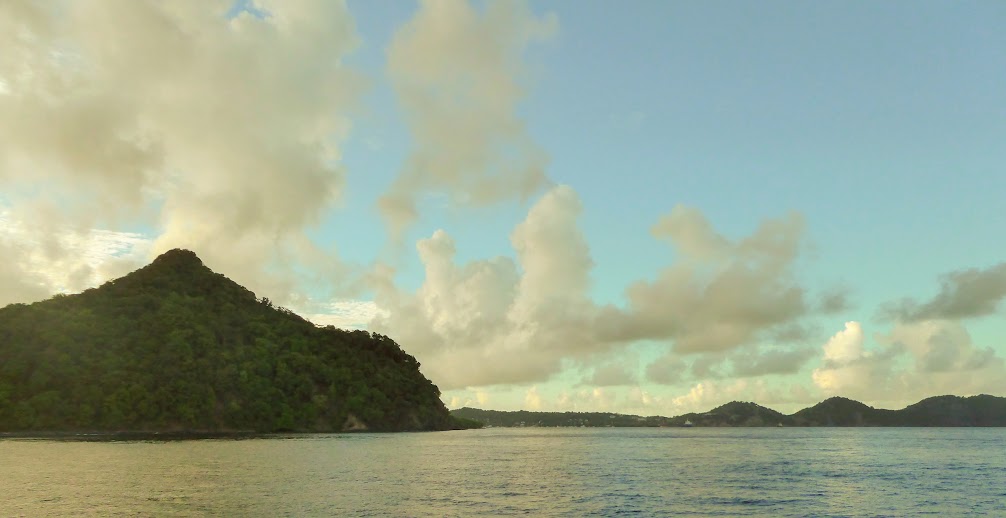
After an easy overnight, we approached Carriacou (pronounced Carri-a-coo) just after dawn. The island belongs to Grenada, and we planned to clear into the country here.

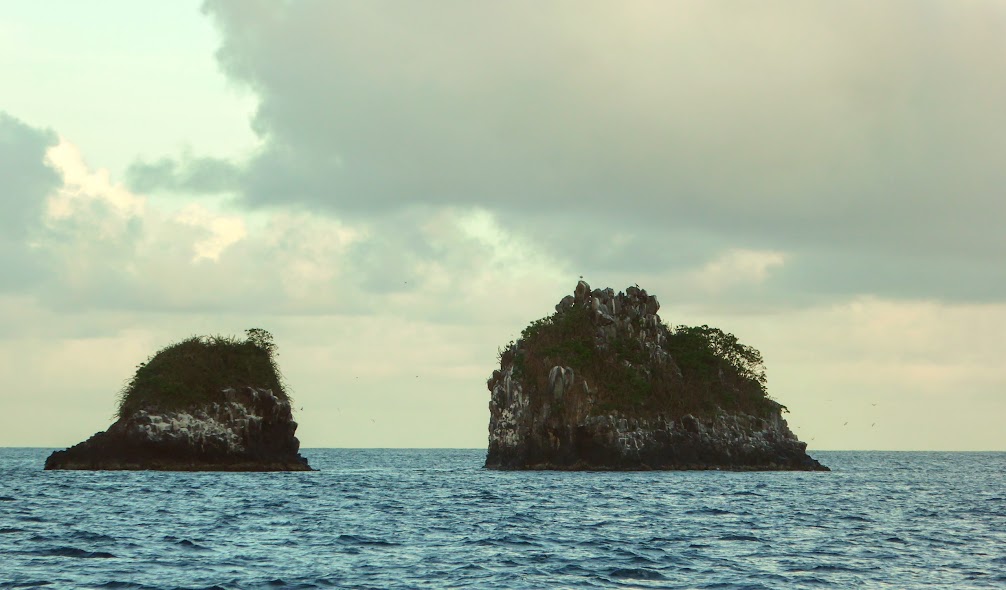
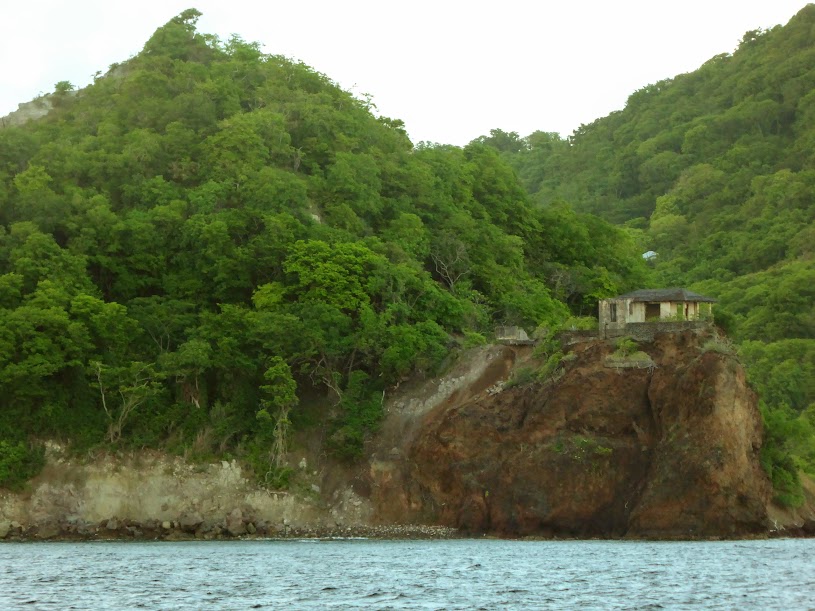
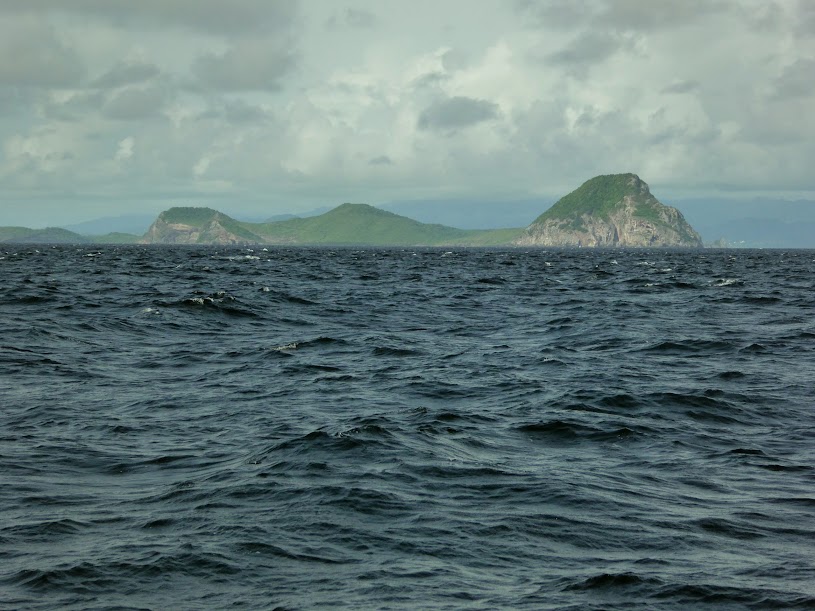
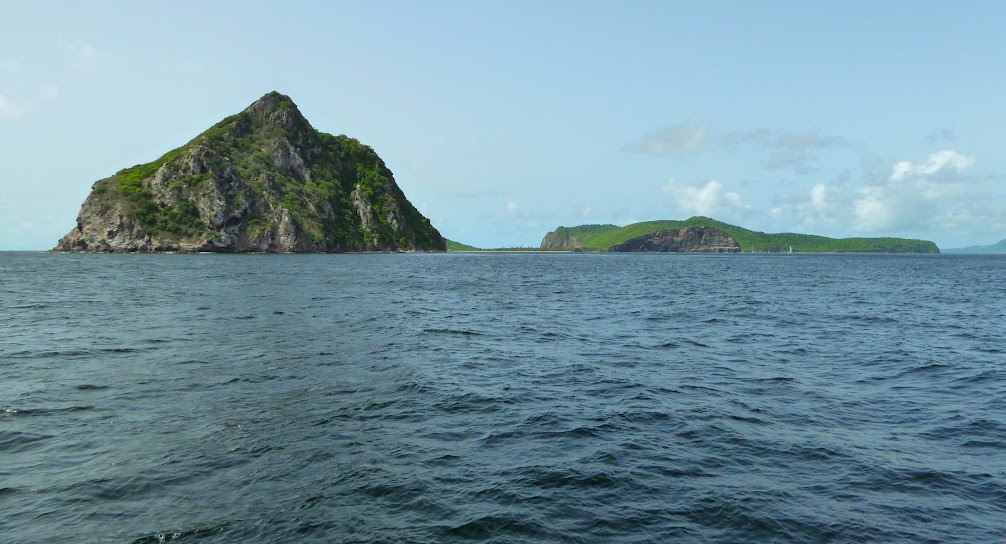
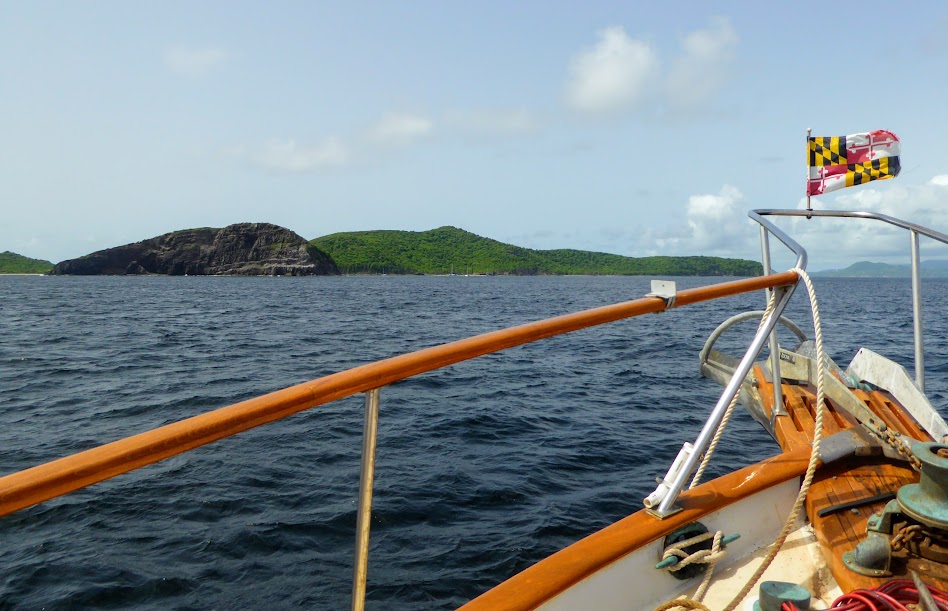
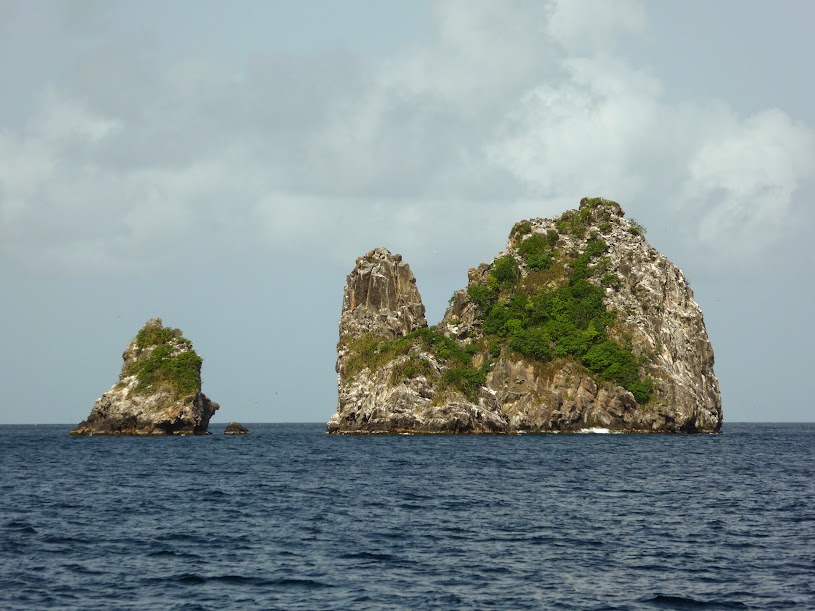
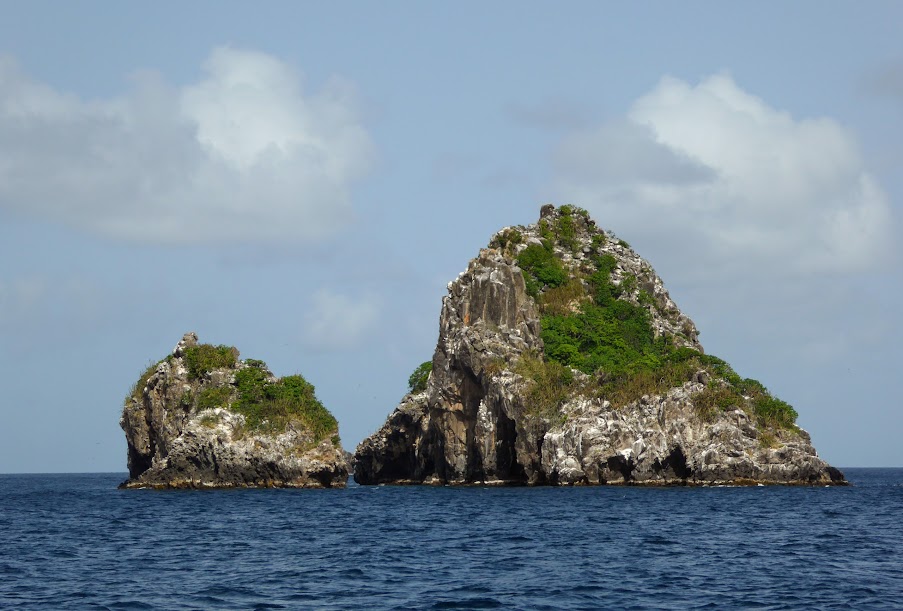
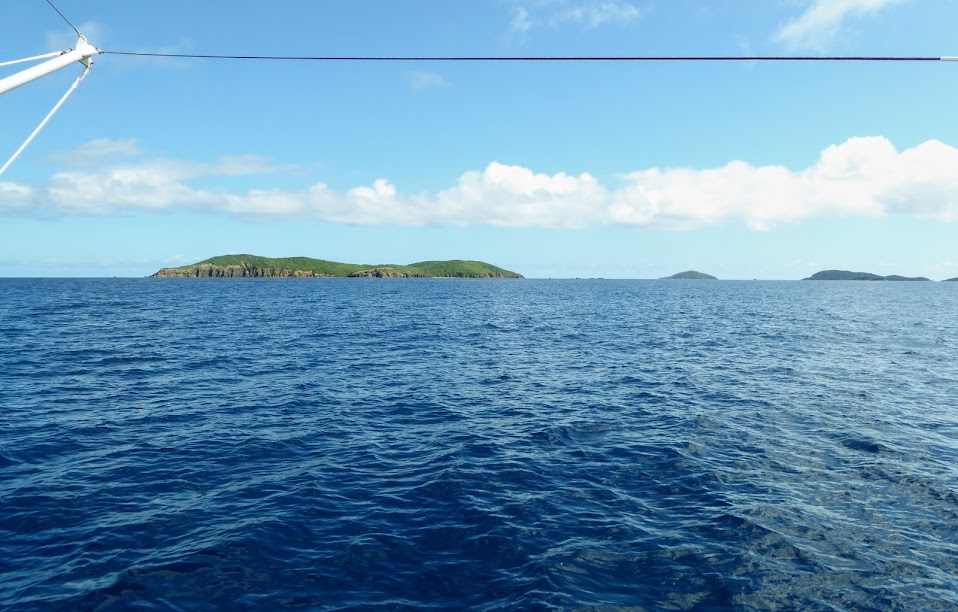
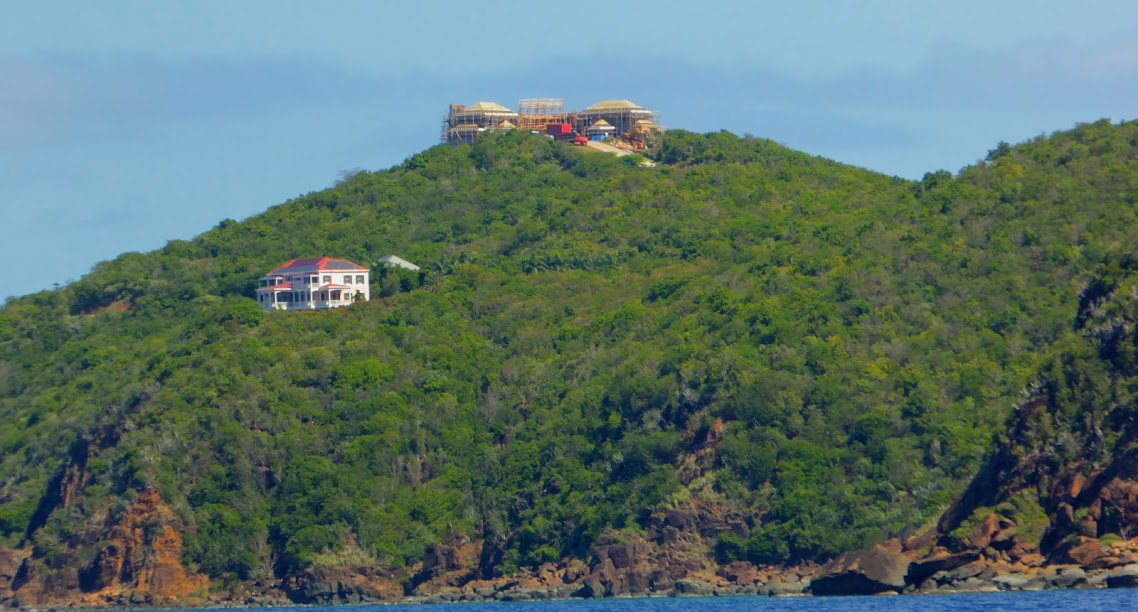
As usual, there were interesting sights along the way: interesting rock islands, and a waterfront house that caught Scott’s eye.

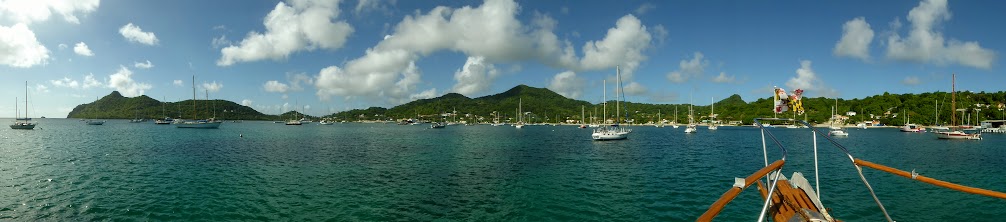
In the early morning hours, we made the turn into Tyrell Bay anchorage. The large bay was full of boats, boats and more boats…I counted 82! We definitely weren’t in Kansas (aka, the Western Caribbean) anymore.

Once we were anchored, Scott made his way over to nearby Tyrell Bay Marina, where the customs and immigration offices were located. He arrived just as they were scheduled to open, but there was no sign of the customs officer. Thirty minutes later, the young officer showed up, and let Scott and several other cruisers inside.

Apparently, he’d been at a party the night before, not getting home until the wee hours, and consequently had a late morning start. Scott, having learned much patience with customs and immigration in the Western Caribbean, just smiled, nodded and waited to be called on. There is an online service in place for several of the Eastern Caribbean islands, called Sea Clear. Clearance forms can be complete online before arriving, saving time when in the office. Customs officials like it, as they spend much less time deciphering handwriting.

Not all cruisers use this service, and end up having to fill out the lengthy forms by hand before getting their turn. As a result, Scott has ruffled feathers more than once, by being waived to the front of the line. Sea Clear, and Scott’s patient attitude, has made for quick and friendly clearance on several Eastern Caribbean islands.

Back to Carriacou…the immigration officer must have been at the same party, and must have stayed even later, as he never showed up at all! Once the customs officer finished his paperwork, he did the immigration clearance for Scott as well, and we were official in Grenada.

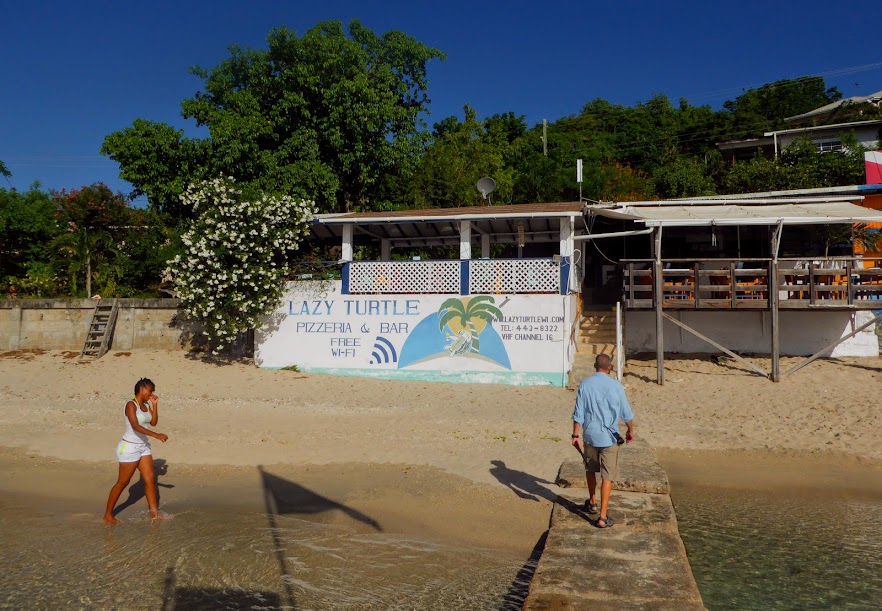
To celebrate, we headed to shore for lunch at the Lazy Turtle. In addition to other items, pizza was on the menu, and was billed the “best in the Caribbean.”

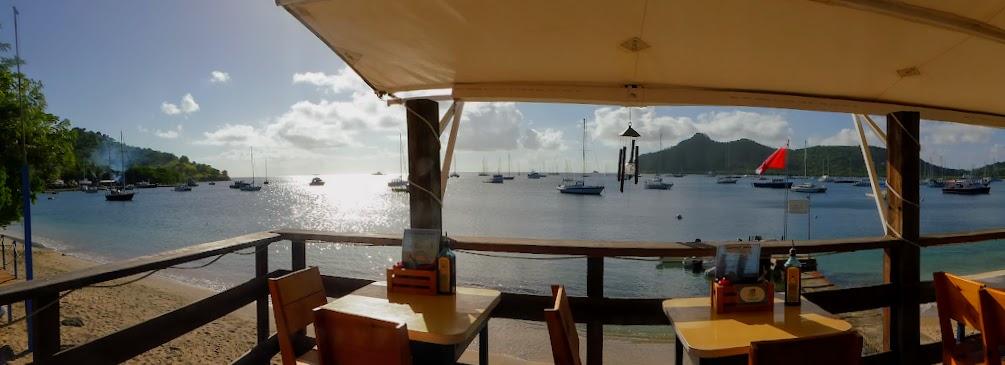
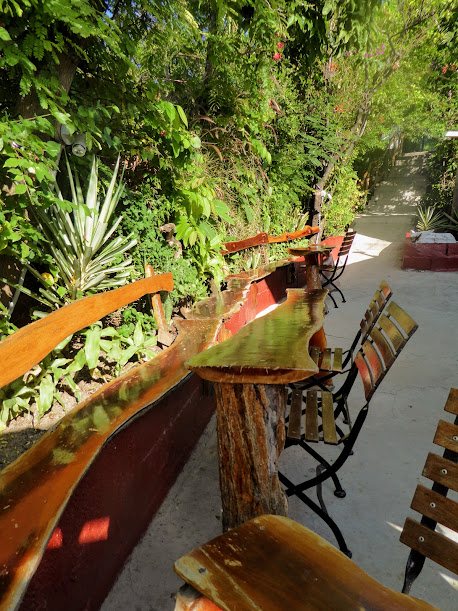
The pizza was far from the best in the Caribbean, but it fit the bill for lunch, and views back out at the crowded anchorage were good. Soon, the afternoon sun had us changing locations, over to some funky, wooden tables in the shade. After lunch, we spent time wandering the island a bit, then returned to Sea Life for an early night.

The next morning, we raised anchor and continued toward Grenada. We made one last stop at Rhonde Island, also owned by Grenada, for a few quiet nights at anchor.

There anchorage has room for only four or five boats, a nice change from 82! We enjoyed the quiet, space and Scott got some exploring in.


From Rhonde Island, it was just a day trip to Grenada. We passed more interesting rock islands, and Scott put some lines in the water hoping for a nibble; unfortunately, he got skunked again.

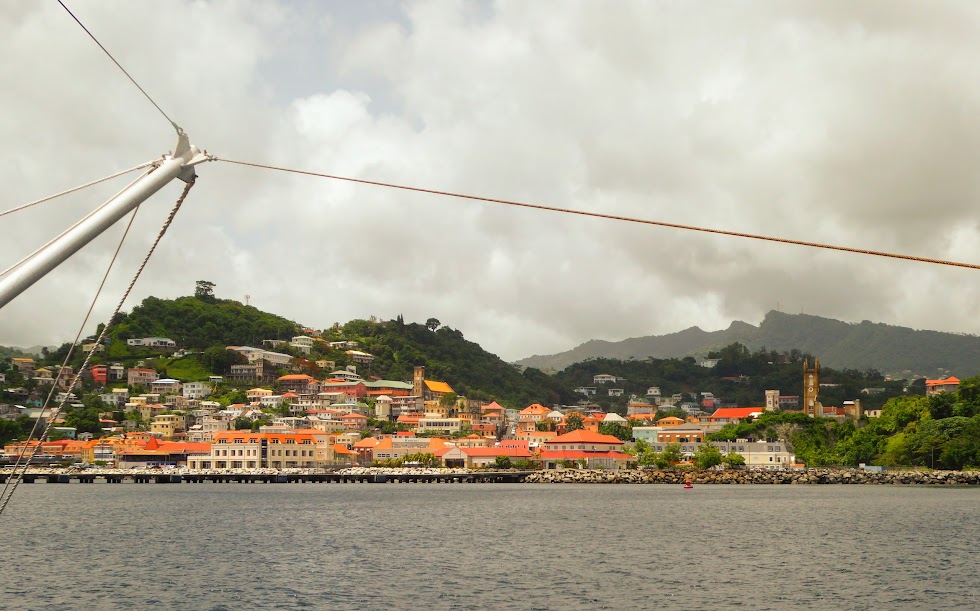
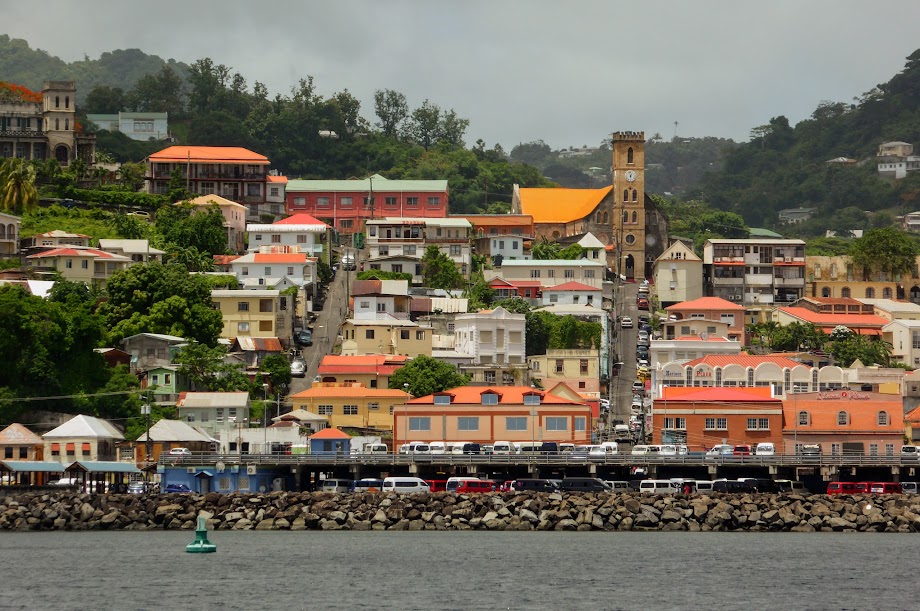
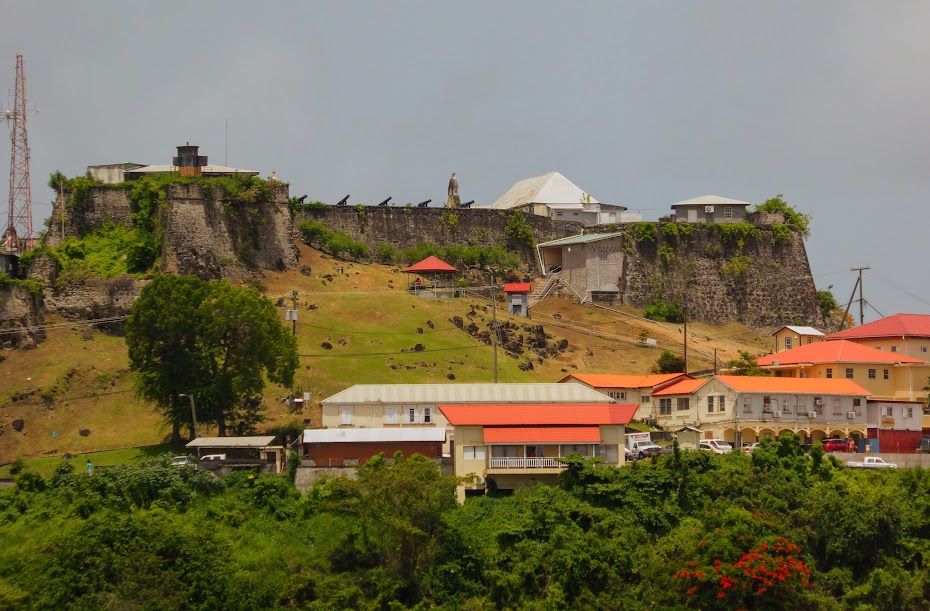
Moving down the west cost of the island, we passed the capital city of St. Georges, and the remains of Fort George.


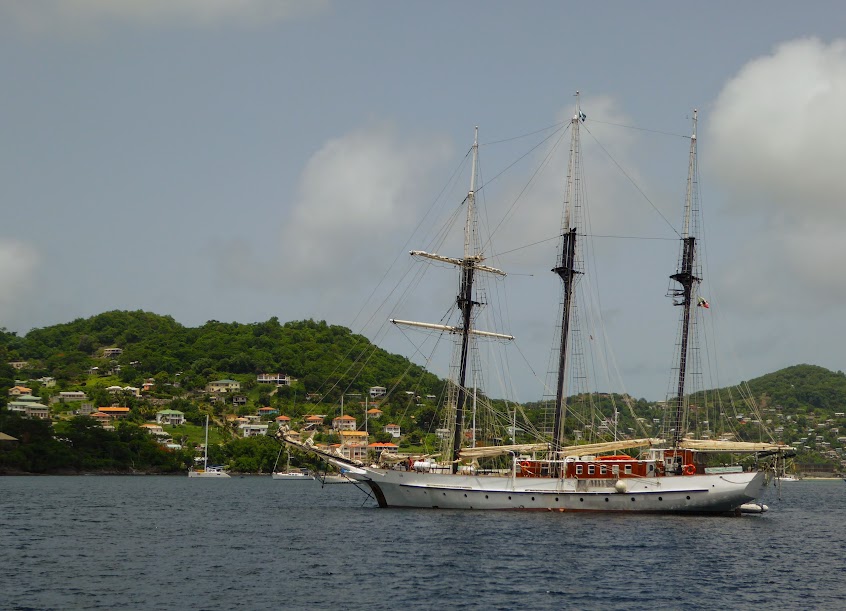
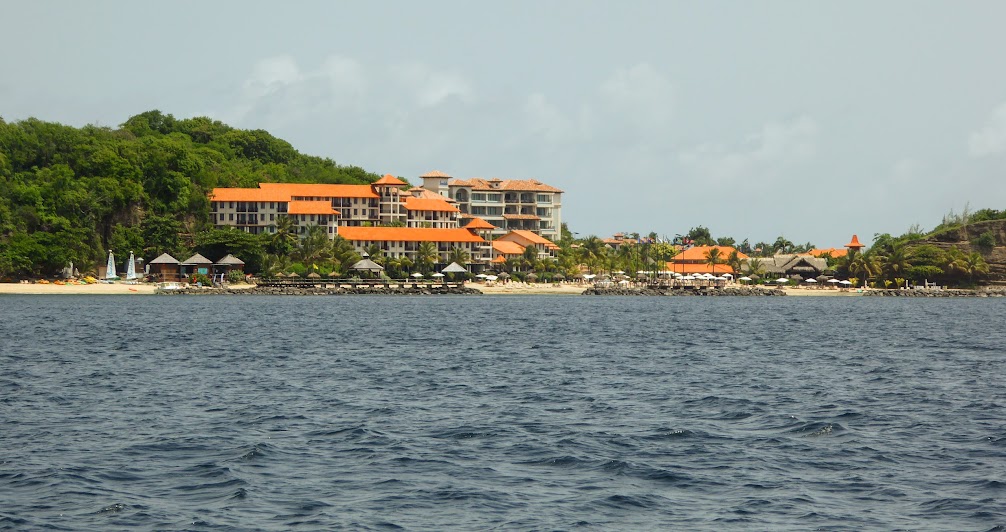
We passed several types of interesting boats in St. Georges anchorage, and the large Sandals LaSource Grenada, before turning east, to head along the south coast.

An hour or so later we made our final turn, into Prickly Bay.  Again, this large bay was full of boats. There wasn’t enough room to lay out a proper amount of anchor chain, so we chose to grab one of the marina’s mooring balls.


We’d made it to our hurricane season home. Howard checked out his new surroundings, and we settled in.

Here are more photos of our final push to Grenada.


“Shells Sink, Dreams Float. Life’s Good On Our Boat!”

The Beautiful Island Of St. Lucia

Our next stop on the way to Grenada, was the beautiful island of St. Lucia. The island was named by the French, after Saint Lucy of Syracuse, and it is the only country in the world to be named after a woman. The French were the island’s first European settlers, after signing a treaty with the native Carib Indians in 1660. England took control of the island from 1663 to 1667, and in the years following, it was at war with France 14 times. Rule of the island changed frequently (it was ruled seven times each by the French and British), which seems to be a pattern on many of the Caribbean islands.

In February of 1979, Saint Lucia became an independent state, and a member of the Commonwealth of Nations. Formerly the British Commonwealth, the Commonwealth of Nations is associated with the United Kingdom, and made up of 52 member states, which are mostly former territories of the British Empire.

Scott and I vacationed on the island 14 years ago, and were looking forward to a return trip. Unfortunately, the island hasn’t been the most safe location for cruisers in recent years.

We learned early on in our cruising life, that visiting an island by plane, for vacation, is much different than coming by private boat. Cruisers interact much more with locals; shopping for food, eating at local restaurants and exploring an island’s hills, mountains and beaches.

In contrast, most vacationers don’t leave their resort, and for the most part don’t need to (food, beaches, water sports and entertainment are usually all onsite). When they do, it’s most likely with an organized tour of some kind. With cruisers being anchored relatively close to shore, they are more at risk of being boarded by desperate islanders, and unfortunately, boardings on St. Lucia have becoming more violent.

On many islands we visited, cruisers only experience the rare case of a dinghy being stolen, or a snorkel and mask gone missing’ in most cases, these things were left outside, or left unlocked. St. Lucia, however, has seen more and more cases of violent assault on cruisers, both at anchor and ashore. These incidents did not sway us from visiting the island. Instead, we adjusted our anchoring plan for safer locations, and  were extra cautious of our surroundings.

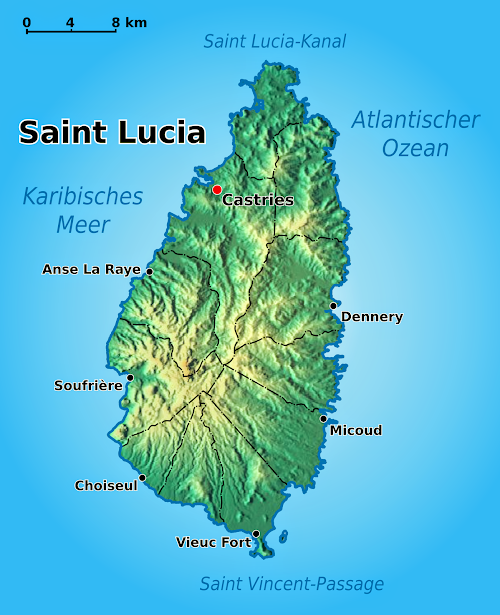
This volcanic Caribbean island is more mountainous than most, with its highest point being Mount Gimie at 3,120 feet above sea level. Here’s a topographical map of St. Lucia that I found online:

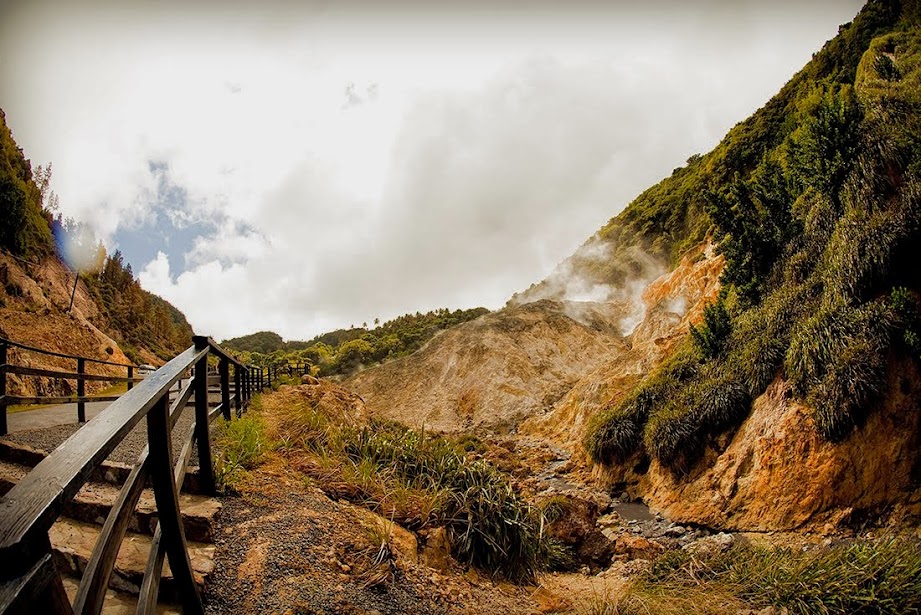
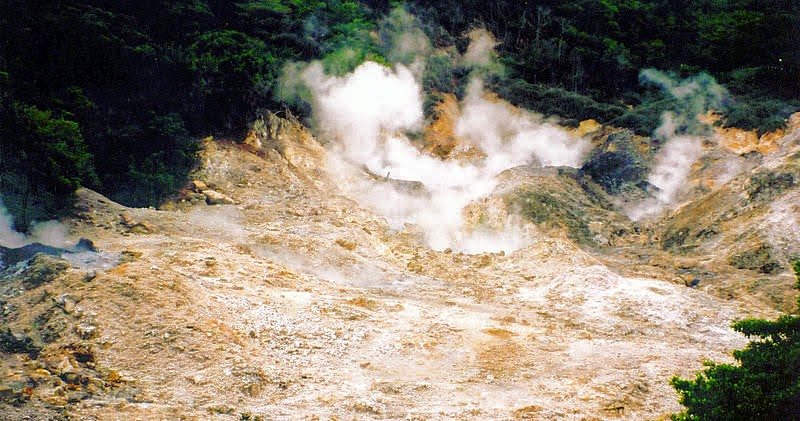
St. Lucia’s Soufriere Volcano, locally known as the Sulphur Springs, is considered the only “drive-in” volcano in the world. It’s a major tourist attraction on the island, with the road running right up to, and through, the crater of the volcano. Steam and sulfur waft out from the crater, providing a lovely, thick smell of rotten eggs. Boiling mud and water bubble just a few feet from the overlook. (We did not visit the volcano during this visit to St. Lucia, so I borrowed some photos online.)

The sulphur springs emit a mixture of iron, calcium oxide, sulphur, copper oxide, carbon and magnesium, creating the pungent smell and staining the surrounding rocks a green color.

The volcano is considered to be dormant, with its last eruption occurring in the late 18th century, unlike the highly active Soufriere Hills Volcano, located on the island of Monsterrat, who’s pyroclastic eruption in 1997 destroyed much of the island.

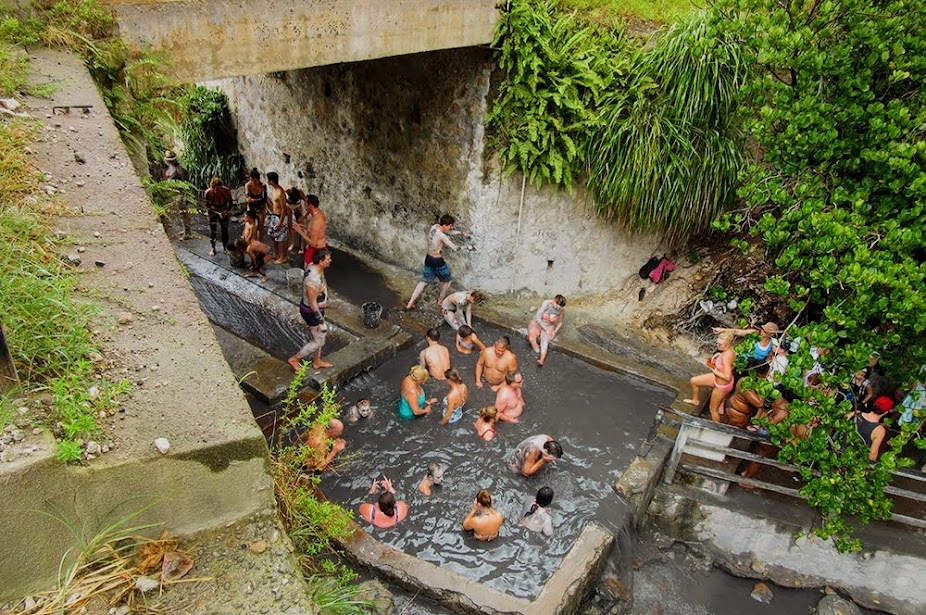
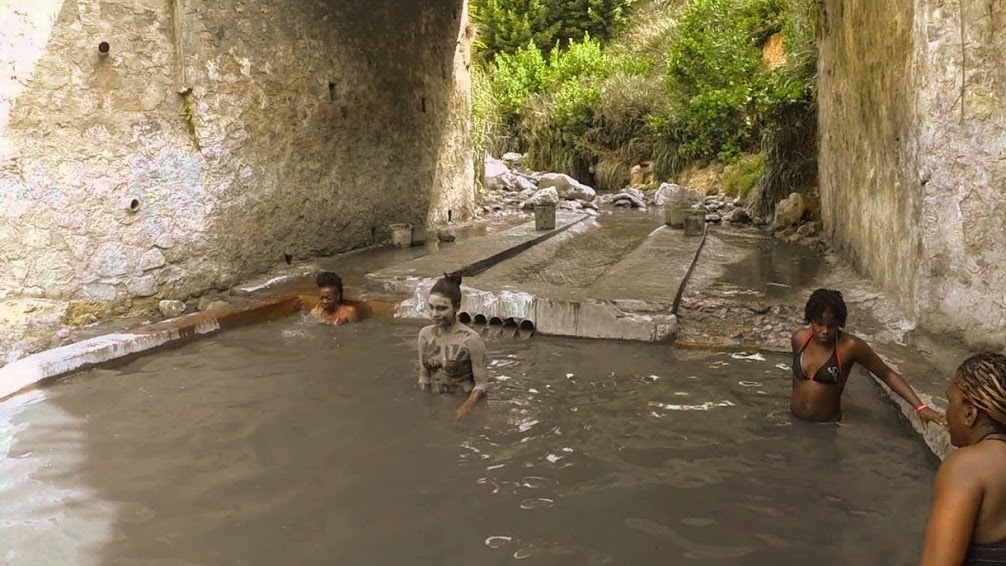
There are well-established hot springs and mud baths here as well. These bathing pools, hotter than the average bath, contain volcanic minerals which are believed to have therapeutic qualities for the skin, and are a big tourist attraction.

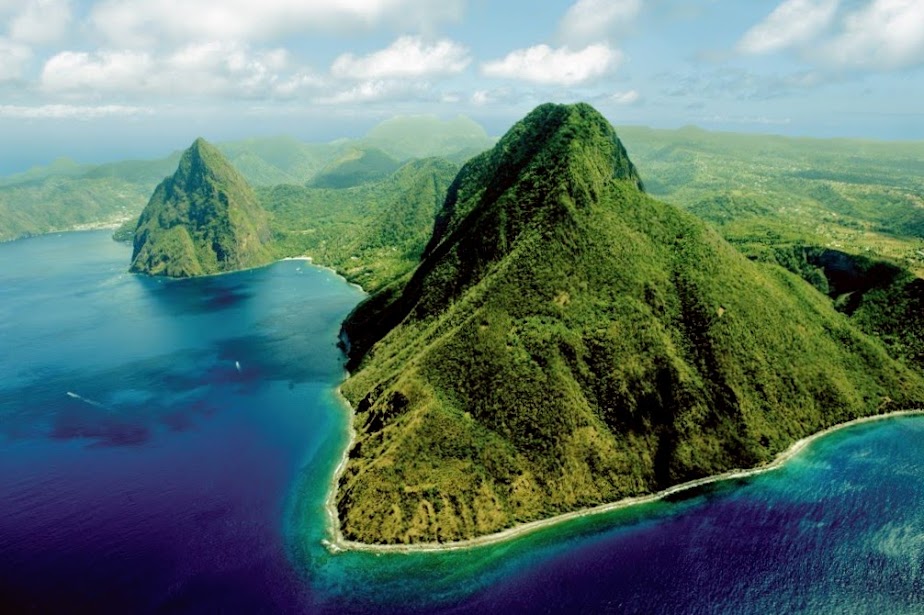
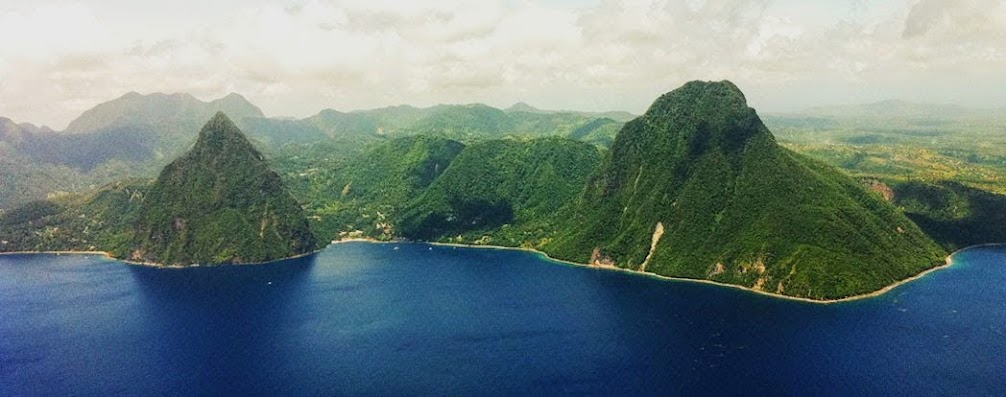
While stinky, mineral-loaded mud baths and hot springs are all well and good, the show stopper on St. Lucia is definitely it’s Piton Mountains. Here are some aerial views of the island’s beautiful signature attraction.

Said to be the most photographed site in the Caribbean, and most famous mountain pair on earth, the Pitons were created less than a million years ago by volcanic activity. Located near the town of Soufriere, in southwestern St. Lucia, the Arawak Indians considered the mountains to have mystical powers, and early European explorers noted their unique beauty. In 2004 the Pitons, along with the Soufriere Volcano, were awarded World Heritage Site status.

These volcanic plugs, land formations made out of volcanic material, are the most iconic sight on the island. They are the symbol St. Lucia, and also appear on the island’s flag.

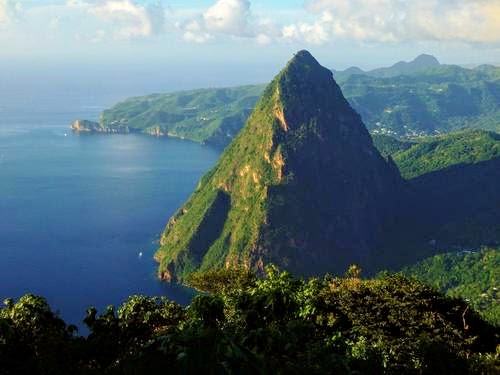
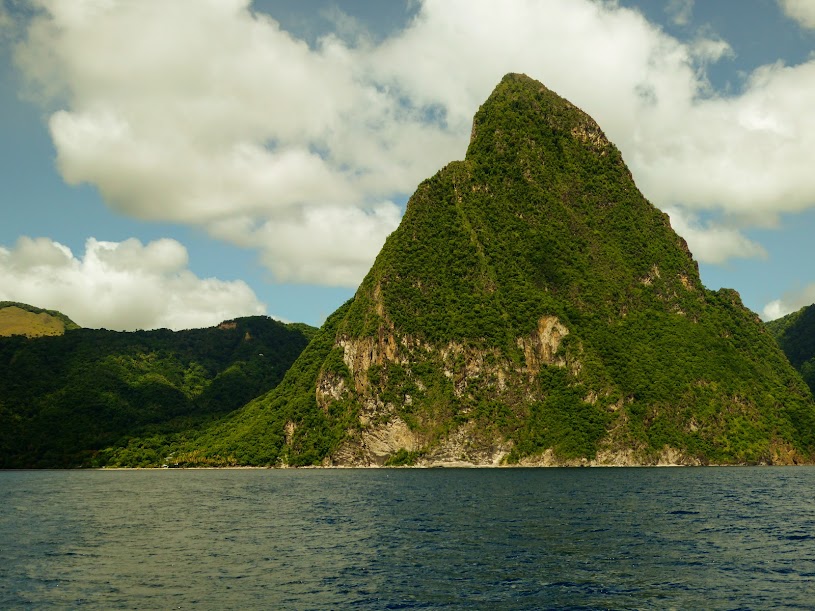
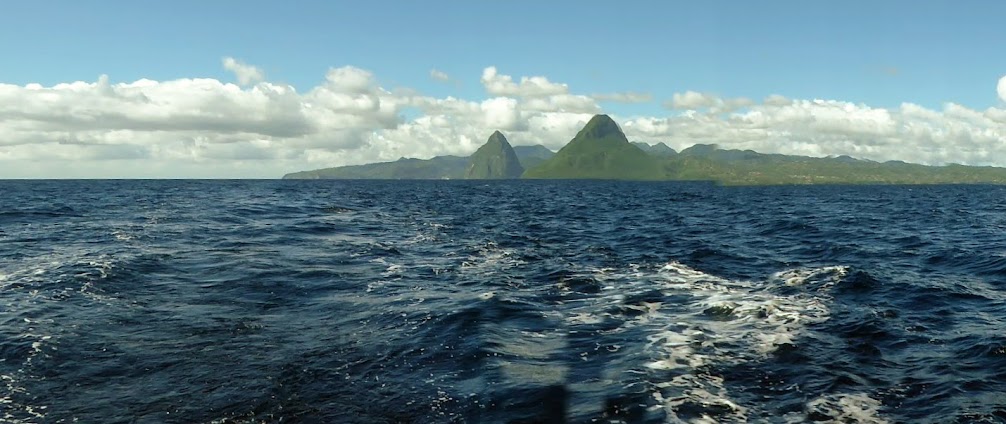
Gros Piton, and its smaller sibling Petit Piton, are easy to spot from many points along the island’s southwest coast.

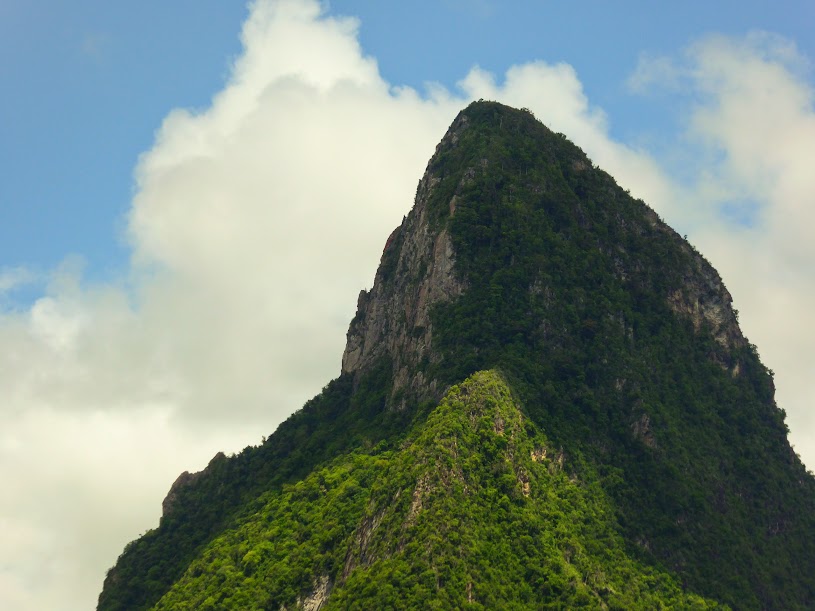
Although both peaks are available for climbing, locals caution against hiking Petit Piton unless you are an experienced climber, as the mountain is incredibly steep. Gros Piton is the higher of the two mountains. It’s easier to climb than the Petit Piton, but still a strenuous go.

Gros Piton rises to a height of 2619 feet above sea level, and is the second highest peak on St. Lucia, after Mount Gimie (3120 feet). Petit Piton rises to a height of 2461 feet, is steeper than Gros Piton and is therefore much more challenging to climb. Here are views I found online, of views from the top of Gros Piton:

We made our way from Martinique to Rodney Bay, on St. Lucia’s northwest side. The large bay provided an easy ride to customs and immigration, as well as several grocery stores. Customs wanted Howard to have a vet exam for clearance, but Scott managed to convince them that our cat would not be swimming ashore, and soon we were all three officially checked in.

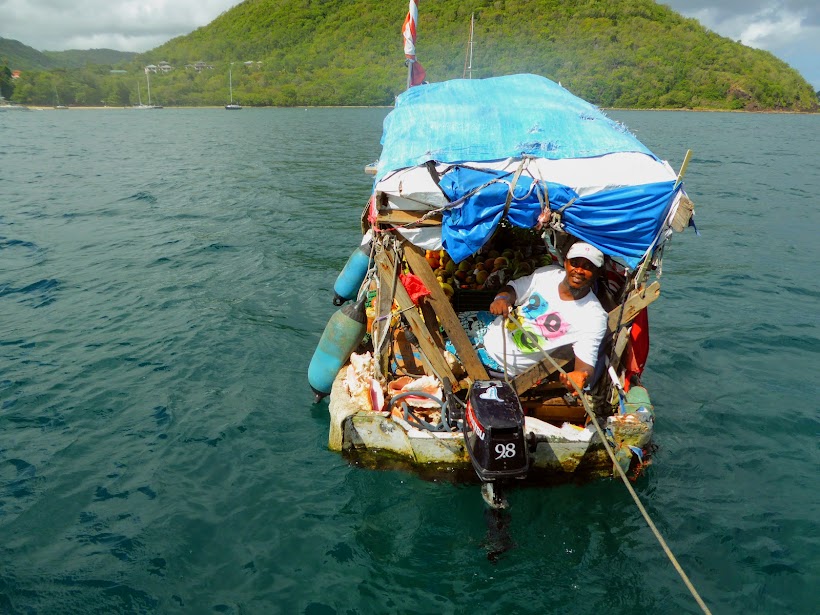
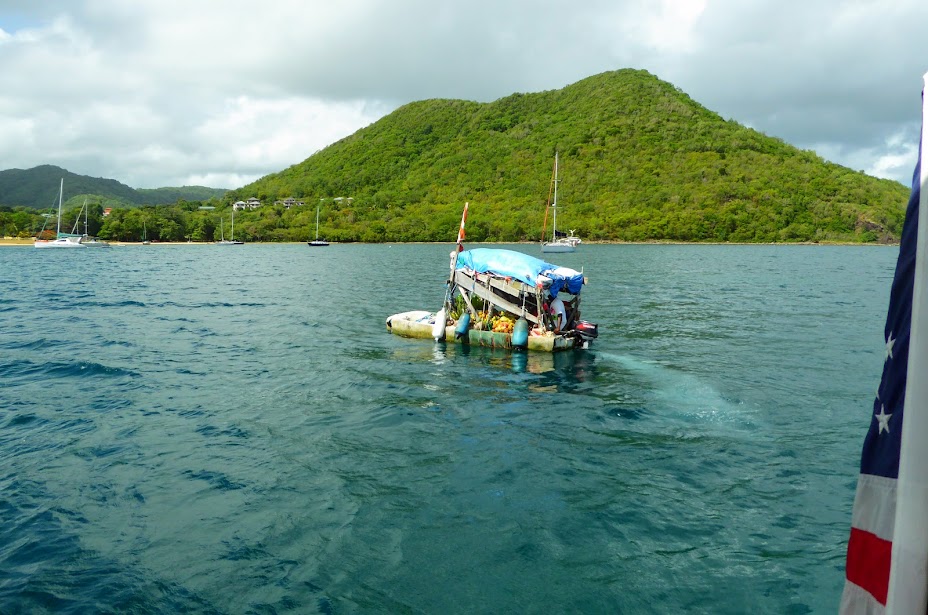
Bright and early the next morning, we spotted Gregory , a local man who’s small boat was loaded down with fruits, veggies and plants for sale. Several cruisers were put off by him, but after having much experience with veggie boats in the San Blas, we were definitely game for some easy, door-to-door local shopping. We chatted with Gregory, bought some sugar-sweet, local mangoes and then he was on his way.

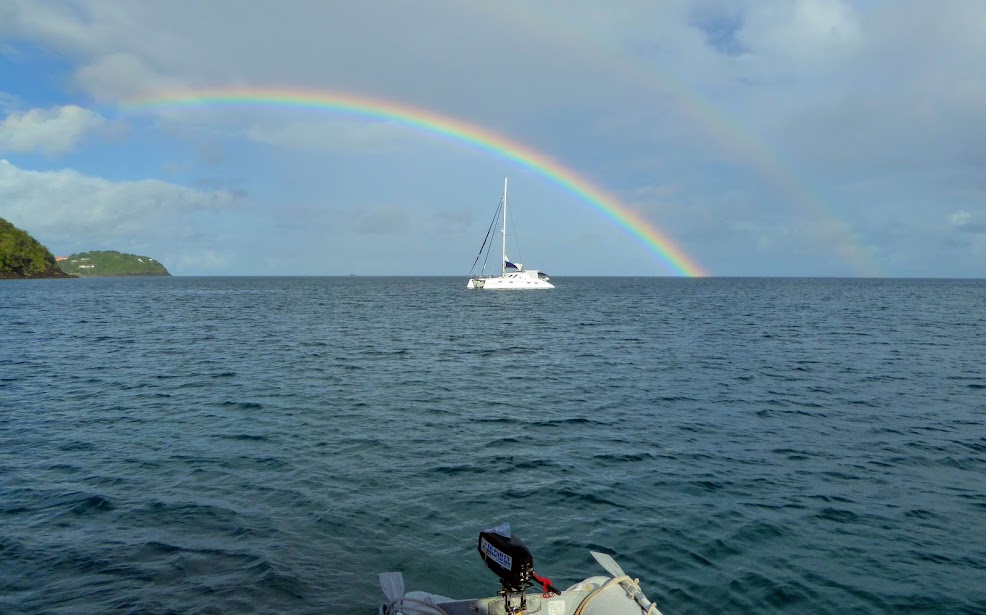
During our shopping run, we spotted an Indian restaurant on the marina grounds, so we decided to treat ourselves to dinner ashore, but not before enjoying a vivid rainbow on the horizon behind us.

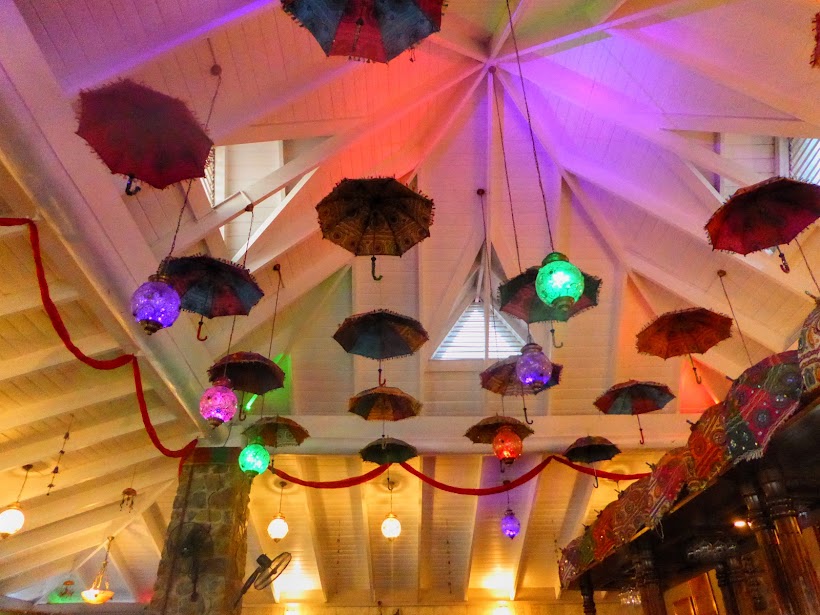
We enjoyed a tasty dinner at the colorful restaurant, with views of the marina, and then headed back to Sea Life, taking care to be back on board by dark.

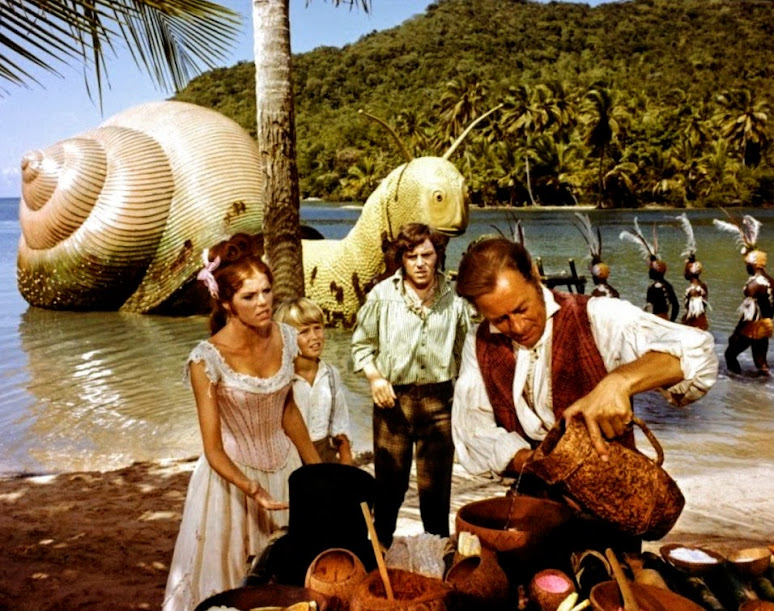
Not having long to linger on the island, we raised anchor the next morning, and headed farther down the coast to Marigot Bay. This scenic bay is a historical landmark, and was the site of many battles between the French and British navies. The bay was also used as the setting for scenes from the 1967 film Dr. Dolittle; the original musical film, not the Eddie Murphy remake.

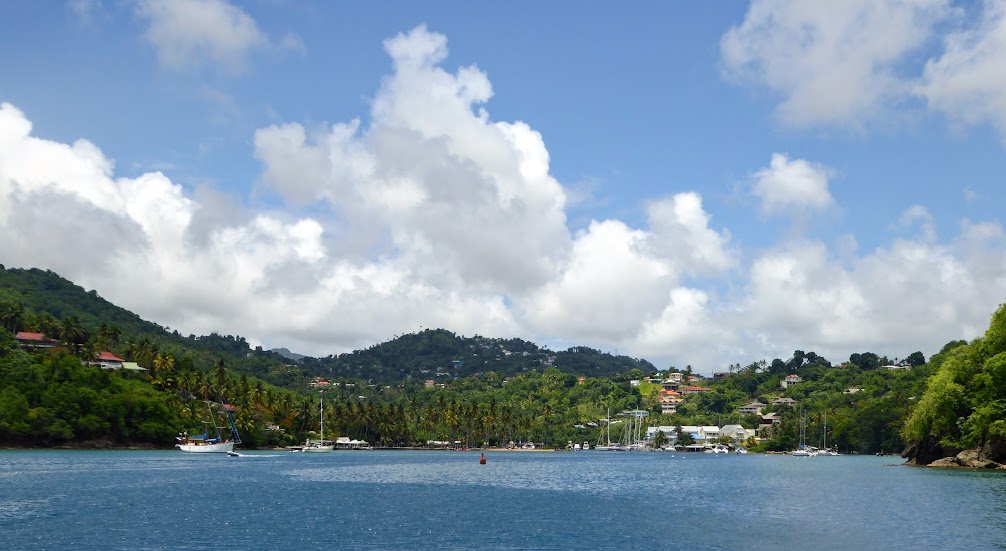
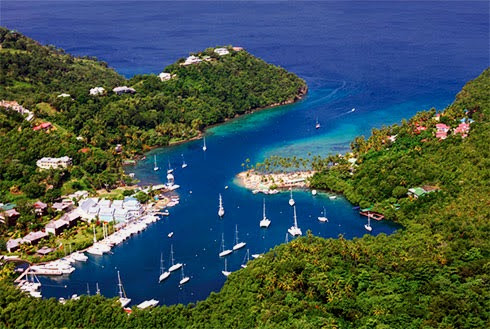
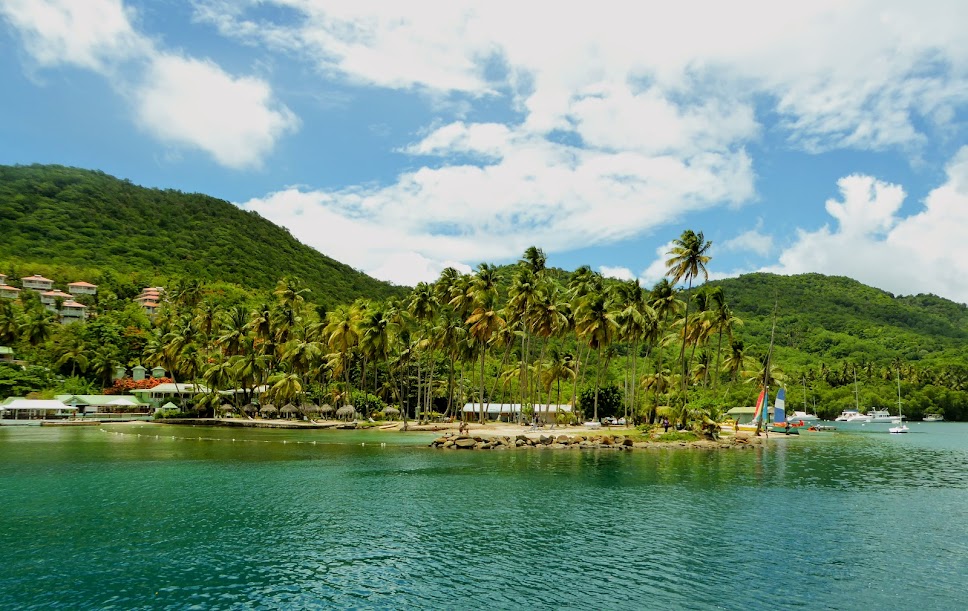
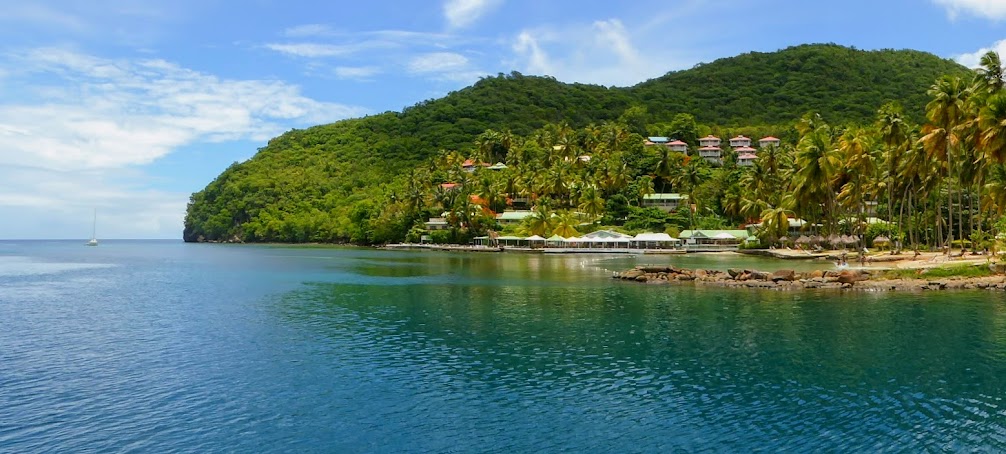
Coming in, a line of palms hide an open area at the back of the bay, but these aerial photos give a better overall view.

Scott and I visited the bay on a day trip when we were on the island 14 years ago, and were eager to see it again. Entering the bay, we were glad to see that the Marigot Bay Beach Resort was still in business.

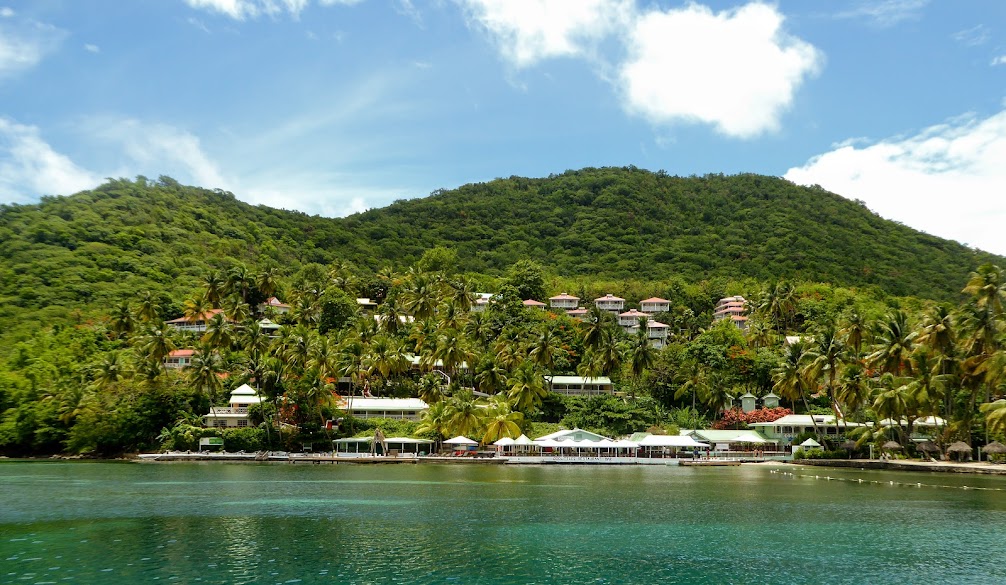
Not surprisingly, there had been much development in the past 14 years, with the addition of an upscale resort and marina at the back of the bay. We made our way in, and picked up a mooring ball just off of the resort.

The development has not detered the locals, who netted bait fish near us in the mooring field.

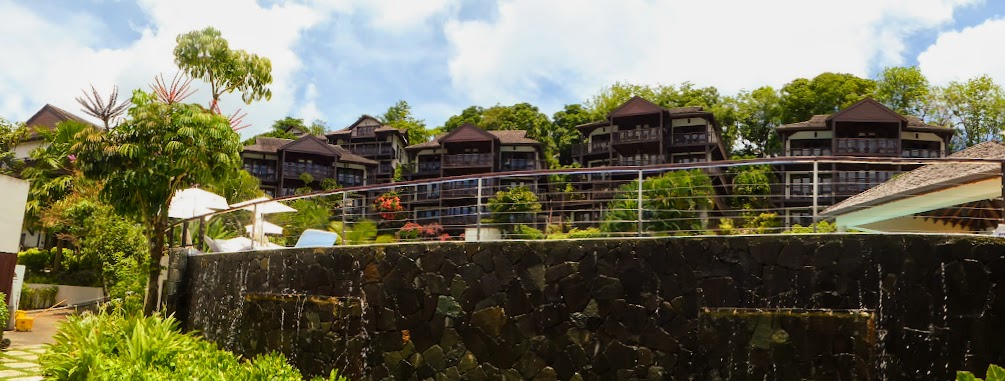
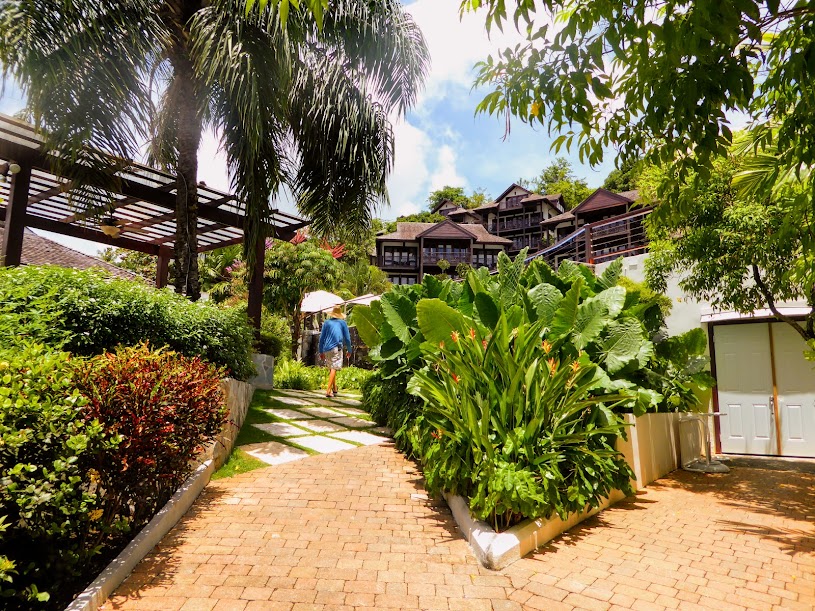
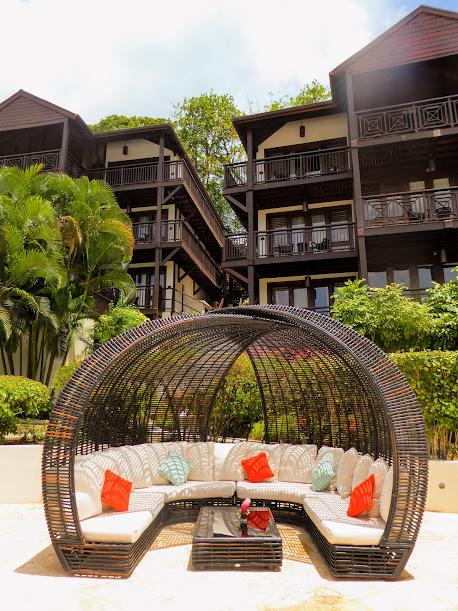
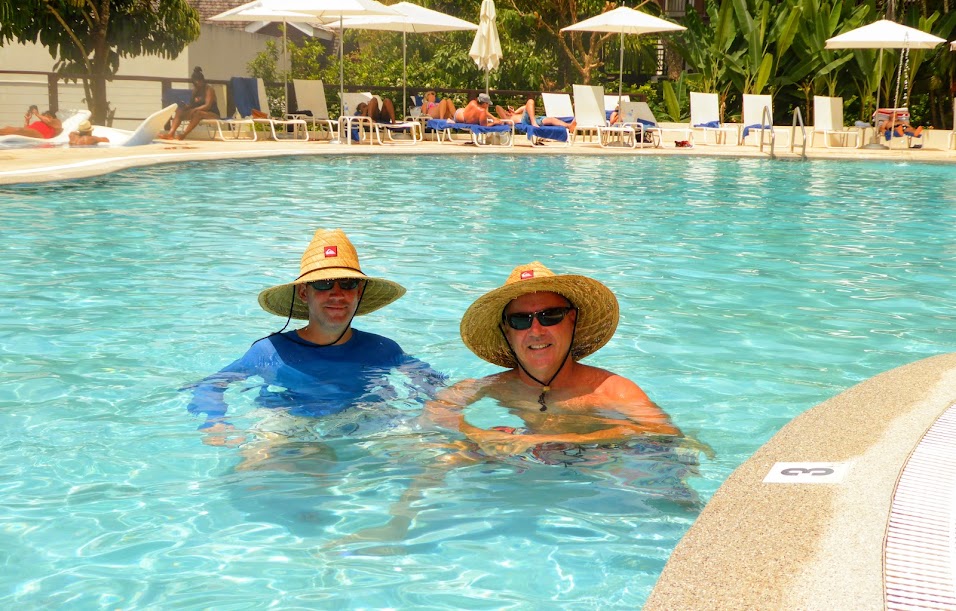
For $20.00 a night, we had use of the resort grounds, pools and restaurants…not a bad deal! The next day we went ashore to wander around, and then settled in for an afternoon poolside.

We’d made new friends in Fort de France, who had traveled to Marigot as well. Mark and Deb were also heading for Grenada, on their catamaran, Kefi. We enjoyed our day by the pool with them, in our posh surroundings.

Mark and Scott have similar taste in hats.

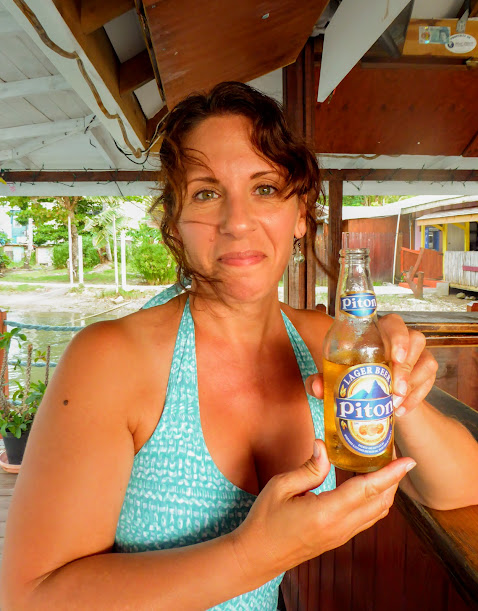
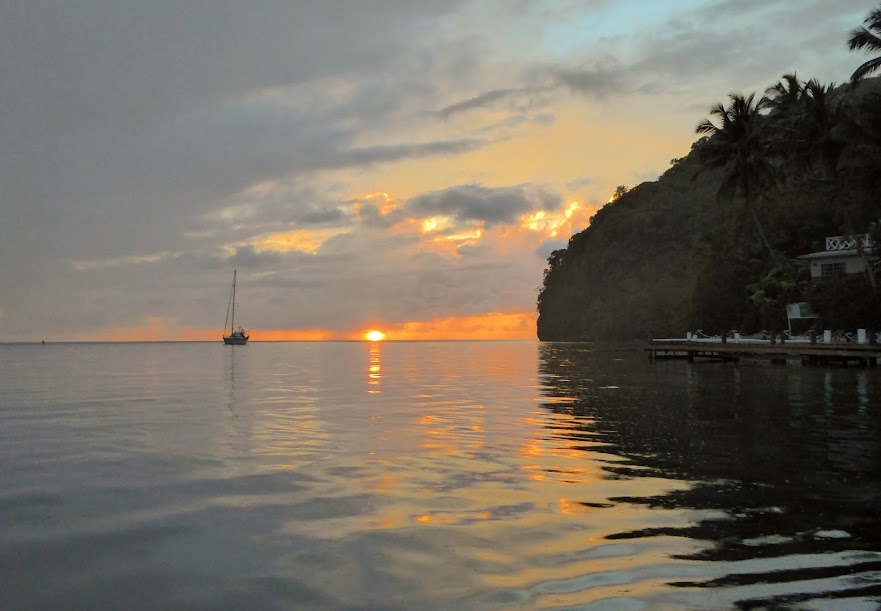
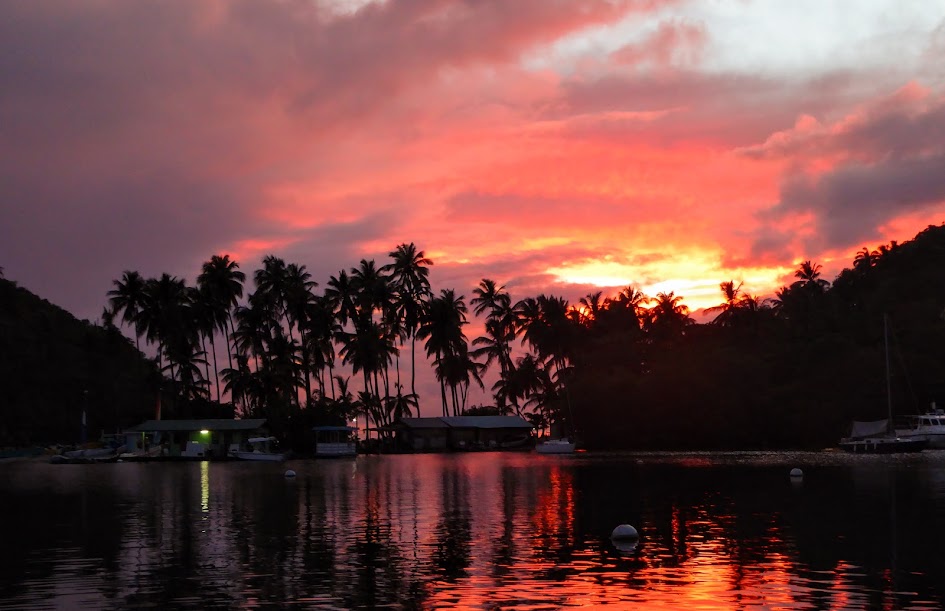
That evening, Scott and I took the dinghy out for happy hour at nearby bars in the bay. We enjoyed rum punches, cold Pitons (the local beer) and a beautiful sunset.

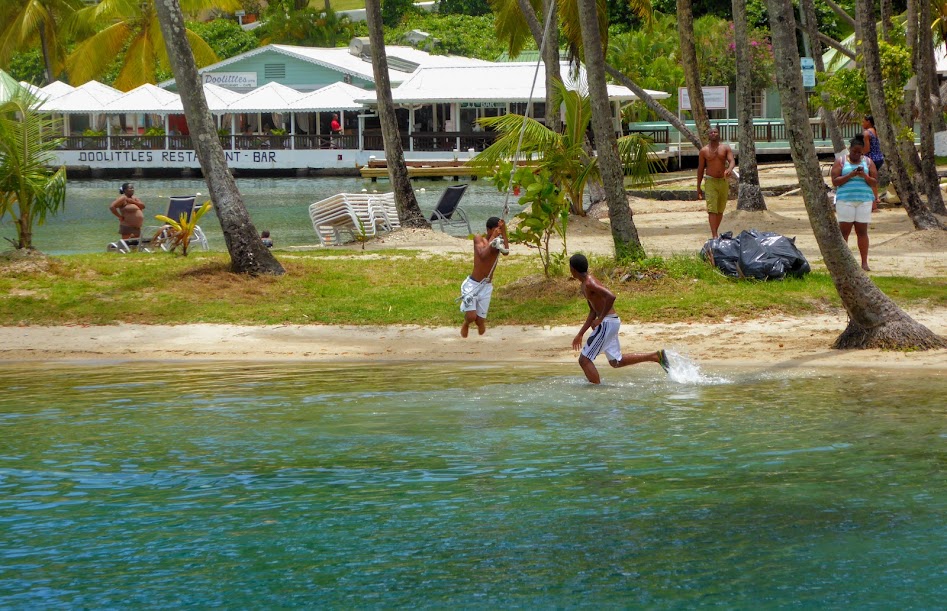
The next morning, it was time to push on. We passed local children having fun on a rope swing and enjoyed a few more scenic views as we said goodbye to Marigot Bay.

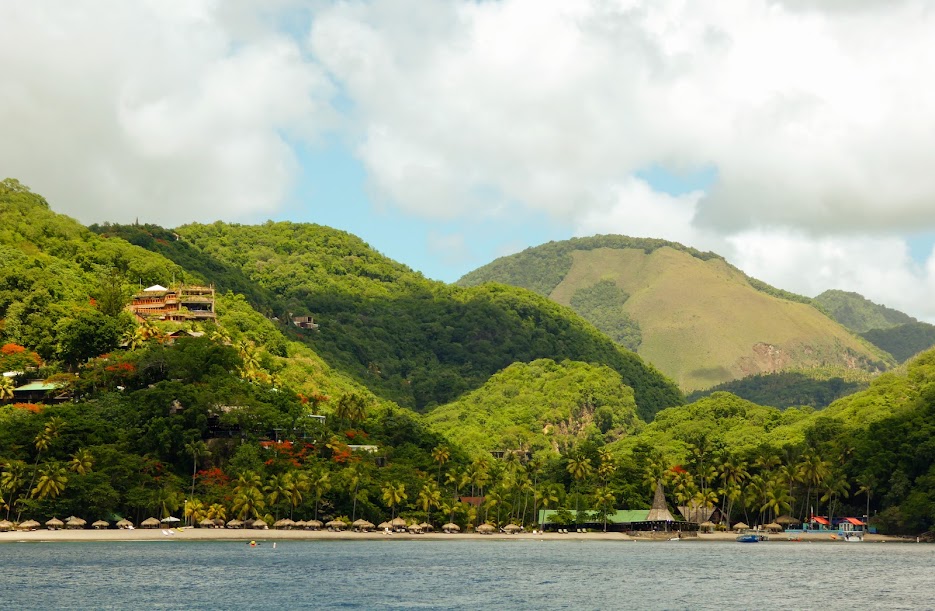
We made our way south along the coast, which was dotted with local cottages at the shoreline and multi-million dollar houses in the hills.

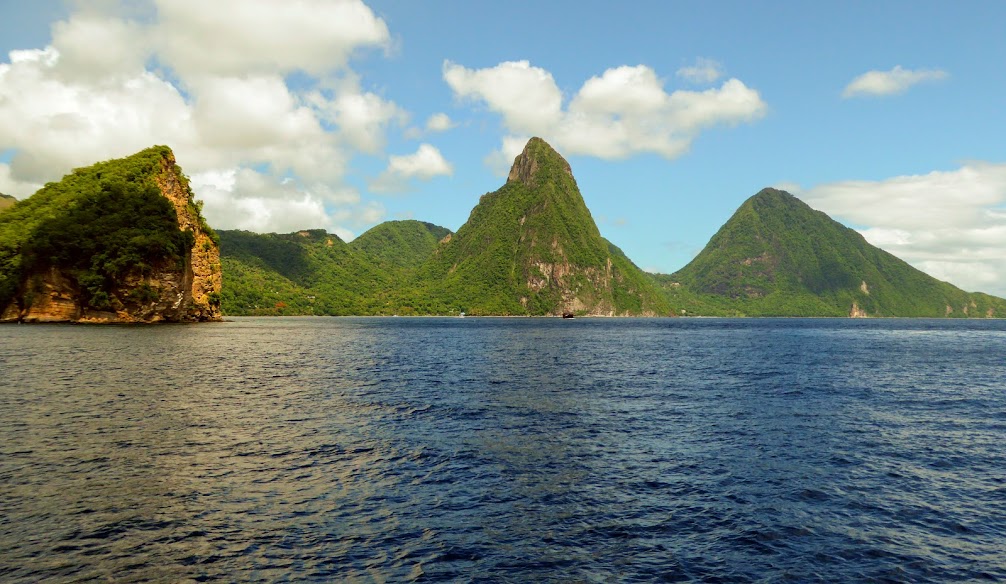
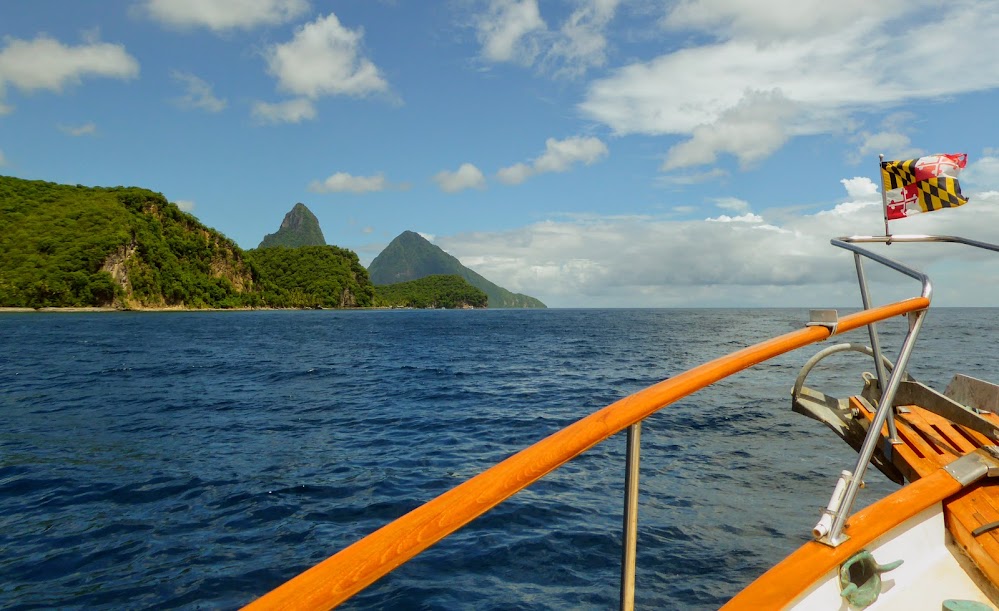
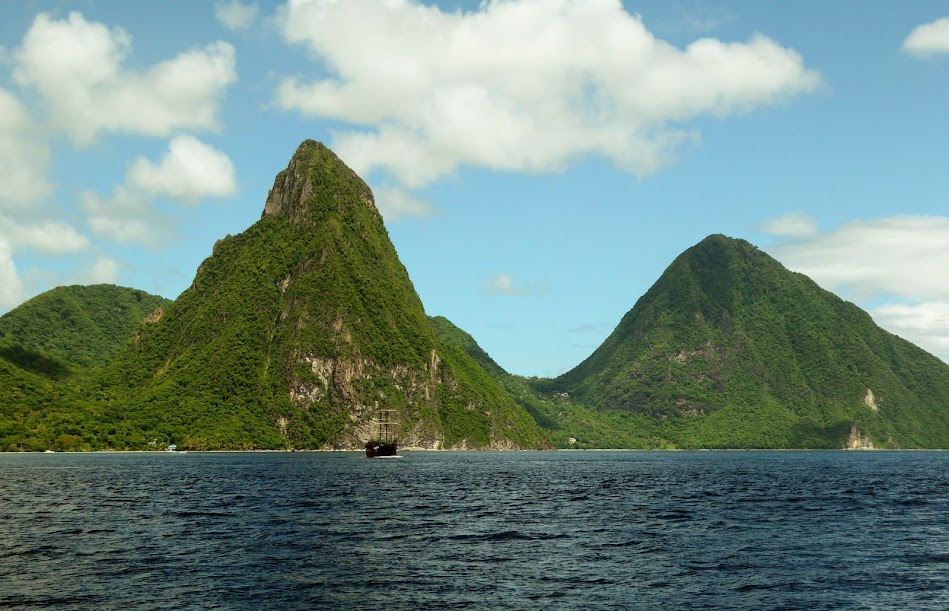
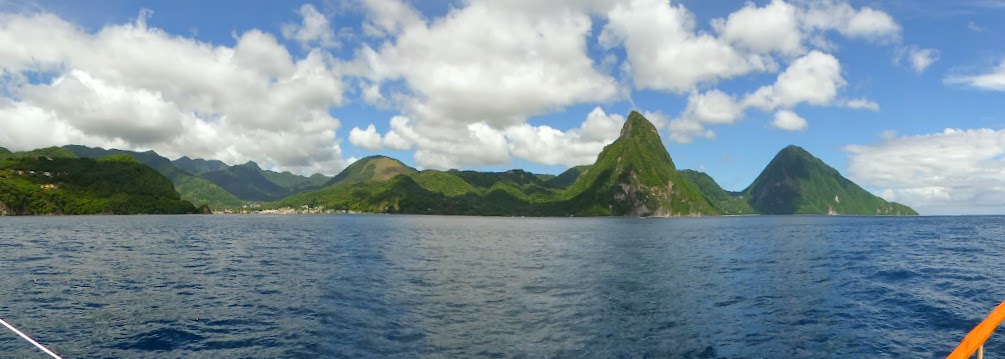
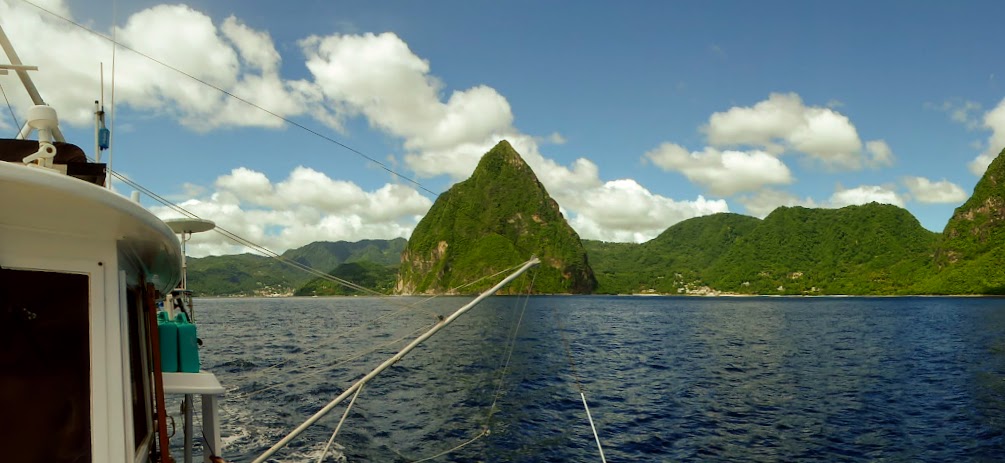
Eventually, we caught sight of the pitons in the distance. Coming south, they look much closer together than they actually are.

There are several resorts with terrific views of the pitons; some have open walls, offering unobstructed views.

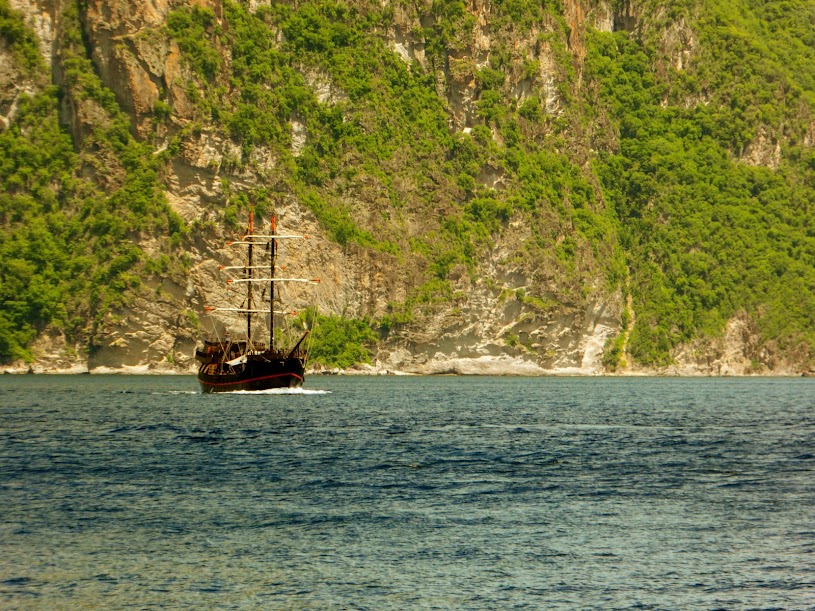
As we approached the pitons, a pirate ship tour boat made for a great, “Pirates of the Caribbean” photo.

There are mooring balls at the base of these awesome mountains, but unfortunately the area around them isn’t safe for boaters anymore, so we didn’t stop. We did, however, take our time passing the twin mountains, to take many, many photos and just admire them.

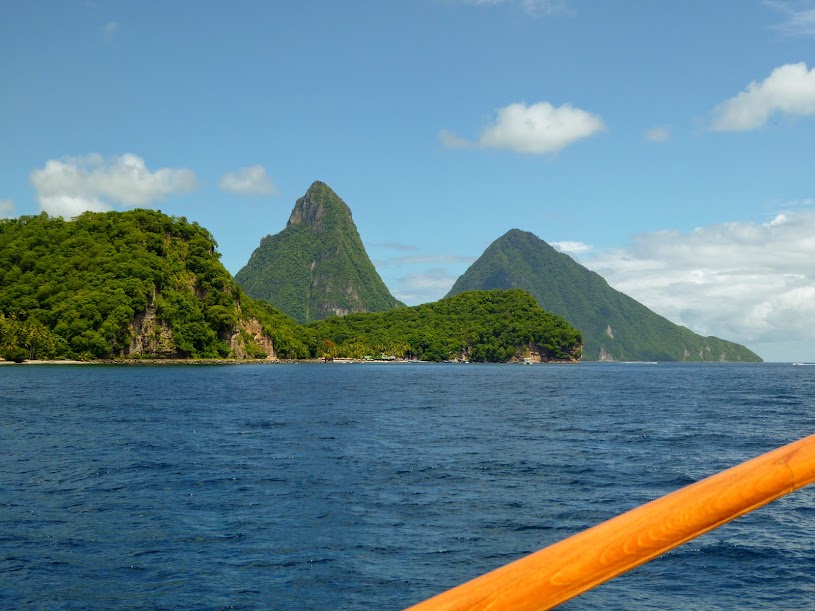
Approaching from the north, Petit Piton seems larger, and it was obvious why this mountain is harder to climb.

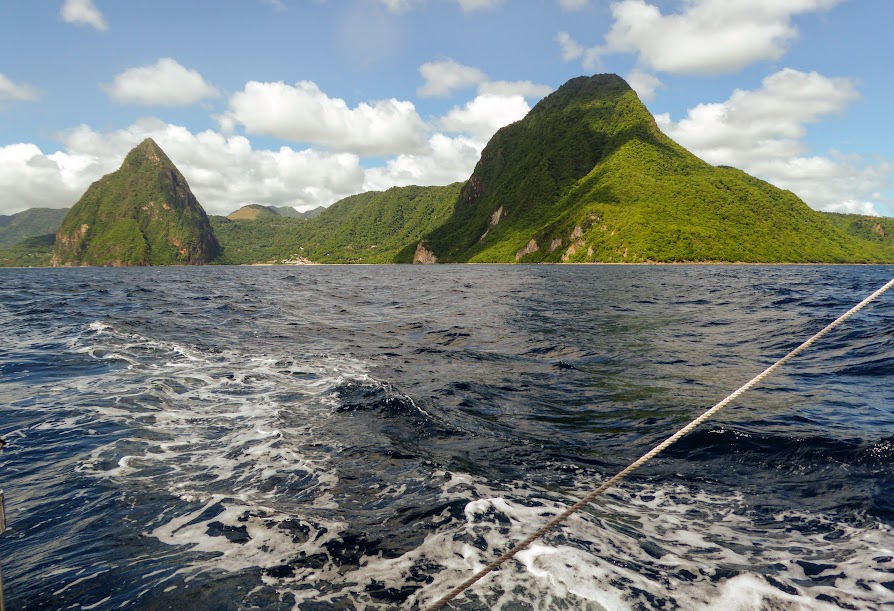
Further along, Petit Piton shrinks in size, and Gross Piton rises above it.

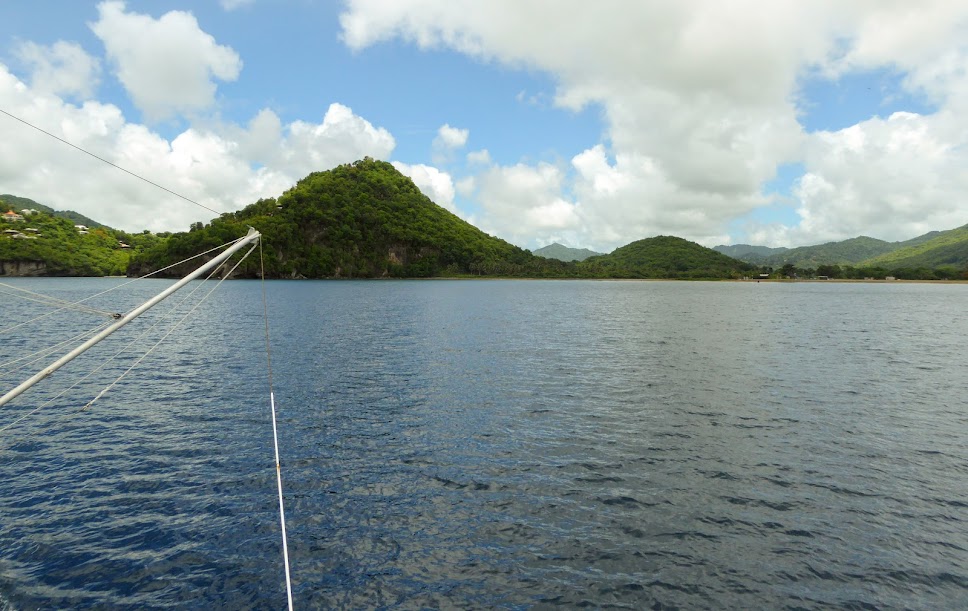
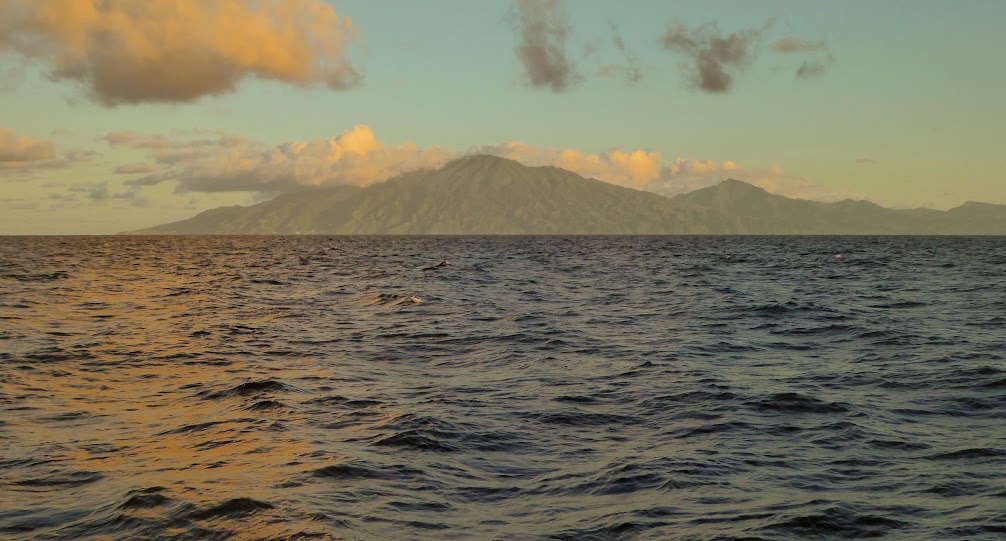
As we pulled away from St. Lucia, I snapped some final photos of the pitons, just as St. Vincent came into view off of our bow.

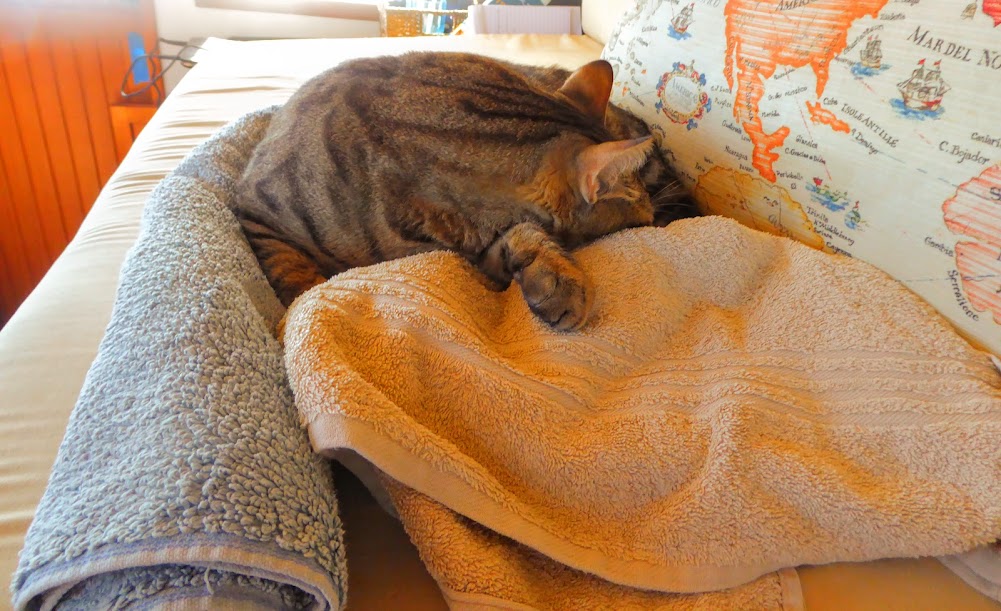
We were on an overnight run to the island of Carriacou, part of Grenada, where we would clear into the country . Howard was hunkered down for the night, and a bright moon rose over St. Vincent to light our way.

Here are many more photos of our brief visit to St. Lucia, and the amazing Pitons.

“Shells Sink, Dreams Float. Life’s Good On Our Boat!”

Fort de France, Martinique

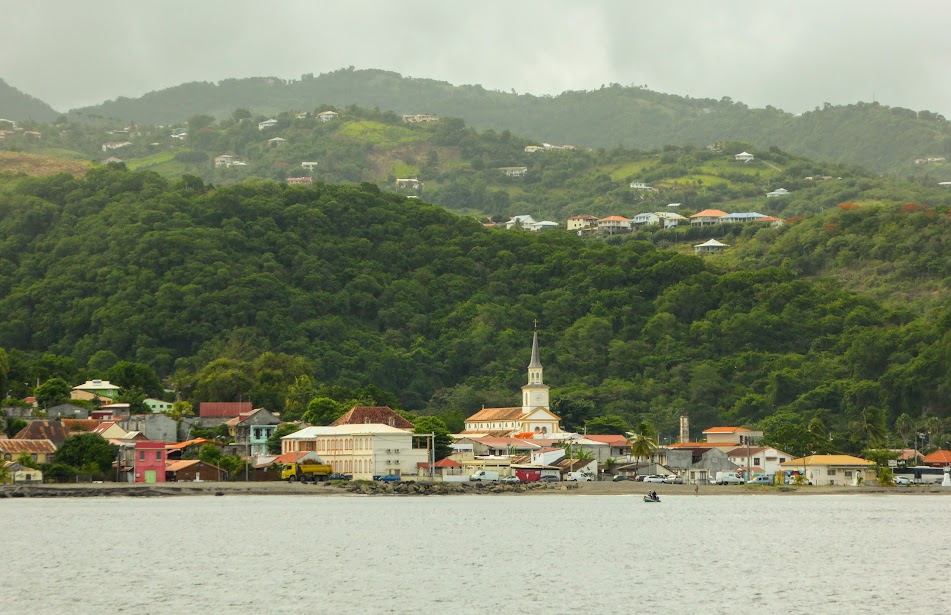
Leaving the quiet, scenic town of St. Pierre, we made our way just a few hours along the coast of Martinique, to the capital city of Fort de France. It was a good next stop, and offered larger stores for groceries. Along the way, we again enjoyed scenic views of this beautiful island.

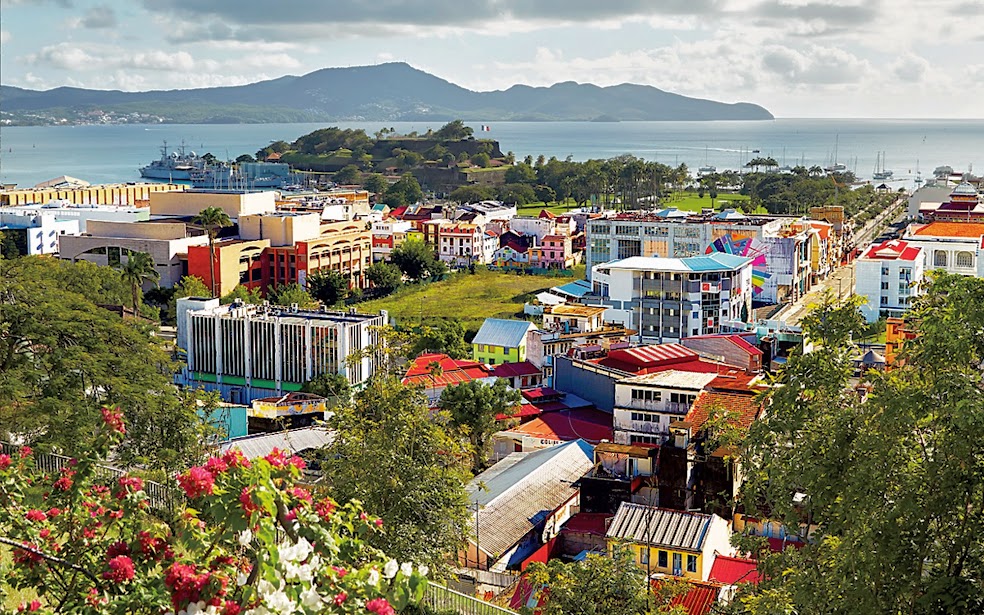
 Fort de France became economically important after the eruption of Mount Pele, and the destruction of the town of St. Pierre in 1902. In addition to being the capital of Martinique, it’s also one of the major cities in the Caribbean, exporting sugar, rum canned fruit and cacao. I found some good aerial views of the city online:

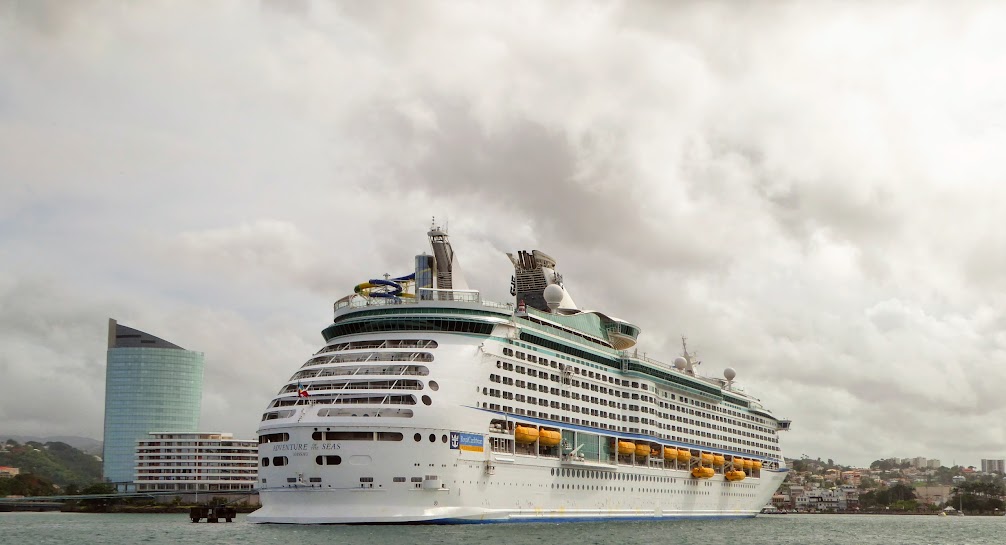
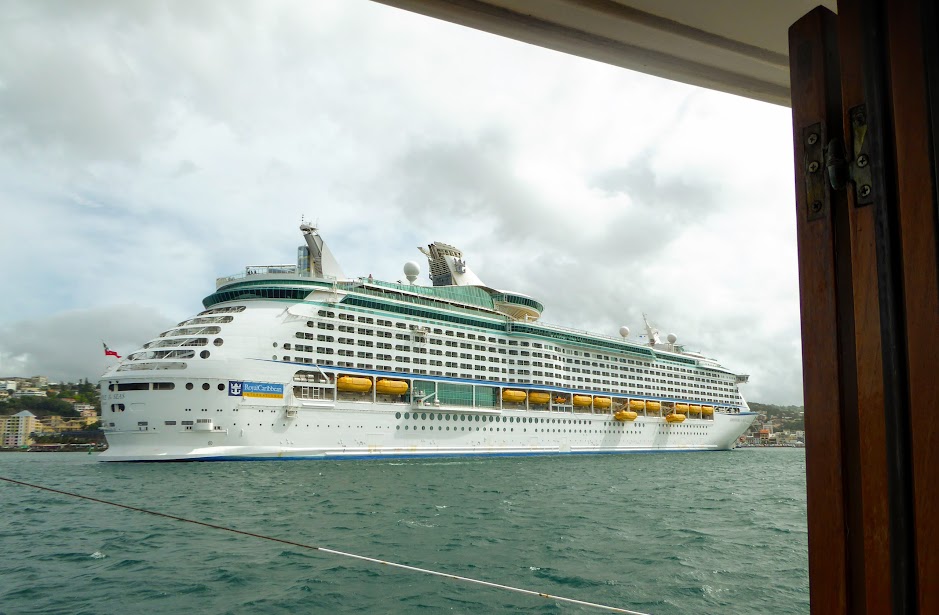
The capital city has recently reinvented itself as a cruise-ship destination, with the construction of two new terminals. As we approached the harbor, it was clear we’d have an imposing neighbor nearby.

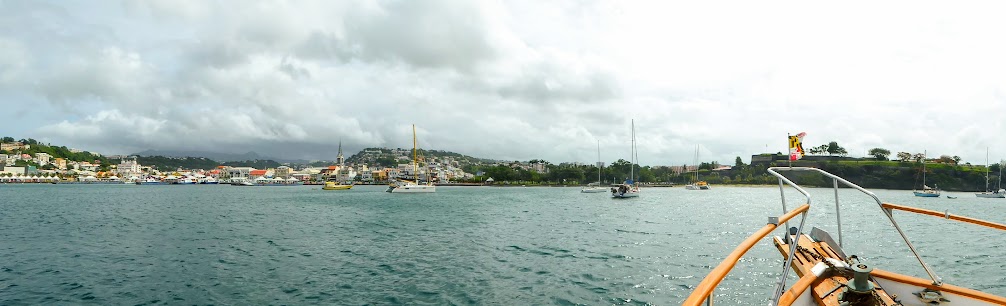
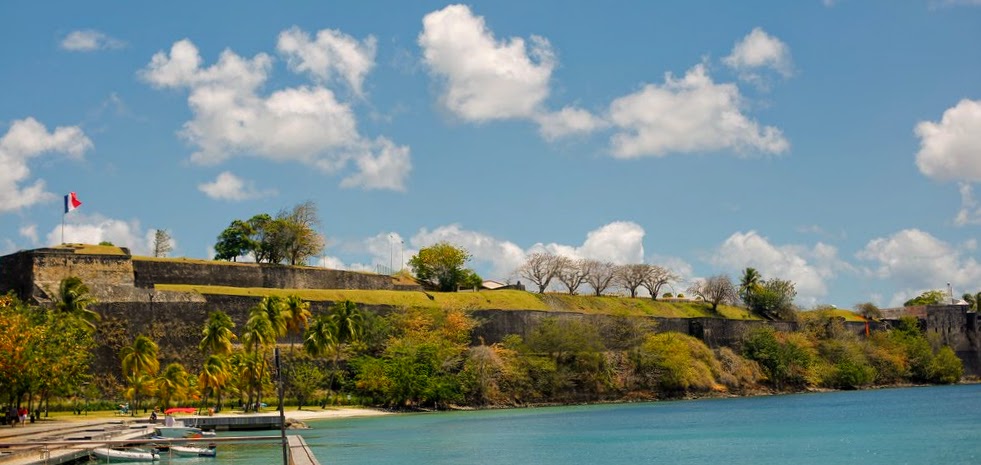
We anchored just off of the downtown area, and in view of Fort St. Louis, which is still in use by the French navy.


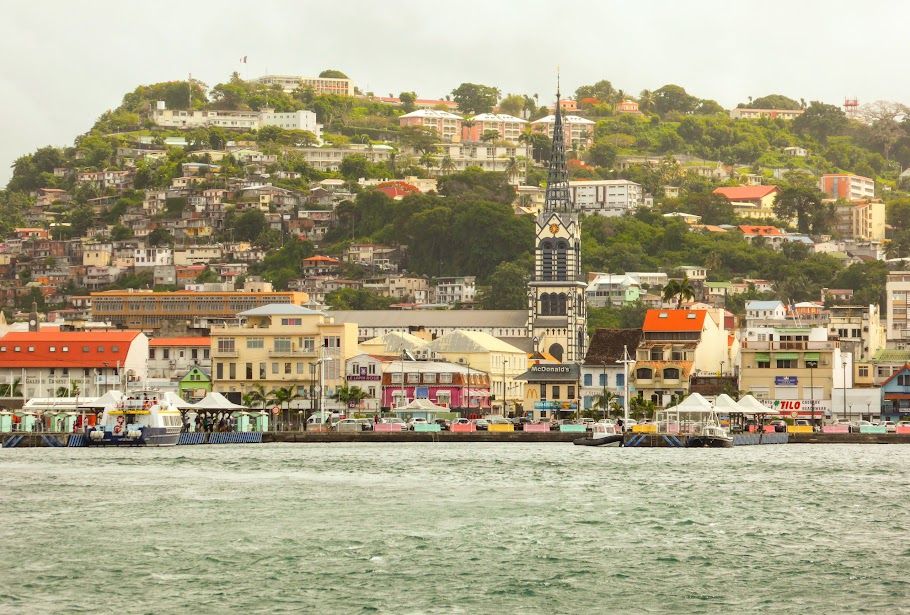
(Notice the McDonald’s in front of the cathedral, Scott was  thrilled.)

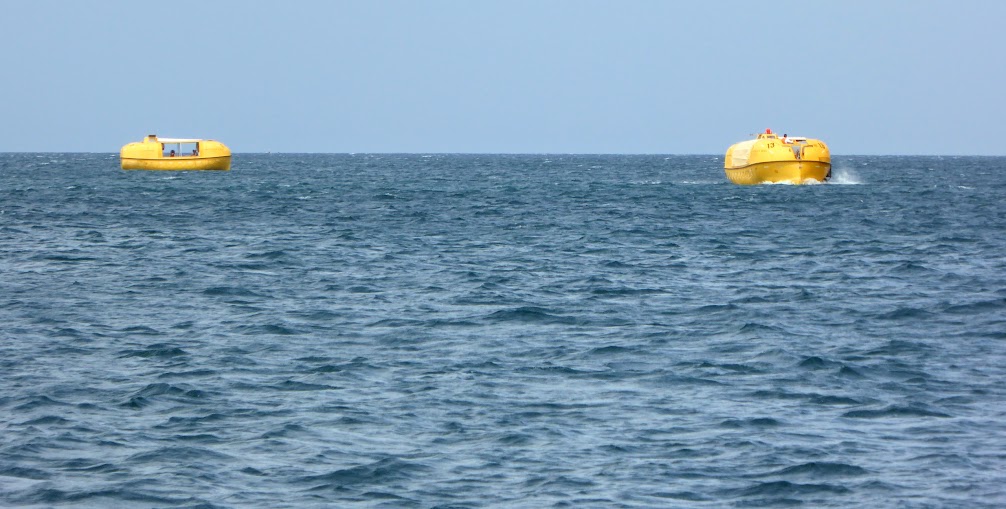
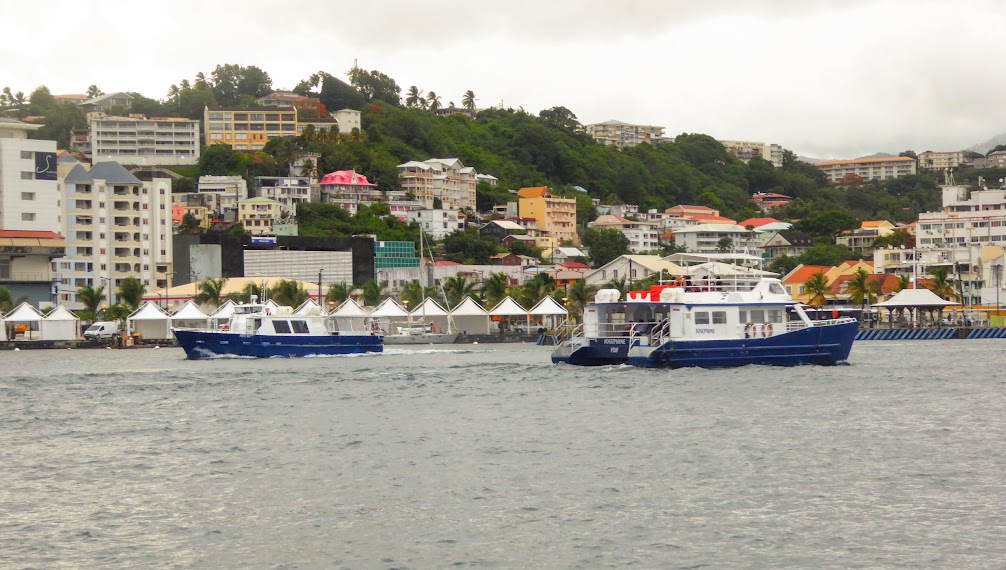
We enjoyed our first evening watching the cruise ship crew test lifeboats, and bracing ourselves against the wakes of the constant ferry traffic going to and from the town dock.

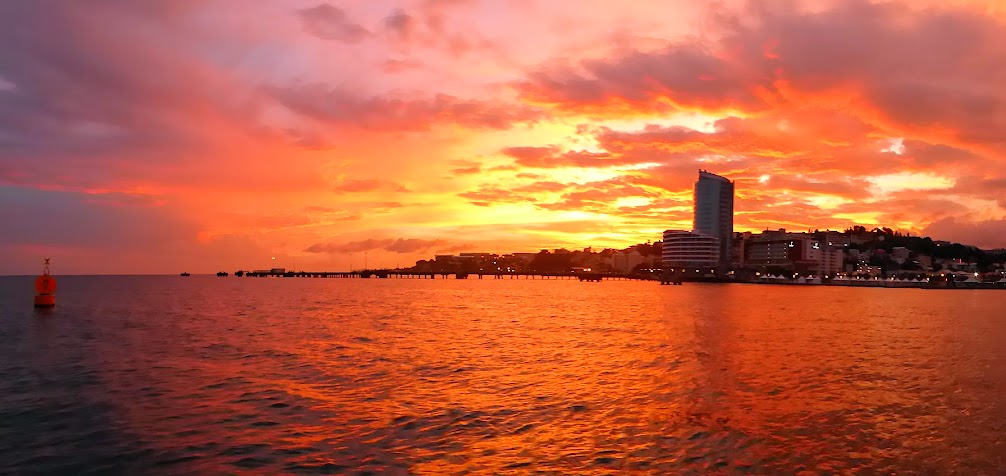
The many wakes were worth the colorful sunset views over the city.

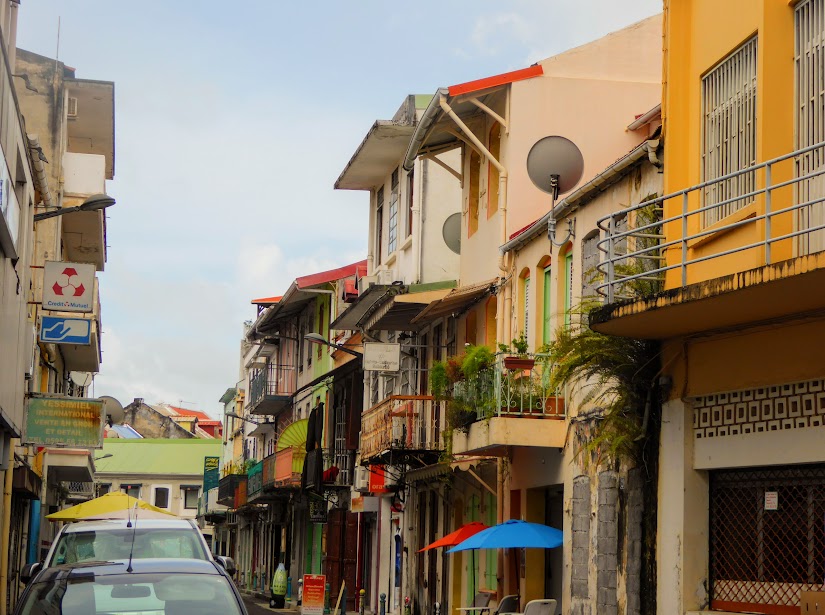
In the morning, we made our way to the dinghy dock and into town, zigzagging the narrow, colorful streets.

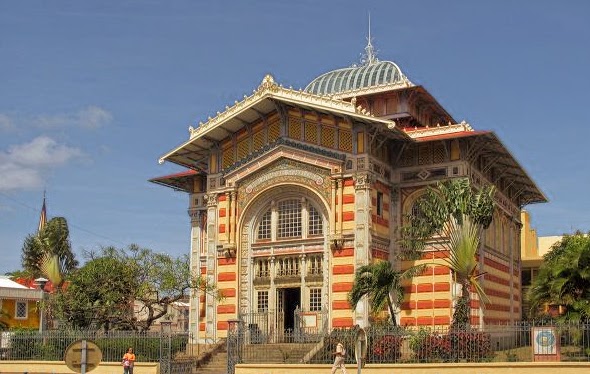
We turned a corner, and came upon the colorfully ornate Bibliotheque Schoelcher (Schoelcher Library), at the edge of the city’s park. (the lighting was horrible in my photos, so I borrowed some online)

Abolitionist, writer and politician Victor Schœlcher left his vast library of 10,000 books to the General Council of Martinique in the late 19th century, on the condition that they should be kept in a private library open to all, with the intention of educating former slaves. Today, the library houses over 300,000 books.

We learned that the building was created in Paris, and then shipped to Martinique in pieces to be assembled…impressive!

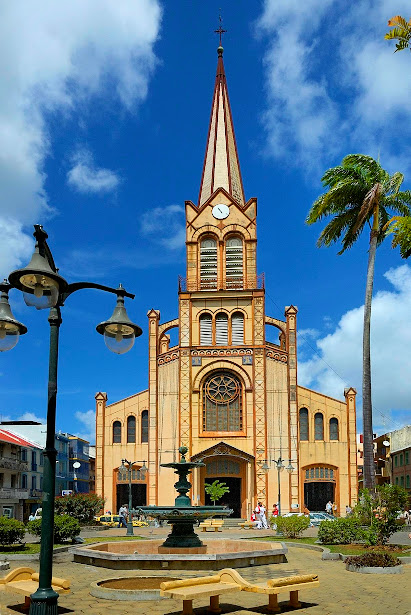
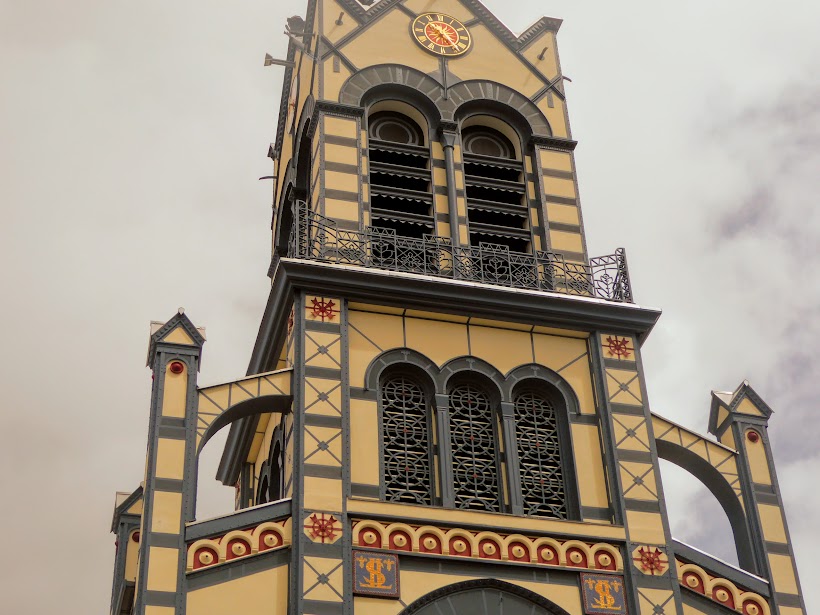
Just blocks away is the St. Louis Cathedral, the seventh to have been built at this site. (I borrowed this photo online, due to construction fences around the entire base of the cathedral when we visited)

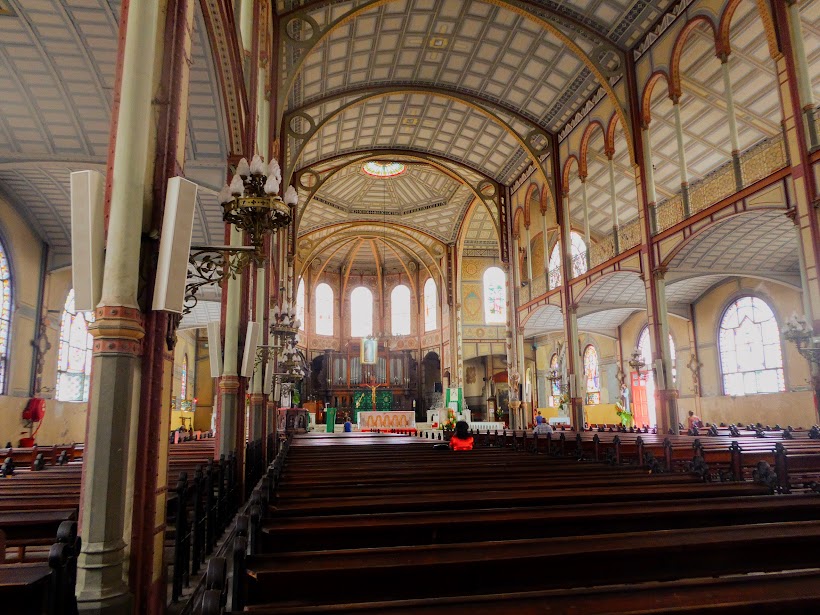
What we found most impressive about the cathedral is that the present one was completed as far back as 1895. It was designed by Henri Picq, who also envisioned the Bibliothèque Schœlcher.  This current cathedral is constructed with an iron frame and reinforced concrete, which has contributed greatly to its longevity.

Inside, we learned that the wooden pulpit, 19 stained glass windows, organ and wrought-iron railing are all original to the 1895 structure.

Scott stopped for a McDonald’s fix, and then it was on to Leader Price, a local grocery store. We perused the aisles, and bought a few things at good prices. With groceries in hand, we called it a day.

The next morning, it was back into town to clear out of Martinique. As I mentioned previously, clearing in and out of the French islands is far less complicated than other islands in the Eastern Caribbean, and much easier than on the western side. Computers are located in various shops throughout the islands, and except for a few euros paid to said shops for the service, the process is free. Find a computer, fill out the online form, pay at the register, and receive your printed clearance papers…done!

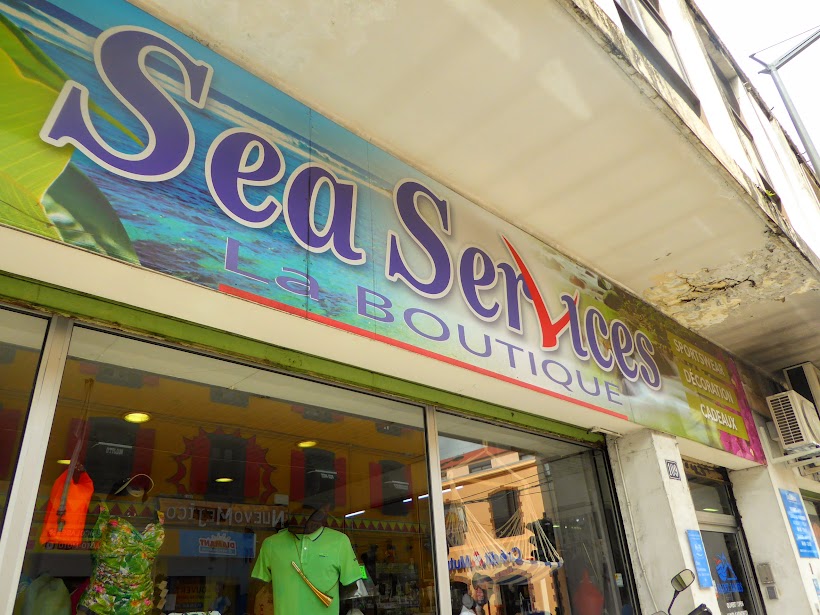
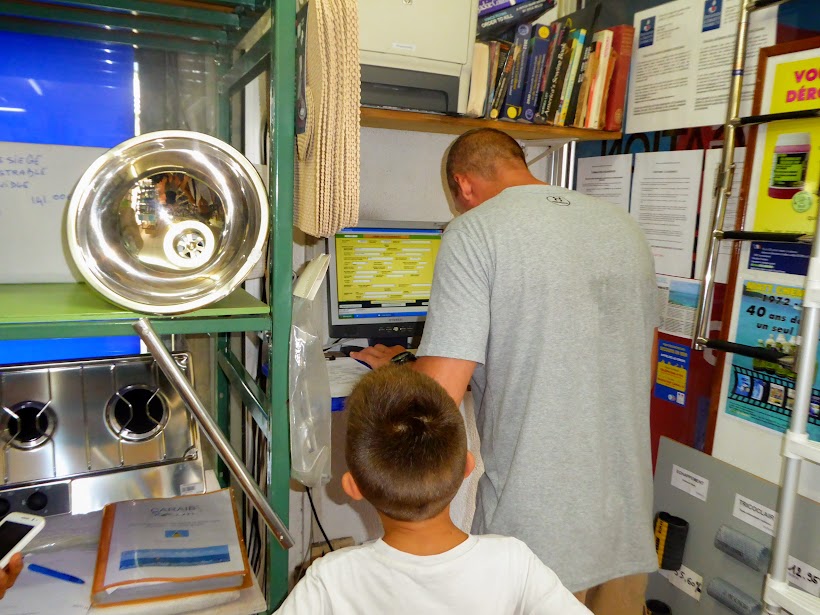
However, there are a few challenges: obviously, the language can cause some confusion when filling out forms, and European keyboards are a bit different than what we’re used to…just enough to cause frustration. We stopped in at Sea Services to clear out, and Scott managed the process just fine, despite a small boy looking over his shoulder.

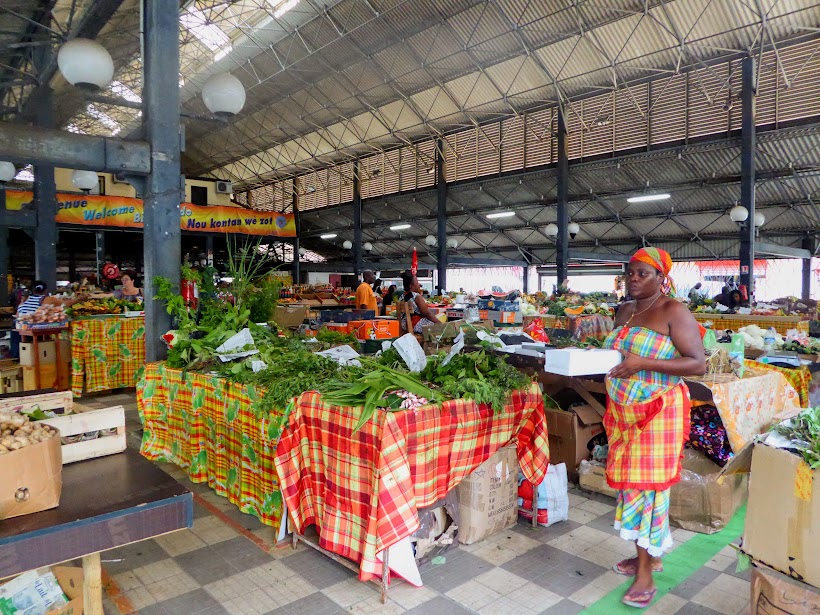
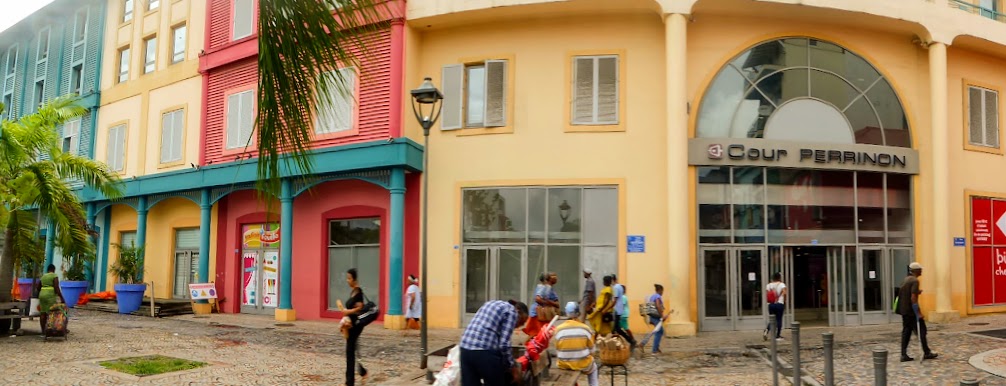
Once cleared out of Martinique, we had 24 hours before having to leave. We set off to find the local mall, where another grocery store was located. Along the way, we poked our head into the local open market, before finding the mall just a few blocks away.

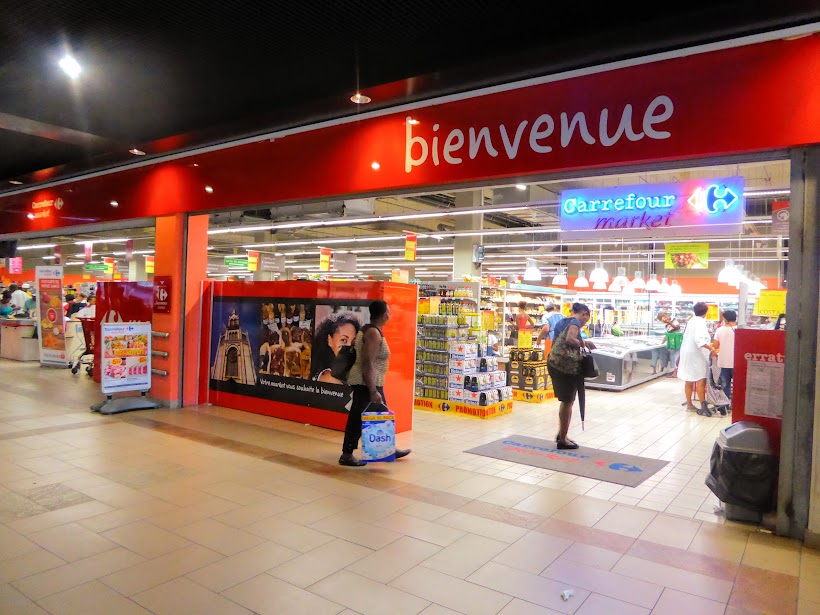
It was strange to see a large grocery store inside of a mall, but Carrefour did not disappoint. We came out with more groceries, and cheap, French foods. Wine, cheeses and other yummy items are incredibly affordable on the French islands.

We made our way back to the dinghy, using strange, revolving gates to cross the main street.

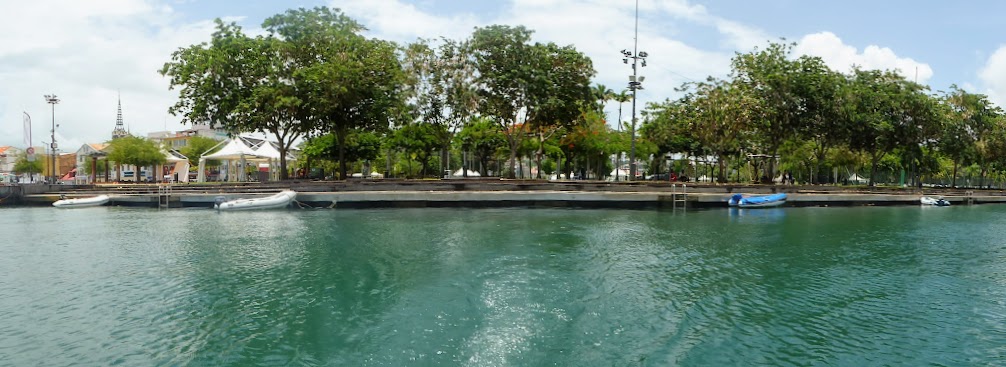
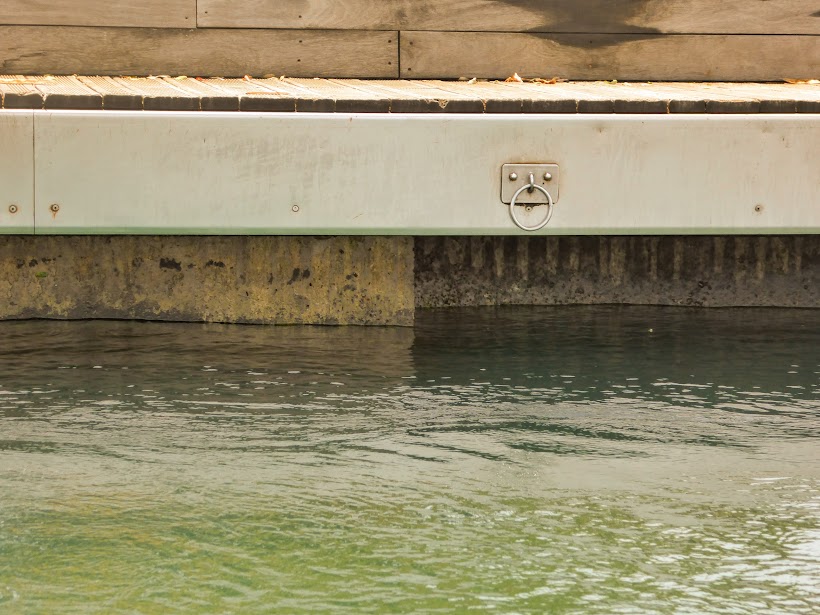
Scott was in love with the dinghy dock here. It was huge, with plenty of space for dinghies. The edge was covered in stainless steel, providing a smooth, kind surface for inflatables, and offered many stainless rings for tying off.

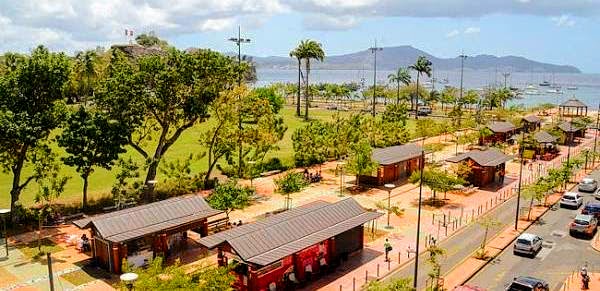
Later that evening, we returned to town for dinner at one of the many food stalls lining La Savane park, near the waterfront. I was so hungry, I forgot my camera, so here’s an online, aerial view.

We opted for kabobs, and they were nothing like I expected…much more delicious! Chicken was carved off of a spit, similar to a gyro, then placed on bread that was thinner than a pita, but thicker than a tortilla. Next, yummy garlic sauce was added, followed by tomatoes, peppers onions and…wait for it….french fries! Then, for the “piece de resistance,” the whole thing was wrapped like a burrito and placed in a hot press.

Whoever came up with this thing was a food genius. The wrap of awesomeness was yummy in my mouth, long after I was finished eating it. We hope to visit Martinique again, to explore more of the island, and will definitely make a pit stop at Fort de France, for another fix.

Our short stay in Fort de France was over, as winds were good to make another jump toward Grenada. We were leaving one beautiful island and heading for another; next stop, St. Lucia. Here are a few more photos.

“Shells Sink, Dreams Float. Life’s Good On Our Boat!”


A Day Of Rum, At Depaz Distillery On Martinique

Martinique is home to seven rum distilleries, one of which was within walking distance of our anchorage in St. Pierre. A day of rum was definitely appealing to Scott, so we set off to visit the Depaz Distillery.

We climbed out of town, past more “volcano” ruins, and onto a rural road that led to the distillery. Our path was lined with sugar cane fields.

Dodging rain along the way, we eventually spotted the distillery ahead, with it’s grand manor house.

We walked up the lane, past the restaurant with Mt. Pele in the distance and began to explore the grounds.

Several out-buildings described how the rum is made, and a small museum in the visitor’s center depicted Martinique’s history of rum, and that of the Depaz Distillery.

Here is what we learned:

Rum’s origins can be traced to the Caribbean, where over time, each island developed its own approach to making rum, but Martinique’s is very different from the others.

Almost all of the world’s rum is produced by fermenting and distilling molasses, a byproduct of the sugar industry, and is referred to as “rhum industrial.” When sugar cane’s power plummeted in the mid-19th century, distillers in Martinique and its neighboring French islands began a large-scale production of rum that originated directly from sugarcane, removing the sugar factory (the source of molasses) from the standard process.

The juice of fresh-cut sugarcane is taken directly from field to distillery, preventing spoilage. This “land to bottle” style is where the island’s signature spirit gets it’s name: “rhum agricole, or agricultural rum. As a result, Martinique’s distilleries were booming by the early 1900’s. The number of operating distilleries has shrunk dramatically, from around 75 in 1935, to just seven today, but rhum agricole has held on.

Martinique is the only geographic area in the rum industry that has earned an AOC,  which translates to controlled designation of origin, which is a big deal. AOC specifies that a particular food or drink (such as the yummy blue cheese from Roquefort or the sparkling wine from Champagne), is a regional specialty, and notable enough to merit it’s own “identity.”

The AOC requires the cultivators of the sugar cane, and the producers of rum, to adhere to various regulations. Neighboring French islands of Guadeloupe and Marie-Galante make near-identical styles of rum, but only Martinique has earned this AOC mark from the French government, which was awarded to them in 1996.

Above the city of Saint Pierre, among the hills that gradually rise to Mount Pele, is the Depaz distillery, a grand sugarcane plantation manor. The original distillery and manor house were destroyed by Mount Pele’s eruption. The sole family survivor, Victor Depaz had been studying in Bordeaux, France at the time of the eruption. He returned to Martinique 15 years later, and began to rebuild his family’s extensive estate and distillery. His return was an emotional one, as the city of Saint-Pierre had been described by some who knew the family as the “cradle of Victor’s childhood, and the tomb of his family.”

Working tirelessly, Victor Depaz focused his efforts on replanting the surrounding land, specifically rebuilding the agricultural distillery on the hundreds of acres he called home.

As luck would have it, the volcanic eruption left extremely fertile topsoil, in which Victor planted rare “blue” sugar cane (blue cane is the only type that requires true volcanic soil to flourish). This signature estate-produced blue cane is considered the most costly and difficult to grow, and delivers the ideal balance of sugars for Depaz rum’s maximum flavor and character. Today, it’s his signature blue cane that produces the agricole rhum called Depaz, and it’s production represents only 3% of the world’s rum.

Eventually, Victor’s hard work paid off, and he successfully rebuilt the Depaz Estate to the brilliance it had historically known.

Nothing is, or can be added to an AOC designated rhum agricole, such as coloring or flavors. To further intensify the blue cane’s natural flavors, only oak barrel aging is permitted.

The rhum is aged in special small, charred oak casks, for at least three years, which we were told infused  “attractive” barrel wood, and mountain air aromas into the finished product. Aged rum from Martinique is among the most highly regarded in the world.

With our lesson over, we wandered on, past a huge water wheel and up to the sprawling manor house. Sitting high atop a hill, the views back down toward the Caribbean were amazing.

Once inside, Scott admired the large study, with it’s antique furniture and “mature” smells. He took note of the details, planning a similar room in his future.

Outside, the rear of the manor house was just as grand, and the surrounding landscape just as beautiful.

Of course, no day of rum would be complete without  a tasting, so after roaming the grounds and manor house, we headed for the tasting area of the visitor’s center.

Depaz rum comes in bottles of all sizes and styles. I found this colorful photo online:

We tried several of the rums offered (well, Scott did), and learned about  Ti’ Punch, the national cocktail of Martinique. It’s extremely popular in the French islands of the West Indies, including Guadeloupe and Haiti. The name is taken from the Creole, Petit Punch, and has been abbreviated over the years down to Ti’ Punch. The cocktail is created by adding a large amount rhum agricole (ick), with a touch of fresh lime juice and a splash of cane syrup. “Purists” agree that a real ti’ Punch should be served without ice..bleh. This cocktail was much too “flavorful,” shall we say, for me. (Another online photo)

Making ti Punch calls for a unique type of swizzle stick, made from and named after a perennial tree called the bois lele, which is native to the region. Its branches have a unique end, that spreads out into five separate, small sections (More online help).

Image result for bois lele tree

Image result for ti punch lele

Image result for ti punch lele

The “lele” is used to dissolve all of the cocktail’s ingredients. A bartender uses two hands on the stick, rolling it between his palms, similar to starting a fire, when mixing.

Image result for how to make ti punch

Ti’ Punch is usually served before meals as an aperitif, due its high alcoholic content. There is a tradition known as “chacun prepare sa propre mort” which roughly translates to, “each prepares his own death.” The bartender or the host will lay out the ti punch ingredients, and drinkers will prepare the cocktail to their own taste.

Having had our fill of all things rum for the day, we walked back to town, making our way back to the dinghy along the waterfront promenade, admiring it’s quirky shops and homes, while Sea Life waited quietly for us in the distance.

Here are more photos.

“Shells Sink, Dreams Float. Life’s Good On Our Boat!”


Bon Jour, Saint Pierre, Martinique!!

After a month in Virginia, Mom was healing like a champ in rehab, and Dad had food in the freezer. It was time for me to head back to St. Thomas, where Scott and I would point Sea Life toward Grenada, where Sea Life would spend hurricane season.

Soon after I returned, the wind forecast was favorable for an almost three day leg to Martinique (a hop, skip and a jump, after the hellish 6.5 days from Cartagena to Puerto Rico…ugh!). After two over-nights, and zeroing in on hour 50, we caught sight of the beautiful, volcanic island.

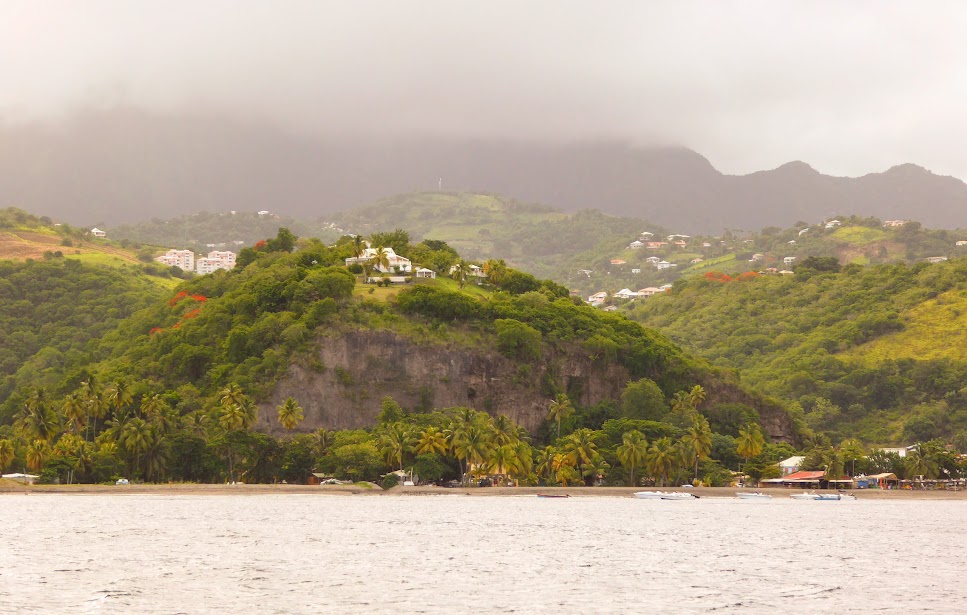
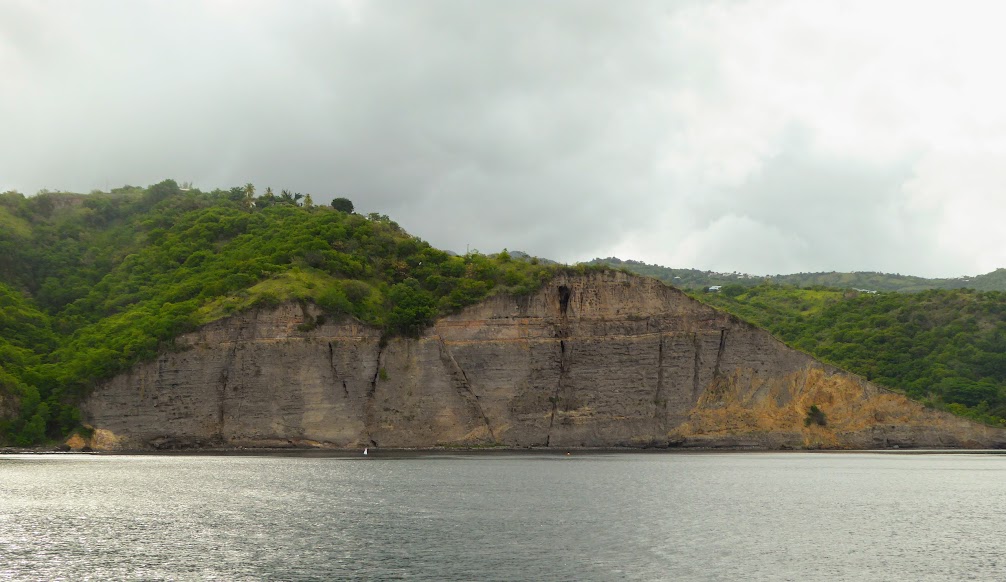
We made our way down the coast, admiring the steep, deep green slopes, dotted with small villages and bright green fields.

Our destination was the small town of Saint Pierre, not far down Martinique’s west side. I found this great geographical map online, marking Saint Pierre, and also showing how  mountainous the island is.

Image result for map of martinique

We approached the quiet town, and anchored at the south end. Local children played in the sand on shore, and we had views of Mt Pele in the distance. In the evenings, the sounds of tree frogs in the hills just off shore was music to our ears. It was relaxing, peaceful and beautiful.

Howard immediately liked Saint Pierre, heading outside as soon as the motor shut off.

He and Scott spend time relaxing on the side deck, taking in the sights and “smells,”


Scott enjoyed a celebratory, end-of-passage/arriving-at-a-new-island cocktail, while Howard enjoyed a post-passage scratch on the dock lines hanging nearby.

Knowing that this doesn’t thrill Scott, Howard will look back, to see if there’s a reprimand coming.

Later, there was play time on Howard’s “jungle gym,” aka our inflatable dinghy. For one reason or another, and always on passages, the dinghy get’s stored on the side deck, and Howard cannot resist jumping up on it.

It is free for cruising boats to clear in and out of the French-owned islands…big plus; cheap wine, bread and pastries…even BIGGER plus! There are usually several locations on the islands (stores and shops) who have a computer on site, and cruisers just have to enter their boat information, etc. and click “print” for clearance papers. There is even an option of clearing in an out at the same time, if you enter your expected date of departure.

The morning after arriving, we went to a local restaurant  just a block from the town dinghy dock,  to use the clearance computer. With the online form in French, the obvious language barrier made filling in our information a bit challenging at times, but the owner happily helped us. He spoke English, and helped me better pronounce a few key phrases (most important: Please forgive me, I’m just learning, and my French is horrible!), and served us cold, Lorraine beer while we finished our check in form.

Now that we were official, it was time to wander through town a bit.

Scott was also thrilled to once again be able to buy Orangina (still another French island plus), which he’s come to love.

We learned that Saint Pierre used to be known as the “Paris of the Caribbean,” and was culturally and economically the most important city on the island. Unfortunately, this town has taken quite a beating over time.

A hurricane pummeled Martinique in 1780. Known as “The Great Hurricane,” it produced a storm surge of 25 feet, which inundated the city, destroying all houses and killing 9,000 people. The devastating storm is the deadliest Atlantic Hurricane on record. Between 20,000 and 22,000 people died throughout the Lesser Antilles Islands, when the storm passed through them from October 10th–16th of that year. Specifics on the hurricane’s track and strength are unknown, because the official Atlantic Hurricane database only goes back as far a 1851.

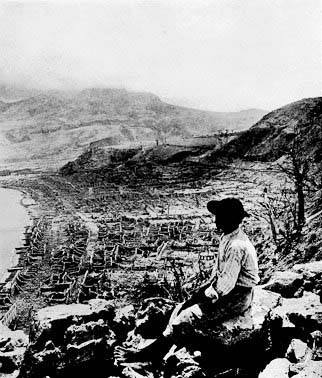
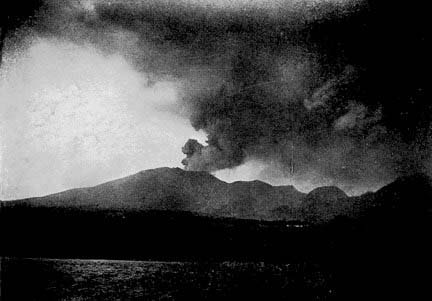
The town was destroyed again in 1902. when the volcano Mount Pelée erupted. It’s destruction dubbed the Mount Pele Eruption the worst volcanic disaster of the 20th century. The eruption killed approximately 30,000 people with a pyroclastic flow (a dense collection of fragments and gases, which is much more dangerous than a lava flow).

Mount Pelée sent a cloud of super-heated gas and dust racing toward the city. Within a single minute, the 1,075 degree pressure wave flattened nearly every building in the city of St. Pierre. Anyone unlucky enough to be in its way would have instantly caught fire and burned to death. Even those in shelters suffocated, as the super-heated wave burned up the oxygen and replaced it with deadly gases; lungs were incinerated from the inside, with even a single breath (gross).

 The deadly eruption completely destroyed the city of Saint-Pierre (which was, at that time, the largest city on the island), within minutes. Approximately 30,000 people were killed instantly; the entire population of the town, as well as people from neighboring villages who had taken refuge there for safety. The city burned for days afterward.

Before:

After:

Apparently, there was considerable eruptive activity in the two weeks prior to the fatal blast, but since pyroclastic flow was not yet understood, the danger was thought to be from lava flows. It was believed the lava would be stopped by two valleys between the volcano and the city.

The main eruption left only two survivors in the direct path of the flow: a prisoner in a poorly ventilated, dungeon-like jail cell, and a man living on the edge of the city, who escaped with severe burns.

Mount Pele is currently in a dormant state, but is registering seismic activity.

The city of Saint-Pierre was never fully restored to its former self. However, it is now referred to as a city of art and history.  There were many reminders of the eruption’s damage, as we walked the streets.


The cathedral in town was rebuilt after Mount Pele’s destruction, and the “new” cathedral looks much different.  Only its lower floor, spared by the pyroclastic flow, was preserved in the reconstruction.

The large cathedral was undergoing a current reconstruction when we visited.

We walked along an upper road, and came to the remains of the Theater of San Pierre.

Able to seat 800 people, we read that it was often booked to capacity, with plays ranging from classical to vaudeville, as well as operas. On evenings when there were productions, the stairs and entrance railings were crowded with vendors, selling oranges, pistachios and sweets. The theater also hosted political meetings, and even balls during carnival time.

Due to economic reasons, the theater was closed, just a year before the Mount Pele eruption. The staircase is still pretty well intact, offering views back out to the Caribbean, but not much remains of the great theater’s interior.

On the other side of the theater wall, and down the hill, are remains of the prison, and it’s cells.

On May 7, 1902, a day before the Mount Pele eruption, Louis Sylbaris, the town troublemaker, ended up in solitary confinement here. Since all records were destroyed, and all witnesses killed by the eruption, what Louis was being imprisoned for is a matter of speculation. He later said it was because of a fight, but the cell he was in would have been where someone accused of a more serious crime, such as murder, may have been held.

Trapped in his cell when the volcano erupted, Sylbaris felt the intense heat from the 1,000-plus degree pressure wave, as ash came flying in through the tiny slot in the door. Suffering from burns and desperate to cool down, he urinated on his clothes and stuffed them into the opening. It was just enough to save him, and four days later, rescuers freed him.

Having survived the worst volcanic disaster of the 20th century, Sylbaris became a celebrity, and toured the world with the Barnum & Bailey Circus. He was billed as “The only living object that survived in the ‘Silent City of Death.'” While the eruption was doomsday for the town of St Pierre, it may have been Loius Sylbaris’ savior.

We made our way back to the high road in town, to an overlook area with views of the sea. Fisherman cast lines off the docks below, to the north, and Sea Life was contently at anchor to the south.

Immediately below us…more of Mount Pele’s devastation.

Maritime commerce increased through the eighteenth century, and by the mid-century,  seven eighths of all the island’s trade came through St. Pierre, as well as that of St. Lucia, Guadeloupe, Dominica and Grenada. With such a high volume of commercial activity, there was a great need for warehouses and shops along the waterfront. As a result, Quartier du Figuier was developed.

Scott and I went down some steep, steep steps, to the road below, to get a closer look at the remains of the buildings.

Warehouses along the Quartier du Figuier held merchandise that had just been loaded off of ships, and also goods waiting to be loaded. Shops stocked items that ships traveling through may need, such as ropes, hoists, anchors, etc. Most of the buildings had upper stories, which were used for residences.

With a full day of wandering behind us, we stopped for a pizza to go, and enjoyed cold Lorraine beer while it cooked. Then it was back to Sea Life, traveling along the historic town’s shoreline, as we made our way in the dinghy.

Tomorrow’s plan…..a day of rum! Here are many more photos, of our stay in Saint Pierre.

“Shells Sink, Dreams Float. Life’s Good On Our Boat!”


Scott Explores St. John

While I was away, Scott had roughly three weeks to explore, and was deciding what to do with his time: Stay in St. Thomas? Wander over to St. John? Venture as far as the British Virgins? With many variables in play, out came the paper charts.

Even though we navigate using both GPS and our iPad, Scott’s still an old-school, paper chart guy. We are lucky enough to have dear friends who spent more than ten years circumnavigating the globe. Kirk and Gisela graciously gifted us a stack of their charts (fyi, paper charts are not cheap!), and Scott often goes to them as an additional source of reference.

He pulled some of Kirk and Gisela’s charts of the British Virgin Islands. Their charts are full of notes about snorkeling and hiking spots, favorable anchorages and even pay phone locations (remember them). We always enjoy reading the notes, and comparing them with current guide books, and the surrounding area.

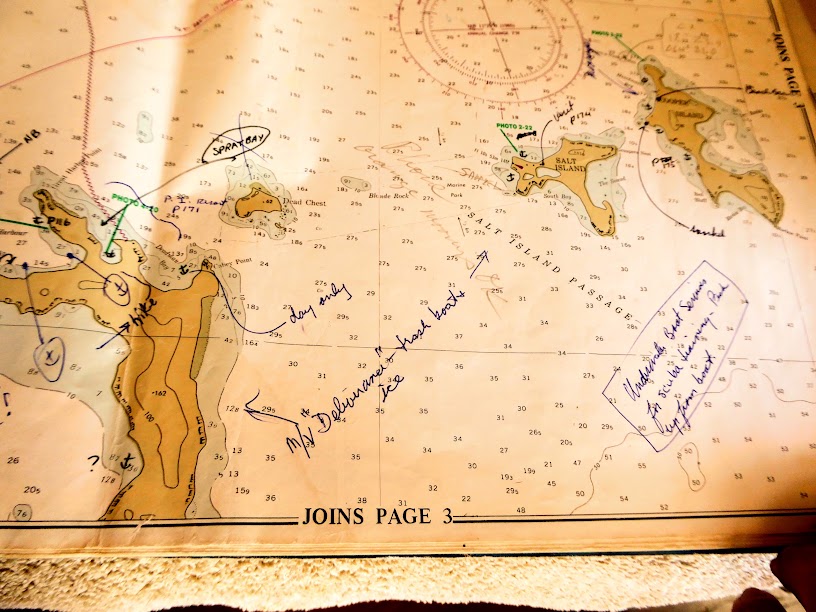
The British Virgins were tempting, especially in May and June, when they would be much less crowded than in winter’s high season. However, traveling there and getting back to St. Thomas in time for my return, with allowances for weather, may not give Scott much time to linger. The fees for the BVIs were more of a concern. He didn’t feel it was worth paying to clear in, and for nightly mooring ball fees, if it was just himself, and not both of us. With no clearance fees for a U.S. Virgins, and cheaper mooring balls (sometimes free), Scott decided to explore St. John instead.

Here are some interesting things I discovered about the U.S Virgin Islands, and St. John, on the good-old internet:

St John is actually a volcanic island, part of a undersea mountain range which includes the larger islands of the Greater Antilles, the Virgin Islands, and the Lesser Antilles. There is a clear geologic record that stretches back some 100 million years, and earliest stages of the island’s formation began when the major continents were closer together. The first stages took place underwater, and the first volcanic flows were later uplifted and exposed. The oldest exposed rocks of St John are still recognizable as separate flows.

Image result for geological map of the virgin islands

Saint John was first settled by the Taino Indians, who migrated north from coastal areas of present-day Colombia and Venezuela, around AD 300. The Arawak inhabited the island until around the year AD 1300, when they were driven off by the more aggressive and warlike Carib (who obviously later inspired a name for the now-popular Caribbean beer)!

Image result for taino indians of the virgin islands

The first European to discover the Virgin Islands was Christopher Columbus, on his second voyage to the New World, in 1493. He first landed on St. Croix, which he named Santa Cruz. He then sailed further north, discovering many more islands. A Catholic, Columbus named the group of numerous islands as Once Mil Virgenes (Eleven Thousand Virgins), in honor of the feast day of Saint Ursula, and the 11,000 virgins who were martyred with her.

Although Columbus was the first to discover the islands, the first Europeans to settle the virgins were the Danish. In 1671, Denmark clearly ruled St. Thomas, establishing the first permanent settlement there. By 1718, Denmark’s settlements expanded to St. John (They are credited with naming the island, in Danish: Sankt Jan), and in 1733, Denmark purchased St. Croix from France, uniting the three Virgin Islands.

Because the island provided perfect conditions for growing sugar cane (intense heat and fertile soil), sugar plantations were soon abundant throughout St. John, with slave labor being shipped in from Africa. The local Carib and Arawak populations were also enslaved, to the point of extinction.

Related image

Related image

In 1917, during the First World War, the United States purchased the Virgin Islands for $25 million dollars from the Danish government in order to establish a naval base. Their intent was to prevent expansion of the German Empire into the Western Hemisphere. As part of the negotiations for this deal, the U.S. agreed to recognize Denmark’s claim to Greenland, which they had previously disputed. The U.S. Virgin Islands are an organized, unincorporated territory of the United States, which means its residents are U.S. citizens, but they cannot vote in presidential elections.

More than 5,000 acres on St. John, about half of the island, is preserved and protected by the Virgin Islands National Park Service.
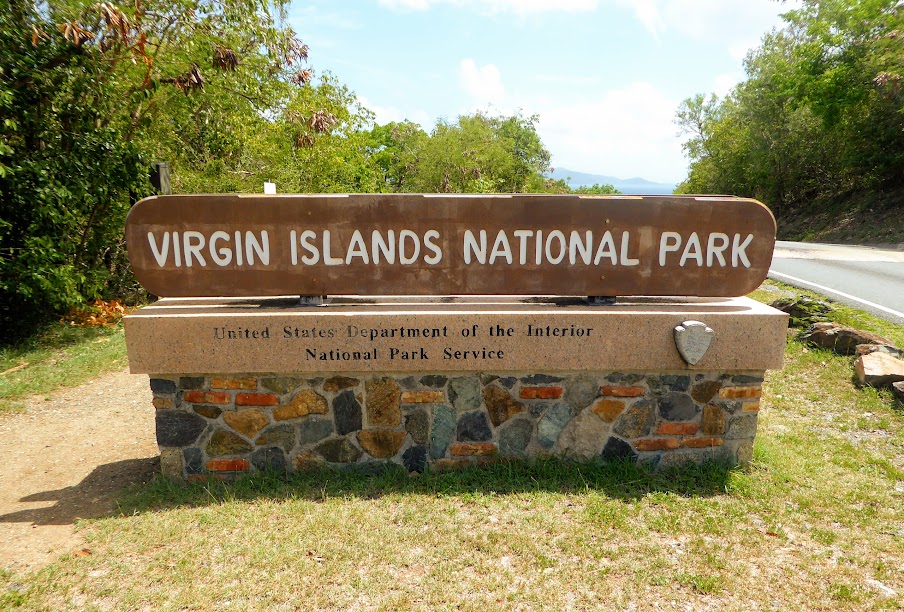
Laurance Rockefeller, John D. Rockefeller’s son, visited the U.S. Virgin Islands by cruise ship in the 1950s. So moved by the island chain’s incredible beauty, he promptly purchased 5,000 acres on the island of St. John.

Rockefeller began construction of a resort on Caneel Bay, and in 1955, began developing an infrastructure on the island to provide the resort with power, fresh water and roads.

Photo of LSR at Caneel Bay


https://s3.amazonaws.com/files.smartertravel.com/uploads/2014/04/brochure-1956-2.jpg

He oversaw every detail of the development personally, and then in 1956, donated the land to the National Park Service, with the contingency that the land never be developed.

Image result for laurance rockefeller's virgin islands national park

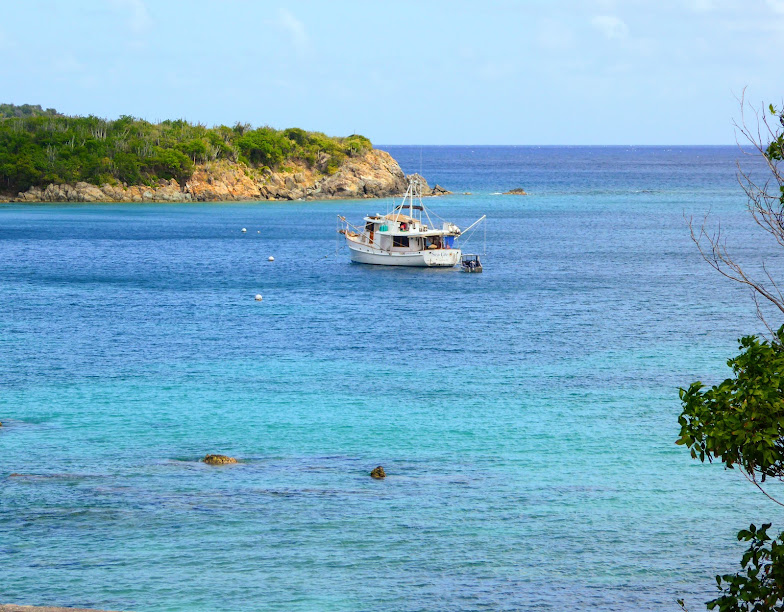
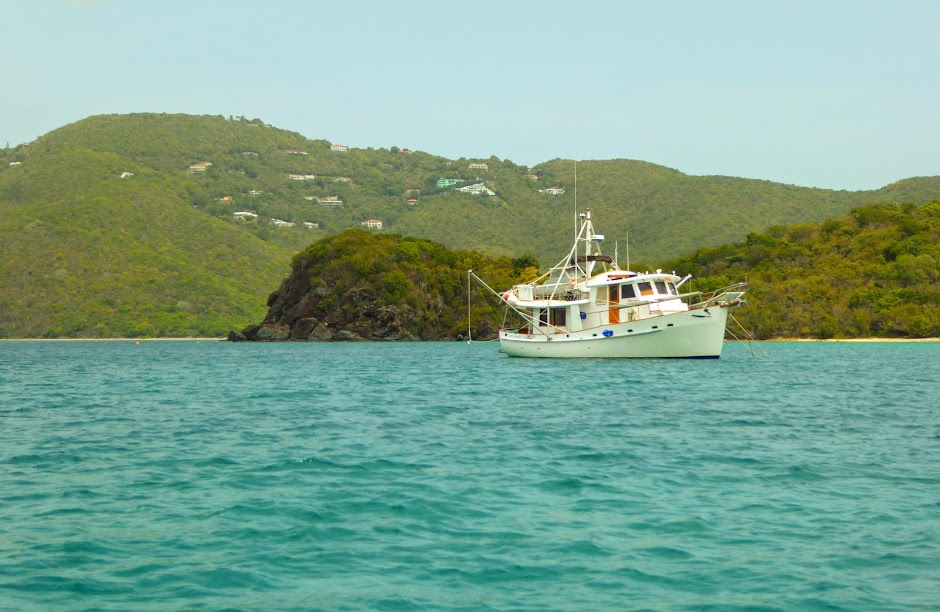
Ok, ok….back to Scott.  He and Howard made the half day trip, around St. Thomas and over to St. John, and the anchored in Maho Bay, on the island’s northeast side. Along the way, views of massive houses; once there, a beautiful sunset.
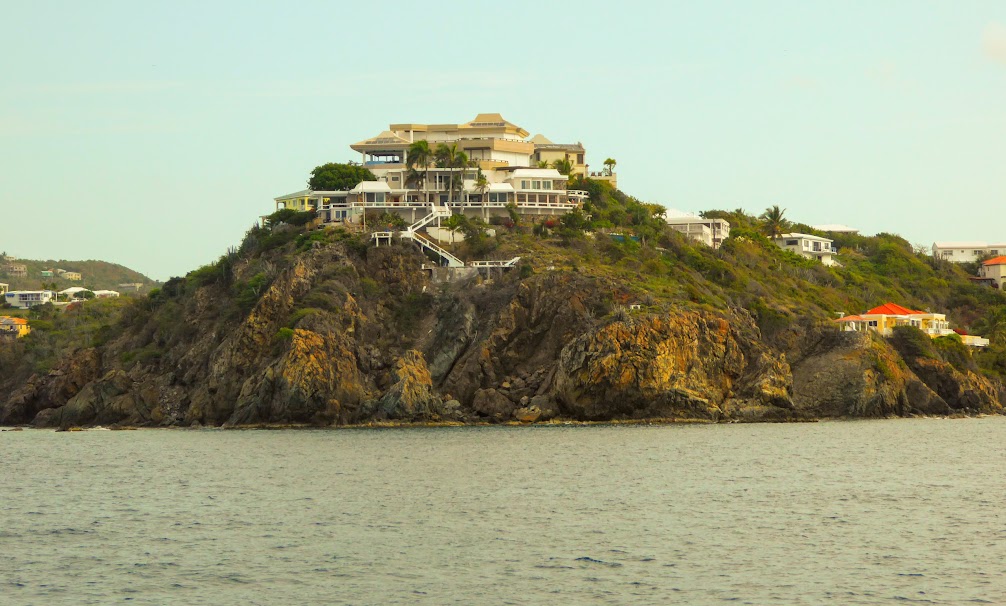
From there, he headed around the eastern end of island, to Round Bay. While there, he visited Angel’s Rest Bar, run by Capt’n Peter.
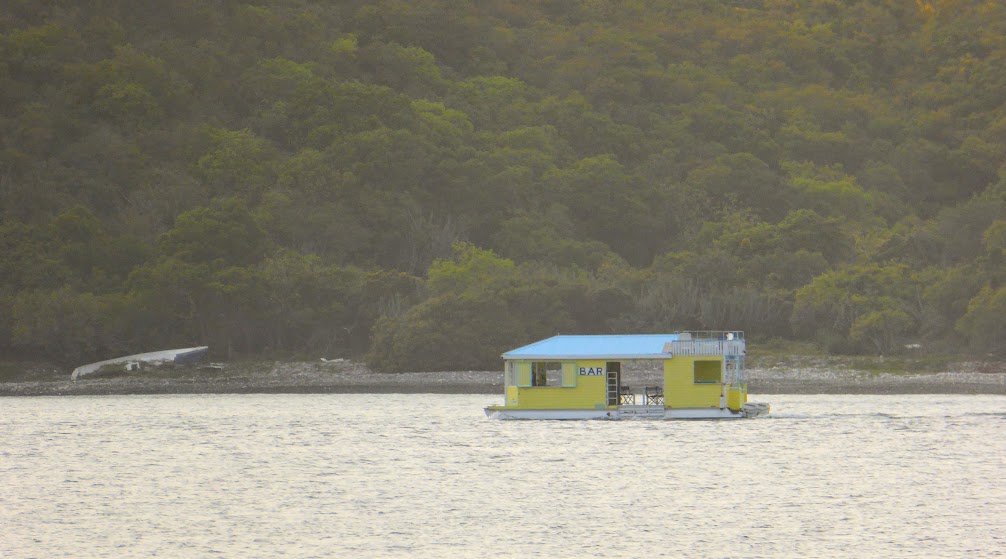
On most days, the bar travels from it’s home in Coral bay, around to an area called Hurricane Hole Bay. Anchoring off of different beaches, it opens for business and patrons swim out to buy drinks and spend time (scary, when you consider that they have to swim back, after said time). The bar offers two things: a cup of beer, or a cup of rum with a splash of punch, each for $5.00. The bar closes when Capt’n Peter gets too drunk, or the alcohol runs out, whichever comes first.

Next, Scott headed to Little Lameshur Bay, on the south side of St. John, for some hiking.
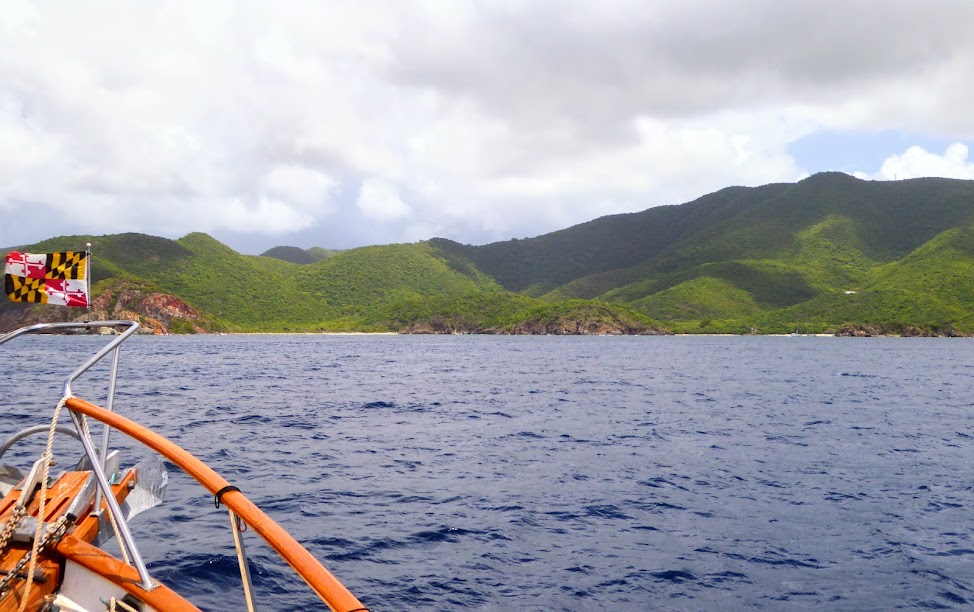
He planned to walk  around to Reef Bay, and do the Reef Bay hiking trail (fyi, Caribbean Travel and Life Magazine lists the 2.5 mile trail on St. John as one of the 10 best hikes in the Caribbean). The path to Reef Bay took him past several ruins, and offered scenic water views.
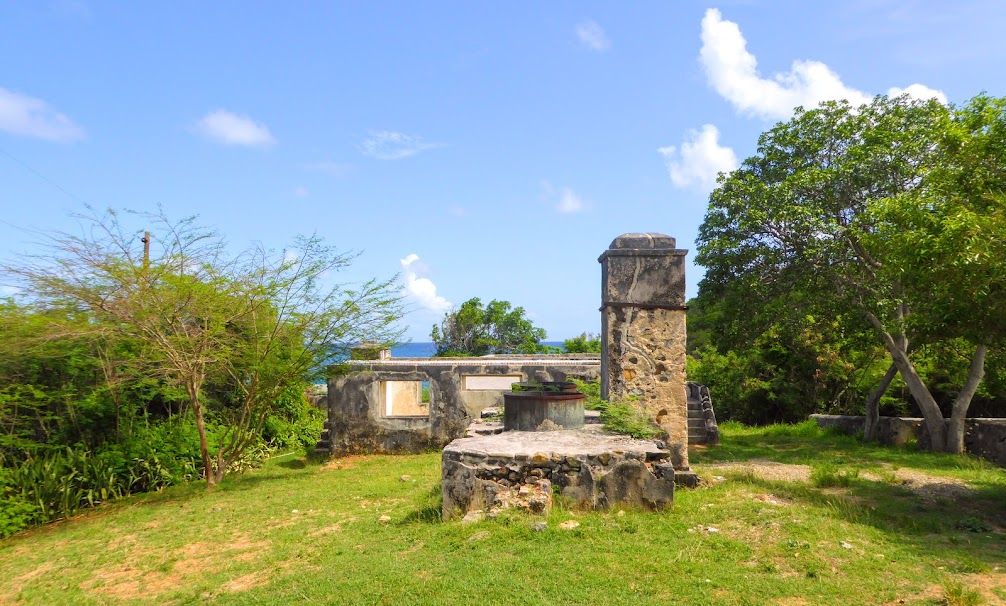
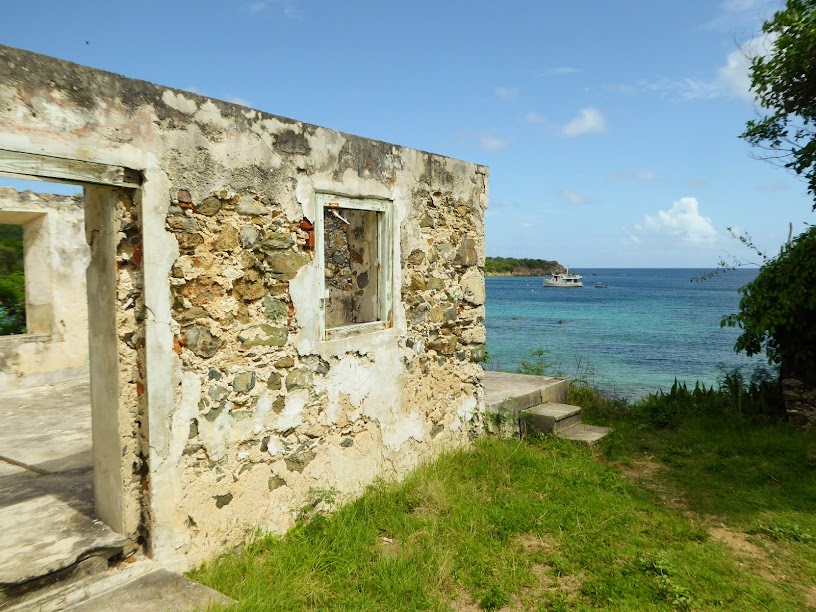
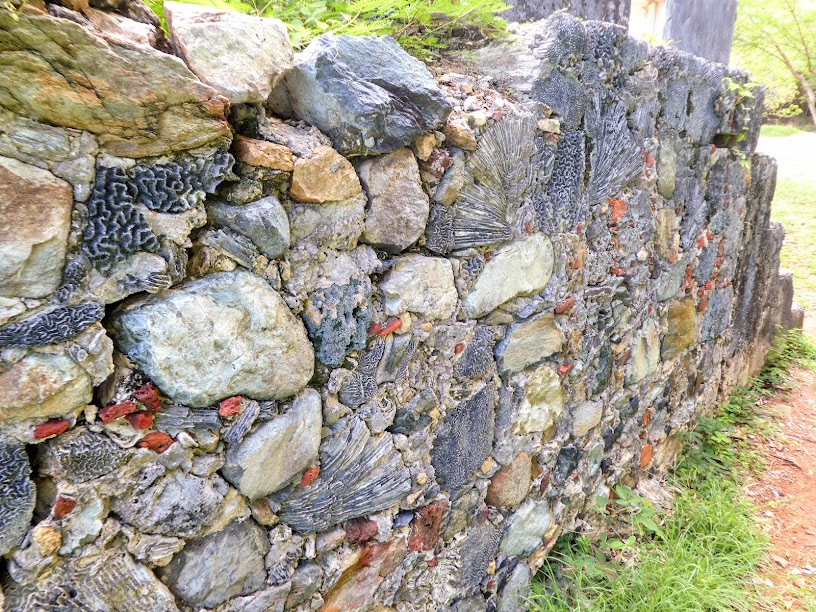
He also passed a wall constructed of rock and brain coral. This coral was very useful as a building material, as it could be easily cut when still wet to fit into unusually-shaped areas. It was then put in the sun to dry, where it would harden.
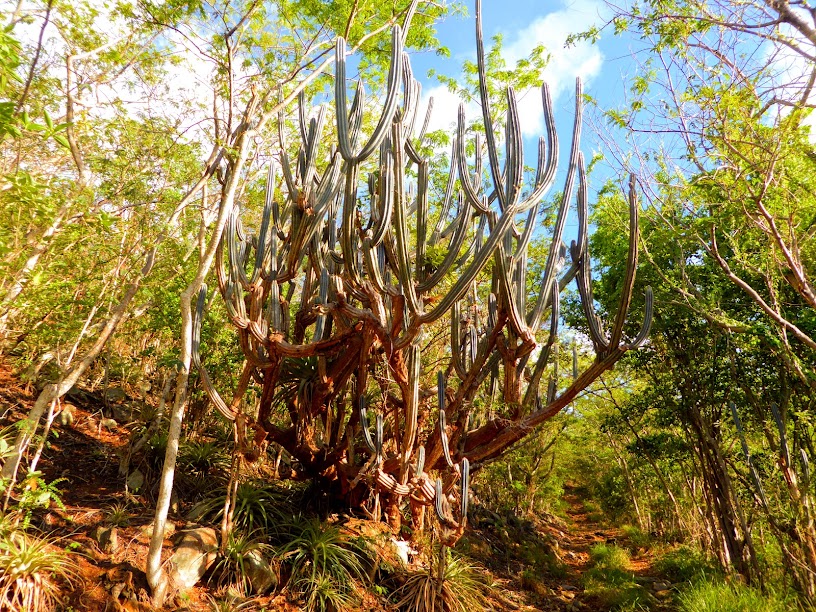
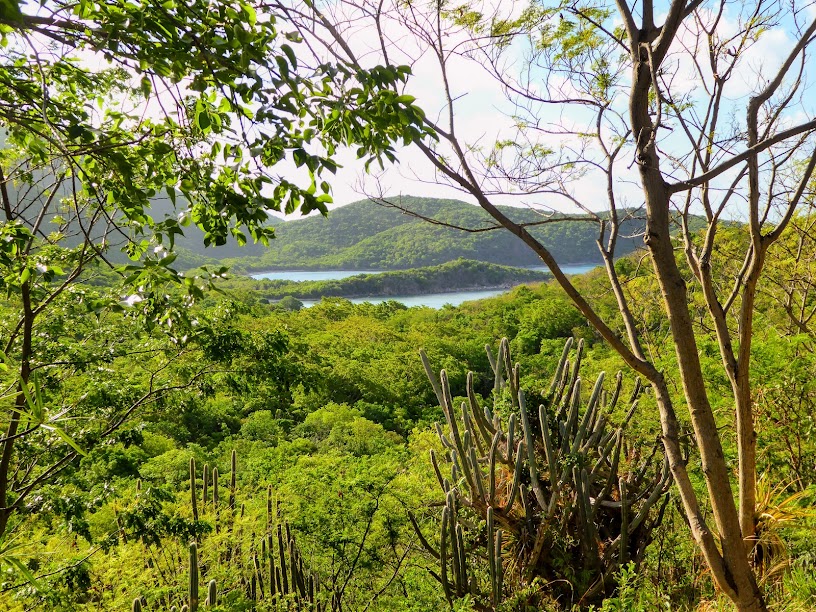
Although very green, Scott was surprised how arid St. John was, as he passed by many large cactus plants along his way. Since leaving Mexico, in March of 2016, we’ve been surrounded by wet, tropical foliage.
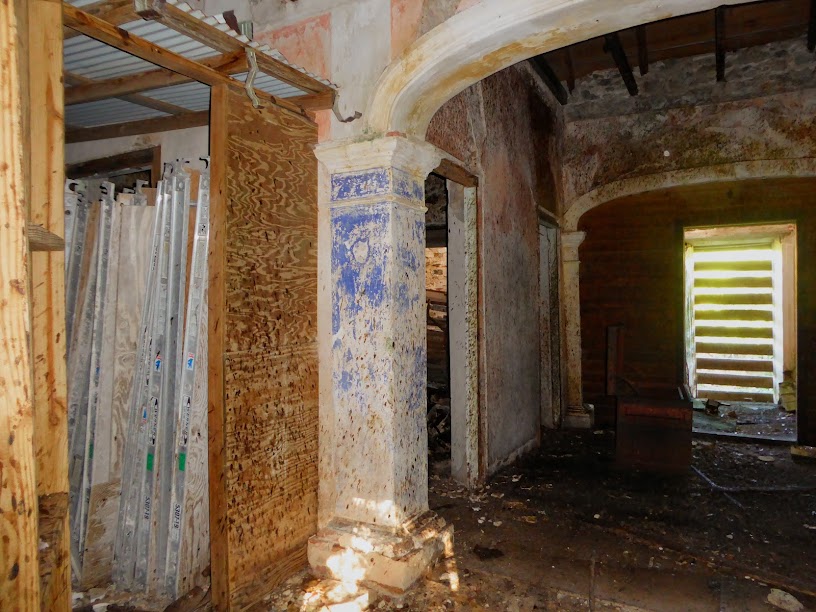
Eventually, he came to Reef Bay, and the ruins of the Reef Bay Estate House.

The house was built in 1832, and reconstructed in 1844. In 1994, it was partially renovated by the National Park Service. After being cleared in 2009, the historic estate house has been left to deteriorate.

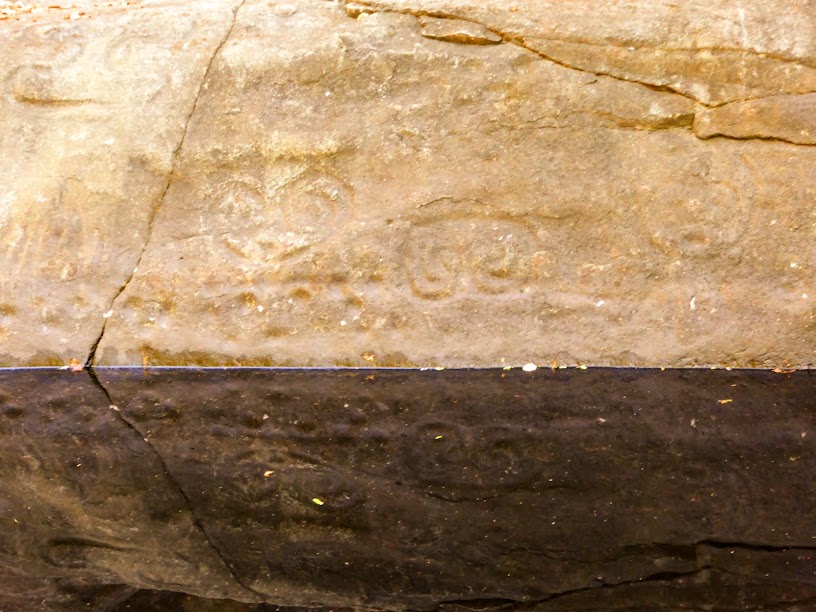
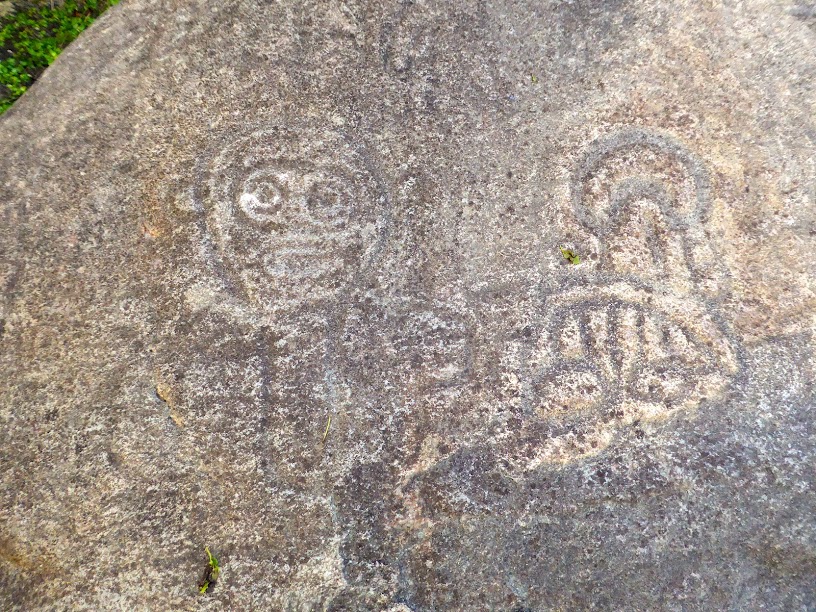
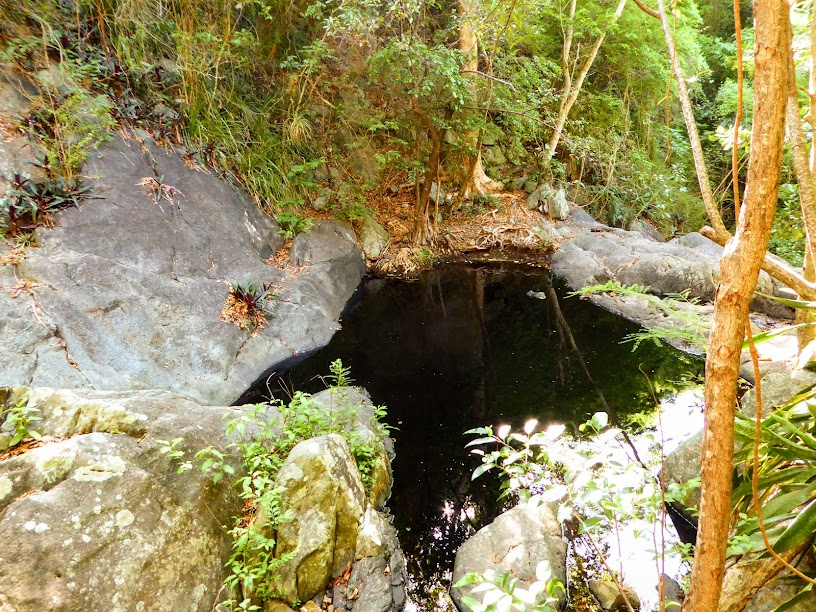
Next, Scott came upon the famous St. John  petroglyphs, They are rock carvings made by the Taino Indians, as early as 500 AD. The petroglyphs depict faces and symbols, and are situated along the edge of a spring-fed pool. The pool level never changes, so the carvings are always perfectly reflected in the water.
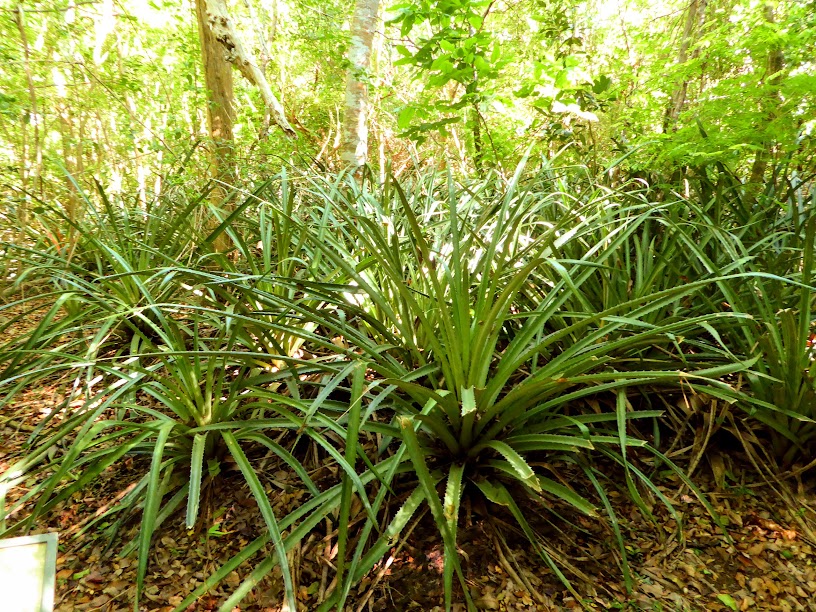
Scott passed many field stone walls, and wild pineapple. The plants thorny leaves made for good use as barrier hedges and living pasture fences.

Finally, Scott came to the ruins of the Reef Bay Sugar Mill.
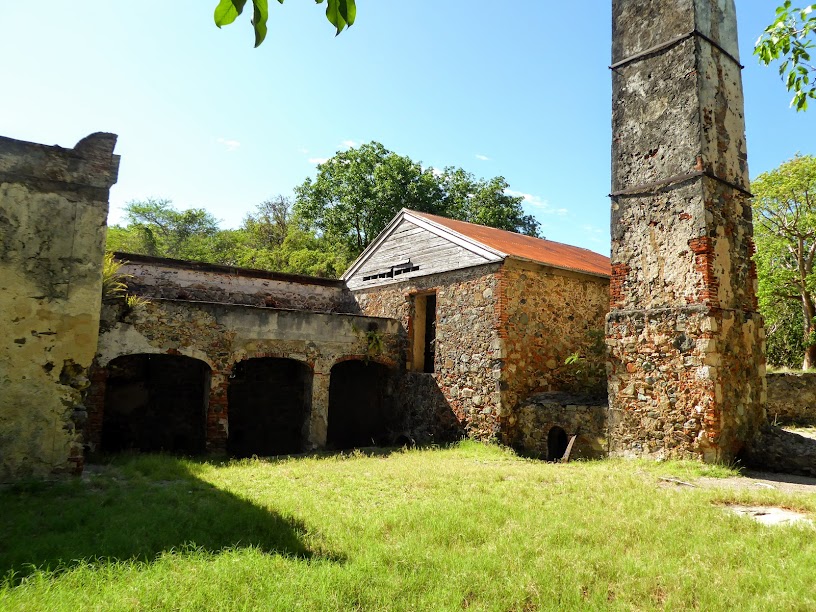
The sugar mill industry died twice on St. John. In plantation days, slaves brought bundles of cane to the horse mill to be crushed.
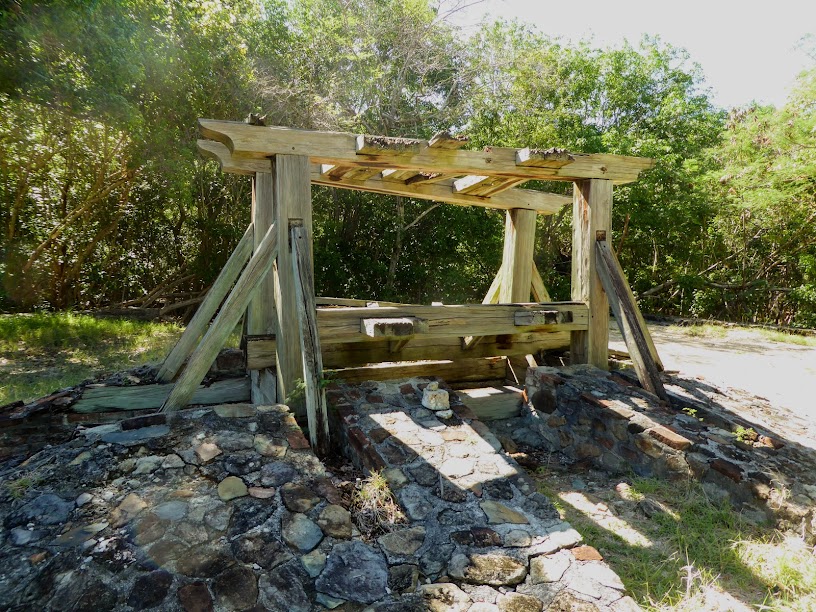
Sugar mill

After Denmark abolished slavery, and St. John’s other mills began to collapse, Reef Bay’s new owners tried to revive the dying industry by installing steam power to crush the cane (the first of its kind). This one was built in Glasgow Scotland, in 1861, and is in surprisingly well intact.
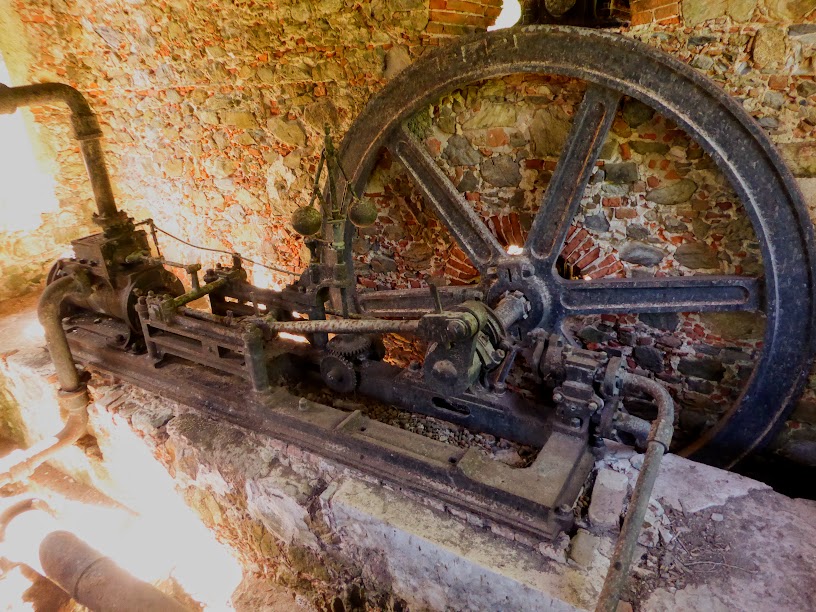
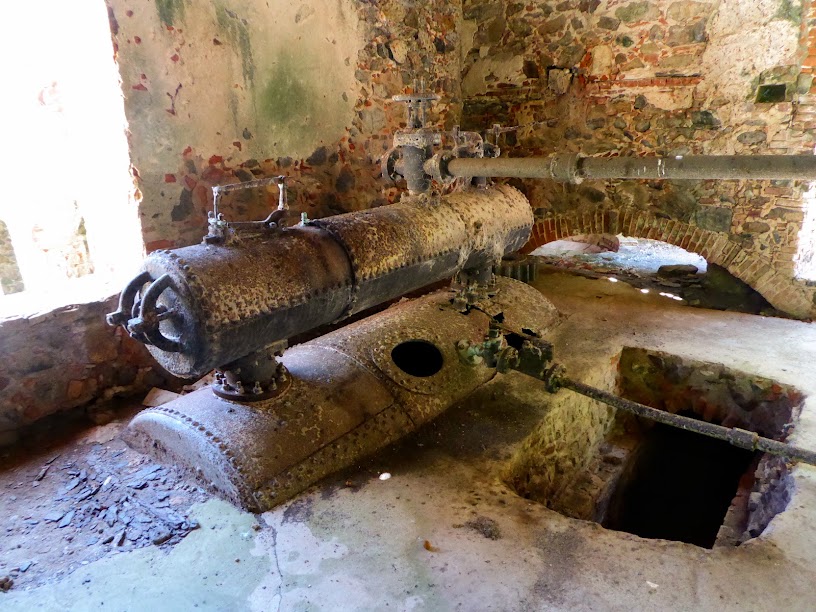
By the early 1900s, a depletion in soil nutrients from sugar cane overgrowth, in addition to the introduction of the sugar beet in Europe, led to a decline in St. John’s sugar production. Reef Bay was the last operating sugar mill on the island, and most of the property was sold to Rockefeller’s conservation project in 1955.
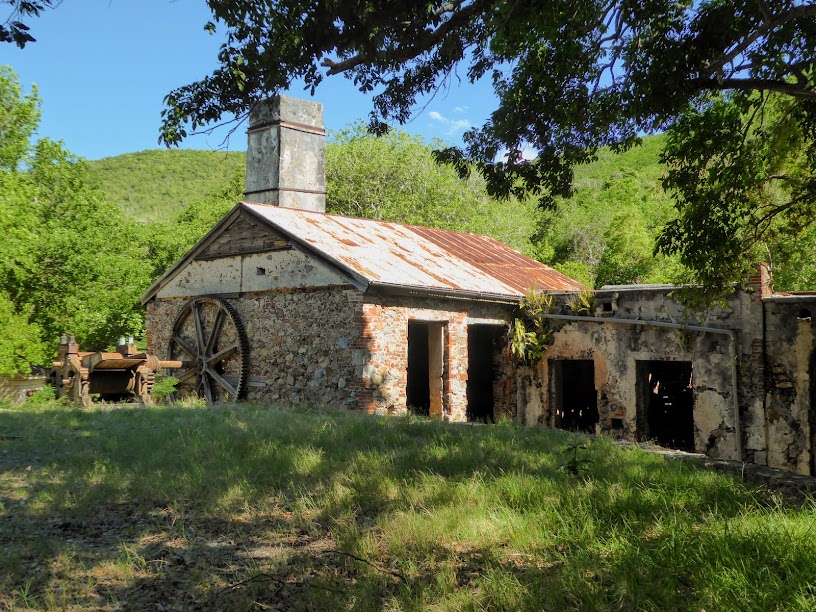
Scott enjoyed more views of Reef Bay, before heading back to Sea Life, moored in Lameshur Bay.

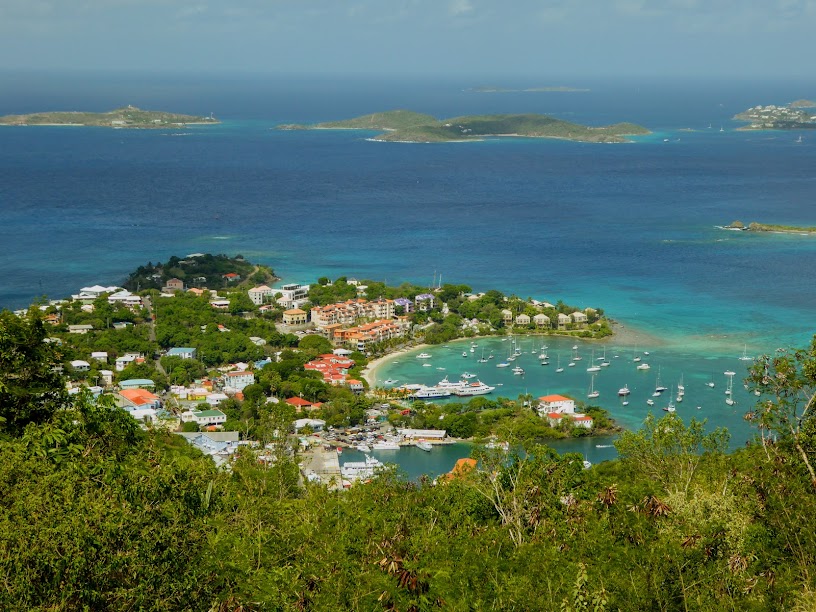
Next stop, Caneel Bay, with more views of huge houses, and a sunset overlooking the British Virgin Islands.
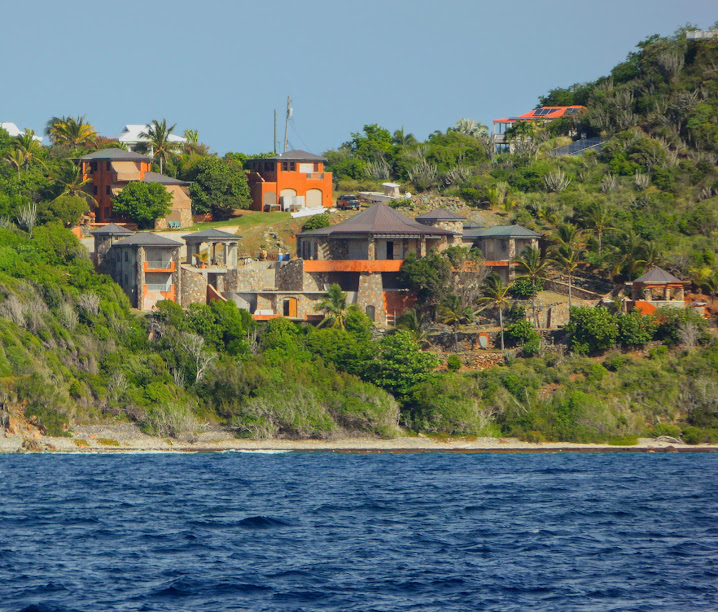
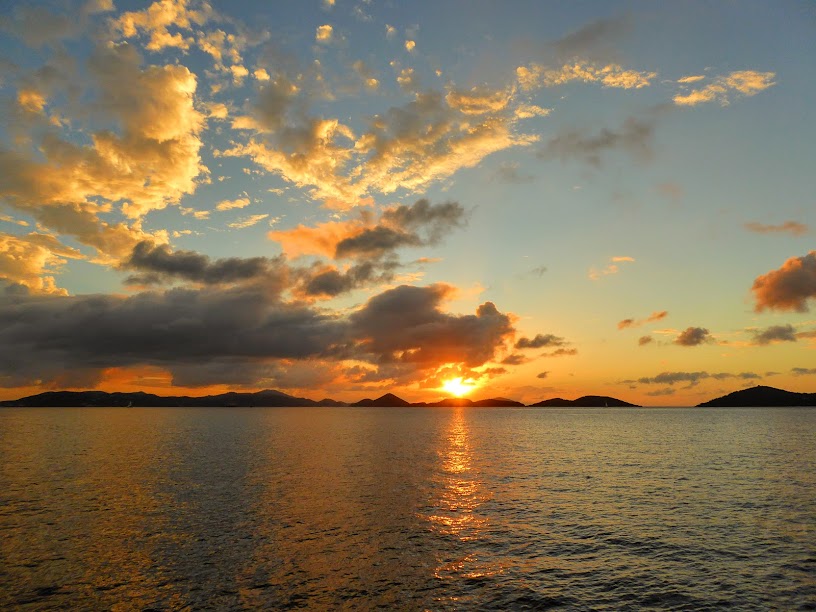
While moored in Caneel Bay, off of the famous Caneel Bay Resort, Scott noticed the beach tightly lined with lounge chairs…not a normal sight. With a lazy day in the sun already planned, Scott set his chair in the sand, and then wandered down the beach for a look-see.

As he neared the resort, it became clear that each lounge chair had it’s own snorkel gear, towel and logo-ed tote bag. People were milling about, and as Scott chatted with one or two of the guests, he learned that there was a company function going on; a pharmaceutical company was celebrating the release of a new drug.

On his way back through the throng of lounge chairs, Scott was stopped by a server, who offer him a drink. He politely declined…until the third offer; after that, it was open season. Several cocktails later, a server came over to announce that lunch was being served in the nearby tent…excellent! Scott helped himself to a plateful of food, and then returned later, through the back of the tent, for seconds.

Wanting to preserve good karma, Scott “paid it forward,” by sharing the intel on how to gain a free lunch with a young, budget-challenged-looking couple who’d set up camp on the beach near him. Feeling that he’d kept his good karma intact, Scott headed back to Sea Life with a belly full of free food and drink, and enjoyed a post party-crashing nap. A satisfying day all around.

Over the next day or so, Scott saw many turtles moored, and hiked up the island for a stunning views of Caneel Bay, the resort below, and the Brisith Virgins off in the distance.
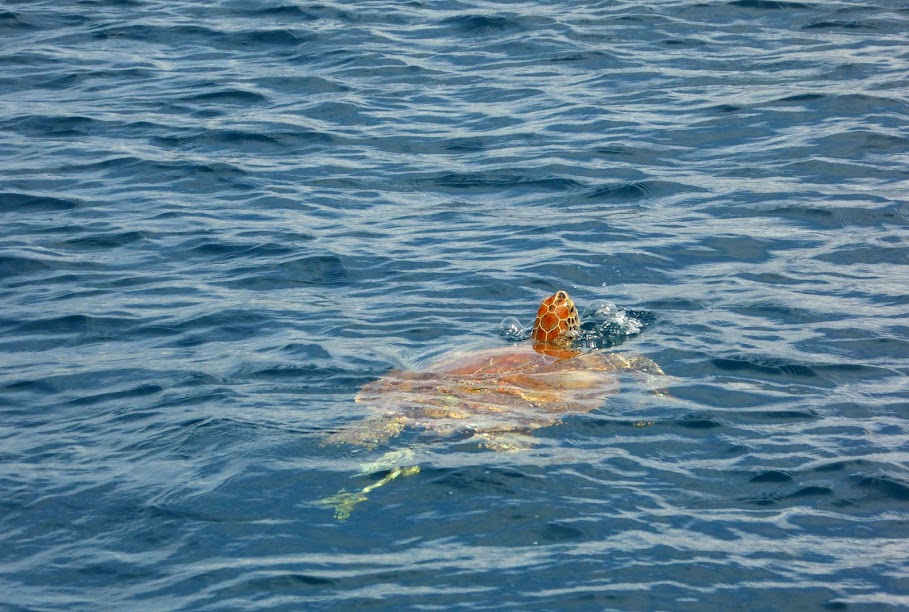
And of course…Sea Life moored below.
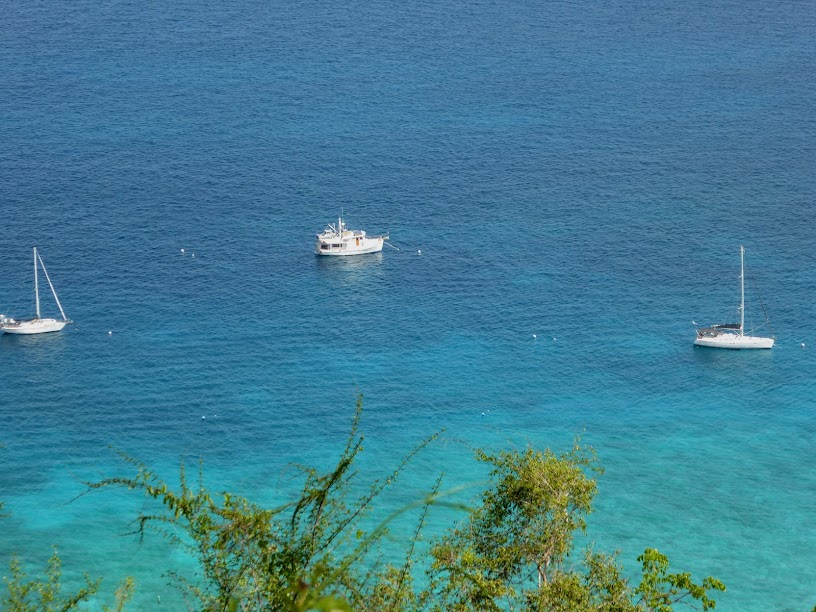
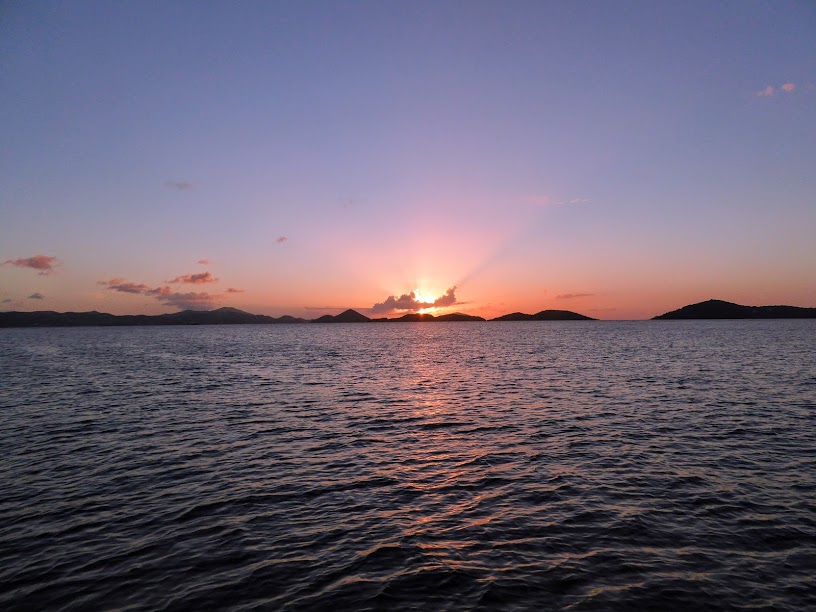
By now, Scott had circumnavigated, and conquered, the island. He enjoyed one last St. John sunset, and then made his way back to St. Thomas. I was flying back from the states, and it was time to set Sea Life on a path to Grenada.
Here are many more photos, Scott’s time in St. John.

“Shells Sink, Dreams Float. Life’s Good On Our Boat!”
 

St. Thomas, U.S. Virgin Islands…Scott And I Part Ways, Just For A Bit

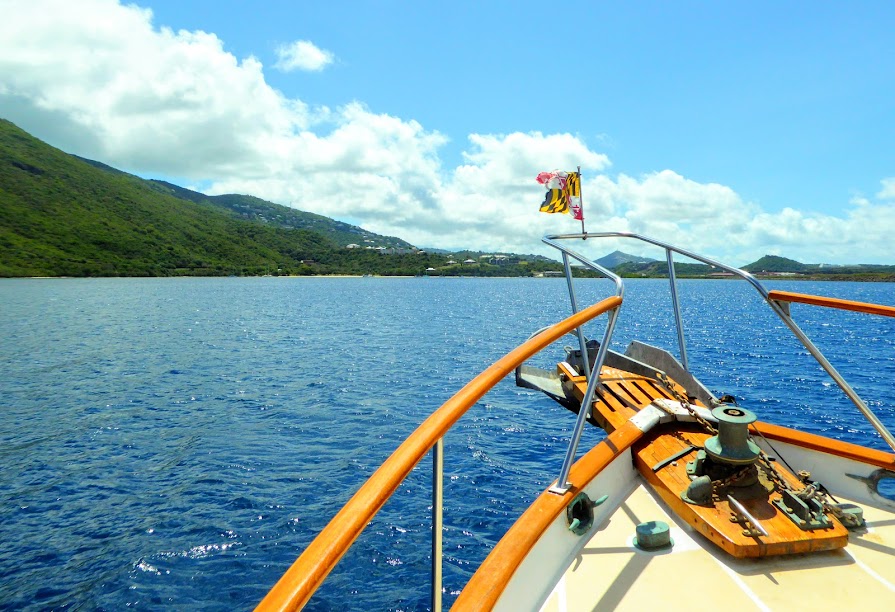
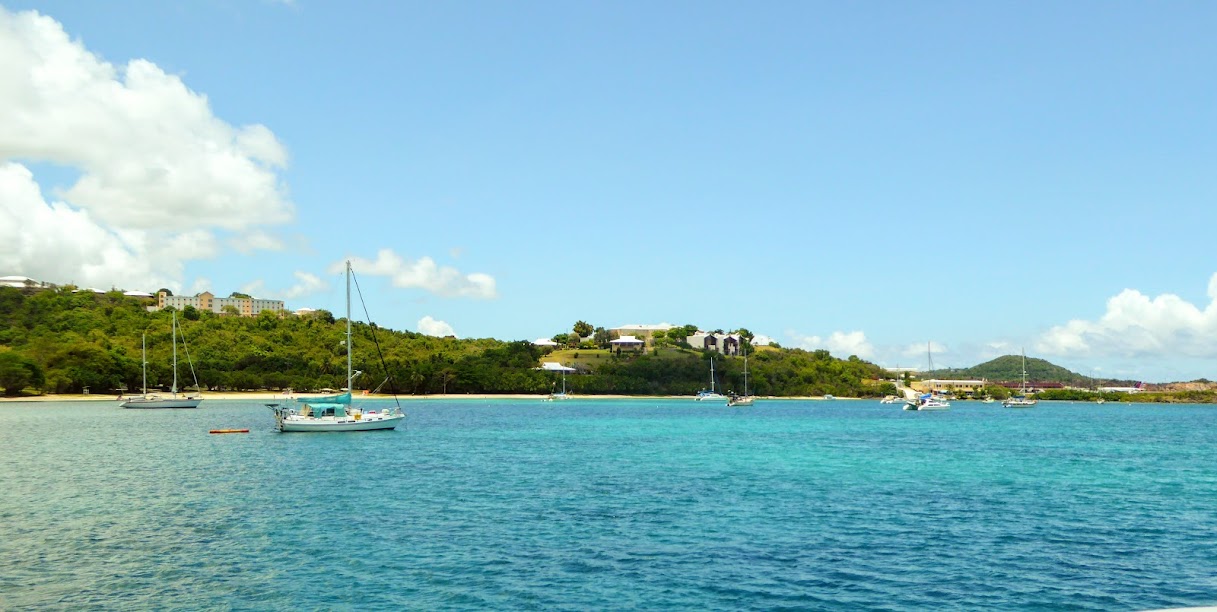
The trip from Culebra to St. Thomas was a bit bumpy, but uneventful. We enjoyed the passing scenery, while heading for our anchorage in Brewer’s Bay: rocky islands, huge houses under construction, green hills and blue water. Howard felt it his duty to make sure we were on course.


We chose to anchor in Brewer’s Bay for several reasons: it was a quick ride to the airport, for me to fly in and out, it was much less crowded than the bays closer to the town of Charlotte Amalie,  it had easy beach access for leaving the dinghy and from there it was just steps to the main road.

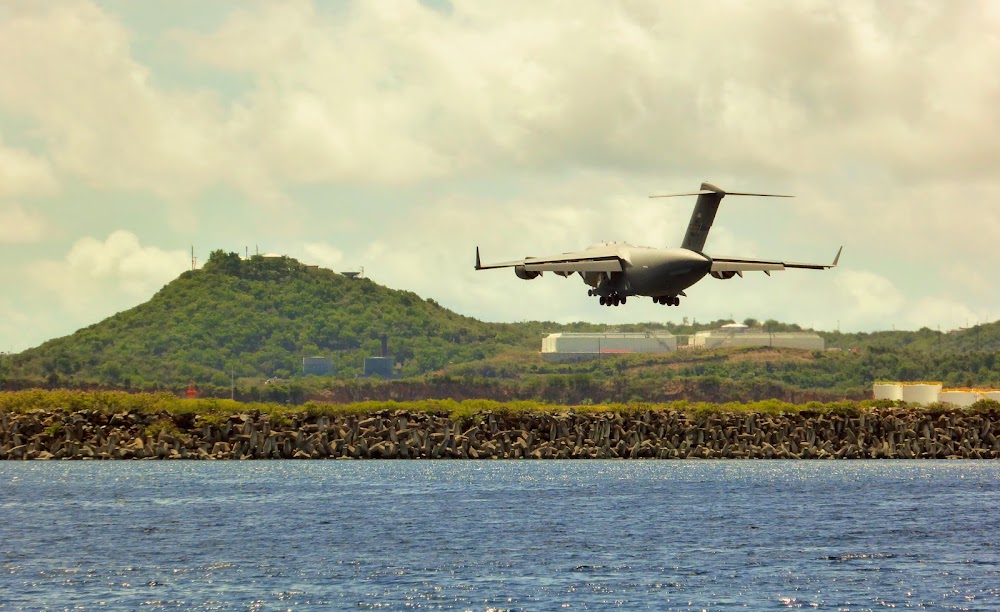
The anchorage was definitely close to the airport..

Really close….

However, the views on the other side of the bay more than made up for the incoming and outgoing planes:

We also came to Brewer’s Bay to meet a couple who had been following our blog. Tristin and Martina had recently began cruising, and we’d exchanged emails about  questions and concerns as they prepared to leave. They are the first blog followers that we’ve gotten to meet in person, and it was fun to spend a bit of time with them, before I headed back to the states.

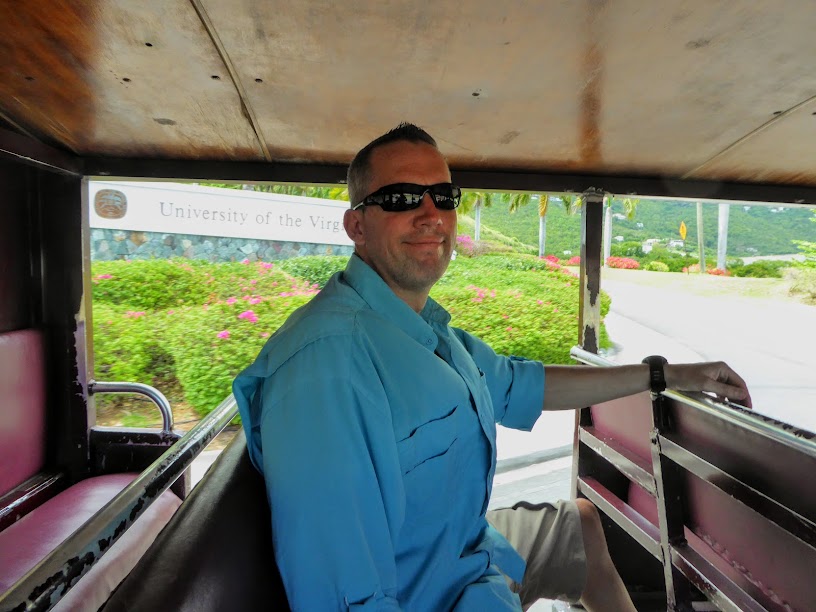
We’d made some good easting from Puerto Rico to St. Thomas, and I could just as easily fly home to the states from here. Before I left, our first order of business was to stock Scott up with food (and drink) while I was away, so we headed for a grocery store. Safari buses service the island, for $1.00 per person, per ride, and it was just a short walk (up a steep hill) to catch one that would take us to town.

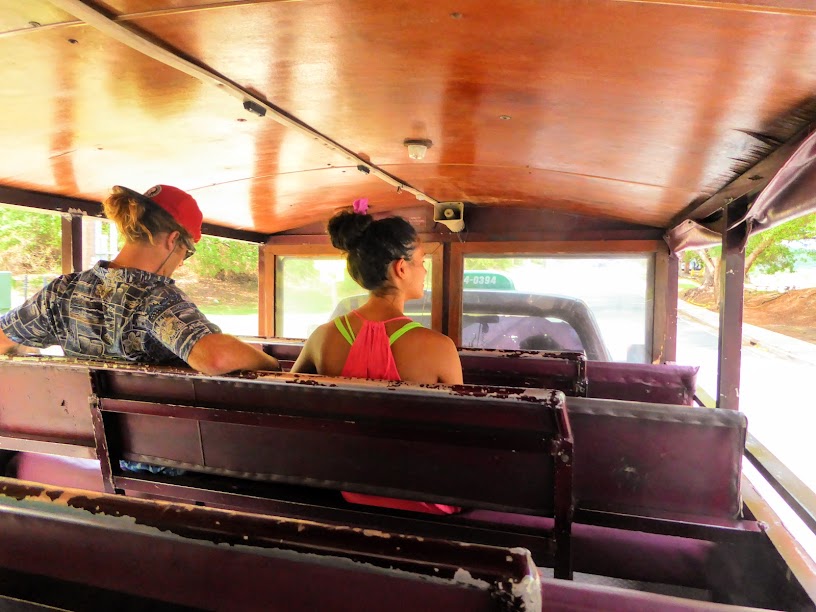
There were doorbell-like switches that ran along the ceiling of the trucks. When you neared your stop, just ring. As we jumped out and paid the driver, Scott thanked him with a friendly “Gracias!”  He’d obviously need time to undo 15 months of Spanish language on the brain.
We found a grocery store that was ok, and a liquor store that had one of Scott’s favorite spiced rum’s he hadn’t seen since leaving Key West. There was also a gourmet food store, where we chose some hard to find goodies, but no food for everyday meals. Before heading back, we walked through the cruise ship terminal’s duty-free stores. The stuff may be duty free, but they more than make up for that in price; it ain’t cheap.

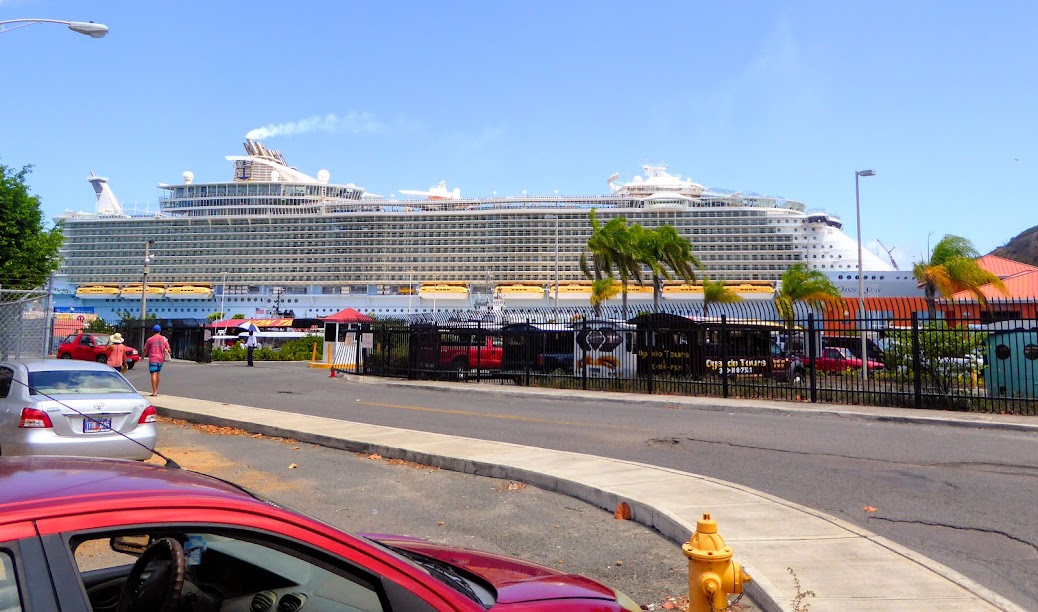
Of course, St. Thomas is a popular cruise ship port. We’re always amazed at the size of these things, and how they keep getting larger and larger; like small cities!

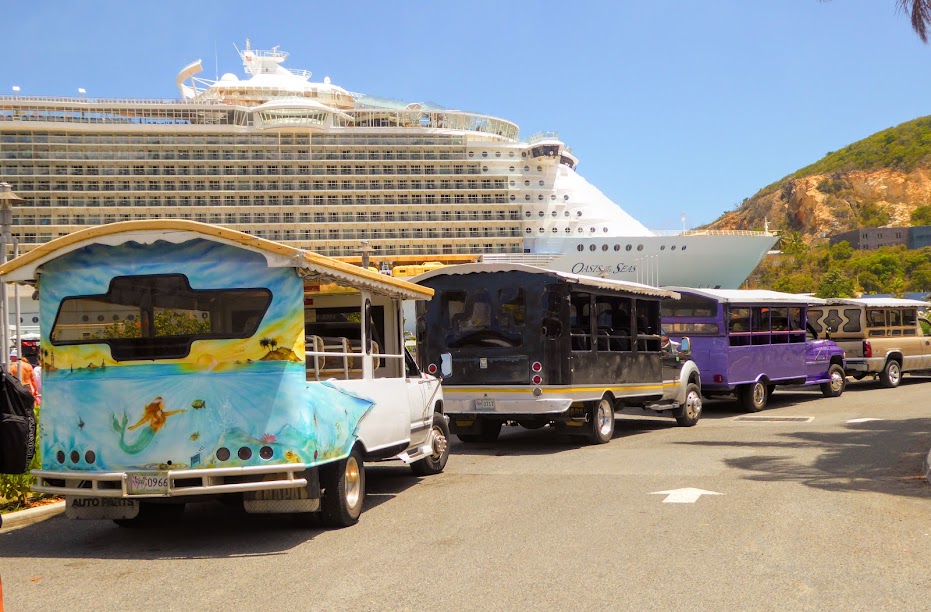
We passed all sorts of safari trucks, waiting to take disembarking passengers to their excursions, tours and shopping in town.

We arrived back at the dinghy at Brewer’s Bay beach, only to discover that someone had tried to steal the motor. They’d gone to great lengths to try and get it off the back of the dinghy, even though it was locked securely to the boat, and the boat was securely locked to a tree (with a stainless steel chain). They managed to break the pull-start and damage the fuel line in, along with getting tons of sand inside the dinghy while they were at it.

Needless to say, Scott  was more than miffed. We’d traveled 15  months, through Mexico, Central America, Panama and Cartagena, without any kind of attempted theft whatsoever. Not three weeks back on U.S. territory soil, and bam, an issue….welcome home.

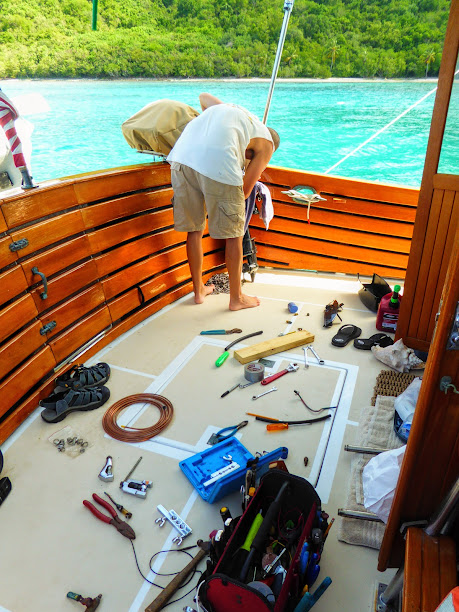
Scott managed to get the motor started, and once we were back on board Sea Life, and had unloaded our things, he got to work fixing the damage, with the cockpit becoming his usual workshop.

Without to much trouble, Scott repaired the motor, Macgyver-stye, and rewarded himself with an Aluminum Princess excursion.

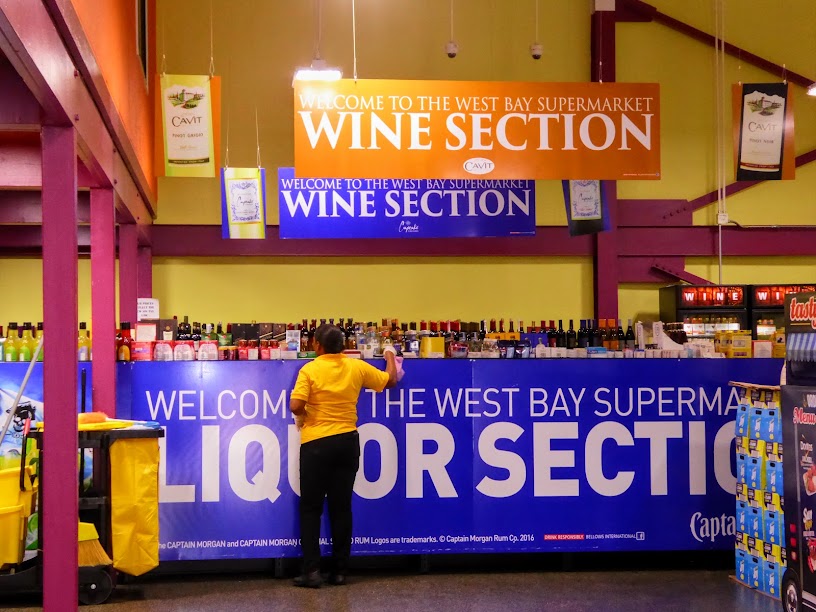
Martina told us of a new grocery store that had recently opened, in walking distance of the anchorage. Scott did a recon mission, and came back with a good report, so one morning we walked up the hill and down the other side, to the store. It wasn’t eye-catching from the road, you’d hardly notice it as a grocery store, but inside was a different story.

They had a great selection of wine, beer and liquor, as well as a decent choice of produce and meat. I loaded up on items to make meals for Scott, and he grabbed some lunch meat from the friendly deli lady.

The boat was stocked with food and drink, and I was off to Virginia. Tristin and Martina had bought a car for their stay on the island, as she was working as a nurse at the nearby hospital. She was nice enough to taxi us over to the airport, and I was off, leaving Scott and Howard to have some “bro-time” aboard Sea Life.

Here are a few more photos.
“Shells Sink, Dreams Float. Life’s Good On Our Boat!”