Tropial Weather Comes Knocking

If you follow our Delorme tracker path, on our Where Are We Now page, you already know that we are still at anchor here off of Bullocks Harbor on Great Harbour Cay. (If you zoom out on that page, you can see our original path in, and out attempt to move on Wednesday, when we turned around. You can also see our trip through the mangroves. We took the tracker with us)

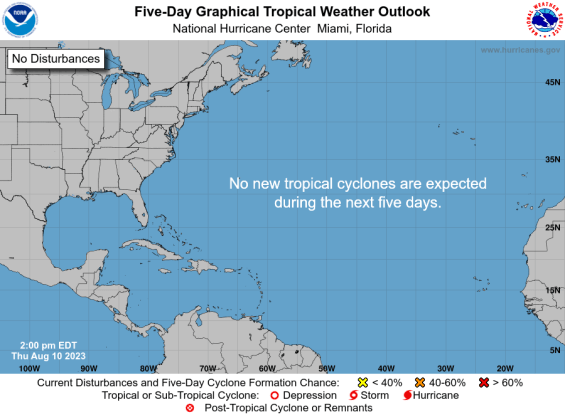
We’ve had a close eye on a tropical wave in the area, that has developed into a low pressure system.  The wave now has a closed off eye wall, and is beginning to strengthen. A tropical wave can become a low pressure system, the low pressure can become a tropical depression, an onward to hurricane status.  Here is the current path of the system:

Chances are very very good, that we could have gone ahead as planned, and anchored on the Atlantic side of the islands. This thing won’t even be a tropical storm as it passes. We are on the far edge of the projected path, and it’s very likely that we’ll get little effect from it. However, not knowing how good the area is for holding our anchor in big wind at the next location, we decided that it’s not worth the risk for blue water.

The National Hurricane Center finally has an eye on this and keeps moving it more and more west, which is not good for us, so we’re keeping an eye on today’s development. The hope is that it stays to our east, in which case we’ll just stay here at anchor and wait it out. If it does keep moving farther west, we’ll go into Great Harbour and get a slip at the marina tomorrow morning. So…here we sit.

Aside from all of that drama, things are good. Howard keeps nightly watch out on the pulpit….all the way out onto the pulpit.

It makes me so nervous, but he loves the smells.

We also enjoyed another beautiful sunset, that Scott captured along the way.

For those of you looking for something to do on a Sunday morning, check out the updated link to Howard’s many photos here

“Shells Sink, Dreams Float. Life’s Good On Our Boat!”

In Sight Of The Bahamas, But Waiting On The Wind

Our hope was to leave Fort Lauderdale on Friday or Saturday, and make our way to Bimimi, in the Bahamas. Unfortunately, Mother Nature has a different plan. Here is the forecast:

NORTHEAST WINDS 15 TO 20 KNOTS INCREASING TO 20 TO 25
KNOTS LATE THIS EVENING. SEAS 6 TO 8 FEET WITH OCCASIONAL SEAS TO
10 FEET BUILDING TO 11 TO 13 FEET WITH OCCASIONAL SEAS TO 17 FEET
AFTER MIDNIGHT. DOMINANT PERIOD 6 SECONDS. INTRACOASTAL WATERS
ROUGH IN EXPOSED AREAS. SCATTERED SHOWERS WITH ISOLATED
THUNDERSTORMS.
MONDAY
NORTHEAST WINDS AROUND 25 KNOTS. SEAS 11 TO 13 FEET
WITH OCCASIONAL SEAS TO 17 FEET. DOMINANT PERIOD 8 SECONDS.
INTRACOASTAL WATERS ROUGH IN EXPOSED AREAS. ISOLATED SHOWERS.
MONDAY NIGHT
EAST NORTHEAST WINDS 20 TO 25 KNOTS. SEAS 9 TO
11 FEET WITH OCCASIONAL SEAS TO 14 FEET. DOMINANT PERIOD 8
SECONDS. INTRACOASTAL WATERS ROUGH IN EXPOSED AREAS.
TUESDAY
EAST NORTHEAST WINDS 20 TO 25 KNOTS. SEAS 7 TO 9 FEET
WITH OCCASIONAL SEAS TO 11 FEET. DOMINANT PERIOD 8 SECONDS.
INTRACOASTAL WATERS ROUGH IN EXPOSED AREAS. ISOLATED SHOWERS IN
THE AFTERNOON.
TUESDAY NIGHT
EAST NORTHEAST WINDS 15 TO 20 KNOTS. SEAS 5 TO
7 FEET WITH OCCASIONAL SEAS TO 9 FEET. INTRACOASTAL WATERS
CHOPPY IN EXPOSED AREAS. ISOLATED SHOWERS.
WEDNESDAY
EAST NORTHEAST WINDS 15 TO 20 KNOTS. SEAS 4 TO
6 FEET WITH OCCASIONAL SEAS TO 8 FEET. INTRACOASTAL WATERS
CHOPPY IN EXPOSED AREAS. A CHANCE OF SHOWERS.
WEDNESDAY NIGHT
EAST NORTHEAST WINDS 15 TO 20 KNOTS. SEAS
5 TO 7 FEET WITH OCCASIONAL SEAS TO 9 FEET. INTRACOASTAL WATERS
CHOPPY IN EXPOSED AREAS. A SLIGHT CHANCE OF SHOWERS.
THURSDAY THROUGH FRIDAY
EAST NORTHEAST WINDS AROUND 15 KNOTS.
SEAS 4 TO 6 FEET WITH OCCASIONAL SEAS TO 8 FEET. INTRACOASTAL
WATERS A MODERATE CHOP. A SLIGHT CHANCE OF SHOWERS
Now the boat could more than handle this…me, not so much. Northeast puts us right into the waves, which means UP……and DOWN, and repeat, repeat, repeat for seven or so hours. ICK!
This isn’t anything tropical, but the result of a high pressure system being wedged in close proximity to a low pressure system. The winds squeezed in between become pretty fierce. On shore, we’re having 25 mph winds, with much bigger gusts, and in the Gulf Stream, it’s much worse.
The winds have blown the sand onto and across the street.
In some areas it’s worse that this, covering the entire street. There are still people on the beach. It has to be painful. The breaking waves go out as far as you can see.
It really picked up last evening, with winds howling all around us and constant noises from one thing or another being shuffled around by the big gusts. Currently here in our slip, things are pretty bumpy. It’s also affecting our large neighbors. When the big boats are moving around, you know it’s windy!

It appears that our next chance of getting out of Florida is the middle of next week…sigh. To keep from busting our budget here at Las Olas Marina, much as we’ve enjoyed our stay, we’re going to leave here in a day or so and head further south along the Intracoastal (yay, more narrow channels and bridge openings!!). The plan is to anchor in the Key Biscane area. We can anchor there for the next week, and head out to the ocean from there once things settle down.

On a Howard note: he went walkabout yesterday, jumping off of the boat and exploring other peoples’ (this was his “M-O” at our marina in Baltimore). I had to get him off our “neighbor” across the way, who is listed for sale at 3.3 million dollars! Scott was having a heart attack as I climbed on board to get him. Howard is now on lock-down!

“Shells Sink, Dreams Float. Life’s Good On Our Boat!”

Hurricane Joaquin

We’ve had several friends contact us, worried about us being affected by Hurricane Joaquin. Not to worry! We are fine, and out of harm’s way.

This time of year, hurricanes tend to swing north, and eventually east, versus going west, like they tend to do in July. As those of you who live in the mid atlantic know, the area is more likely to be in the path of something tropical in September and October.

Here is the current predicted path of Hurricane Joaquin:

Image result for predicted path of hurricane joaquin 2015


We have enjoyed great weather here in St. Augustine, aside from some heat and humidity. Things cool down this weekend, thanks to a front that is also keeping Joaquin out to sea, and away from us.

We have our eye on the storm, and are keeping our fingers crossed that our friends and family in the Baltimore area dodge a bullet!

“Shells Sink, Dreams Float. Life’s Good On Our Boat!”

A Rainy Day In Beaufort, SC

We chose to take the Intracoastal south, to Beaufort, SC, instead of making our way to Florida in the ocean. Here’s why:

Here’s why we’re waiting until tomorrow, to go out (we’re the green dot):

It’s steady raining here today, so we’re laying low. We’ll leave tomorrow afternoon, for a 24 hour or so run toward Fernandina Beach, Fl.

“Shells Sink, Dreams Float. Life’s Good On Our Boat!”

Squeezing South Toward Beaufort, SC

<< Previous | Next >>

This morning, we left Charleston at about 9:30. Scott was aiming for slack tide (when the tide is neither coming in or going out, resulting in near zero current), making it easier for us to get out of our slip. The currents around the marina make docking a challenge.

We  had planned to go out of the inlet, and do an ocean run to Fernandina Beach, Florida, but the weather isn’t cooperating.

Lesson courtesy of Scott, dumbed down by me:

There is a strong low pressure system off of the coast, causing stronger than normal winds, and bigger than normal waves. Usually, a high pressure system will come along an move it, or the natural progression of weather will move it off shore. However, this thing is stubborn. It won’t move, and has had the eye of the National Hurricane Center. However, by all accounts, it should be out of our way by the weekend, allowing us a more favorable ocean passage.

In the meantime, instead of paying for three or four more days at a slip, we decided to weave our way south toward Beaufort SC (I was recently reminded by my good friend, and experienced cruiser, Sue, that you are always headed toward somewhere, and not to somewhere, never knowing what weather and water will bring). The Intracoastal from Charleston south is in sad shape. It hasn’t been kept up well, due to the economy, and budget restraints. It has many areas that have “shoaled,” or filled in, from here all the way through to south Florida. Sea Life draws more water than our last boat, so we have to be even more careful than normal navigating this time.

Our plan is to hit the shallowest points at higher tide, getting the best water level. So far, we’ve squeezed through two of them. Scott meant to photograph one area, where the channel markers are clearly off of where the “pink line” of the chart plotter tells you to go. He’s always preaching to me to watch the water and the depth finder, as opposed to the “pink line,” and today is a reason why. So far, we are snaking through just fine, even after passing this channel marker that is almost completely submerged, at low tide. At high tide, it won’t be visible at all:

Good thing Howard is “happily” on watch:

We’re seeing many oyster beds along this route. They are very visible, with the big tide change in this area. Unfortunately, you cannot eat them, as they spend too much time out of the water. Fortunately, there are a great many of them, resulting in cleaner water!

The hope is to make Beaufort, SC this evening, but depending on tide and current, we may settle for somewhere north of that. We don’t intend to go into Beaufort, choosing to do a night or so on a mooring ball. I’m still wading through things here on board, finding permanent places for toiletries, canned goods, etc. A day at anchor, with no landfall, allows me to catch up a bit. On Friday, we plan to head out of the Beaufort inlet at midday, for a 24 or so hour run to Fernandina Beach inlet, which is just inside the Florida border.

We don’t plan to be at a marina, plugged into power and with endless water, for another 2-3 weeks, so this will be a good test run for the near future of our life “on the hook!” Here are more photos.

“Shells Sink, Dreams Float. Life’s Good On Our Boat!”

Alligator River to ALMOST Oriental, North Carolina

<< Previous | Next >>

So remember our trip to Willoughby Bay, just north of Norfolk, where I said that “It’s a hell of a day at sea!”?? Well today, we squashed that. And I mean really squashed it…kinda like this:

We started out from our anchorage on the Alligator River, with the plan to end the day in Oriental, NC. The route takes us from the Alligator River, into the Alligator River-Pungo River Canal, then into the Pungo River. After that, we enter the Pamilco River and then on to the Neuse River, by way of several smaller rivers.

Oriental, NC sits on the Neuse River, and they have a free 48 hour dock for boaters. It’s a small town, with very friendly locals. On our last trip south, a car did a u-turn to pick up Scott and me as we were walking back from West Marine in the rain. Unheard of in Maryland….or just about anywhere else.

Along the way, we decided instead to anchor about 30 minutes from Oriental, and not deal with coming into town to find the free dock full, or worry about having enough water level there (we’ve heard that it’s good for boats with 5 foot and under draft, and we’re 5).

So our day was going fine. The terrain along the way is really cool. A mix of grasses, dead trees and swampy shoreline, with some interesting housing mixed in for extra interest.

As we were entering the Pamlico River, a line of storms caught up with us. Skies got dark, and the rain came on fast, accompanied by thunder, lightening and wind gusts of 38mph. No, this isn’t the “squashed” part.

All in all, though, it wasn’t bad. The winds didn’t kick up the waves much, like you’d think they would. Soon, the storm line passed, and we continued on through the Pamlico River, and eventually into the Neuse River….HERE is where we get squashed.

The wind forecast was for 10-15 knot winds, with gusts to 20, from the southwest. Not an issue for us, as we are heavy, and roll slowly. Quick information, for those who may not know:

The Neuse River is similar to the Chesapeake, in that is an overall shallow body of water. This causes waves to kick up faster and steeper than deeper water. South wind at the base of the bay, near Norfolk, don’t produce big waves (for the most part), as the wind hasn’t had time to travel and build them.

By the time you’re up near Annapolis and Baltimore, however, the wind has traveled a distance, and has built bigger waves. The shallow water also causes the waves to be closer together, or have a shorter wave period. So stronger south winds can be a miserable go in the middle and upper bay. The reverse is true for north wind, which makes things worse by the time it gets to the southern bay.

Ok, lesson over…

So we’re in the Neuse, in the south winds, that shouldn’t be a problem for us, as they are FORECASTED. However, we all know how a forecast can turn on a dime. Instead of winds 15-20, with gusts up to 25…WE, at the flip of a switch, got sustained 25-30 knot winds, which translates into about 28-35 mph winds….sustained, meaning constant. Our gusts were 46 or so mph, and they were often. Another tidbit of note, the power of wind quadruples, when it’s speed doubles…yay for us. You may think that I’m embellishing this..I’m not.

Waves quickly built to 3 and 4 feet, with many 5 footers thrown in. This may not be a big deal to some boaters, and we were in no danger of capsizing or sinking by any means, but it was insanely unnerving. Our bow is eight feet above the water line, and the windows of the pilot house are another five or so feet higher than that. We frequently had waves spraying onto the windows:

Scott installed an awesome paravane system, but we need to be in at least 20-25 feet of water to deploy them. Curses!

A set of big waves would hit, and we’d go UP, and then…DOWN. The down was definitely the more nerve wracking. Scott just kept watching the wind get stronger,  and the waves get bigger. Going up and down so drastically slowed our speed. We went down to 2 knots, and at that speed wouldn’t reach our anchorage before dark. Scott altered course a bit, which allowed us to speed up.

As we inched toward shore, the waves and wind finally started to calm. Howard tolerated all of it like a champ, which shocked us both. I think he was so scared, that he went into a catatonic (no pun intended) sleep.

We eventually made our way into the South River, off of the Neuse, and anchored in a creek. Scott kicked himself for not looking at the NOAA weather fax, but they are usually most useful in ocean waters. Live and learn.

Thankfully, tomorrow should only be a four hour or so trip to Beaufort, NC. Hooray! Here are our photos from today.

“Shells Sink, Dreams Float. Life’s Good On Our Boat!”
Welcome To Norfolk??

<< Previous | Next >>

A long, eventful day! We started out of Olverson’s pleasantly, everyone relaxed and ready for a long day. Not two hours later, before we were even out of the Potomac, things picked up a bit, causing Howard to go into full seasick mode. I managed to get a anti-vomiting pill in him, and he and the water settled down.

We got lucky for a long while, with big current behind us, despite the wind coming at us we moved along pretty well. The big wind and waves held off until about 4pm, as predicted. We were getting a pretty good fetch off of the ocean, as we got closer to Norfolk, which sent Howard back into seasick mode. With an empty stomach, and anit-vomit meds still in him, all he could do was howl and drool.

So while we’re pitching around, he’s trying to find a place to vomit, and I’m trying to chase him with a towel, to catch it, in case he actually did vomit. After spending some time panting on the salon floor (where is was close to 90 degrees), he eventually settled into his litter box.

Now we’re approaching Willoughby Bay, and our anchorage for the night, and we spy a helicopter hovering over the water, with a cable coming down from it. Not that it wasn’t odd enough to see a helicopter towing something by a cable, but this thing was kicking up a massive amount of water and spray around it:

While we’re trying to figure out what the heck is going on with the helicopter, Scott notices that the channel markers were all askew. He then remembered reading that the channel had shifted, and was now marked with floating, relocating markers. This made our chart plotter worthless, and Scott had to do some old school navigating, while keeping an eye to make sure that the helicopter wasn’t going to swing toward us, bringing the wall of water.

Once we navigated through the floating markers, Scott stumbled across a note about the helicopter, on our Ipad navigation system: (prepare for Coast Guard-speak)

“Helicopter Mine Countermeasures Squadron Fourteen (HM-14) routinely conducts airborne mine countermeasures (AMCM) operations utilizing the MH-53E helicopter at low altitudes over the following inland and coastal waterways.(I skipped the listed locations)

During these operations, the aircraft will be operating at altitudes as low as seventy-five feet and will produce localized winds in excess of 125 miles per hour. Rotor wash produced winds pose a considerable hazard to vessels, especially sailing vessels. The devices the helicopters tow range in size and appearance from a large orange and white sled approximately the size of a pick up truck to slightly submerged steel pipes thirty feet in length, both of which have submerged cable extending well beyond the visible portion of the towed device. The Aircraft Commanders have been directed to exercise every effort to conflict and avoid surface vessels.

“All mariners are requested to remain well clear of the helicopters, the towed devices, and the area extending directly behind the aircraft for four hundred yards. Do not approach or cross the area directly behind the towed device as a submerged hazard exists regardless of whether the device is in motion or stationary.”

“These operations involve large naval helicopters at flight altitudes of 100 feet or less, towing surface and sub-surface devices at speeds up to 25 knots. Helicopters may be identified by a rotating amber position light on centerline of main hull flashing 90 times per minute. An area of hurricane-force winds exists within a 250-foot radius around these helicopters, sufficient to blow people and objects from exposed decks and capsize small craft. The towed devices may be completely invisible and include large cables on or just below the surface streaming up to 1200 feet behind the aircraft.”

So now we have navigated the new channel, know what’s up with the helicopter and that it’s not going to turn near us. We now have to navigate to find a place to anchor, through a mine field of crab pots (no crab pots in sight two years ago, when Scott was bringing the boat up from Ft. Lauderdale).

We get anchored, knowing that we’ll have to be careful getting out of the snarl in the am, and I go off to locate Howard. I find him wedged in some stuff that I have stored in our forward head (bathroom). Once I grab him, and he realizes that the motor and motion are done, he begins to purr like crazy and beg for food. Not scarred at all:

So we survived our long day. To quote Overboard, one of my favorite movies: “It’s a hell of a day at sea, sir!” Tomorrow, on to the Great Dismal Swamp Canal…and the Intracoastal Waterway!

“Shells Sink, Dreams Float. Life’s Good On Our Boat!”