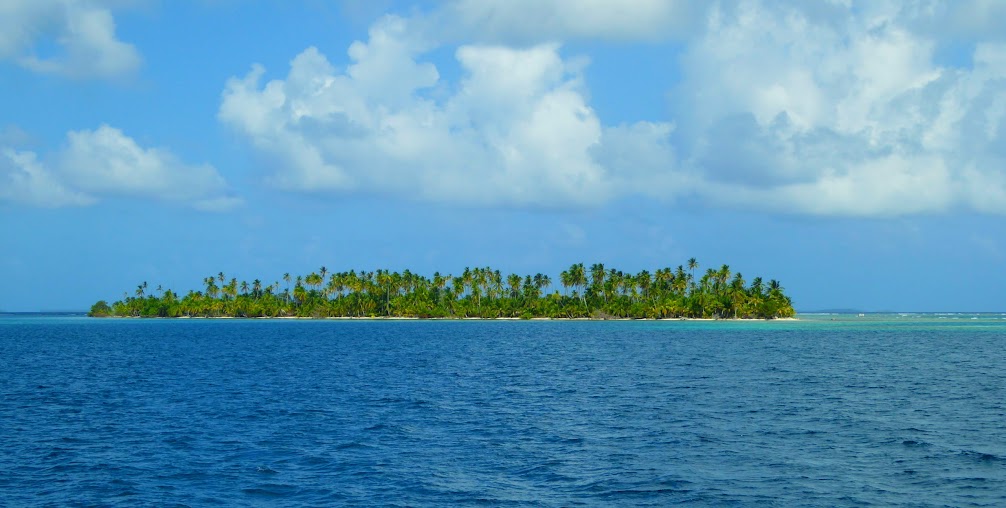
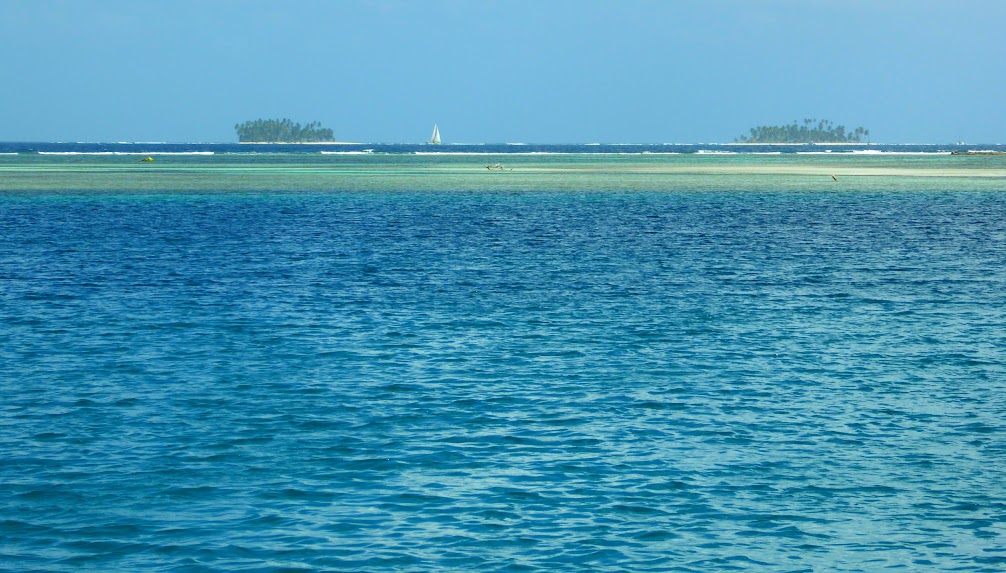
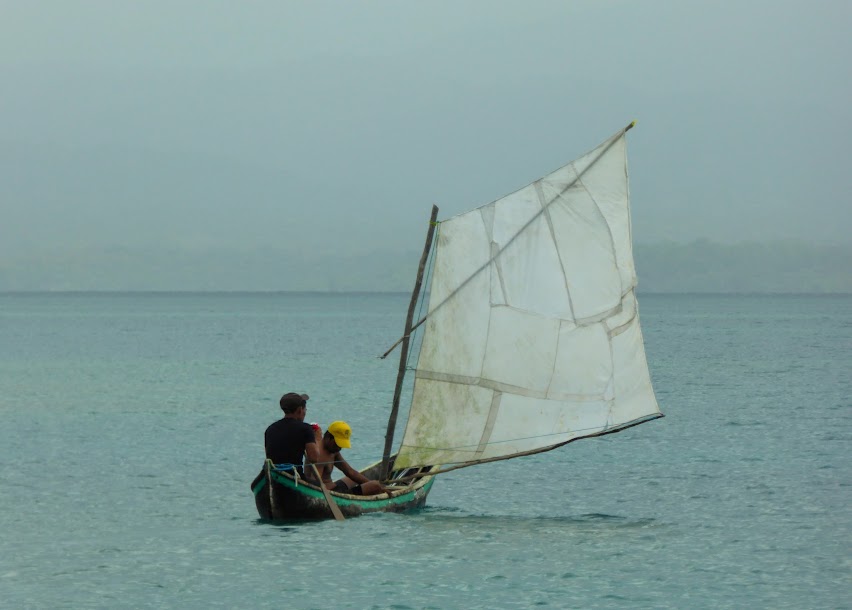
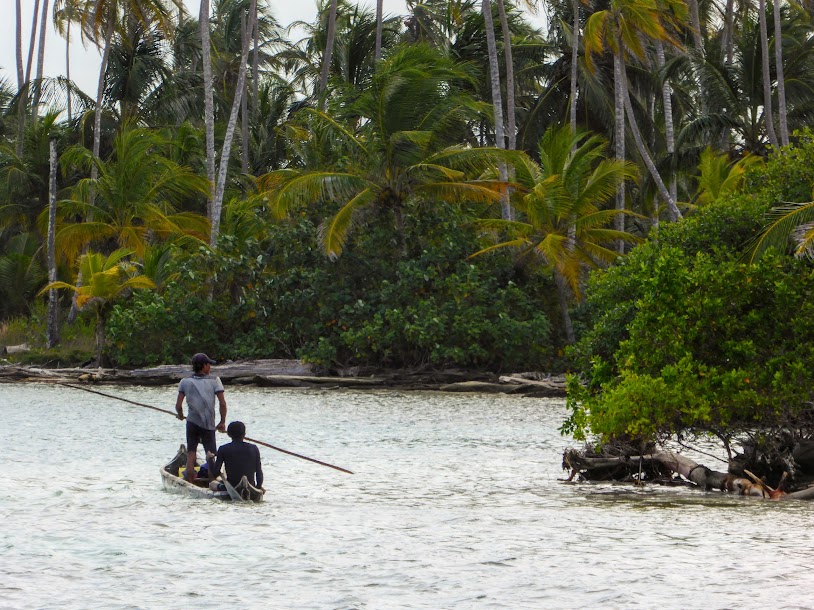
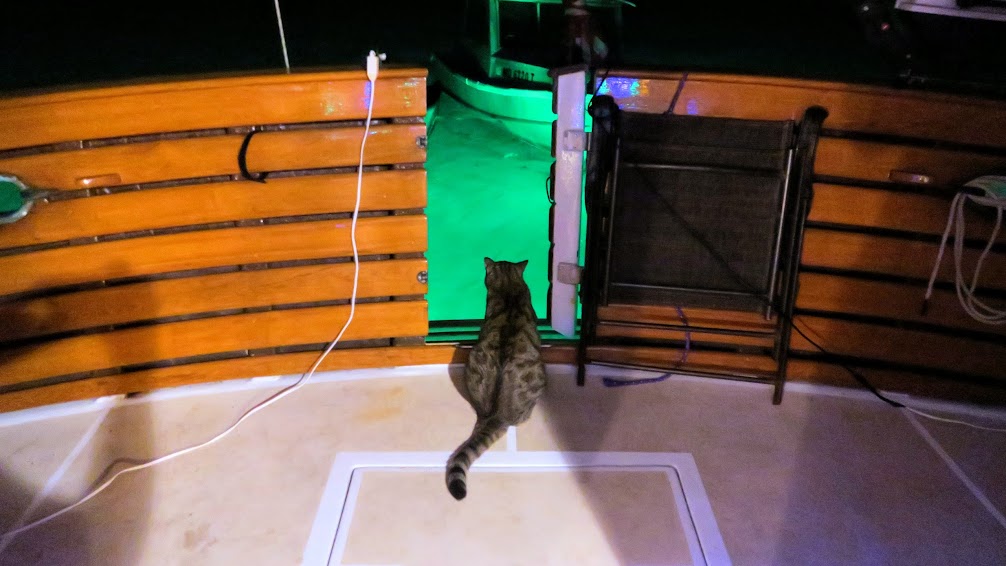
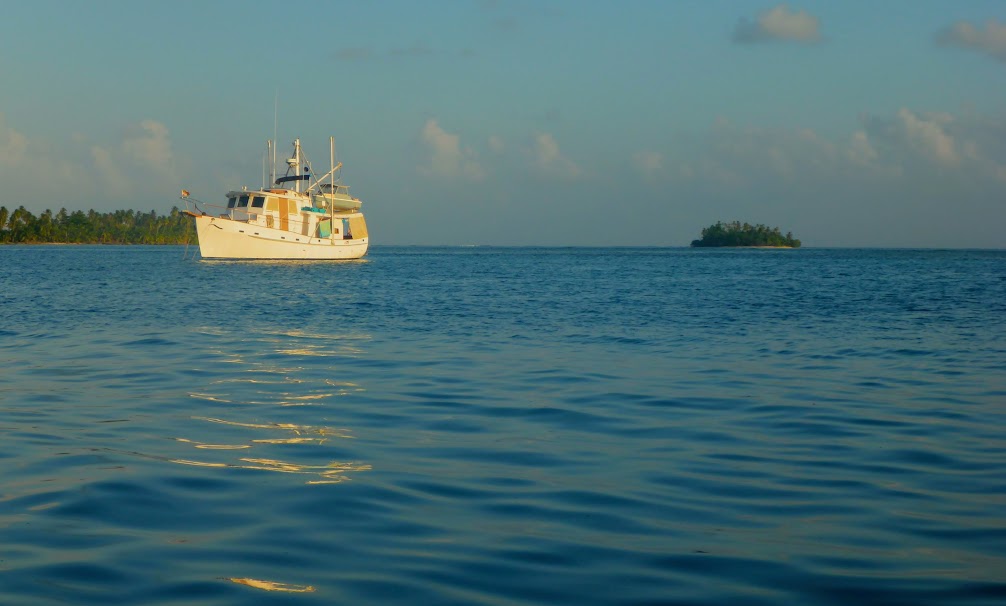
On To Cartagena, Colombia

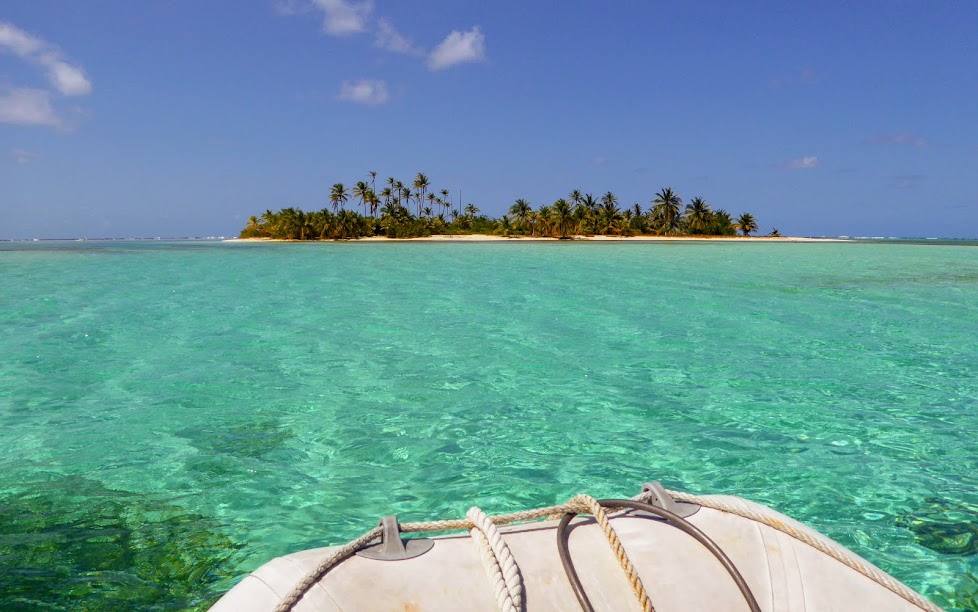
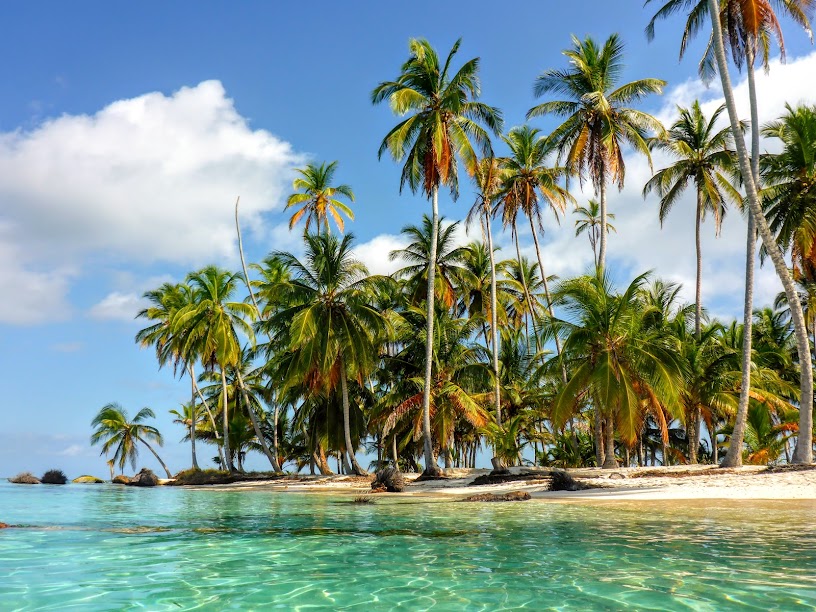
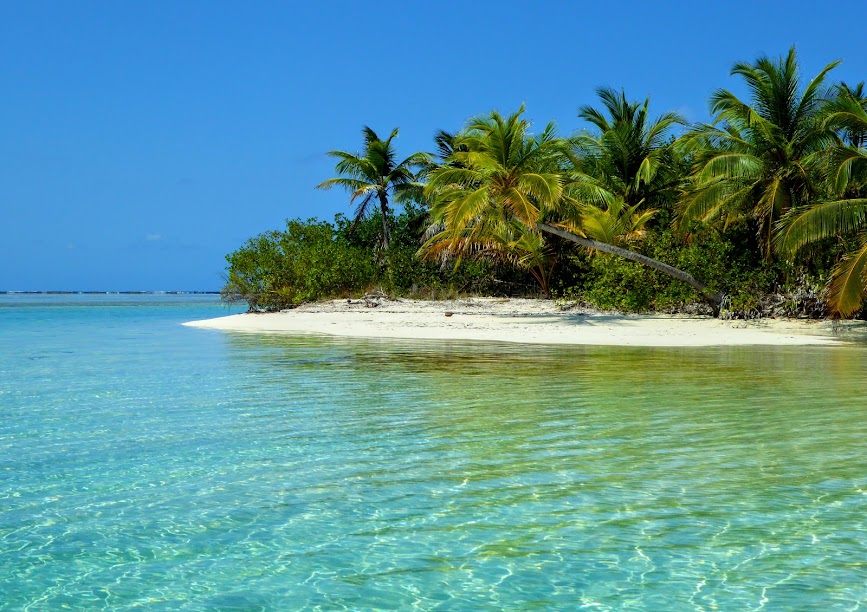
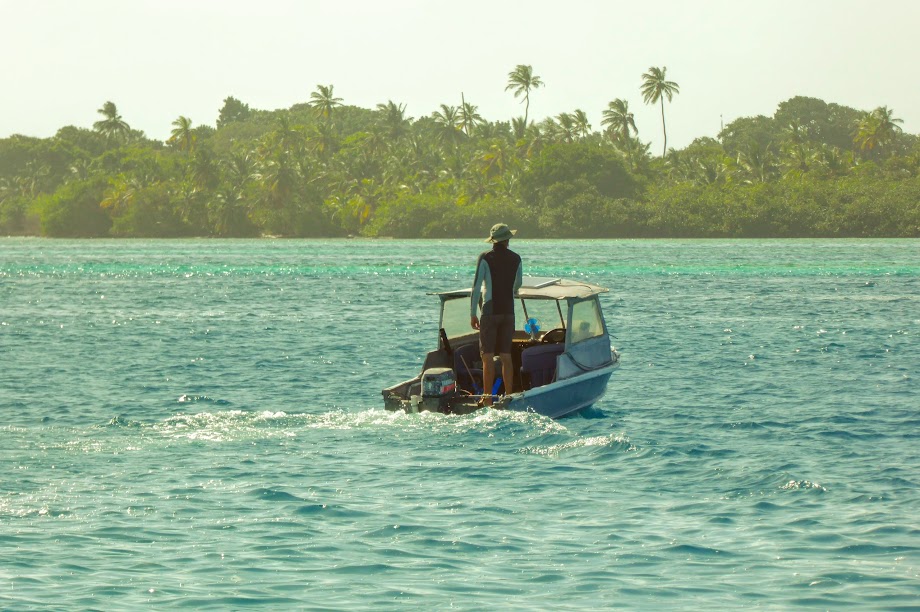
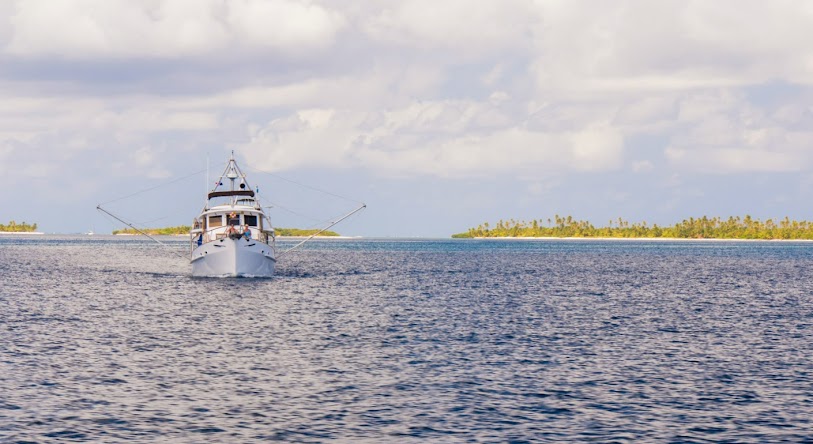
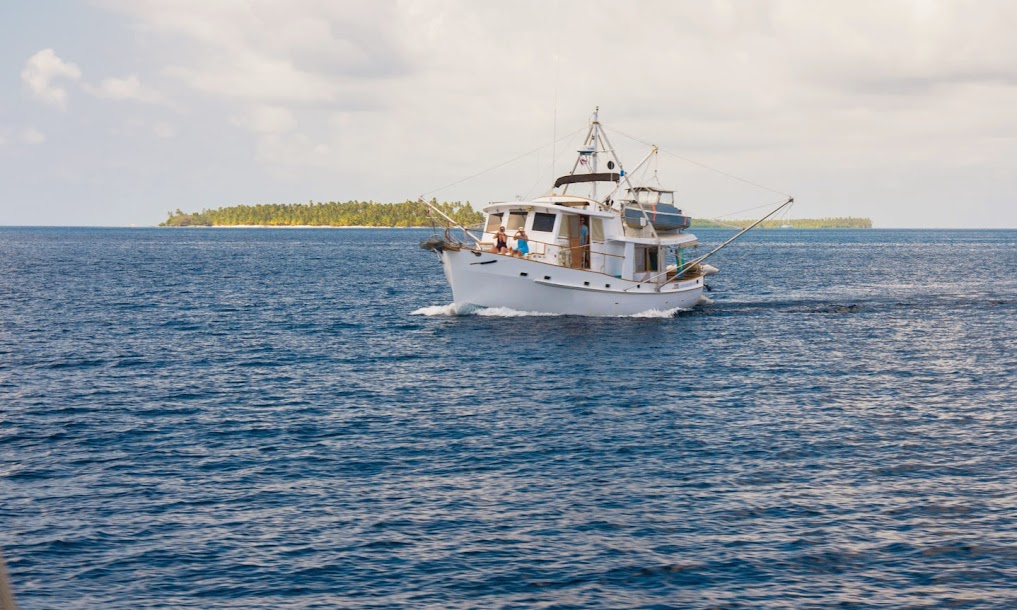
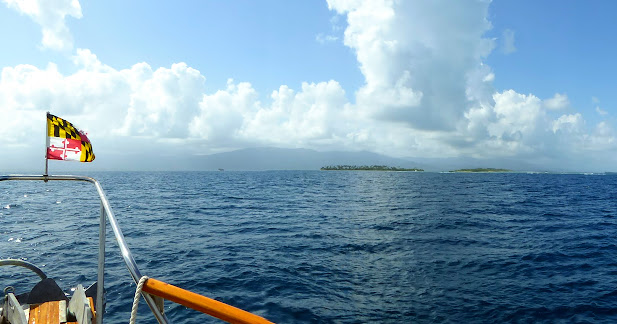
After spending four months in the San Blas, doing short, 2-4 hour jumps at most, between anchorages, we now faced a thirty-some hour run to Cartagena, Colombia. We hadn’t planned to visit Colombia at all, but everyone we’ve met over the last 18 months who’s visited the city says not to miss Cartagena, so here we go . Like the forts we visited in Portobelo, Panama, the city’s historic walled area is also a World Heritage UNSECO site. We’ve been told that it has a very European feel, and are anxious to explore the area.

Whenever we settle in for an extended period, the thought of a long, overnight passage is unsettling. It’s always nerve wracking as we set out. Seas that were previously the norm for us, seem insanely huge until we get our passage “pants” back on.

Our trip got off to a more bumpy start than expected. As predicted, the winds and seas picked up overnight (not Scott or Howard’s favorite trip, so they weathered most of it out on the couch together). Thankfully, by the time we made the turn for our final leg, which was in  a head sea, both wind and wave conditions had calmed wonderfully.

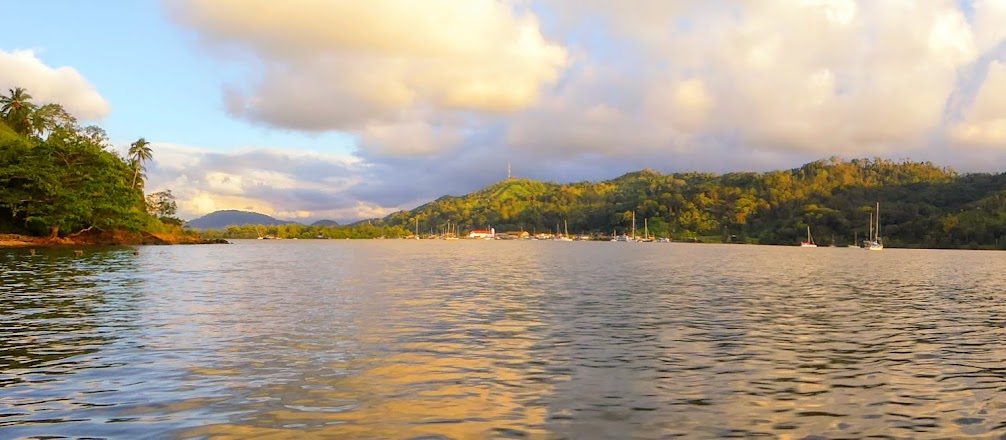
After 27 hours, we approached Cartagena Bay, noticing the increased presence of fast pleasure boats running in and out of Cartagena (yay….wakes!).

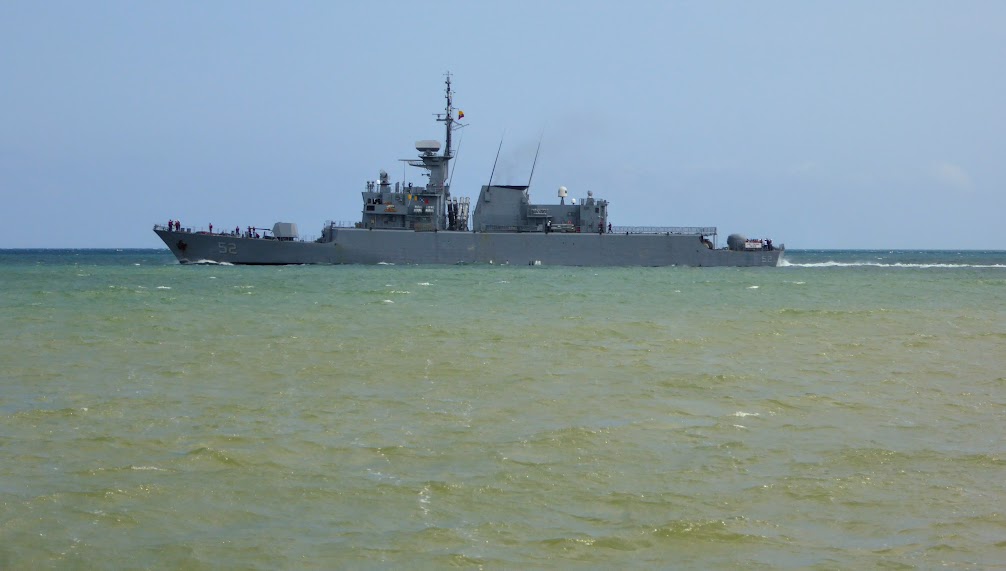
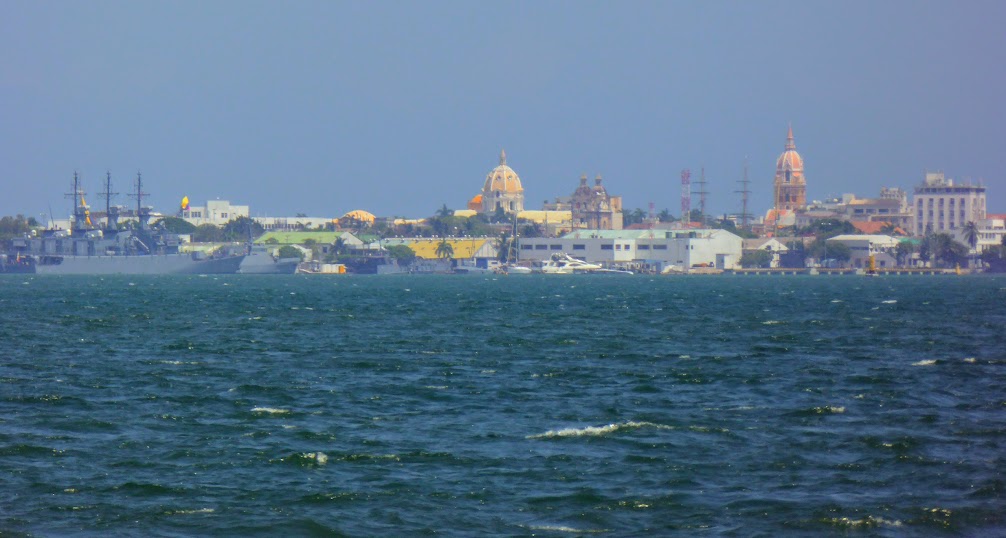
The Colombian National Navy has a base near Cartagena, and we saw several of their ships on our way into the harbor.
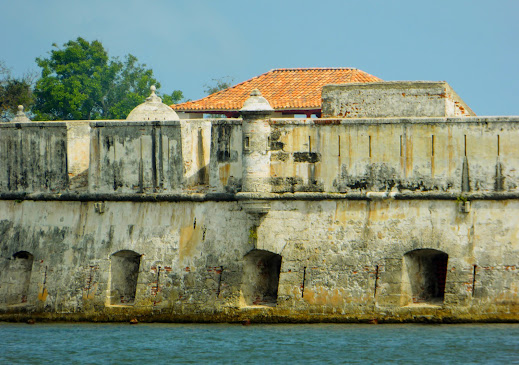
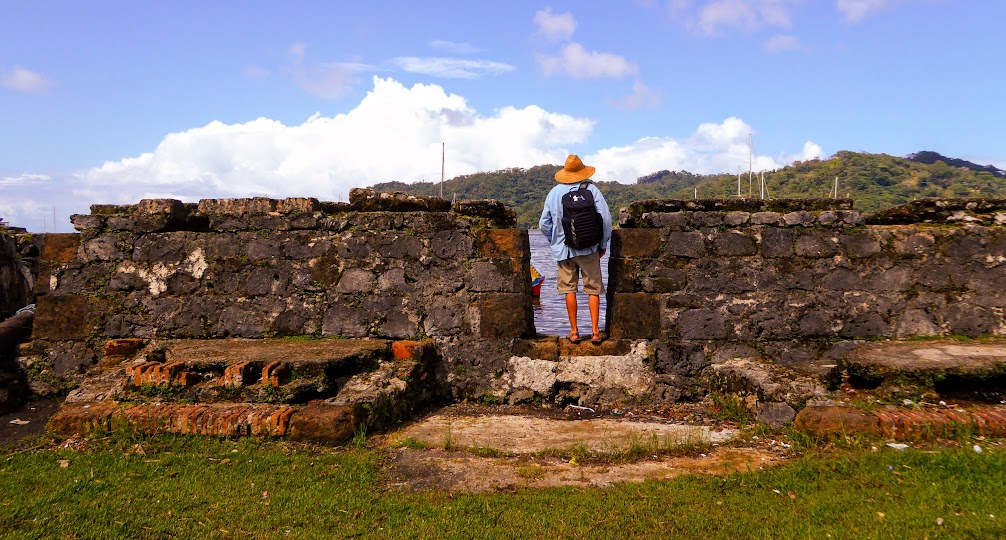
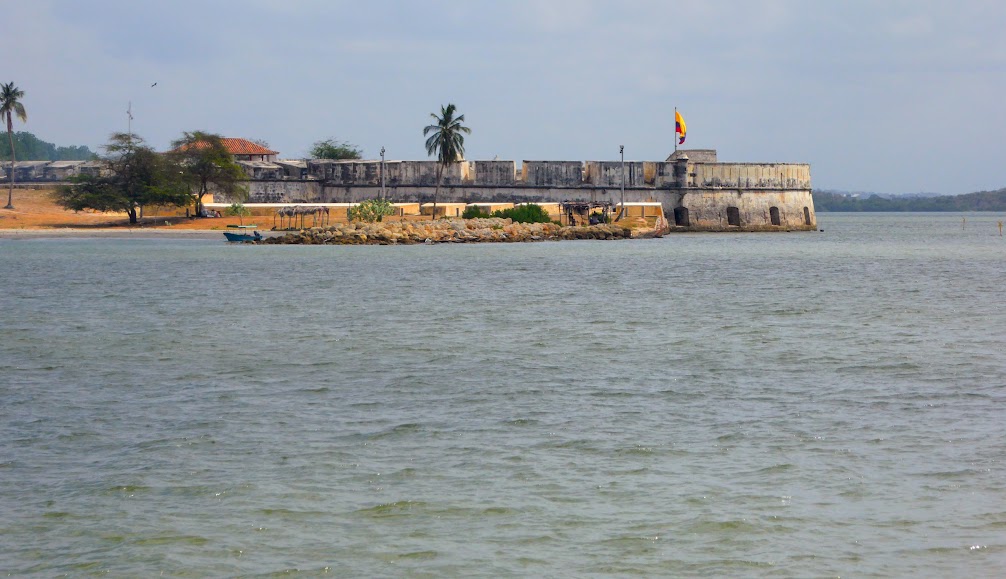
We passed the remains of several forts, their walls still mostly intact. At one time, all of Cartagena harbor’s natural entrances were protected by forts, and the huge  Castillo San Felipe de Barajas that dominated the city to the east, from atop it’s rocky cliff.

MAQUETA

CUADRO DESEMBARCO

Many of these forts are still standing in some form, and we passed several on our way into the bay.
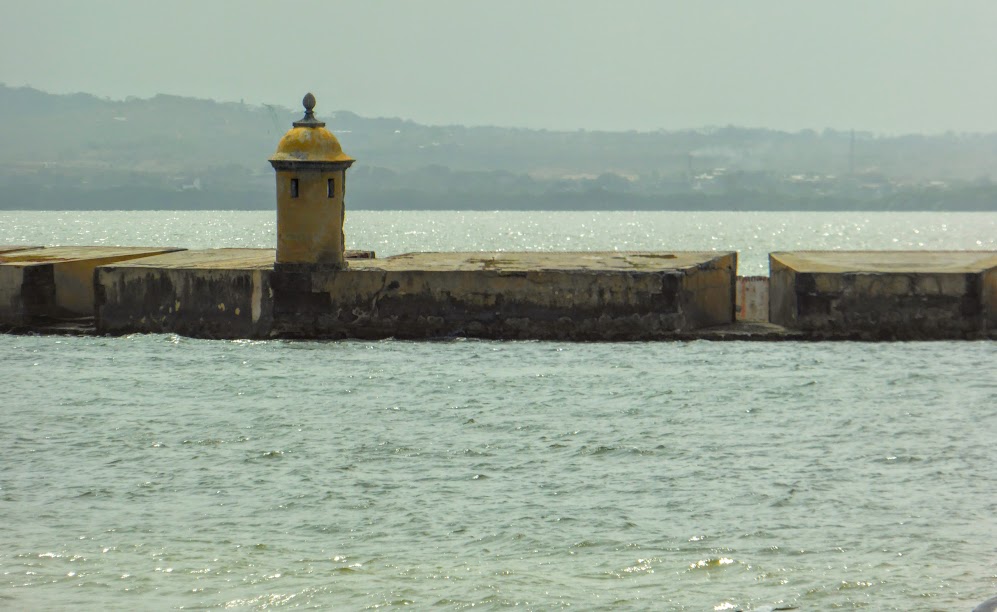
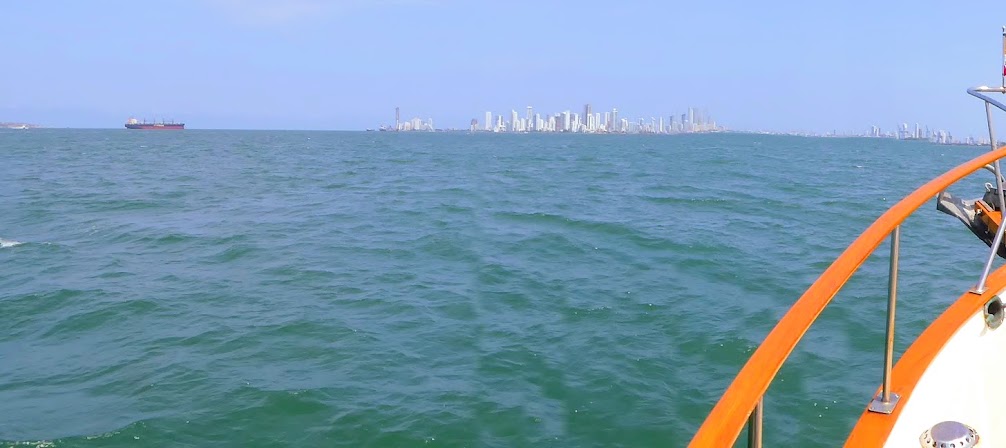
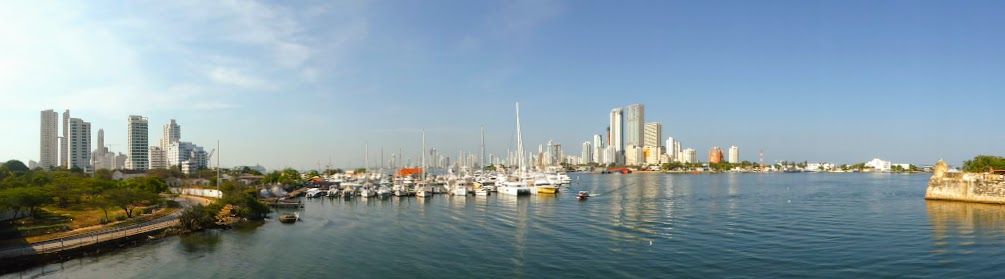
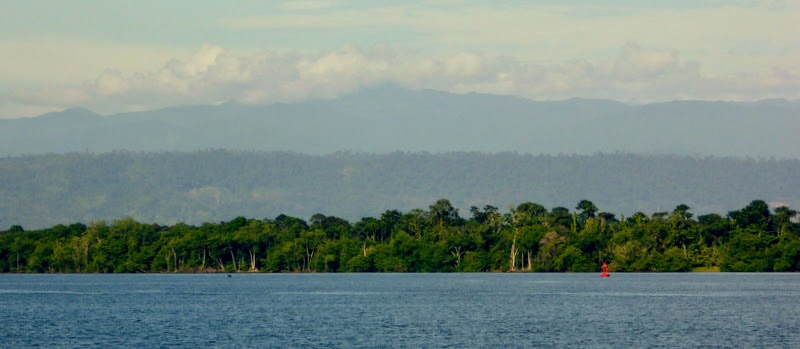
After passing towns and villages,  we eventually got our first glimpse at the modern skyline of Cartagena’s Boca Grande peninsula.
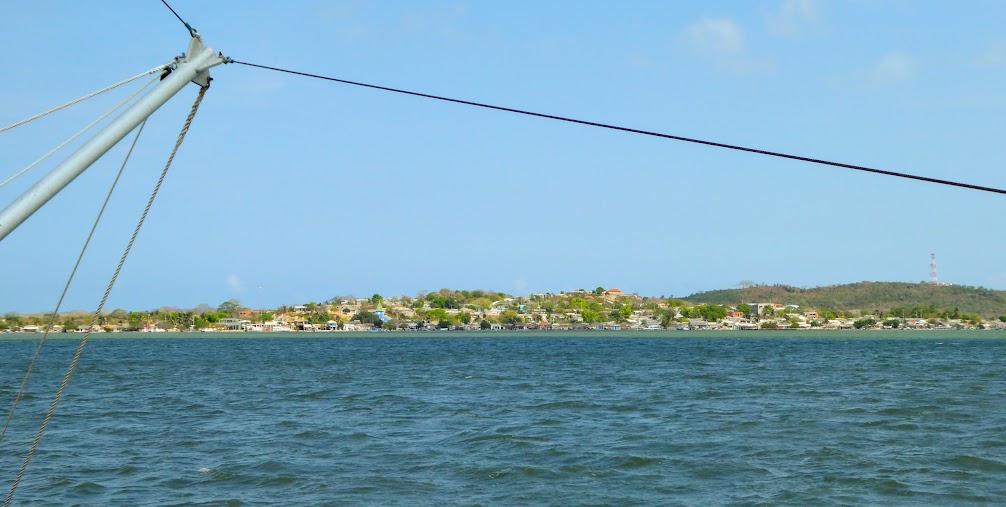
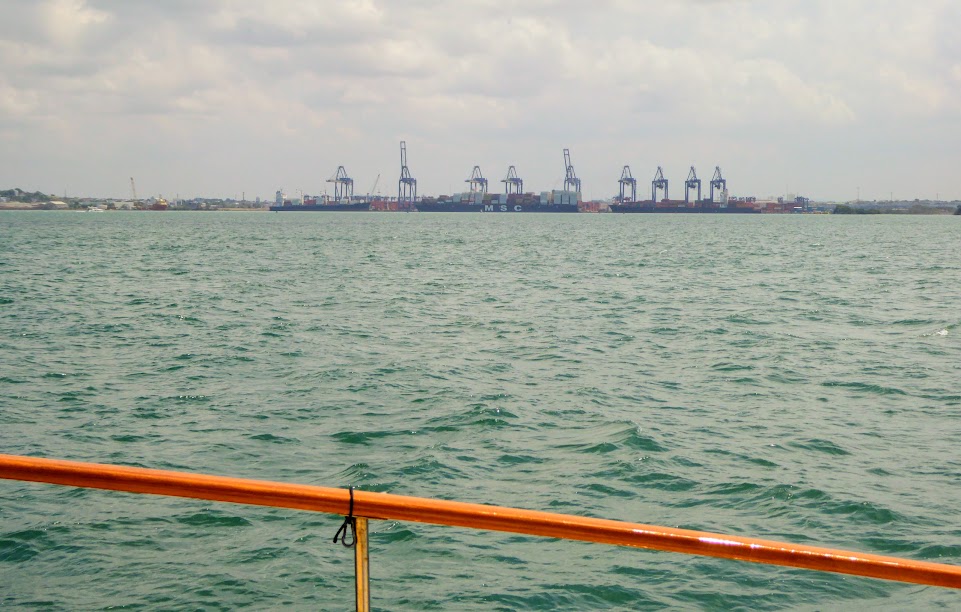
To the west was Cartagena’s commercial port, reminding us of scenes from our home port of Baltimore, Maryland, and it’s busy commercial shoreline.

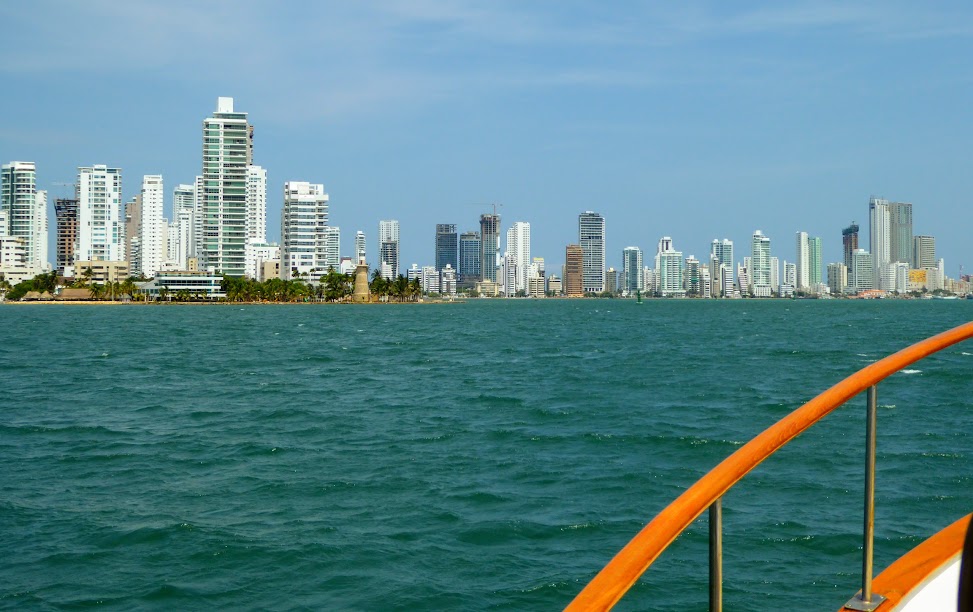
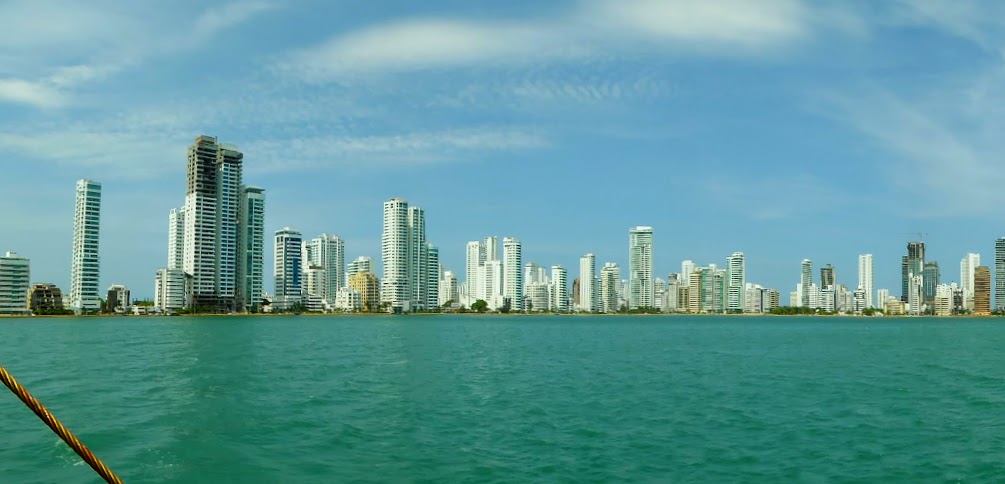
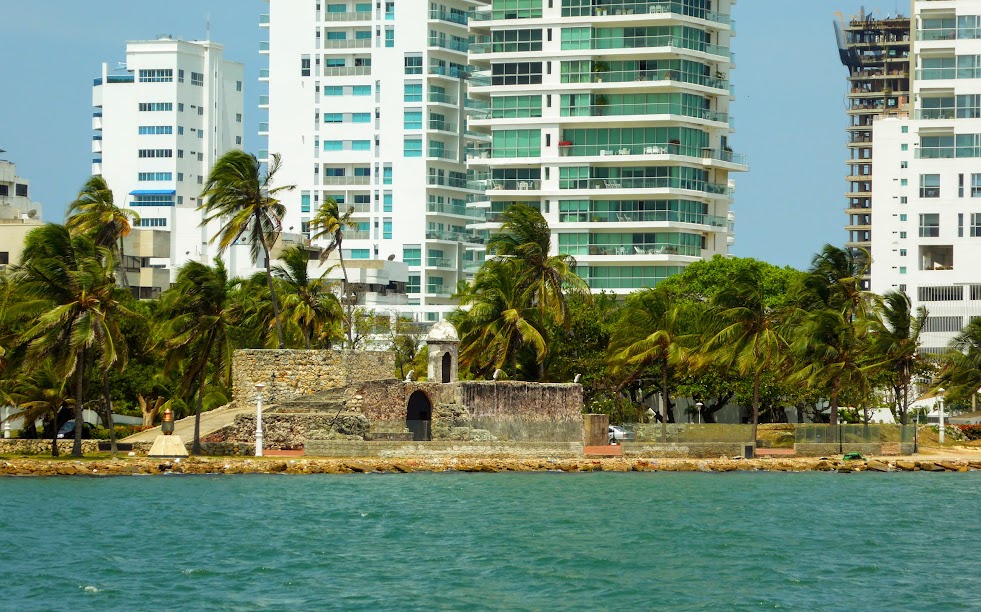
As we came further into the harbor, the expanse of Boca Grande’s high rises came into clear view. The bright, white buildings with their blue and green glass windows gleamed among the palm trees and blue sky, very similar to the syline of Miami, Florida.
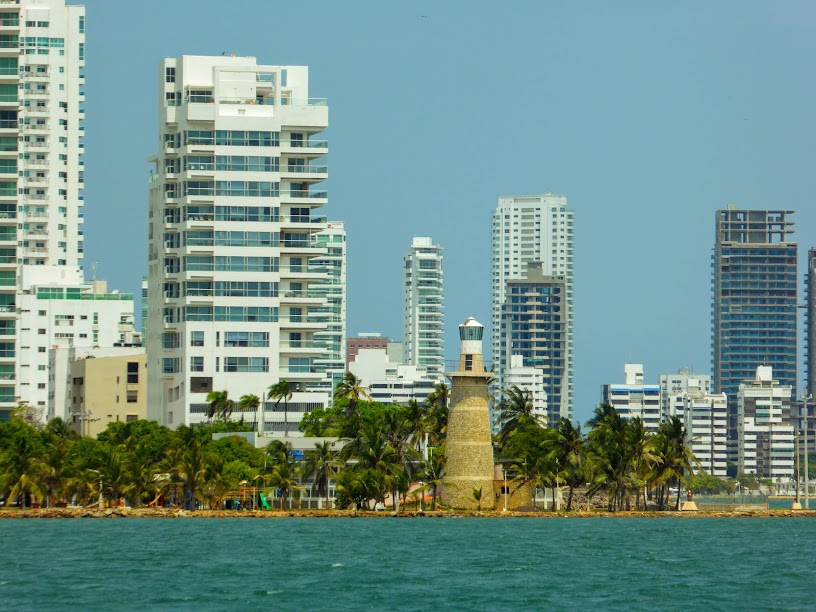
The Castillo Grande Lighthouse, and remains of Fort San Matias stand as a reminder of Cartagena’s history, among the modern skyline.
As we neared the harbor, the old, walled part of the city came into view, with it’s many church steeples rising into the midday sky.
We arrived at Club de Pesca, and headed for our slip. Docking was a bit challenging, as we only have one motor and don’t have the luxury of a bow thruster (they provide propulsion, making a boat more maneuverable). We usually rely on the outer poles of a slip, resting against one as we pivot into the place.

The slips at Club de Pesca didn’t have outer poles, and there were only finger piers on one side of our slip. That meant we had to come into the slip without making contact with the boat next to us, and without a pole to use for pivoting…making  things extra challenging.

Luckily, our friends on s/v Sirena were docked right next to us, on the “open” side of the slip. They’d heard us hail the marina on vhf, and Shawna was out on the bow, in case she needed to fend us off. That left me free to keep watch on the very large boat on the other side of us, as he stuck pretty far out past the short finger pier. There’s always a flurry of activity, and calling back and forth as we back in, but everything went fine.

We were required to use an agent for clearing into Colombia, and Julio was waiting for us on the dock as we came around the corner to our slip. He collected our passports and other needed documents, and was off to begin our clear in process. We settled into our slip, with a great view Roman Bridge, and the edge of the walled city.
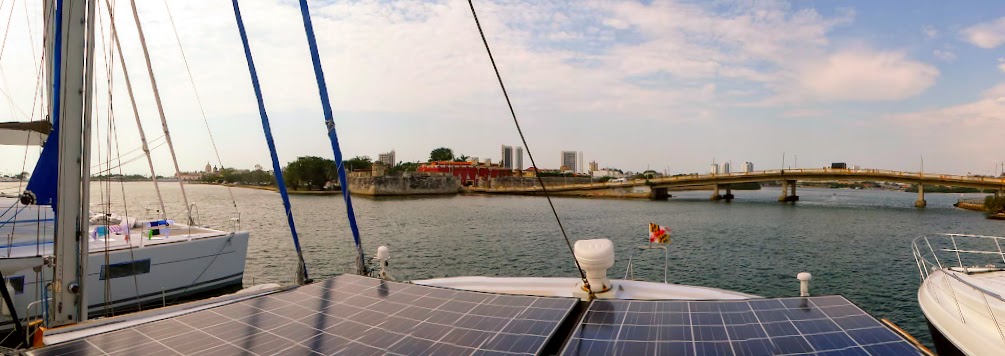
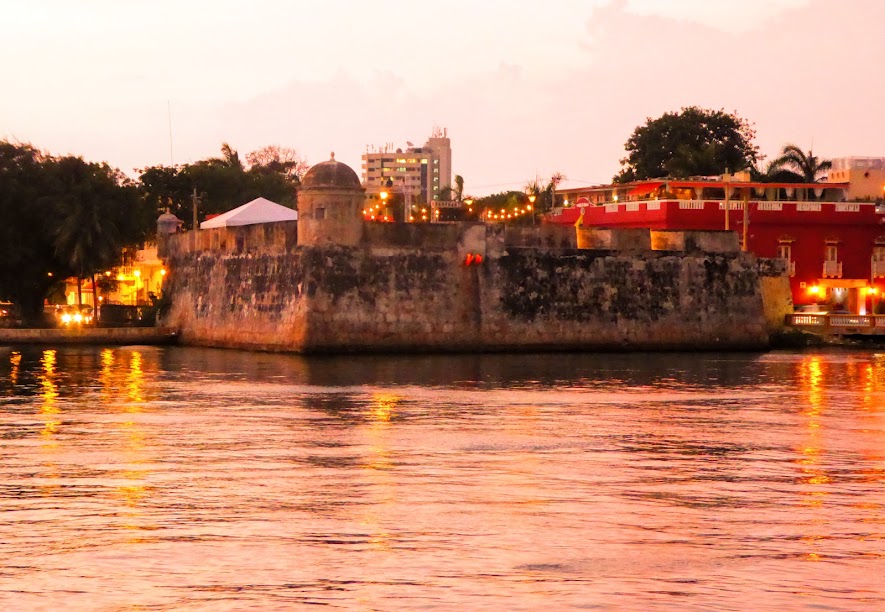
 

We could see over to the many church steeples in old town, and also had views of Castillo San Felipe; behind us, the skyline of Boca Grande.
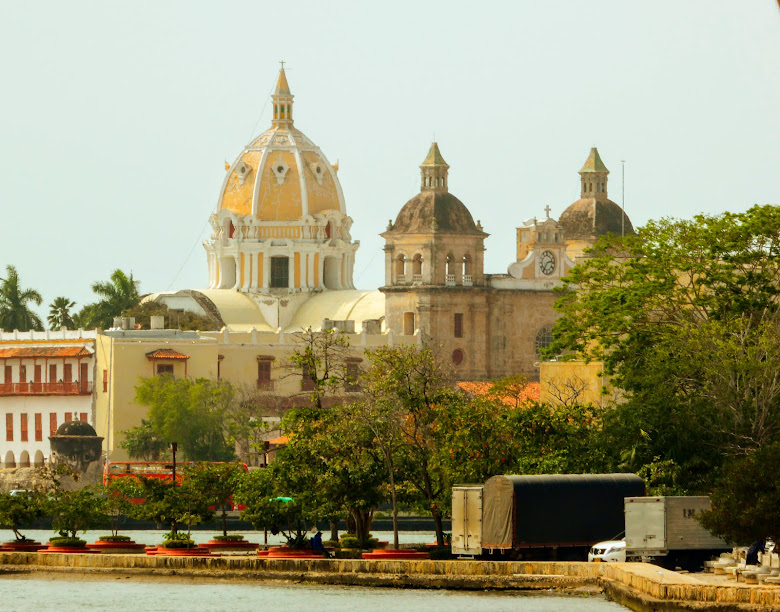
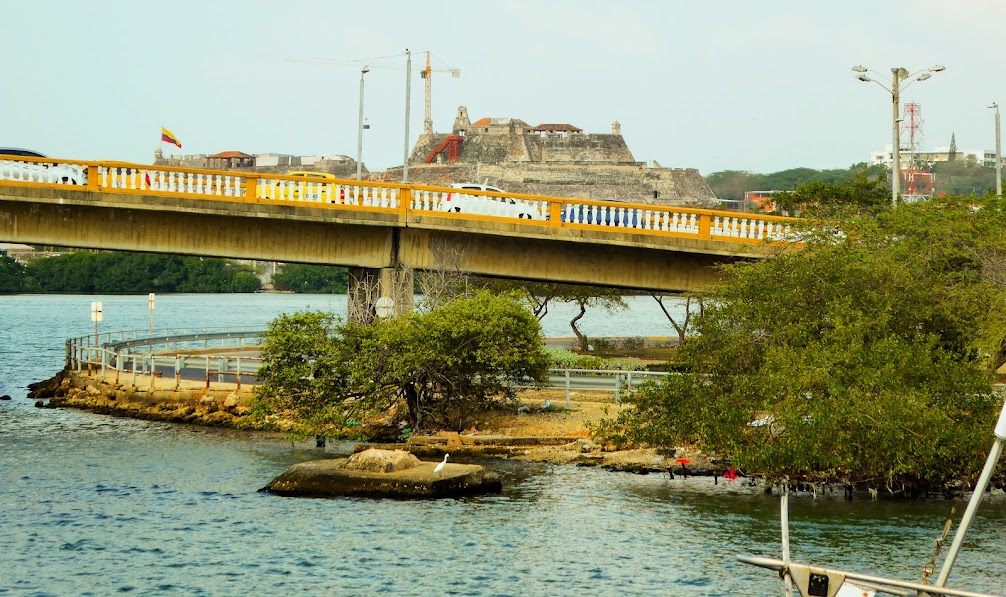
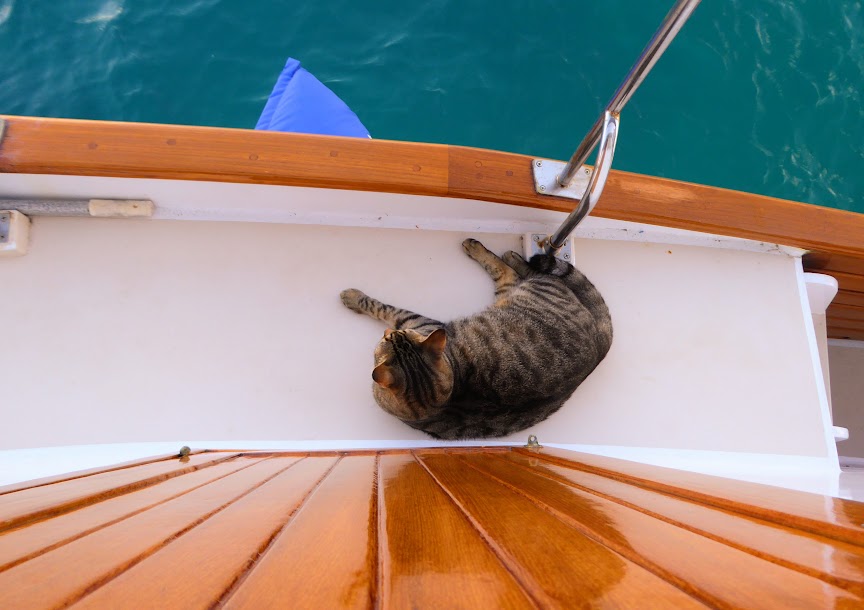
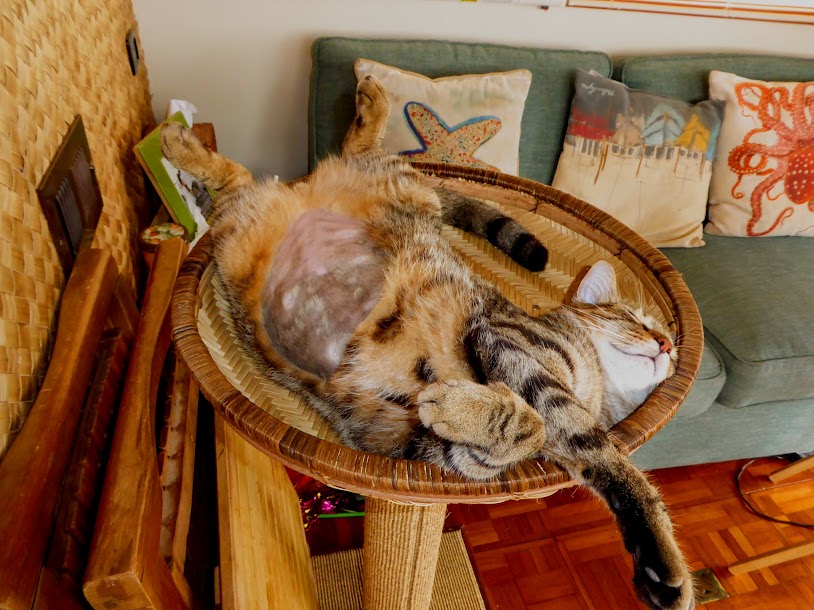
Howard took his usual post-passage, coma nap.

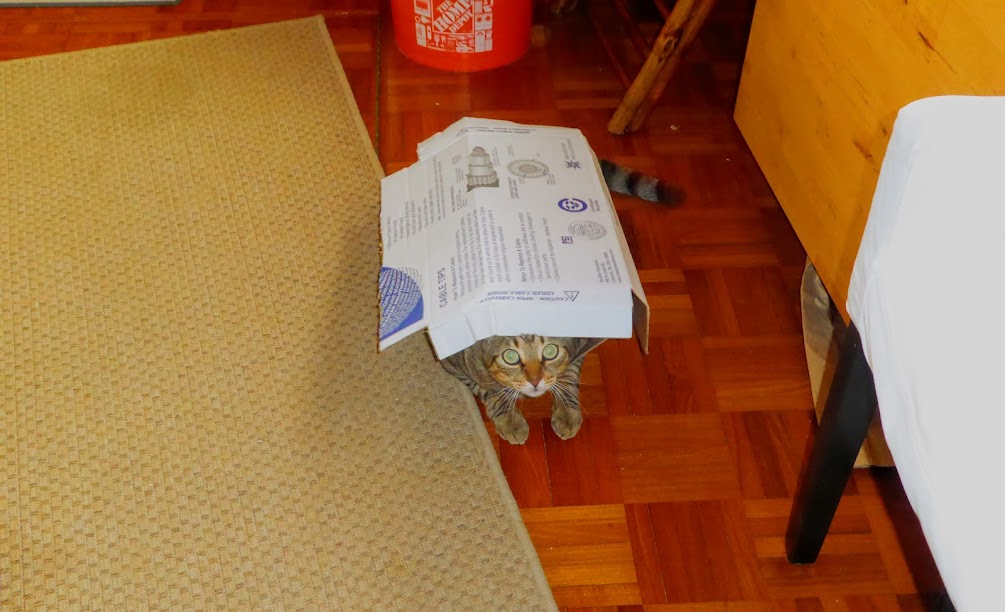
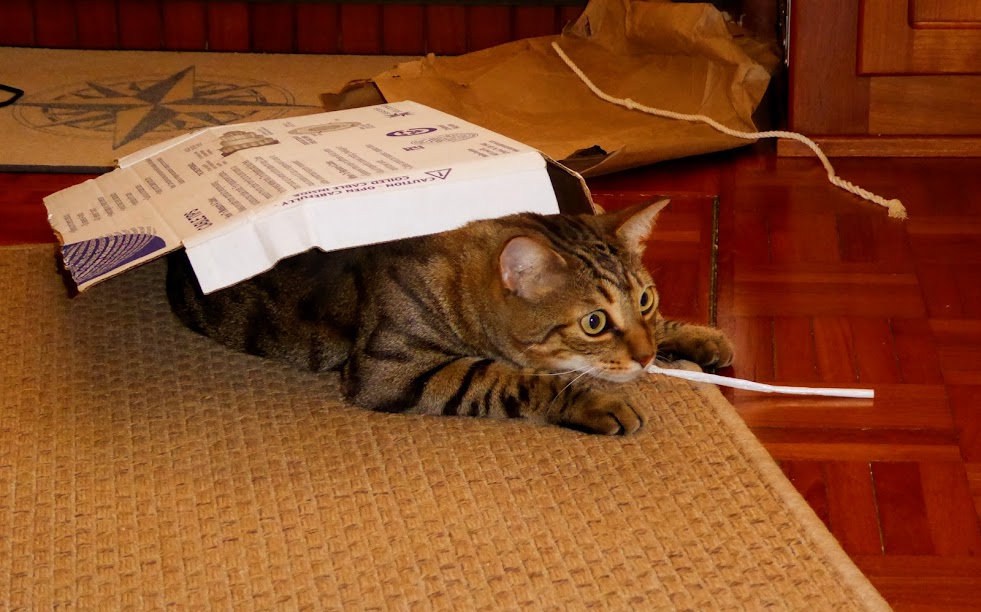
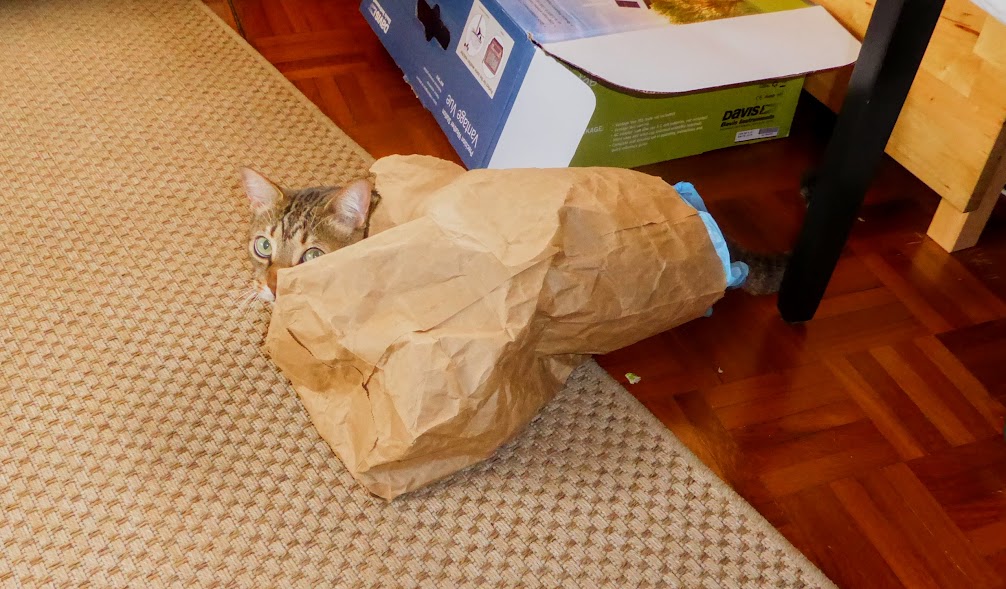
Once rested it was “turtle” box time. He loves to get under this collapsed box and run around, wearing it like a shell. Throw in some string and a straw, and it’s pure bliss…cats are weird. After clearing in, it was time to again raise the Colombian courtesy flag, and Howard helped make sure we had the right one.

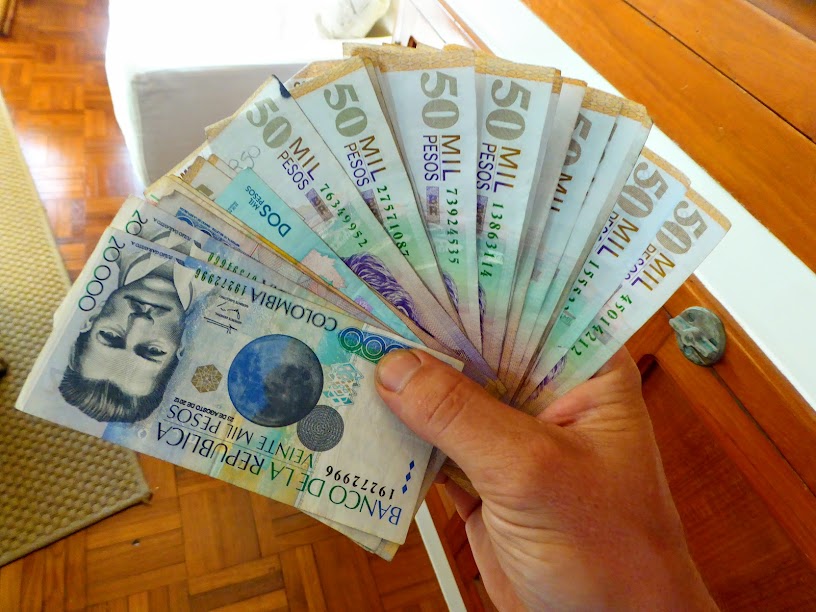
Scott visited the atm to withdraw some cash. The exchange rate in Colombia (as we learned during our stays last year in Providencia and San Andres) is insane: 3,000 Colombian pesos to 1 US dollar; we’re millionaires here! Scott returned with a fist-full of bills…..20,000, 50,000, good grief!
We began to explore our surroundings. Shawna and Chris (s/v Sirena) filled us in on the need-to-knows: locations of grocery stores, restaurants, ice cream spots, etc., and we perused the marina grounds. It was a full house, with lots of daily activity, in the form of washing, waxing and detailing. I think most of the boats were cleaned more than they were used!
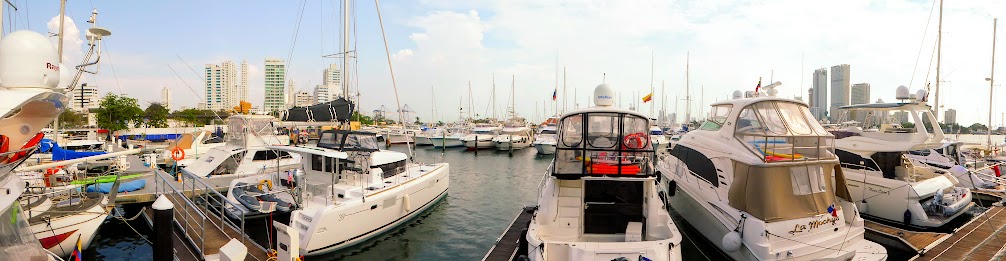
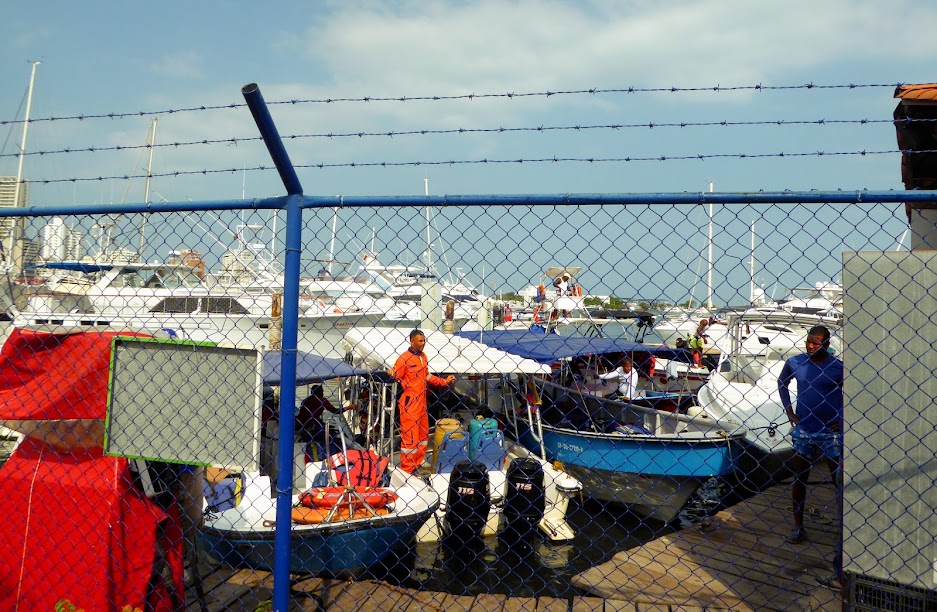
The fuel dock was a traffic jam every day, with boats of all sizes waiting in line to fill tanks and/or jugs. It was amusing for Scott to watch the organized chaos.
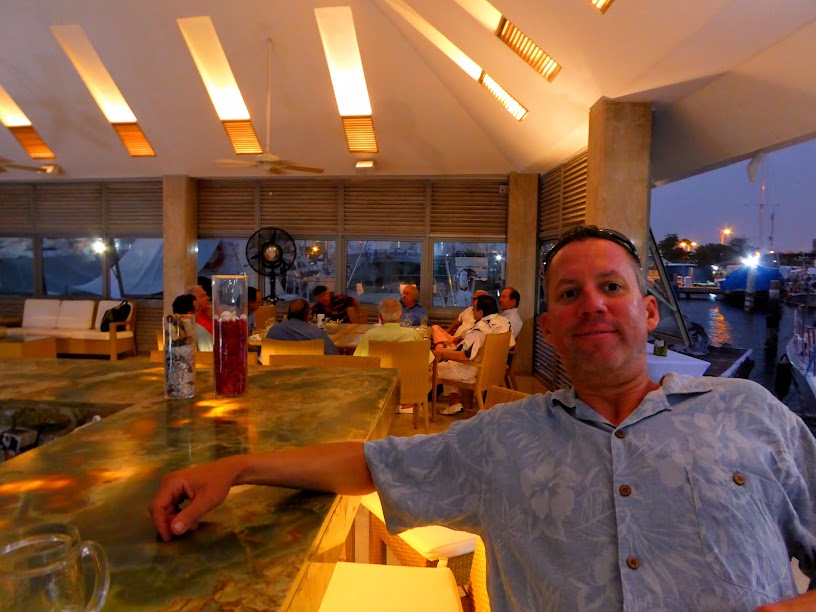
We stopped at one of the two restaurants on site for a happy hour cocktail, and were convinced that there was a meeting of the Colombian mafia at a nearby table. It was like a scene out of Scarface or Goodfellas. We remained quietly amused, not needing Colombian enemies.
Shawna had told me of the many kitties that call the marina grounds home. I bought some cheap cat food at the grocery store, and carried a bag with me whenever we came and went (Of course, I couldn’t get the bag out, without giving Howard some… I called it his McDonald’s treat). The cats came to know our step, and would pop out of their shelter spots, or run up to us for food.
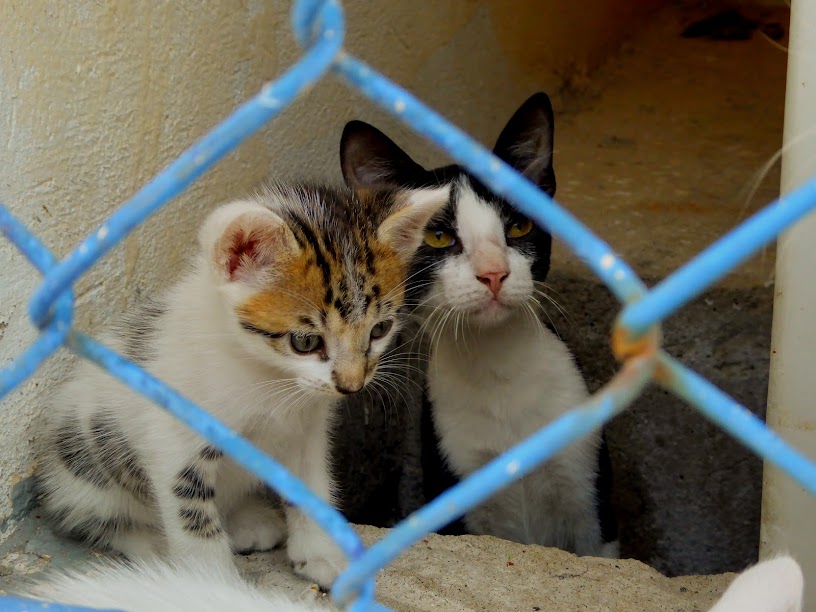
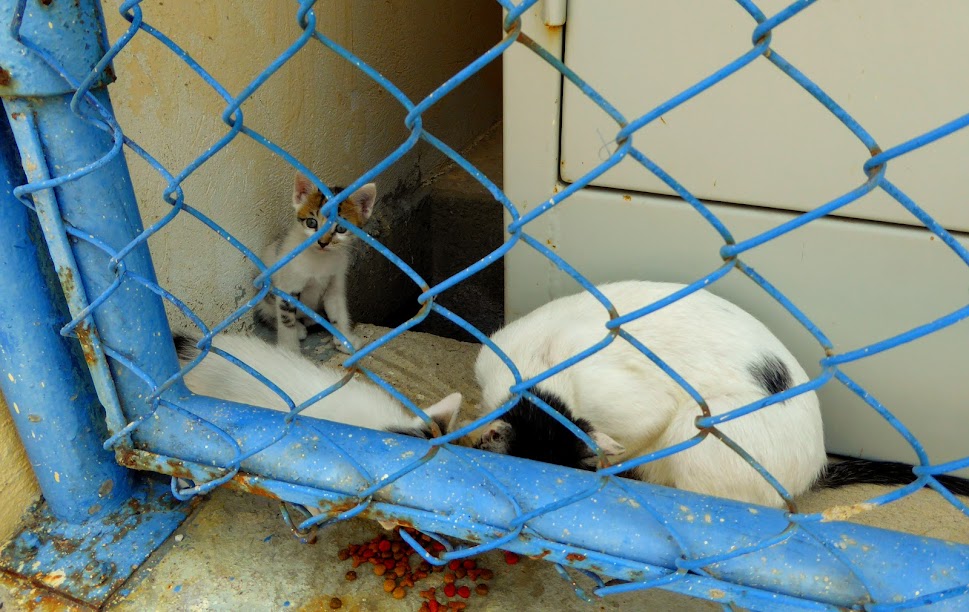
Groucho (aptly named by Shawna because of his black mustache) was one of my favorites. He was very vocal, always greeting us for food near the rear marina entrance. If I thought I could talk Scott into it, and if there was a chance that Howard would share his space….and food, we’d have a second cat.

Club de Pesca in located in the Manga neighborhood, just a short walk across the bridge from the walled city. It was a very safe area, and we enjoyed wandering the streets.
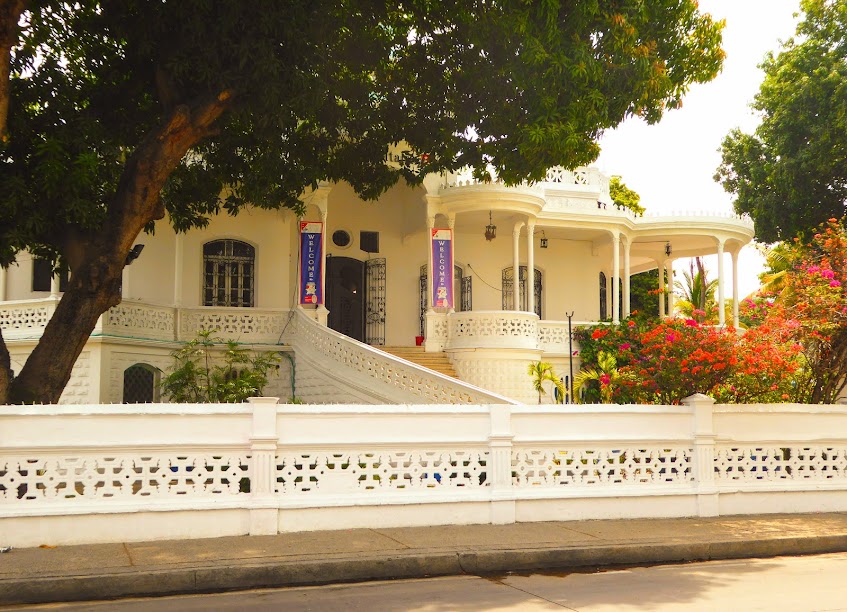
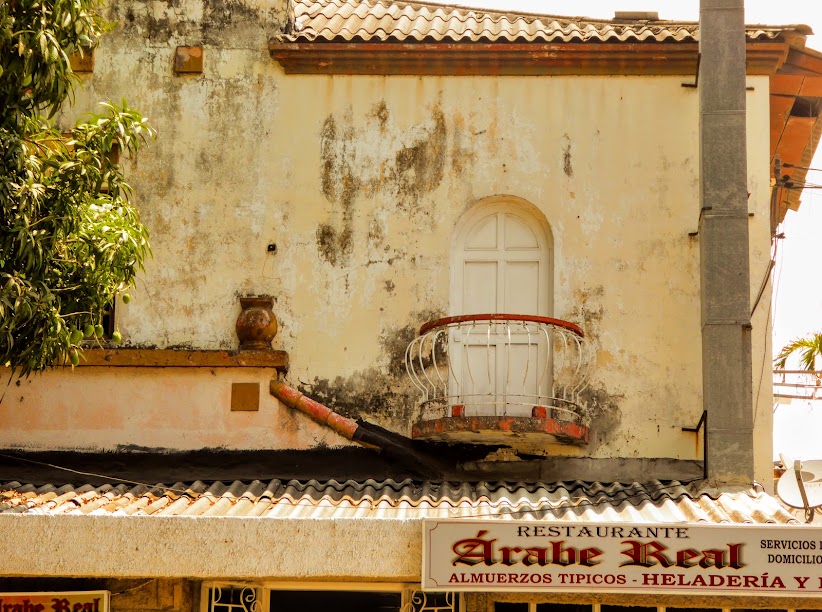
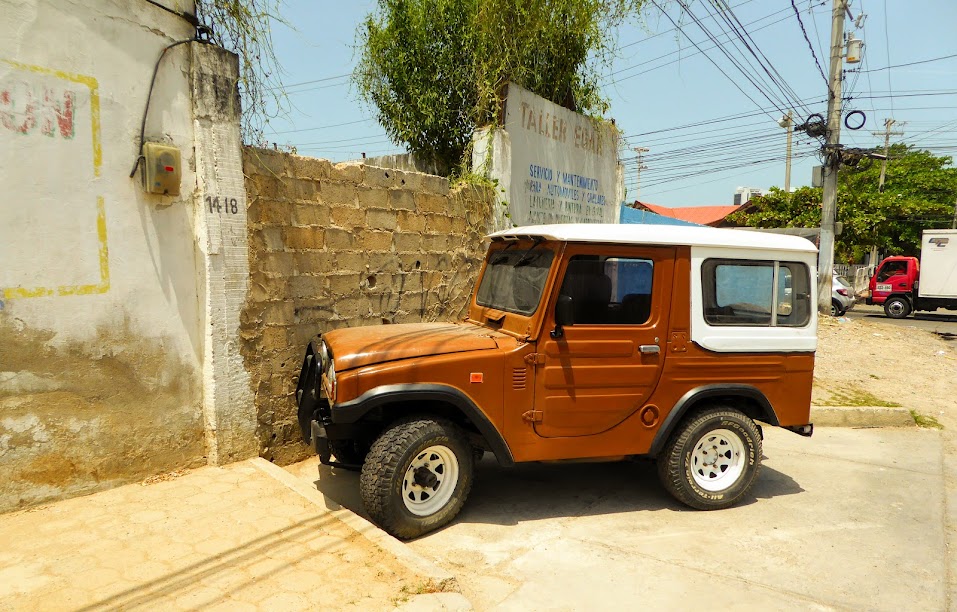
Of course….Scott can always sniff out a unique vehicle.
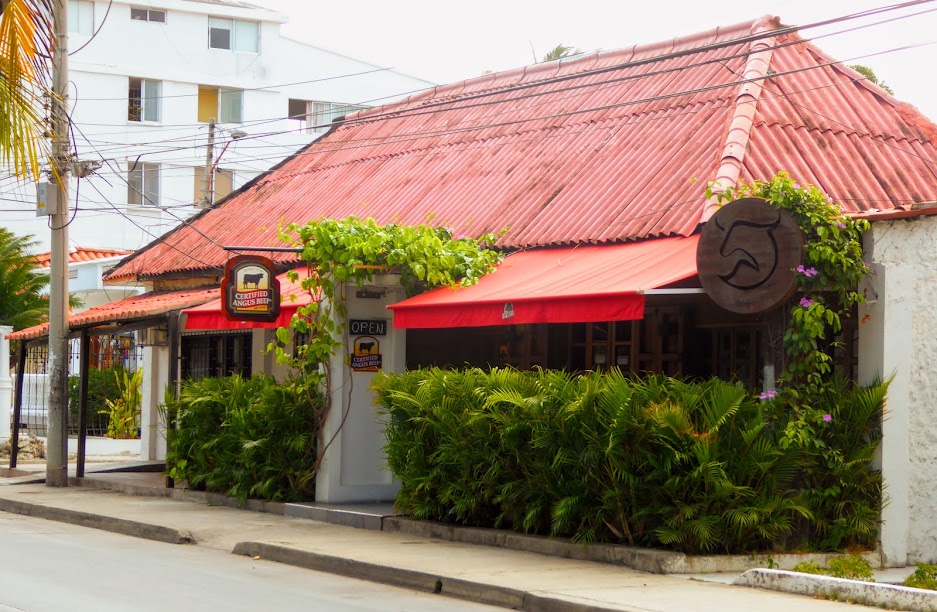
Shawna and Chris took us to their favorite local find, D’Res. It was just across the park outside the  marina, and had terrific steaks at great prices! We returned several times, to get our red meat fix.
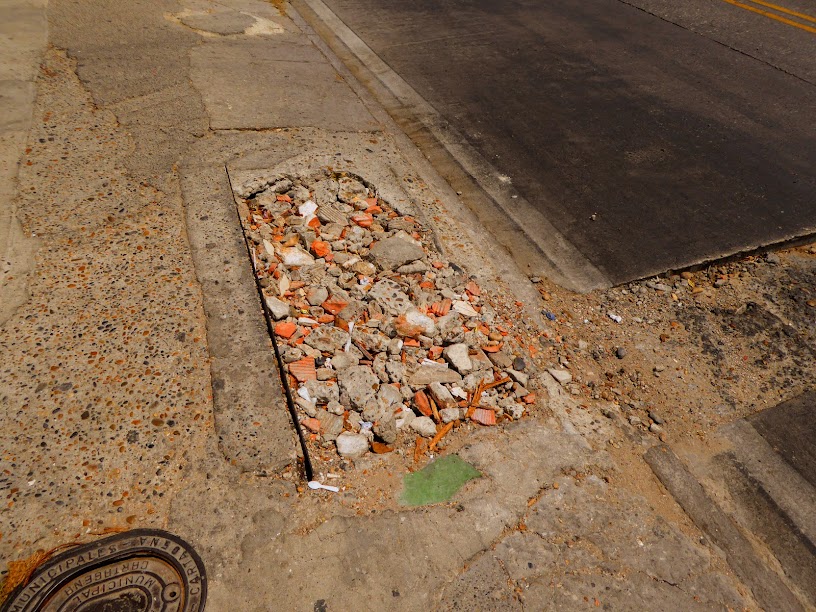
The streets of Cartagena are insanely clean, with crews sweeping them every morning. However, the condition of the sidewalks are treacherous. If you’re not frequently looking down as you walk, it’s easy to twist and ankle on the horribly uneven surfaces, or in the patches of rubble “repairs.”

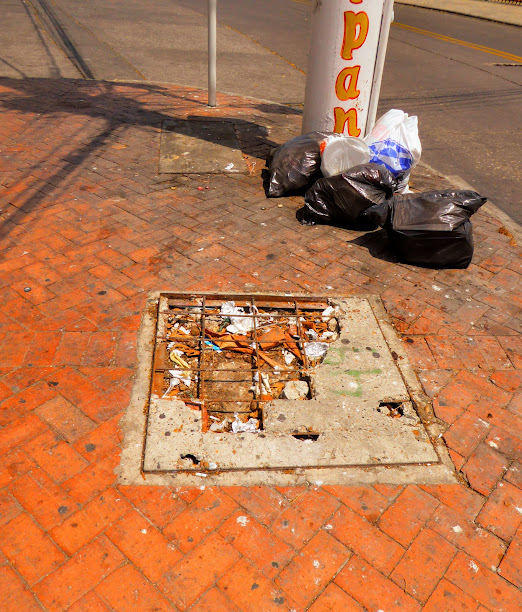
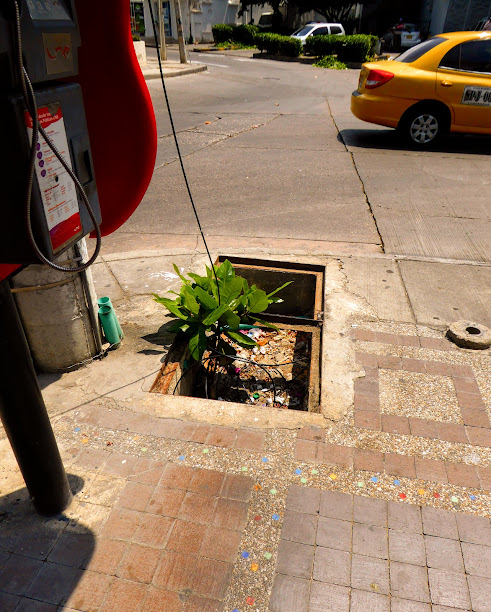
In other places, exposed rebar and open holes wait to cause you harm, making it challenging to try and find your way along streets and across intersections, while looking down for these sidewalk traps.
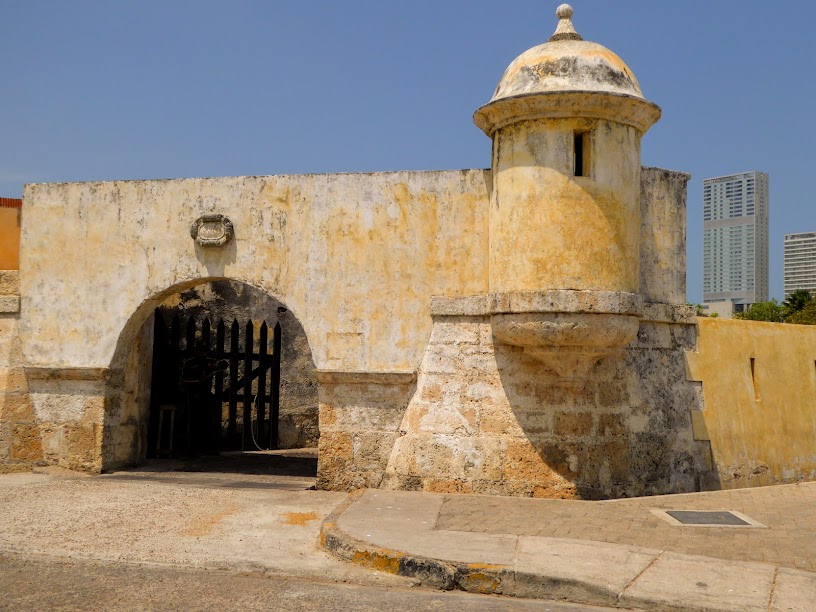
In the late afternoon, when the marina office is closed, we enter through the old walls of Fort Manga, a daily reminder of the history surrounding us.

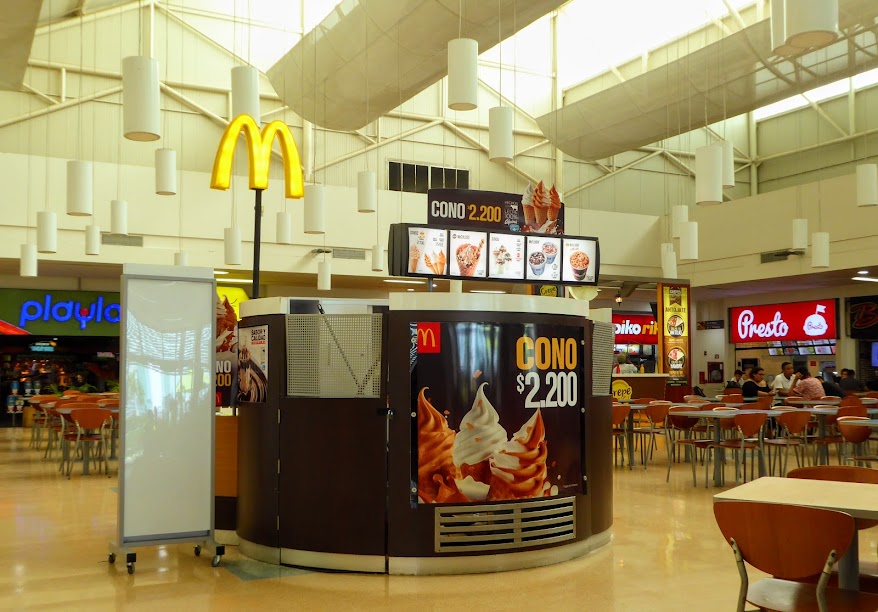
We ventured out to the nearby mall, in search of a sim card for our phone and of course, a McDonald’s fix for Scott. They made the food to order; still quick, but deliciously hot and yummy….. the best McDonald’s ever!!!

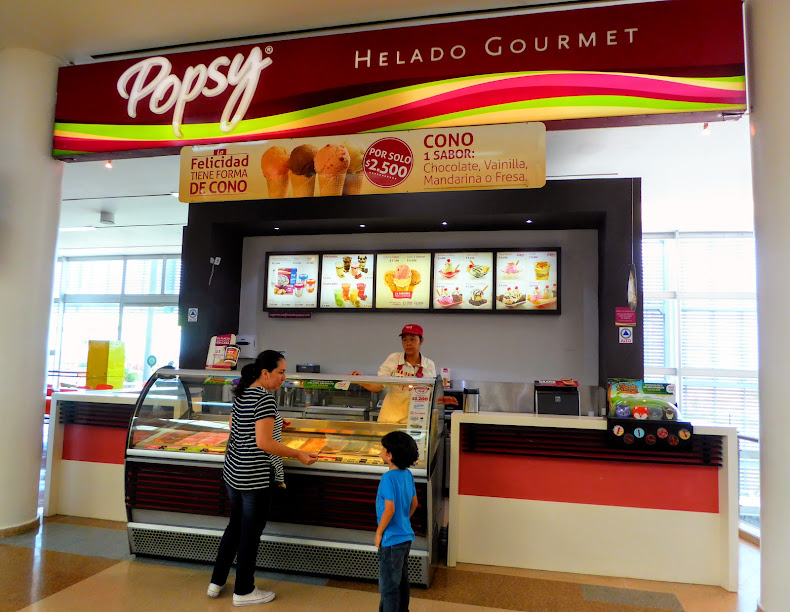
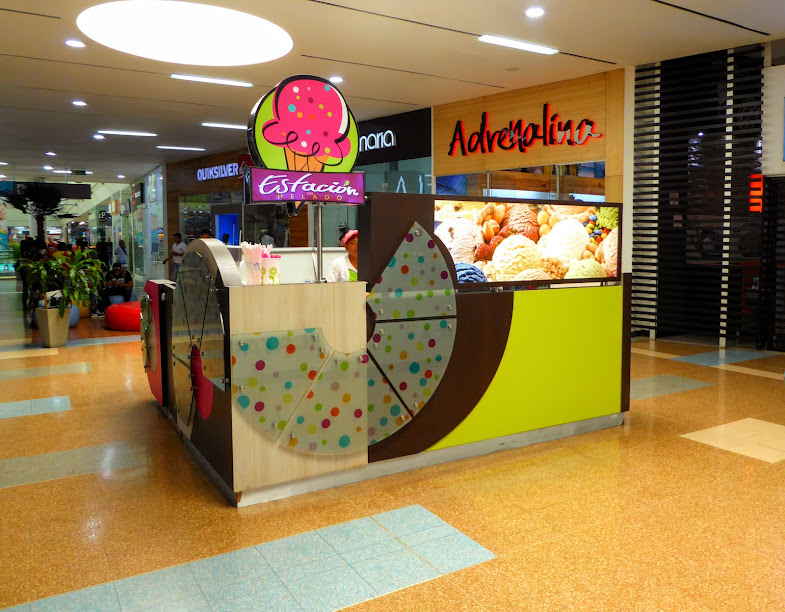
You couldn’t spit without hitting an ice cream place in the mall (or in all of Cartagena for that matter). I counted four, just in the food court area, including a McDonald’s stand-alone kiosk. At most locations, there is a separate ice cream counter, next to where you order burgers and fries. They’re serious about ice cream here.
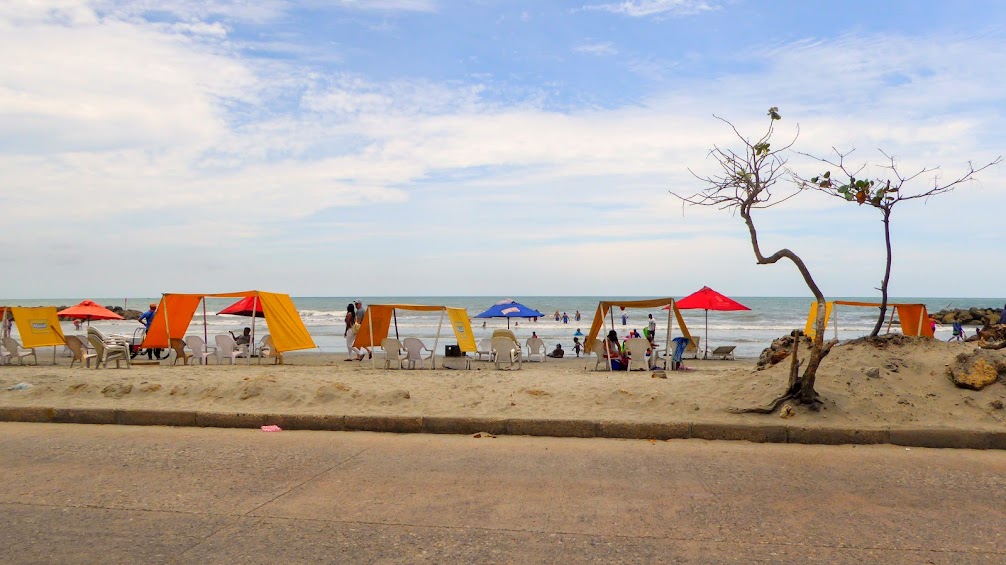
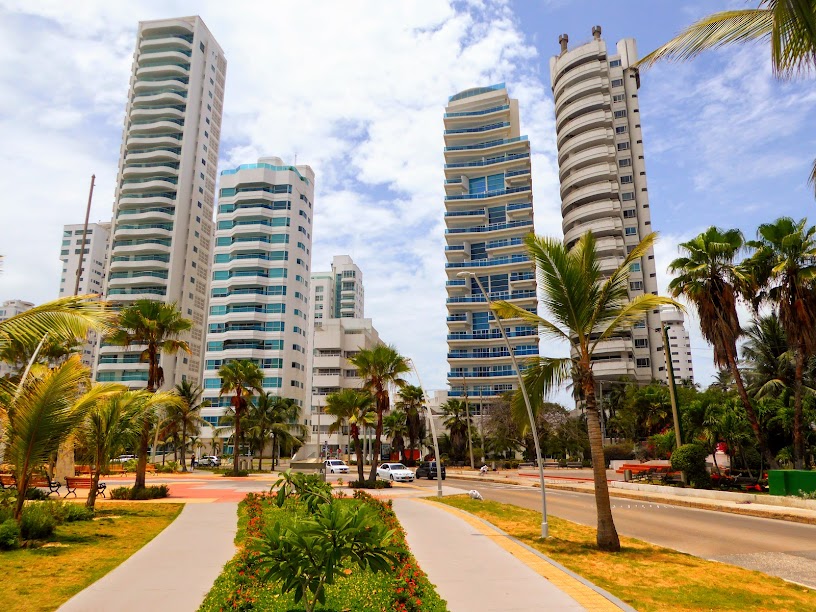
Scott sought out a dermatologist in Boca Grande, and made an appointment for some routine scans. He walked there and back, past the high-rises and beaches. As a reward, he visited Burger King after the appointment, for another fast food fix. Much to his disappointment, it was not nearly as yummy as the McDonald’s food we’d enjoyed at the mall, much to his disappointment.

We were spending a month in Cartagena, so Scott took time for some boat projects. He replaced the raw water impeller, during routine maintenance of the pump. He finds it more thorough to just take the pump apart, so he can inspect all of it’s workings.

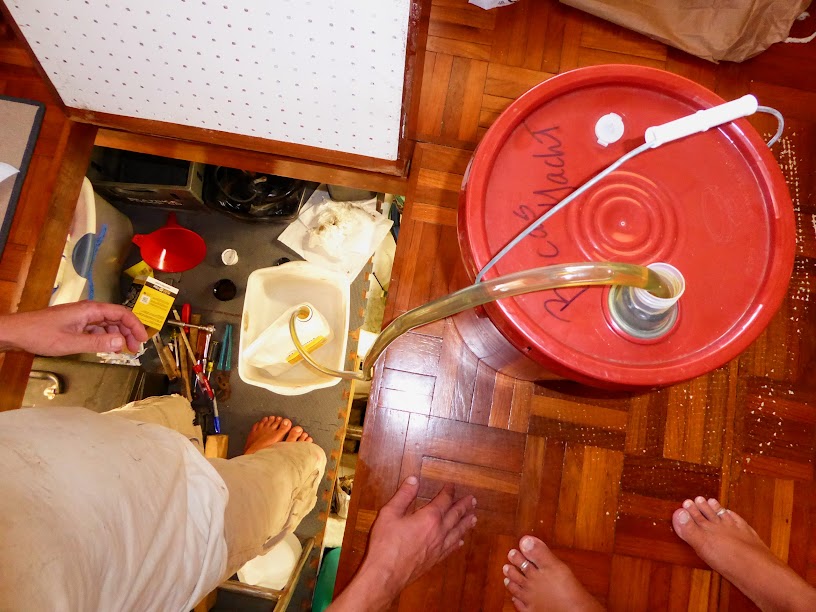
An oil change for the motor was also in order. During the process, he used a jiggle siphon to transfer oil from a five gallon bucket that he’d purchased in Bocas del Toro, to smaller containers for easier storage.
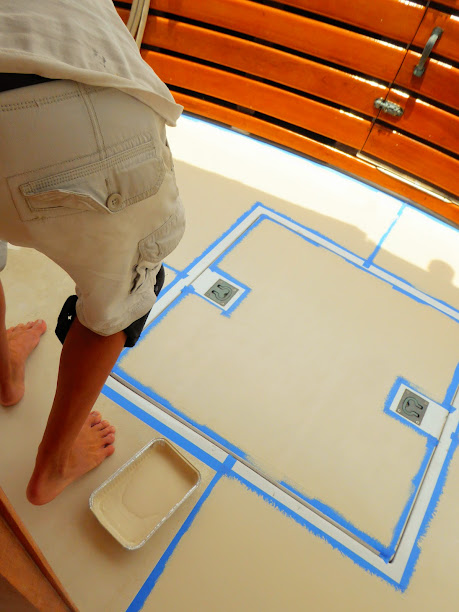
And, our poor, dirty cockpit got a fresh coat of paint…hurray!
As usual, we’re one of the smallest, oldest boats in the marina…but we’re ok with that. We’re enjoying our Cartagena home, and look forward to exploring the walled city!
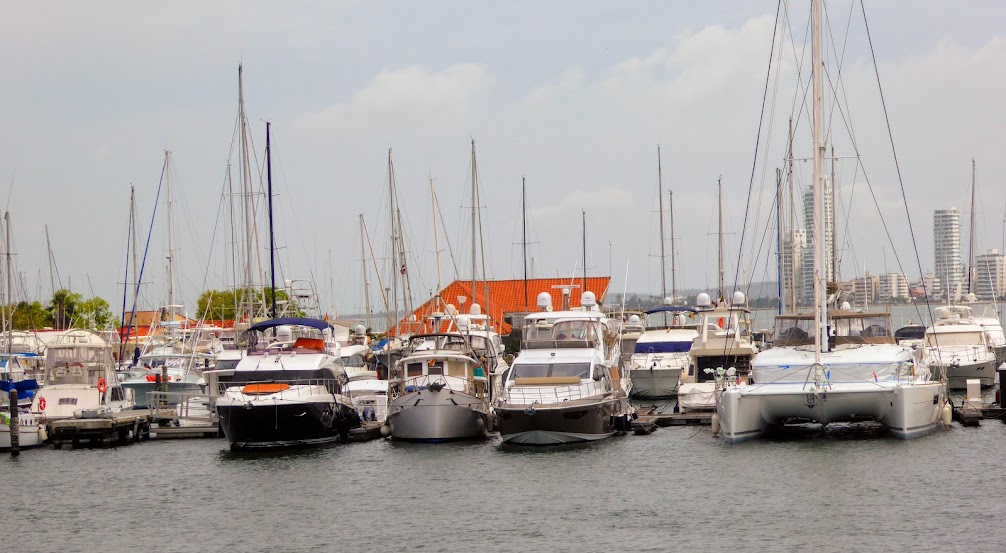
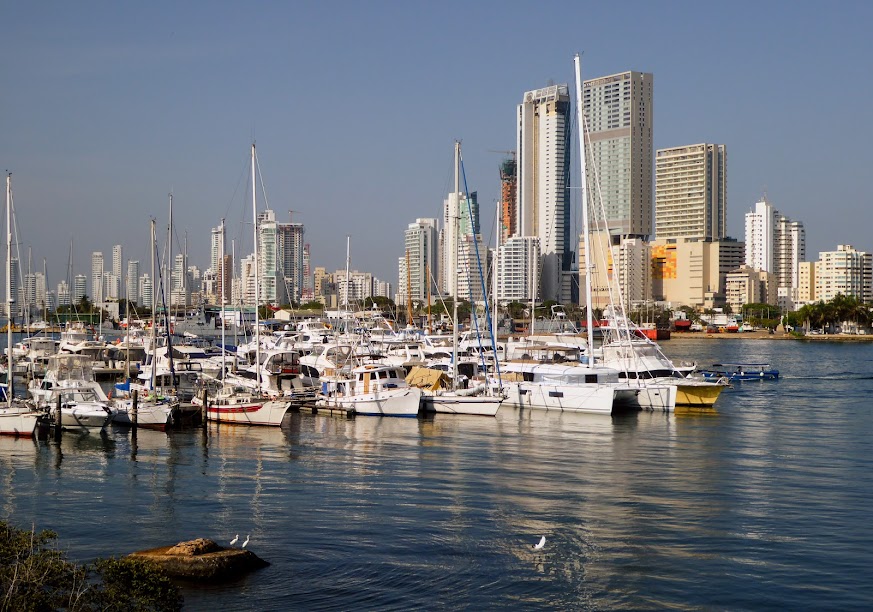
Here are more photos.

“Shells Sink, Dreams Float. Life’s Good On Our Boat!”


Farewell Panama, You Were A Beautiful Host

After spending eight months in Panama, we prepared to leave the San Blas Islands, and head for Colombia. Our original plan was to be in Bocas del Toro by the end of June, and stay for a month. After that, it would be on to the San Blas for the month of August, and then head for Colombia in September. As we’ve well learned, weather rules the cruising world, and as a result, we didn’t arrive in Bocas until the first week in August.

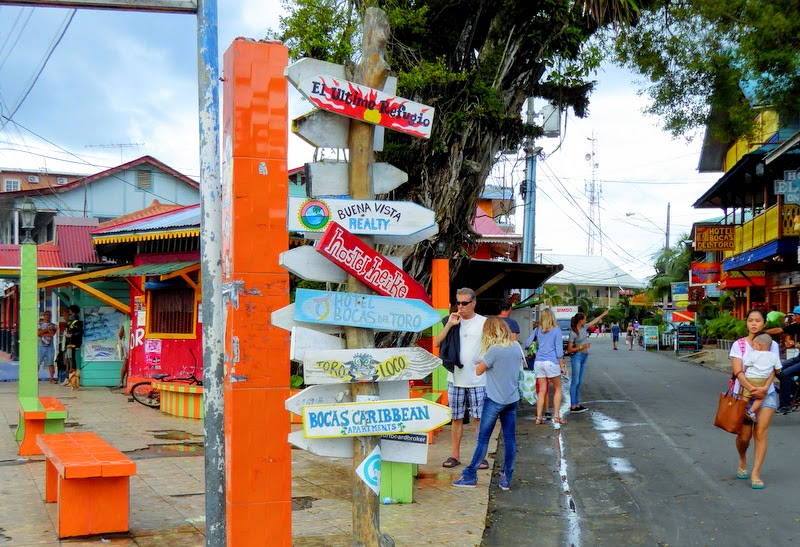
Since we’d arrived late, and paid several hundred dollars to clear into Panama, I told Scott it would be a shame to rush through the country, so we slowed our plan. Almost three months later, we’d grown attached to the laid back, comfortable town of Bocas del Toro, and the scenic surrounding islands. We met new friends, and frequented stores and restaurants in town so much that we were recognized on the street.

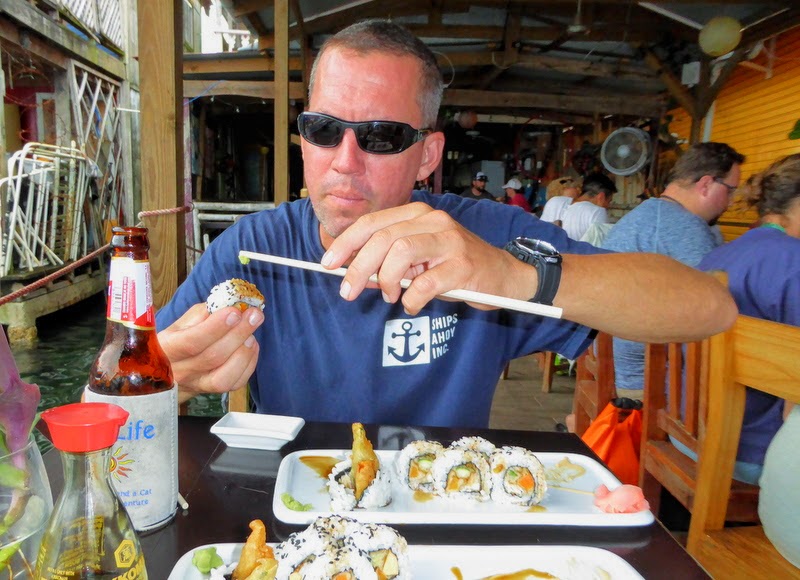
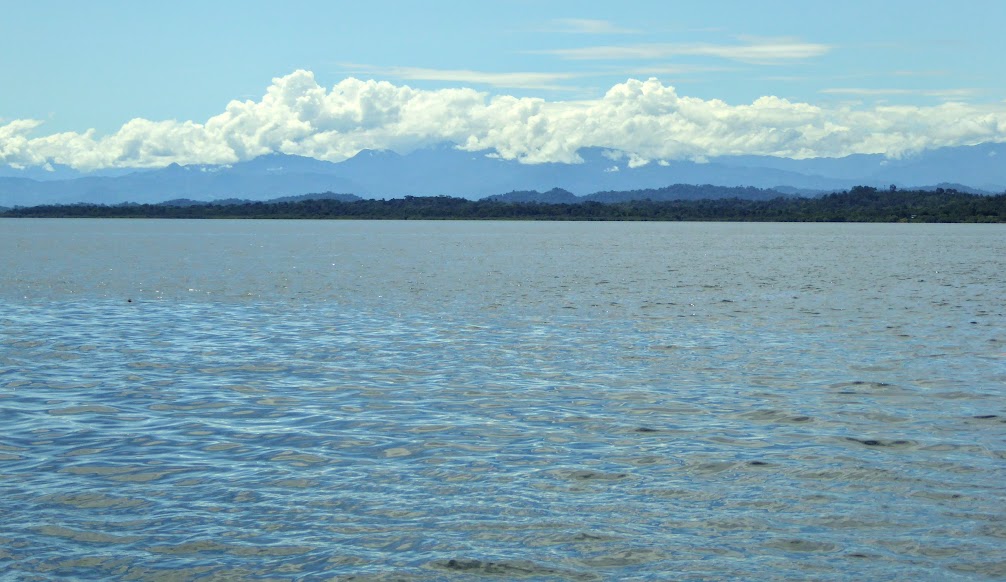
We ate fresh made pizzas at Bocas Marina’s barbecue night, got to know most every happy hour special in town (Scott even came to like sushi!) and never got tired of the mountain views.

At Red Frog Marina, we were surrounded by lush jungle rain forest, and enjoyed the short walk through tropical scenery to the beach, for yummy tacos. The staff quickly became friends, and the sights and sounds of the property were truly beautiful.


Scott crawled through caves with bats, hiked trails on Red Frog’s property and explored the archipelago with the Aluminum Princess.

We went to Sunday parties at Ron Azul,  attended many happy hours on Red Frog’s dock, survived crazy, crowded, high-speed panga rides to and from town and celebrated Thanksgiving at a terrific potluck with friends during our final days in the area.

It was hard to cut the apron strings and leave Bocas, which will always have a special place in our cruising memories, but there was more of Panama to see.

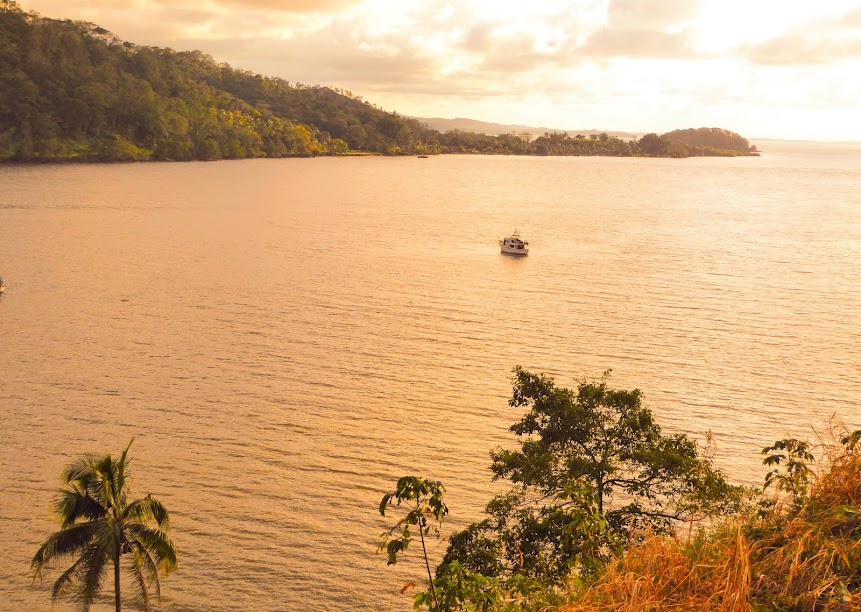
As we headed for the San Blas Islands, our route took us to more beautiful locations. The shoreline scenery at Escucdo de Veragus was almost otherworldly, and we spent hours in the dinghy taking in the sights.

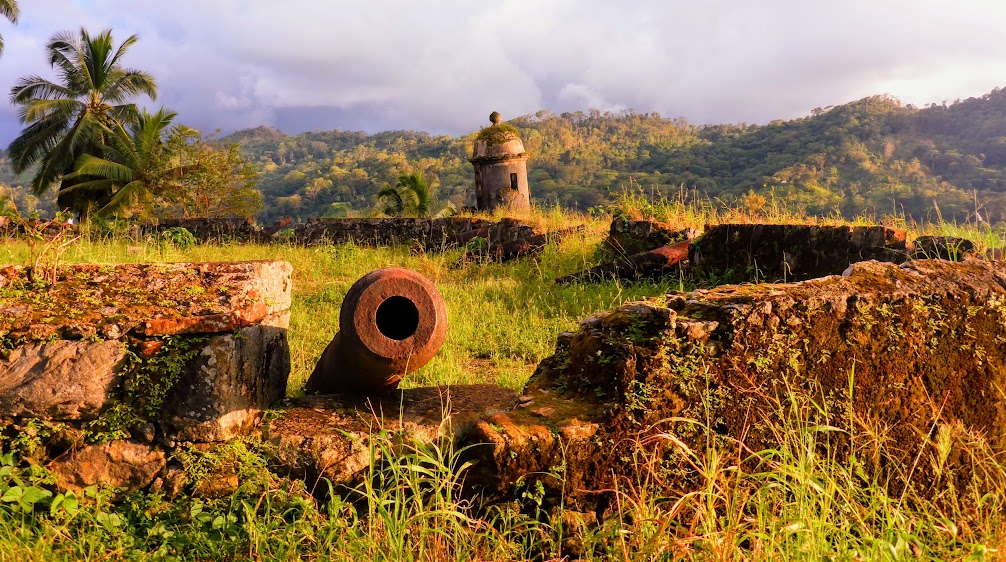
Portobelo’s harbor was quiet and picturesque, and we enjoyed roaming the ruins of the many forts that surround the town.

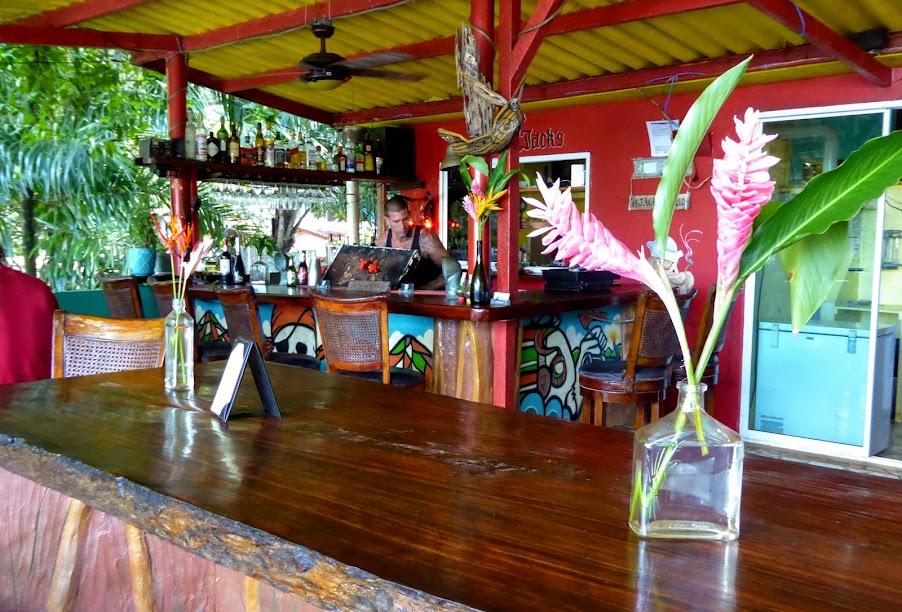
At Captain Jack’s, perched on a hill in town, we were welcomed with cold towels, local info., and delicious food. We’d have liked to linger longer in Portobelo, but weather pushed us on.

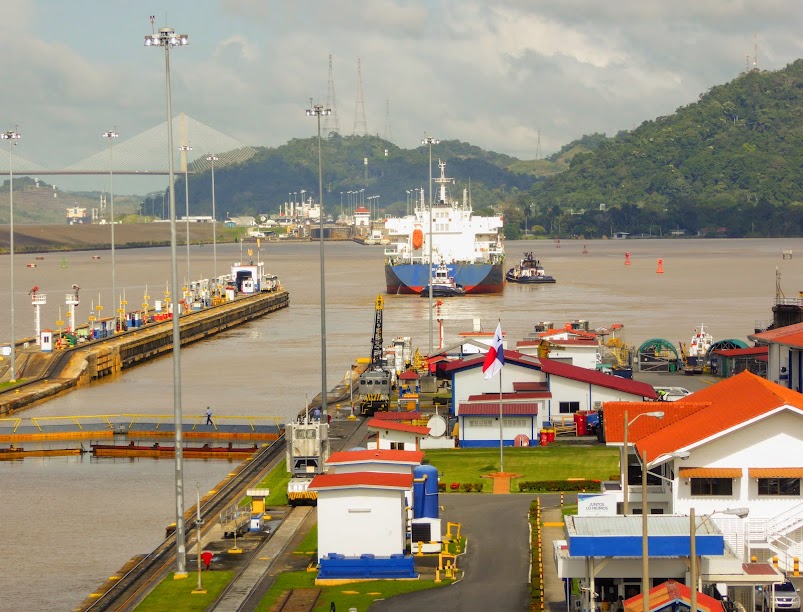
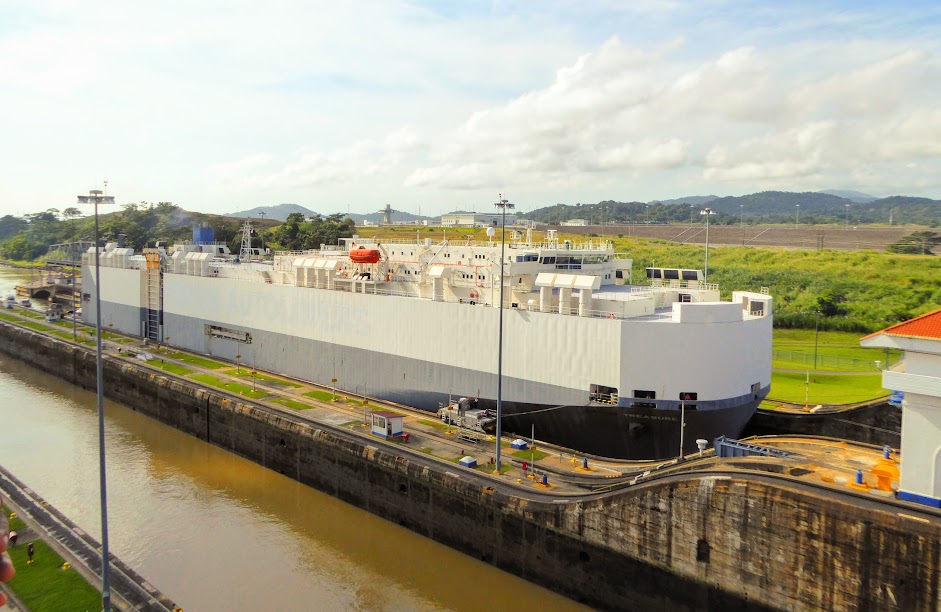
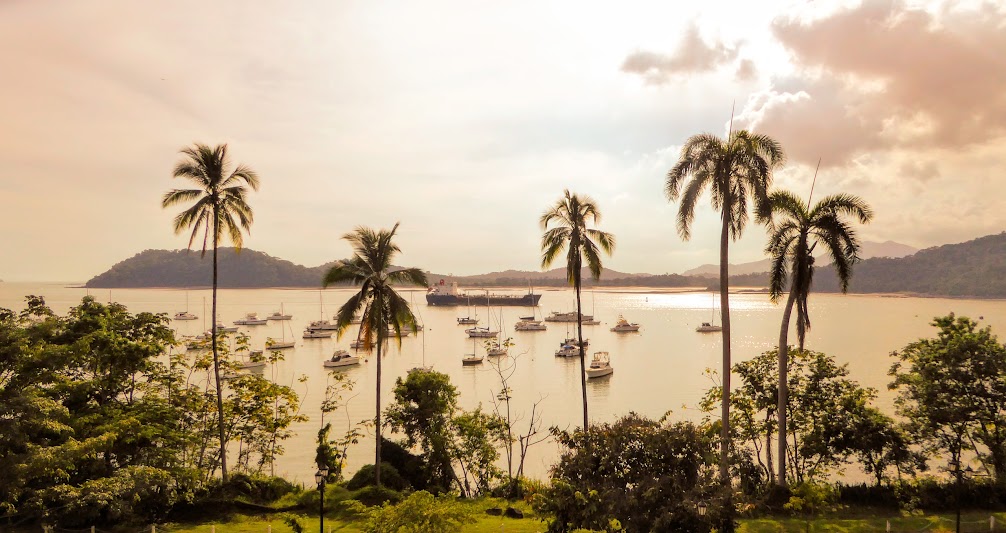
Next was a pit stop at Linton Bay, for an overnight trip to Panama City, and a visit to the Panama Canal. We spent hours watching the huge ships close up, as they passed through the locks on their way to the Pacific.

Then it was on to our hotel for the night, where we continued to watch the ships pass by. It was also a treat to watch tv in English, and take roomy showers.

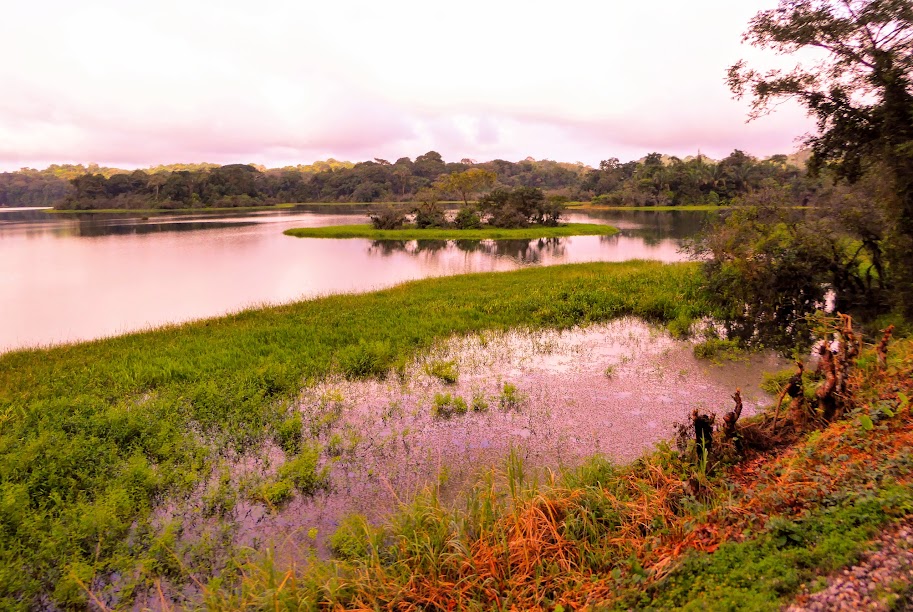
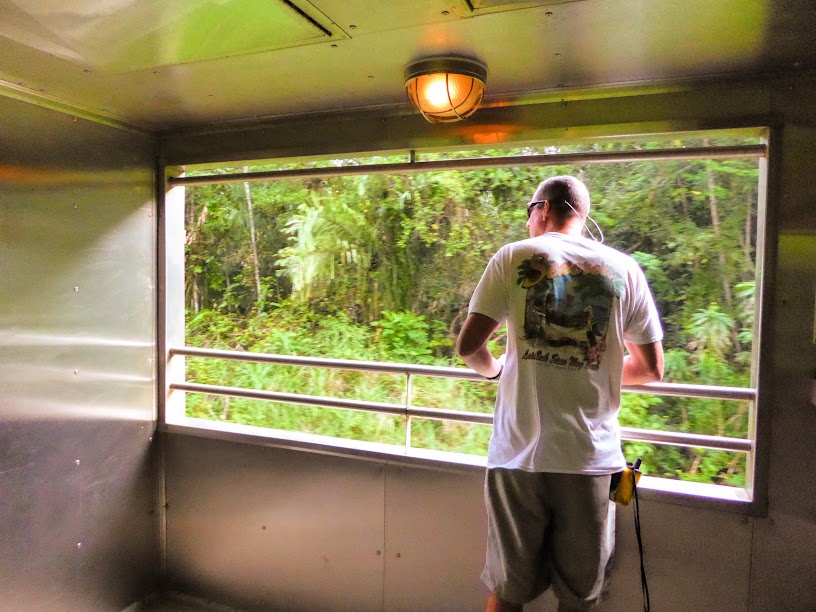
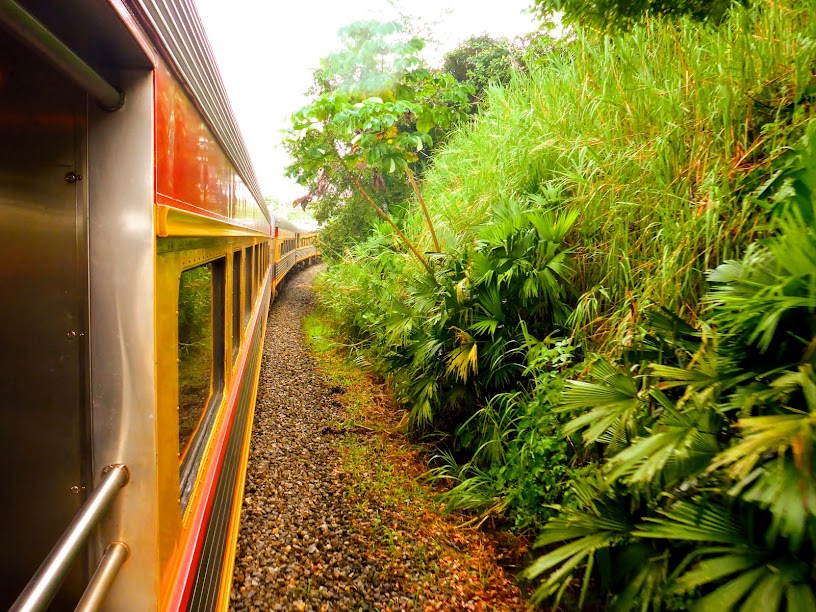
Our return trip toward Linton Bay was by train, on the Panama Canal Railway; what a cool way to travel! We spent the entire ride out on the observation deck, getting up close and personal with our surroundings.

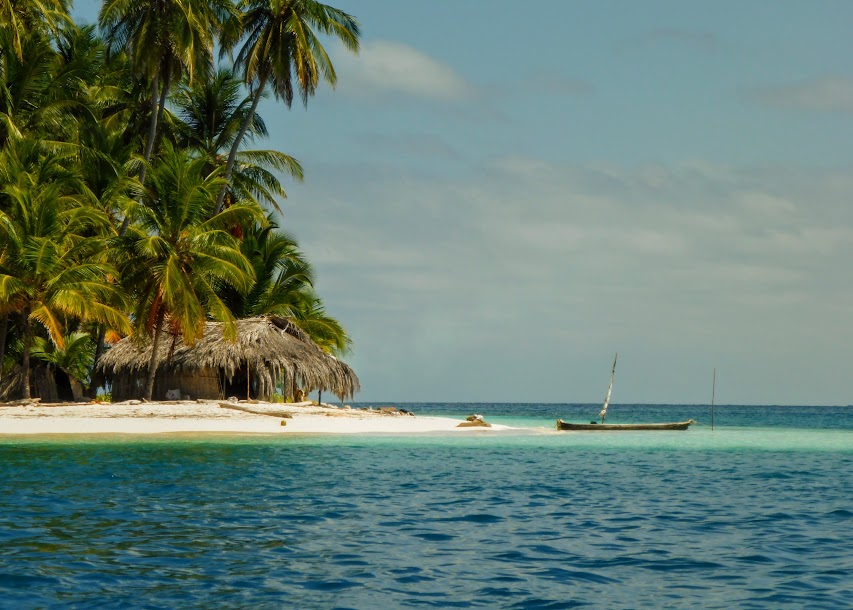
We took advantage of a lull in the wind, and enjoyed a calm ride over to the San Blas Islands, where we enjoyed a tropical Christmas and spent almost four months surrounded by gorgeous water and uninhabited palm tree islands.

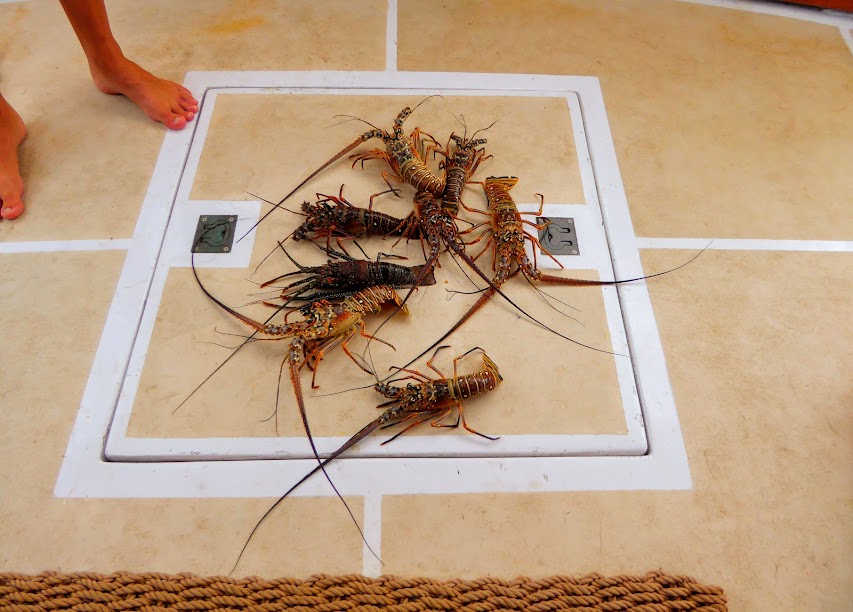
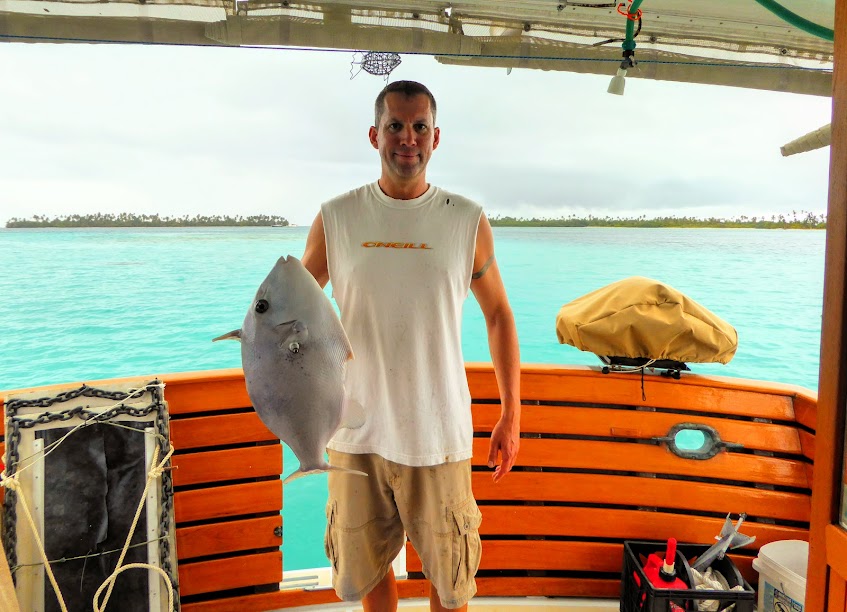
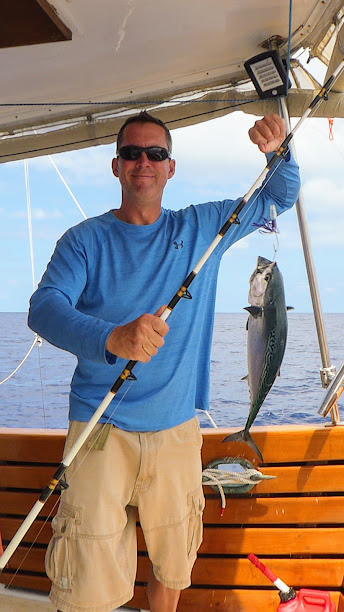
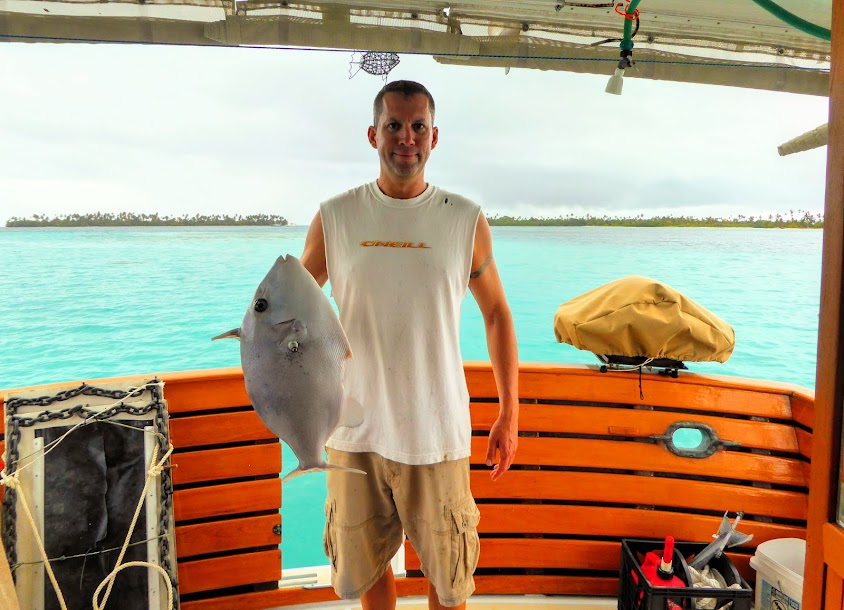
Scott fished almost every day, catching endless lobster, then using the heads as bait for delicious Trigger fish!


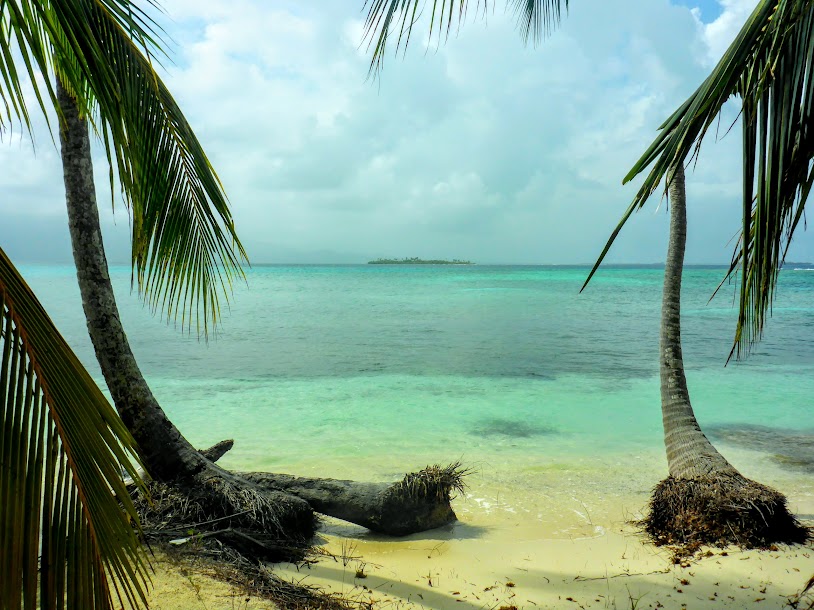
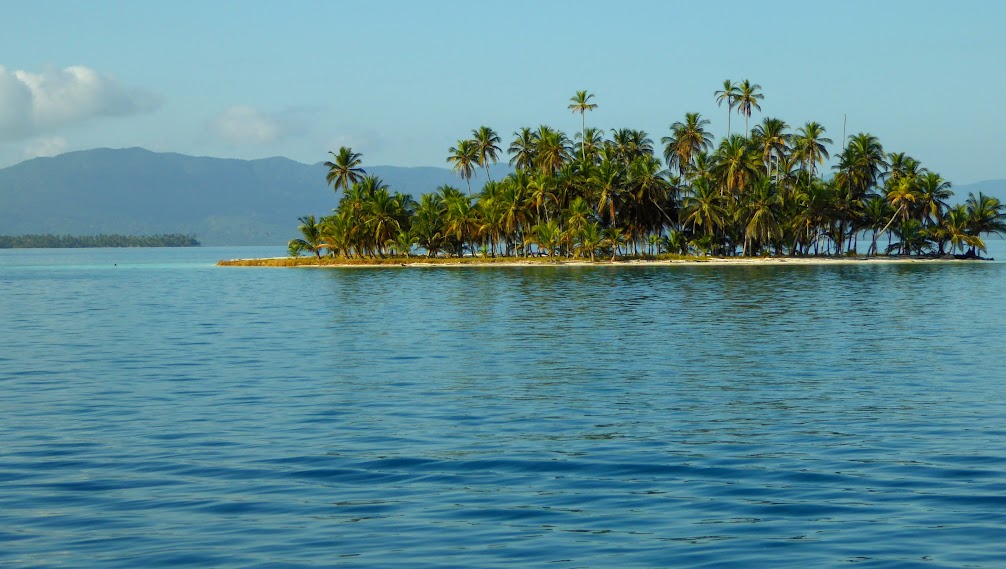
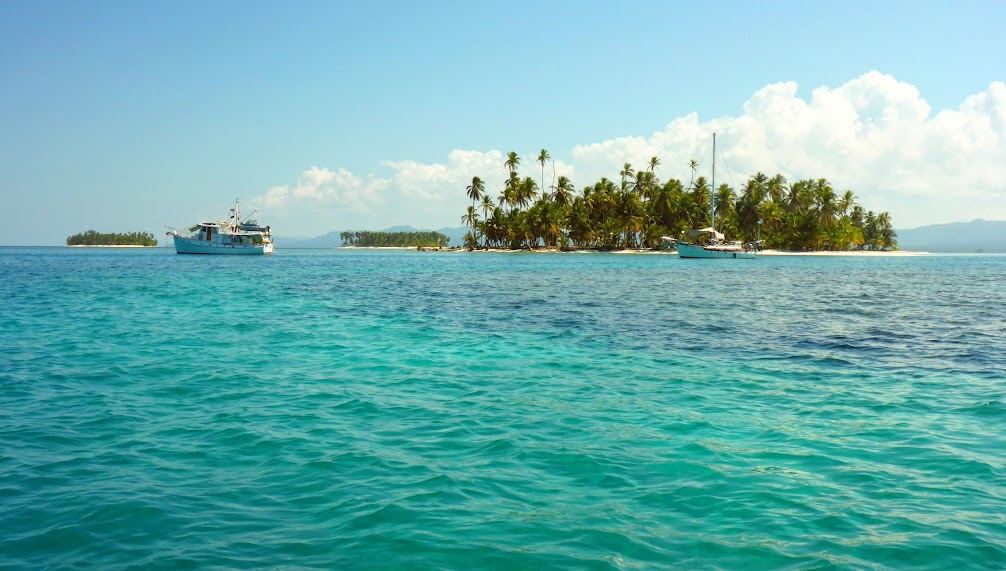
There were endless anchorages, some near the lush, mainland mountains and others surrounded by reef and palms. 

We enjoyed getting food from veggie boats, and interacting with the friendly Guna people.

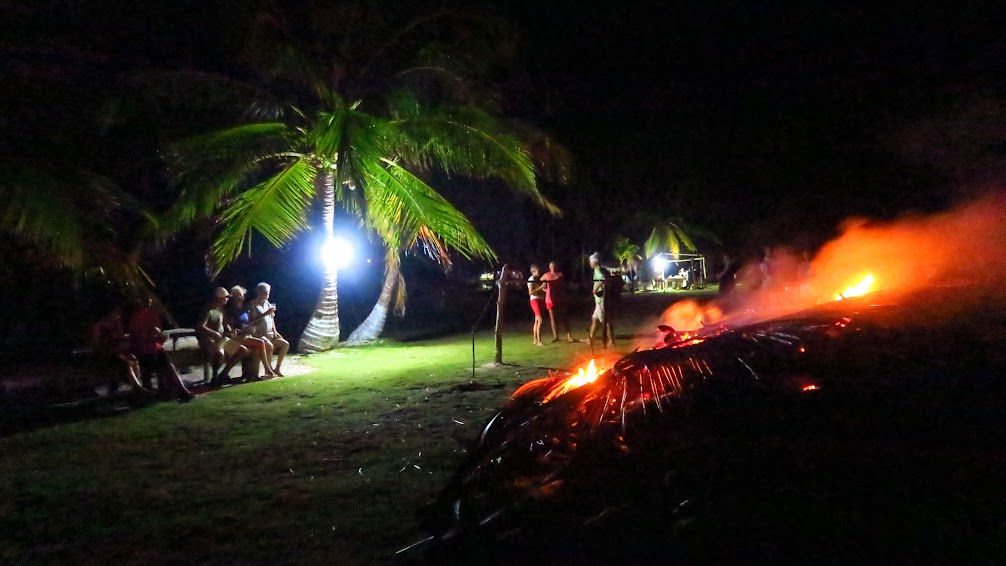
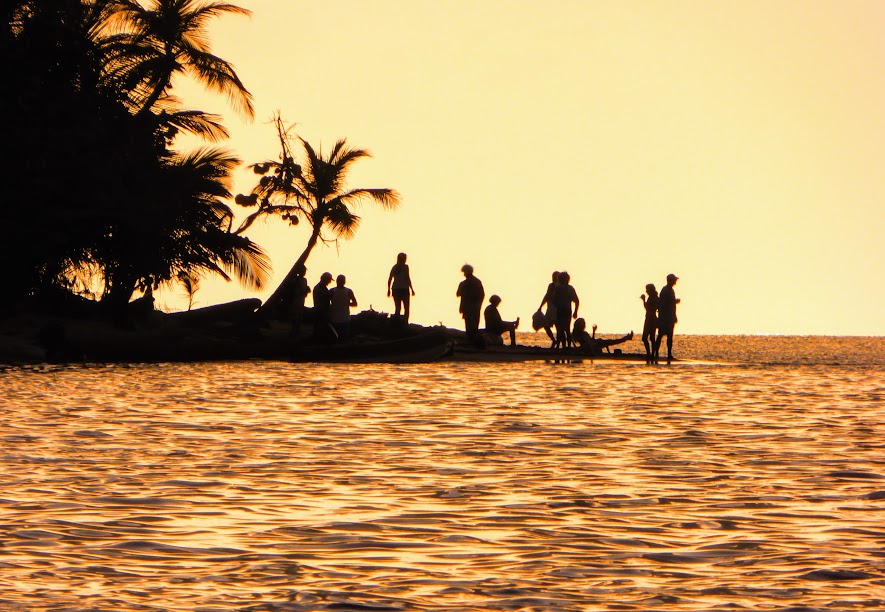
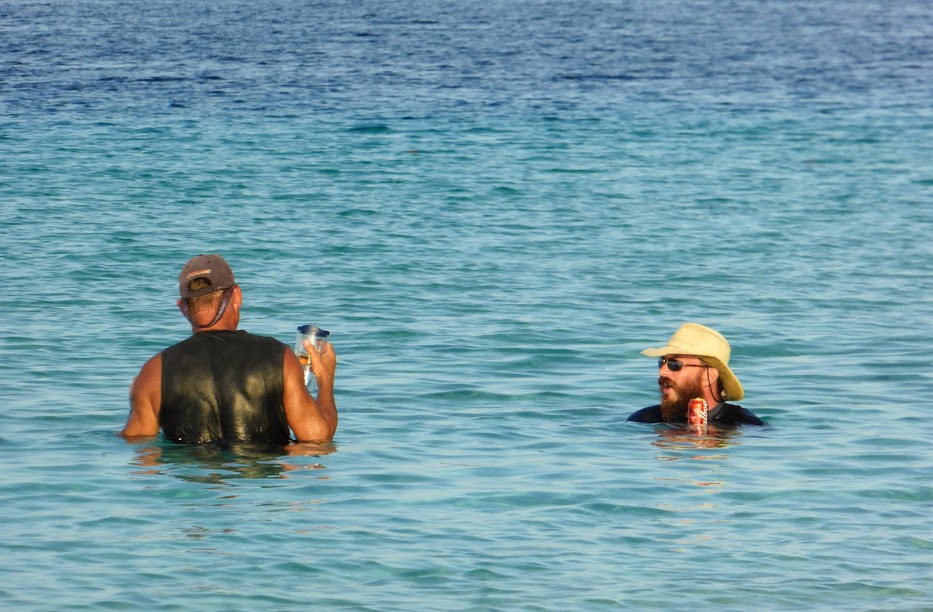
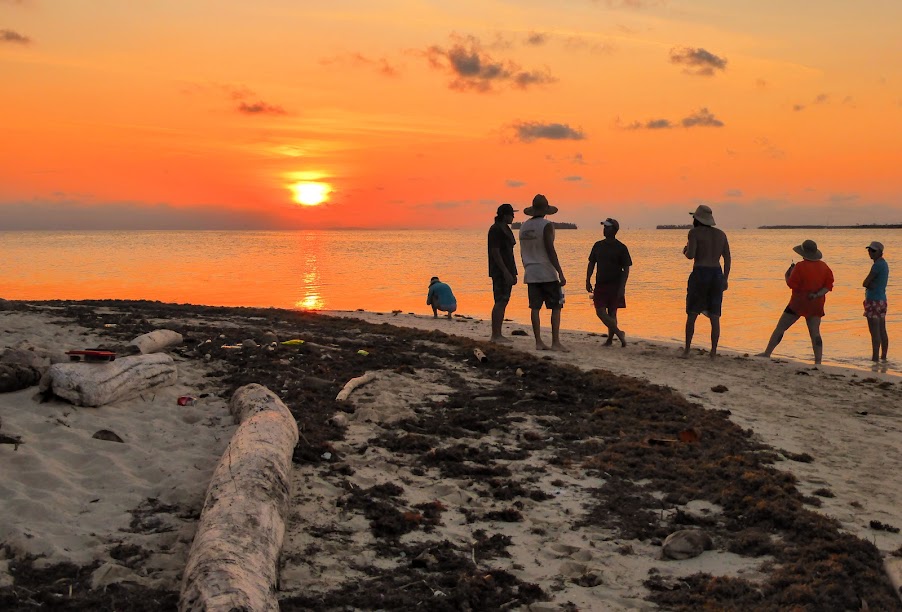
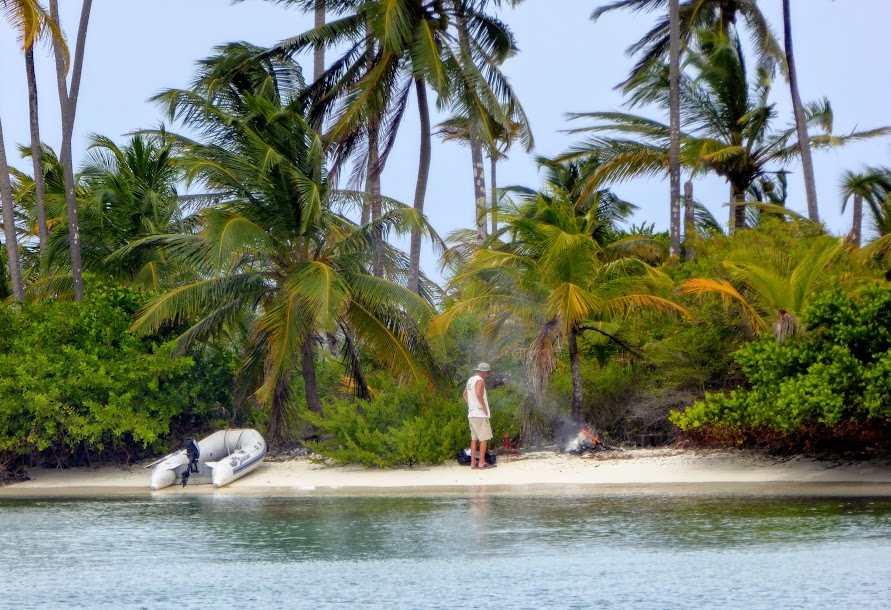
For somewhere so remote, our social calendar was quite busy! We made terrific friends here, who we’ll keep in touch with for years to come. There were many beach parties, as well as trash burning gatherings, which was always a good excuse to bob in the water.

During our time in the San Blas, we had our first official cruising visitor. Our friend Karen made the adventurous journey to see us, and we had a ball catching up, introducing her to our friends, and showing off our “neighborhood”!

Scott continued his explorations, by land and sea, and Howard spent his time in Panama as he does in every location we visit, playing, napping and watching for fishes….and occasionally sharks, and generally keeping us on our toes!


So now it’s time to move on, and leave where we’ve called home for the last eight months. We could spend years here, or very easily live here. The country is beautiful, and offers much to see and do on the water and inland, as well as in Panama City. Our departure is bittersweet, but we look forward to our next stop, and for the adventure to continue.


“Shells Sink, Dreams Float. Life’s Good On Our Boat!”


Snug Harbor And Our Last Days In The San Blas Islands

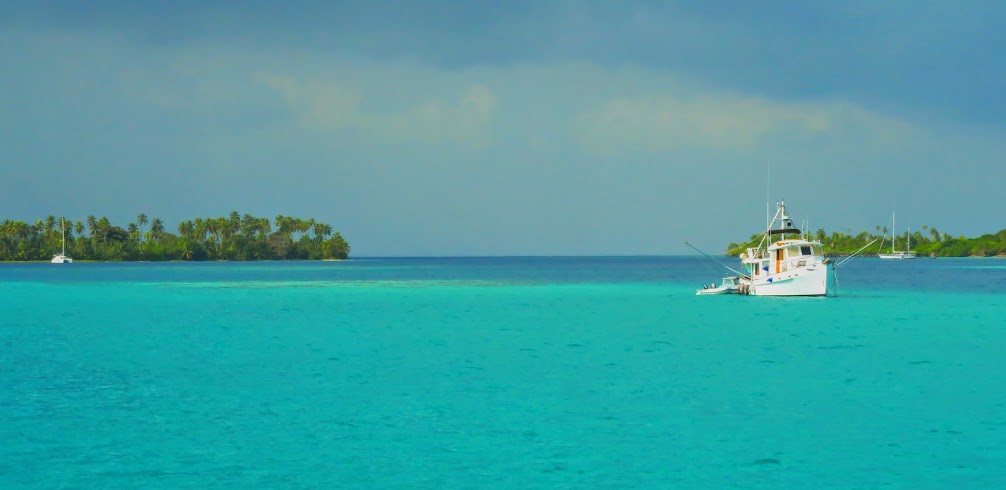
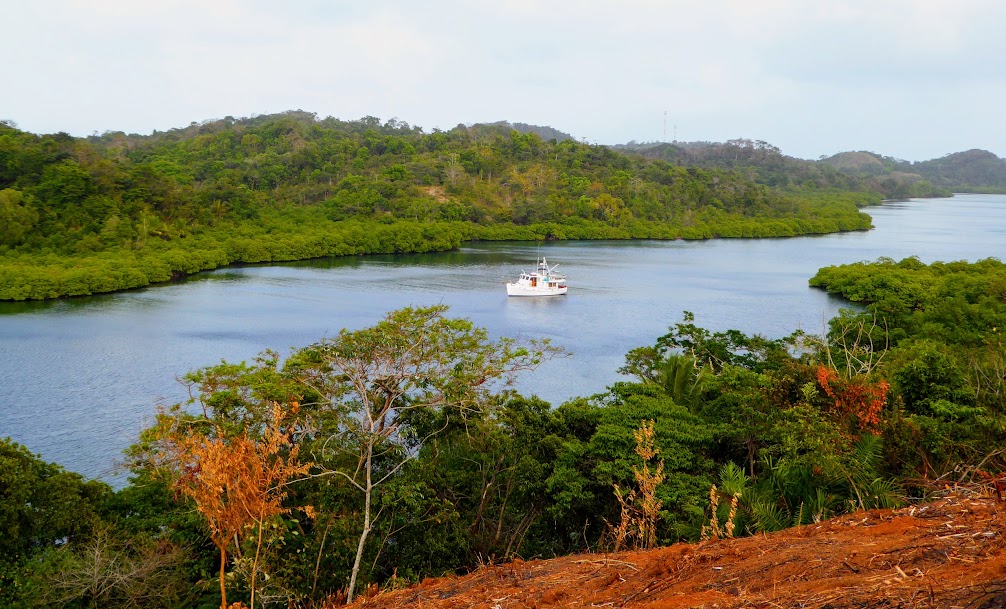
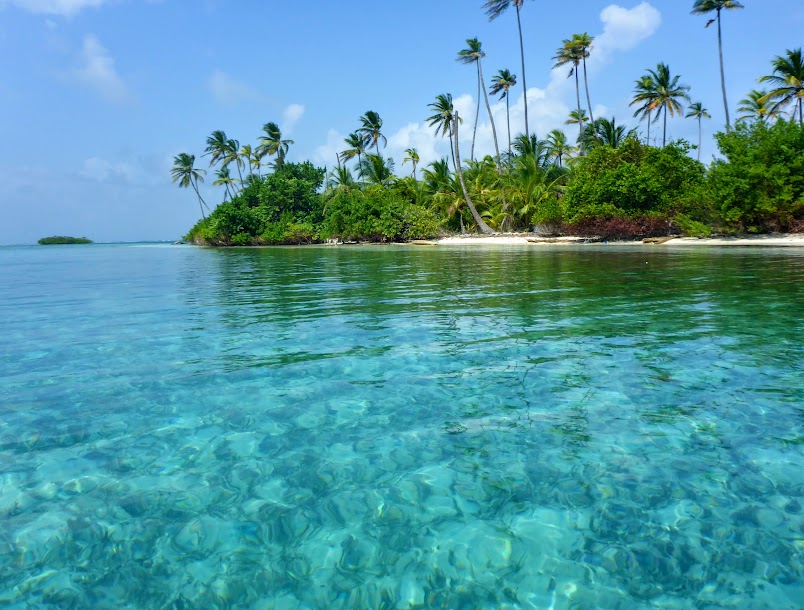
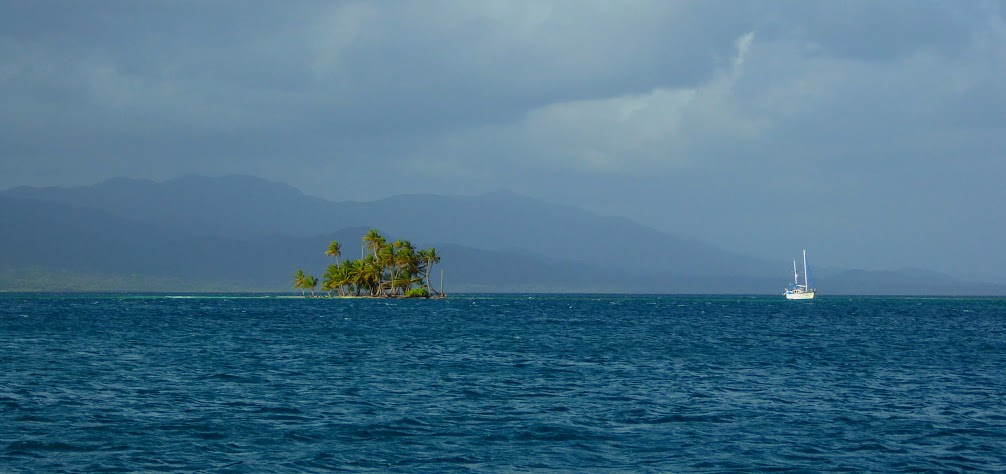
We waived a final goodbye to the swimming pool anchorage, and traveled six hours east to Snug Harbor, one of many anchorages, islands and villages farther east in the San Blas. The quiet anchorage was beautiful, surrounded by small islands made up of palms and mangroves, and again set against the lush mainland mountains.

The three of us spent the evening out in the cockpit, enjoying the scenery (us) and smells (Howard).

After parting ways in the Robisons, our friends Ted and Barbara (s/v Rosa dos Ventos) caught up with us in Snug Harbor. The four of us made our way into the nearby village of Playon Chico, connected to the mainland by a long bridge.

We were in search of the usual…veggies, eggs, Coke and Guna bread. As we wandered the quiet streets, a man offered to help us locate a woman who sold bread. We purchased the most delicious rolls from her, still warm from the oven. The man then led us along a narrow path that wove it’s way tightly between some of the village houses; I didn’t dare take a photo at the most narrow spots, as we were practically inside of peoples’ homes!

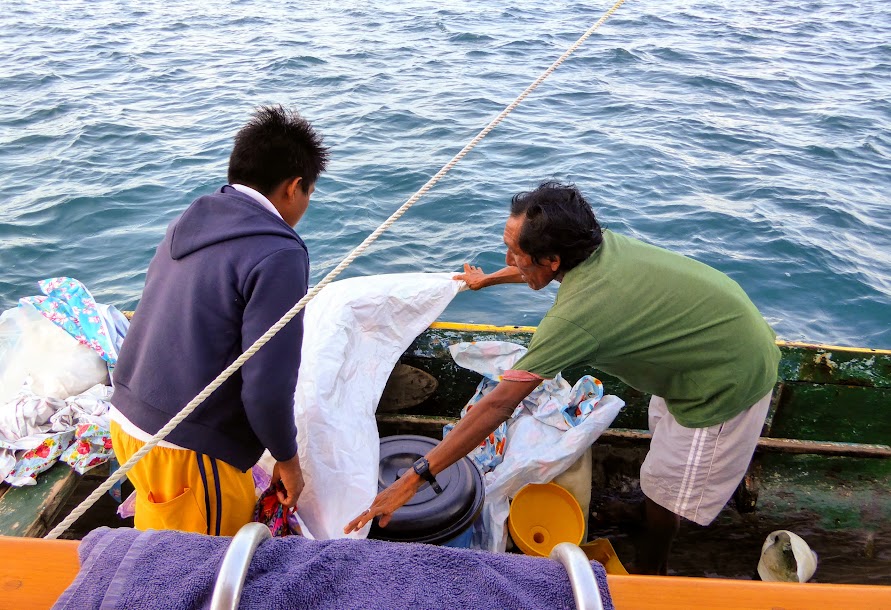
The labyrinth-like path ended at the village docks, where two supply boats were tied. We were able to buy eggs, beer, sodas and a few veggies right off of the boat.

After we’d returned to the boat, and put away our things, Scott and I took a happy hour ride around the anchorage, exploring our surroundings.

As usual, Scott wanted to get his hiking fix in. He’d heard there was a waterfall in the area so he set out the next day with Ted and Barbara to search it out. The threesome made their way to shore, and into the woods.

They passed by several fincas, or farms, where villagers grow vegetables. One farmer offered to lead the three of them to the waterfall. Having local knowledge is always helpful, and it’s also a nice to learn about plants and such along the way. Ted is fluent in Spanish, and could easily translate information, so they accepted the farmer’s offer and continued on with the now guided tour; one of his helpers tagged along as well.

They learned that dark, dirt-like edges around the garden areas was actually made up of ant nests taken from higher elevations. Cutter ants can tear plants to shreds, but it seems the cutter ants down near the fincas don’t like the smell of the “higher” ants, and therefore keep out of the gardens (not sure if this works for other critters as well).

Water is carried from the falls back down to the village through a  pipe system that follows the trail. In most places, the pipe is raised off the ground in an attempt to keep it as straight as possible, and out of the water, using branches and wires.

The guide pointed out a tree whose fruit is used for containers, when dried.

Voila! Guna tupperware!

We have noticed many of the Guna people with red paint-type stuff on their faces. The guide informed Scott, Ted and Barbara that it is actually a type of sunscreen that comes from the berries on this tree. We’d assumed it the red faces had some kind of traditional meaning…sunscreen, go figure.

They continued on through the woods, making their way higher and higher, with the water line leading the way.

The guide stopped to show the three an ant nest, used to create barriers around gardens in the fincas below.


After walking approximately four miles, they arrived at the waterfall. It was time for a lunch break…and a swim!

Fed, rested and cooled off, the group began to make their way back. As they walked, Scott noticed a big line of carpenter ants carrying leaves of a tree, along the top of a water pipe. We’re always amazed at what they can carry, and how quickly they can tear something apart.

Nearing the end of the hike, the guide stopped to pick coconuts, so the three could enjoy some fresh coconut water. Thankfully, Scott has not yet attempted to harvest a coconut himself (Kevin Stotz, if you were here, he’d most likely make you do it!), but I’m afraid that day is coming.

Once they were back down among the fincas, the three were met by other little helpers, who were finishing their day’s work on the farms. They happily posed for a photo.

After only a few days at anchor in Snug Harbor, Scott noticed a good weather window for us to get to Cartagena. Not knowing how long we’d have to wait for another, with early spring weather being unpredictable (scratch that, with all weather being unpredictable), we decided to forgo visiting any more of the eastern islands, and make the jump. It would be goodbye to the San Blas, and sadly, to Panama. Here are more photos.

“Shells Sink, Dreams Float. Life’s Good On Our Boat!”
Visiting The Western San Blas

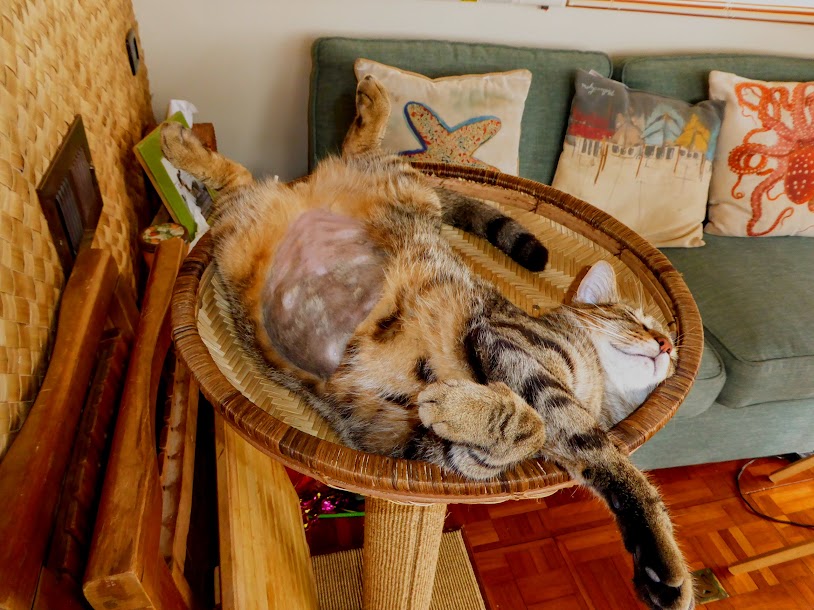
After Howard’s Panama City adventure, we headed back to the Eastern Holandes. We were told that Howard’s post-vet photo didn’t come through on my previous post. It can now been viewed, but here he is in all his shaved belly glory, just hours after returning from his adventure.

Our route took us past the Carti group of islands, most of which had densely populated villages. This overhead photo gives you a good idea of just how crowded they are.

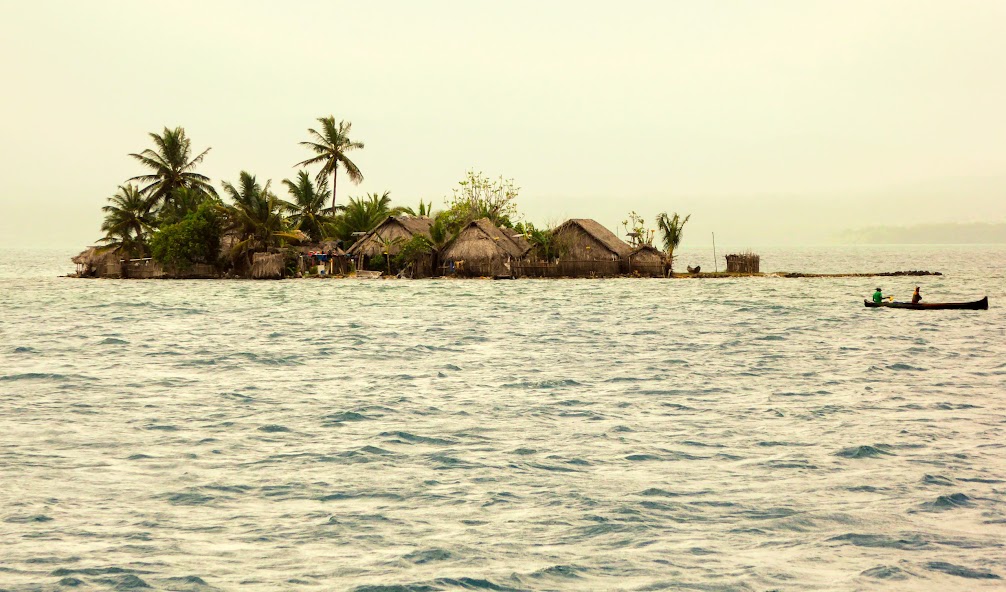
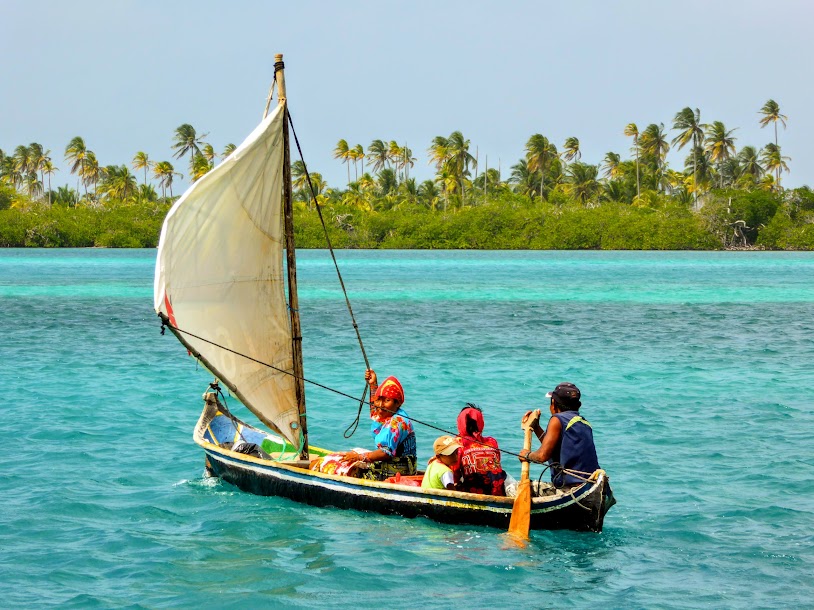
I snapped pictures of the villages as we passed by, and of women paddling their ulus.

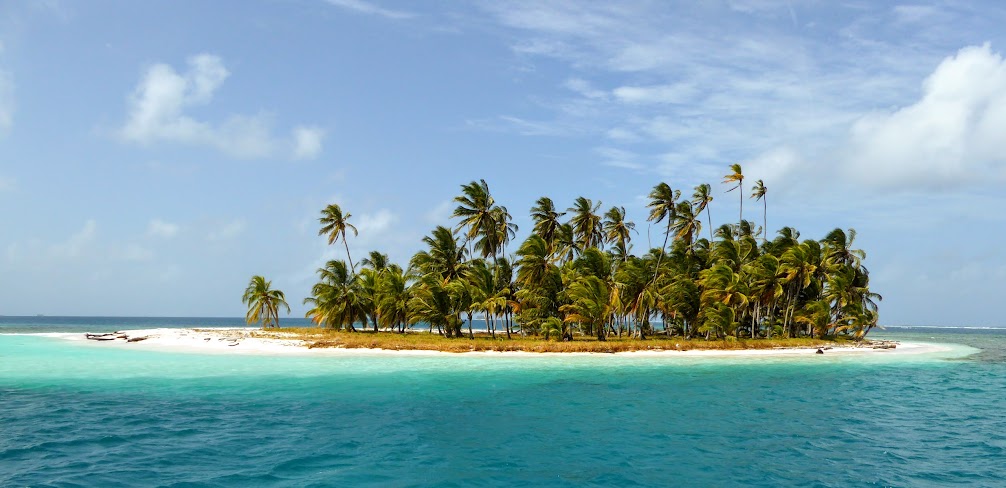
We moved father east, and chose to travel through the Lemmon Cays along the way, admiring the return of sandy, palm tree islands and beautiful blue water.

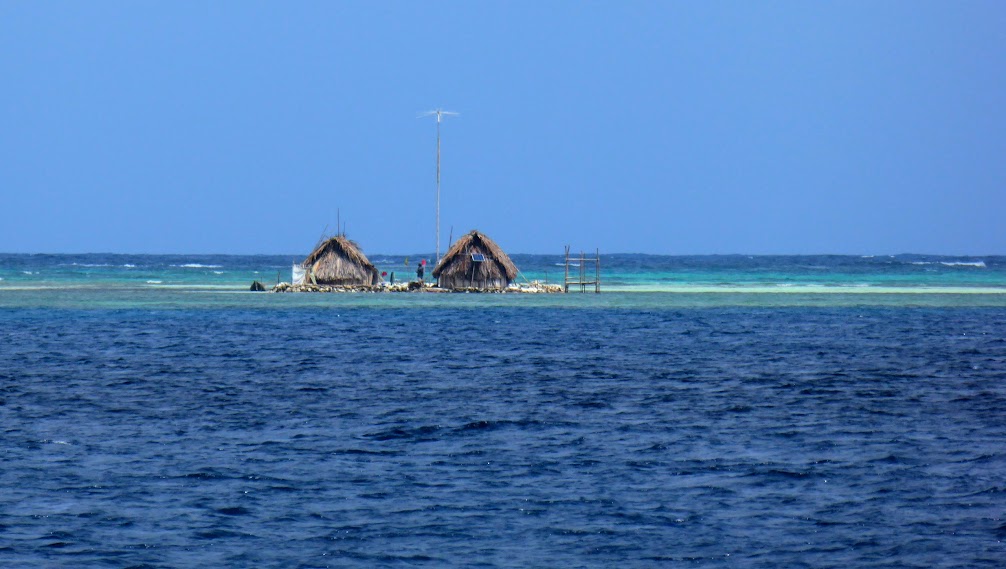
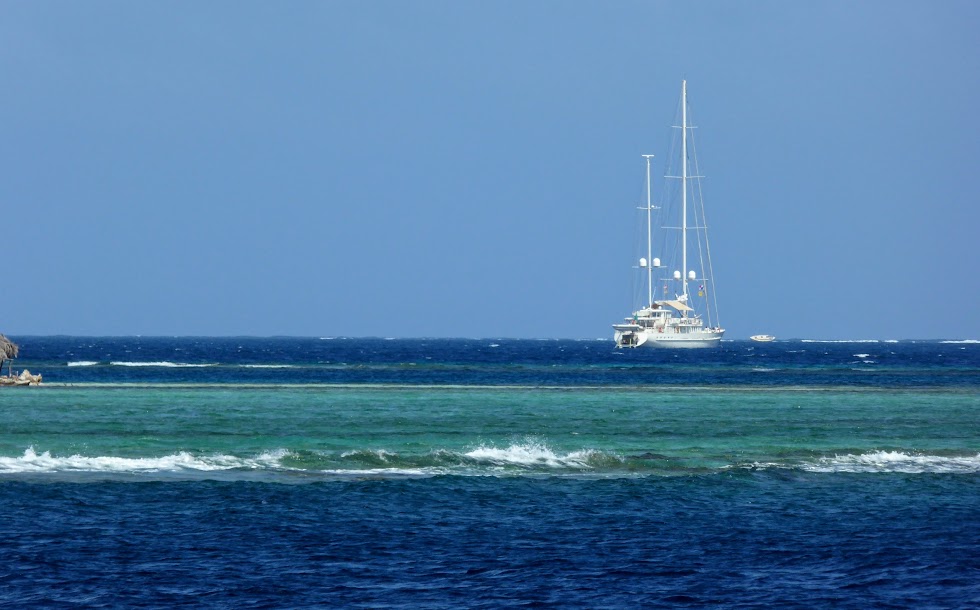
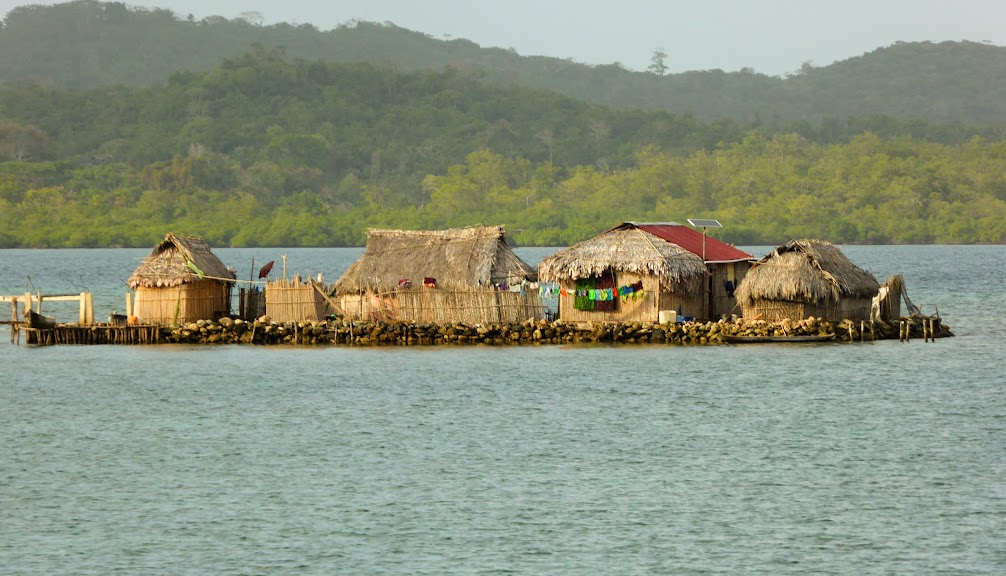
We were amused by these two little huts, smartly outfitted with both solar panels and a wind generator, and also a huge sailing yacht!

In four hours time, we were back in the “hot tub,” and delivered goodies from Panama City for our friends Tate and Dani (s/v Sundowner).

After some time with friends anchored in the area, we returned to Porvenier in early February to see Joe, for Scott’s passport renewal stamp.

My passport stamp date is now different from Scott’s, as I’d flown in and out of Panama when I visited Baltimore, so I am now permitted to be in the country on a “tourist” visa (good for 180 days) until the beginning of April . Since Scott was still working with a “mariner’s visa,” (stamped when we arrived by boat in August), his stamp expires every 90 days, so we needed to get his renewed again.

When we arrived at the immigration office in Provenier, Joe wasn’t there, but the young man on duty stamped Scott’s passport with no problem, (and no charge!) and we headed happily back to the boat.

Our supply of dinghy gas was getting low, so Scott planned to make a stop at the nearby island of Wichubwala while we were here dealing with immigration. However, it was now too late for a gas run, so that would have to wait for morning.

The anchorage off of Porvenier is open to the ocean swells, and even with our flopper stoppers in, it was a rolly go; so much so that Scott got seasick. The next morning, he mustered up the energy to go for gas, only to realize upon arriving at the dock that everything was closed. It was Sunday, so that meant we’d be spending another rolly night at anchor.

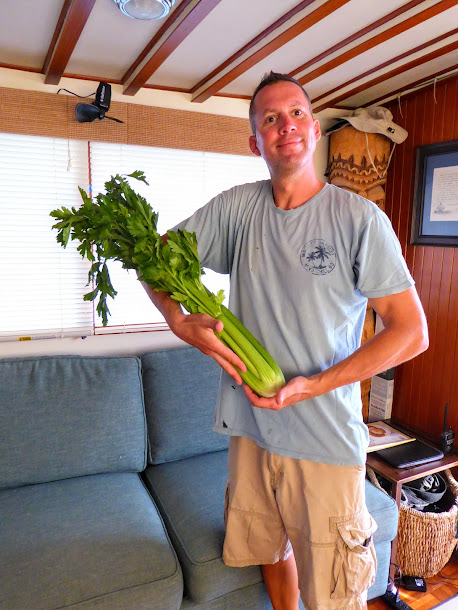
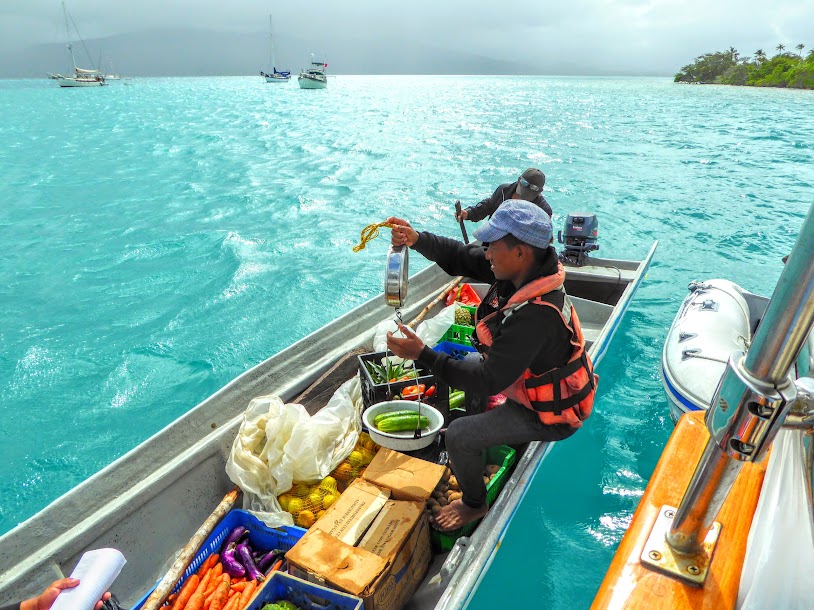
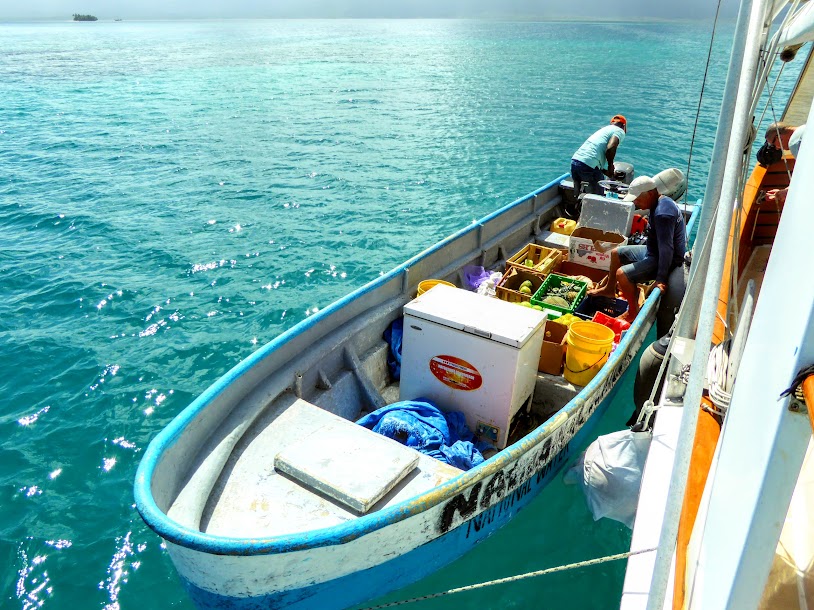
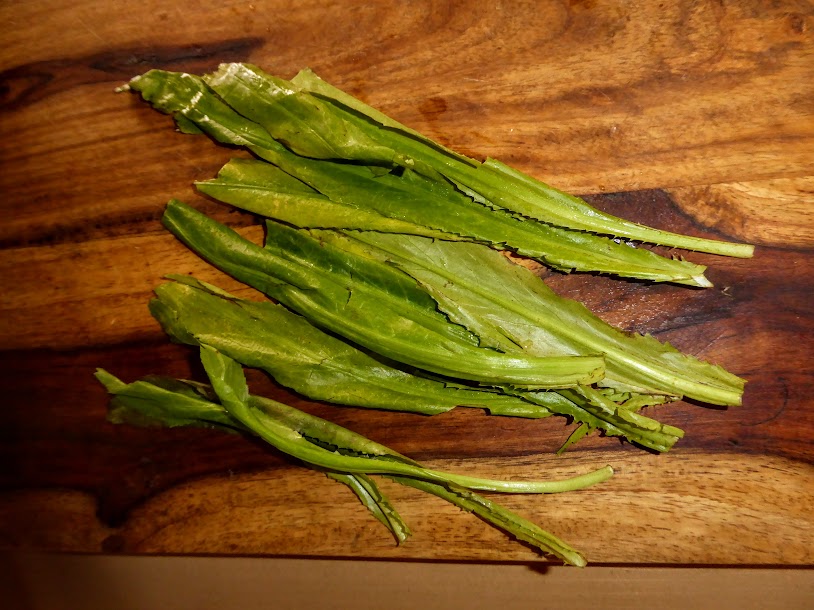
Our extra day was not completely in vain, as we were visited by the mother of all veggie boats! The National Waiters panga stopped by on their way to the outer anchorages, loaded with produce.  As they cut open the large bags of potatoes, onions, cucumbers, peppers and other items to sell us, it was like Christmas! The produce was some of the best we’d purchased so far, including a the longest bunch of celery I’ve ever seen!

After filling our dinghy gas tanks on Monday morning, we left the area near Provenier, passing more densely populated islands. After traveling close to the shore of Panama’s mainland, now in the western area of the San Blas islands, we decided to investigate Nalia Bay.

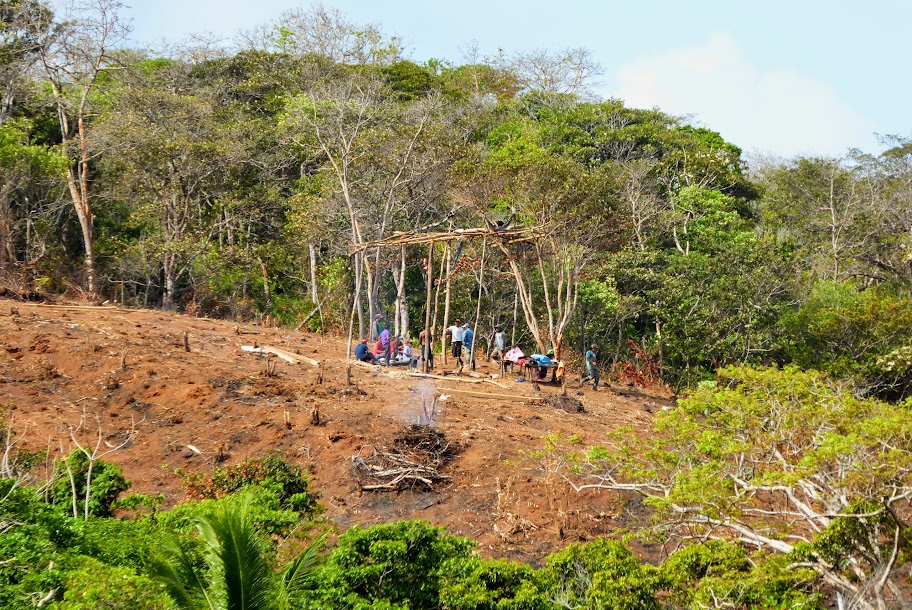
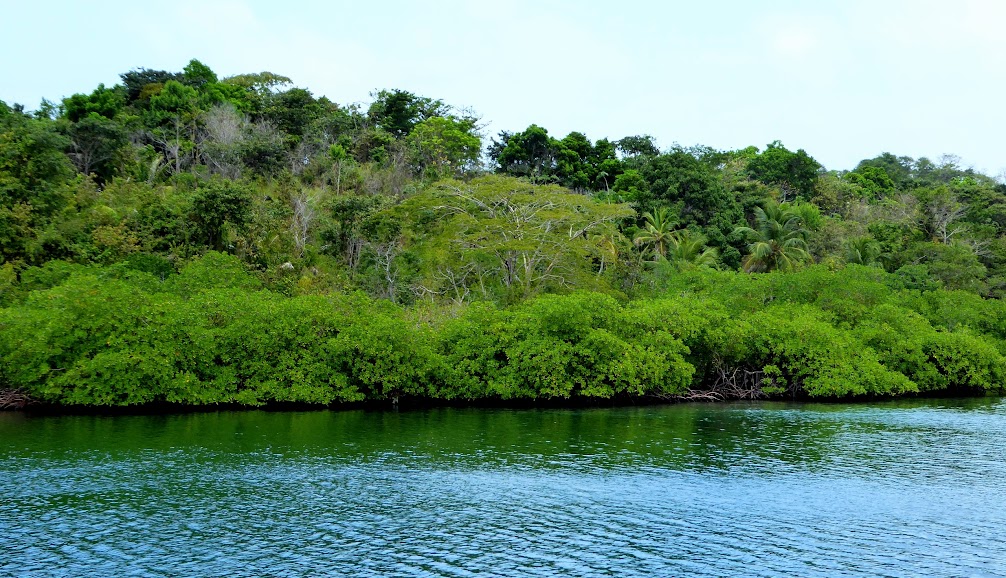
The bay was lined with beautifully lush rain forest. Since we hadn’t seen that much green in months, it seemed like a great place to spend a few days. We had the bay all to ourselves, except for the few locals who were clearing land up on one of the hills, preparing to build a house; they waved their arms in a hello as we dropped anchor.

The surroundings were gorgeous, and it was a treat to have the area all to ourselves. However, in all our excitement, we failed to realize that our anchorage was also surrounded by mangroves….many, many mangroves…which means biting noseeums!

By the time we had pulled all of our screens closed, it was too late. Those evil bugs, the size of a grain of pepper with a bite like a bee sting, had taken over inside the boat. I spent hours just slapping my legs, trying to kill them as they bit me. Scott chastised me, for not “just dealing with it,” but later we both spent the night in long pants and long-sleeved shirts!

Scott finally snapped, as they bit at his uncovered face, and began to smash all he could see on the stateroom wall. Counting each one, he killed 320…just in our stateroom.

Even though the bugs were miserable, the internet signal was surprisingly terrific considering we were surrounded by dense jungle (I have given up trying to make sense of when, where and how internet signals work in the San Blas). We decided to gut it out one more day, so I could upload photos, and get a blog post or two out.

Scott took advantage of his surroundings, and went off immediately the next morning to explore the bay.

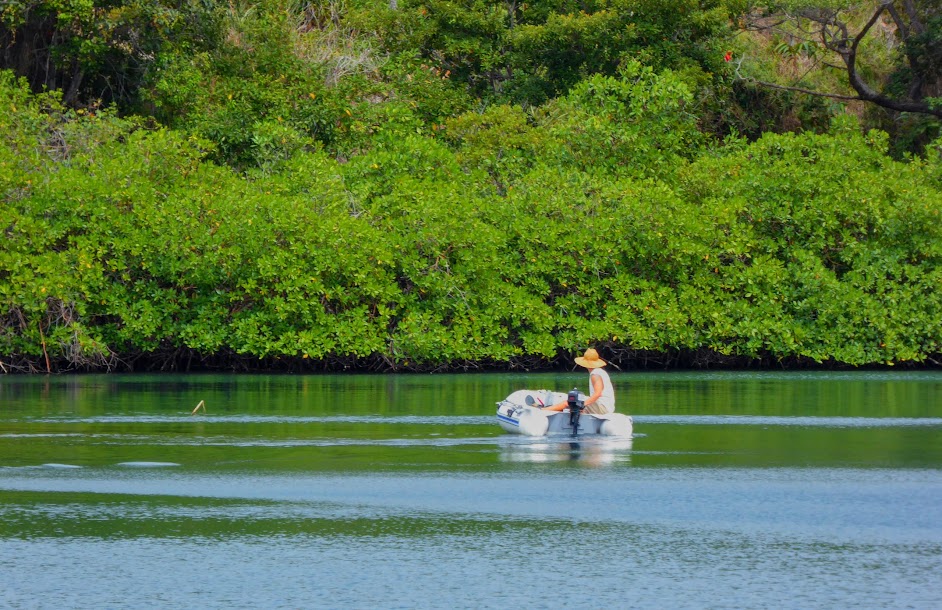
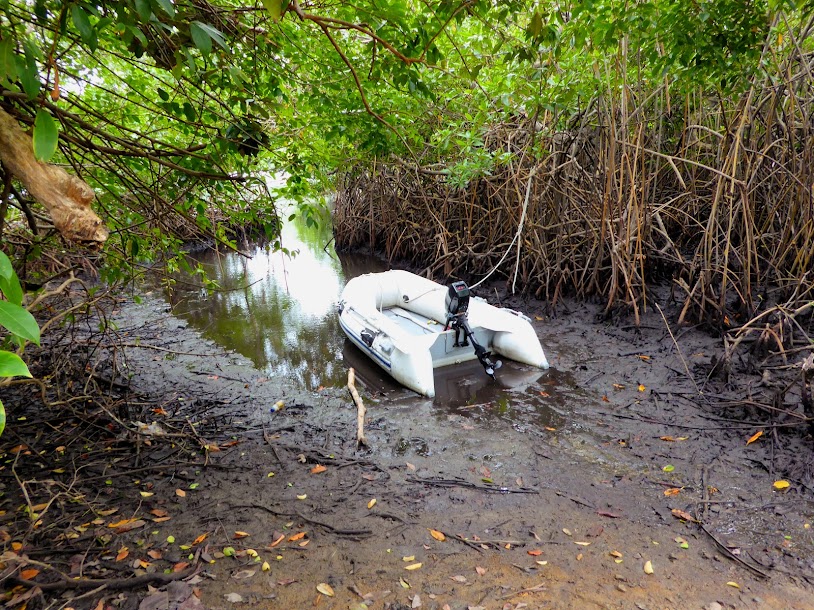
He landed the dinghy in a “mud hole,” and ended up hiking through the surrounding hills.

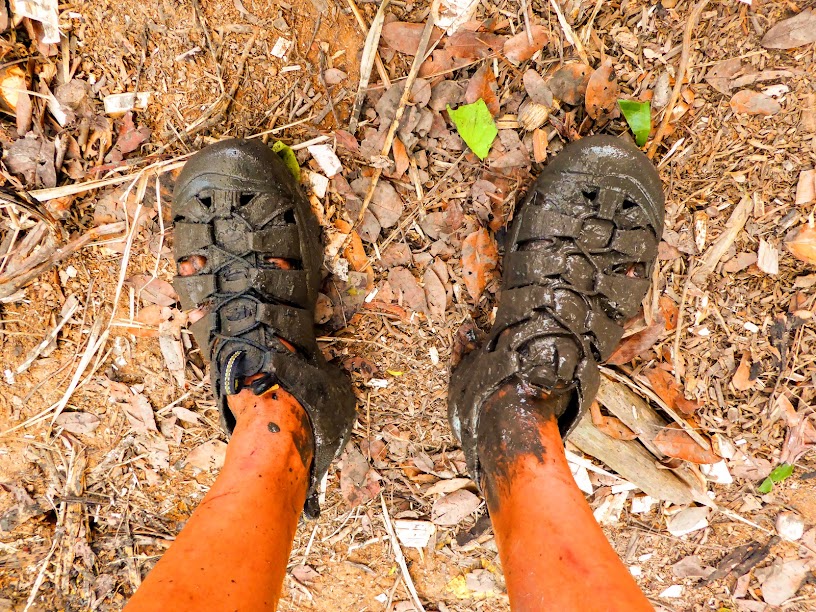
He came back with some great photos of Sea Life alone at anchor, but his shoes were caked in mud.

An additional day was all we could stand, and the following morning we ran, covered in bites, for open water, where welcome winds blew away the unwanted pests.

We continued to follow the mainland coast, and our next stop was the the Robison Island group, where there were many Guna island villages. Here we chose to anchor just off of the mountainous mainland, near three villages, offering us a beautiful view.

The two smaller islands were each made up of one extended family.

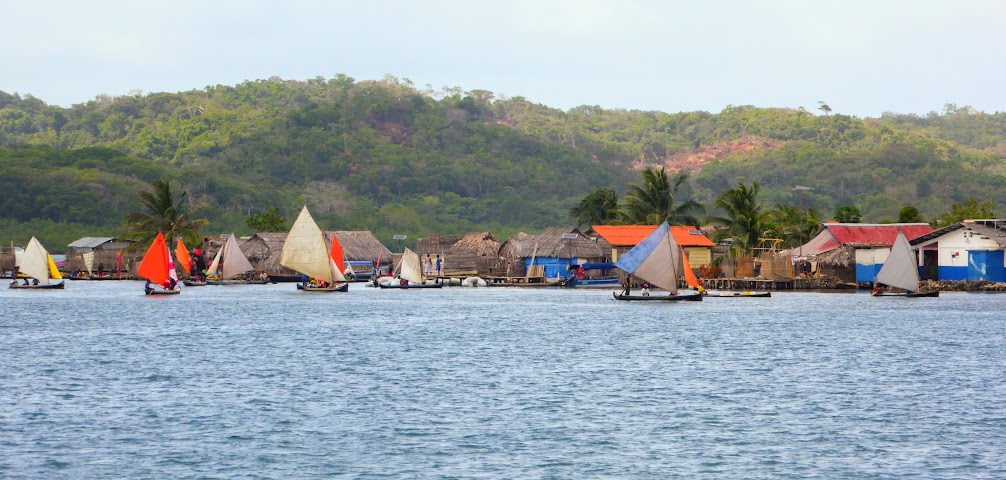
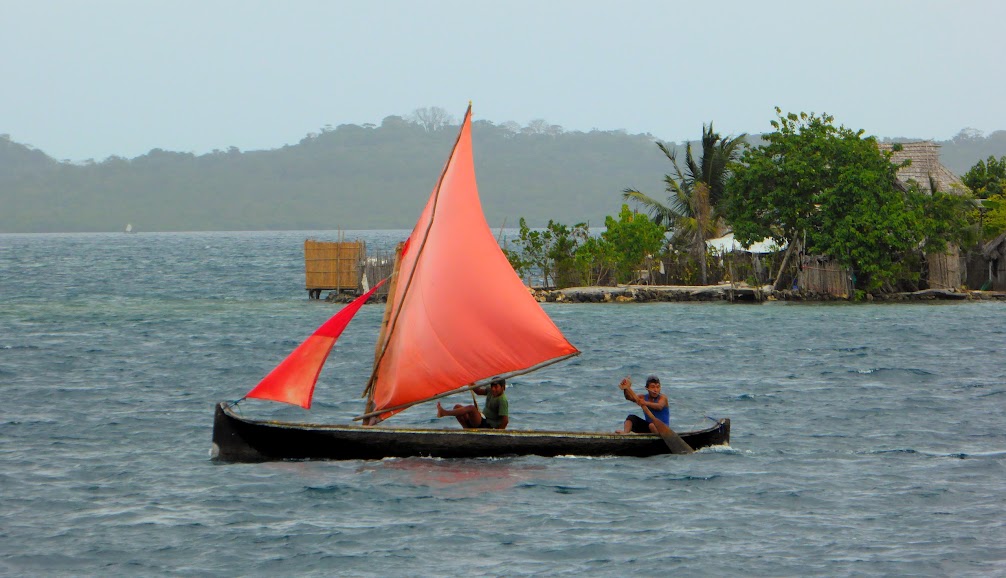
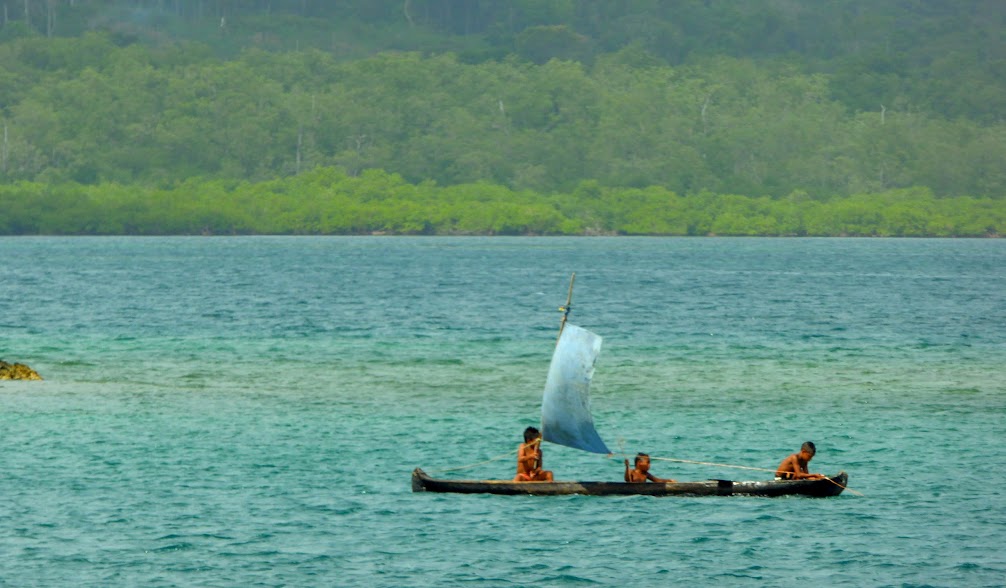
There were many more ulus with sails here (notice the man in green shirt falling overboard…which we saw happen several times, as the narrow boats suddenly shifted).

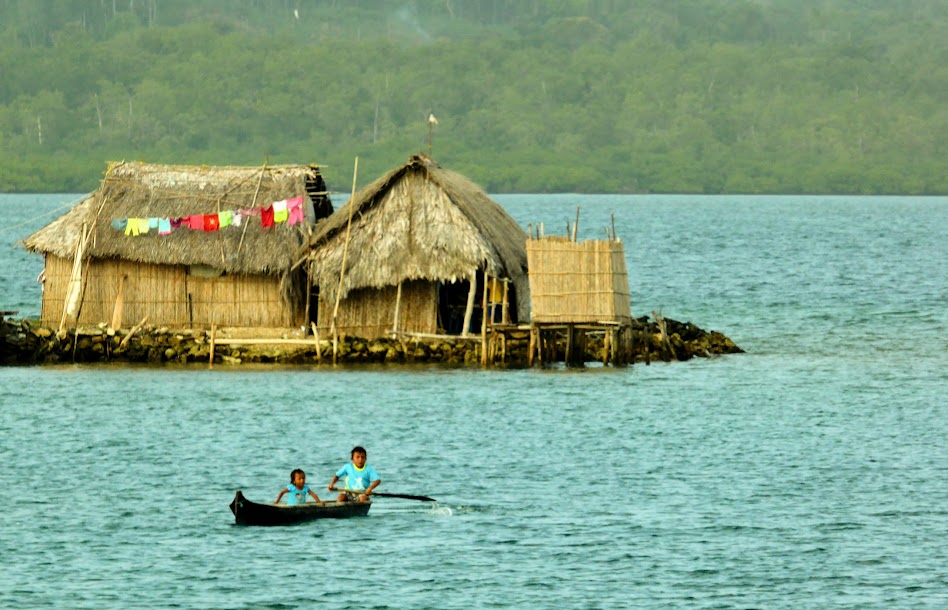
We noticed many more children than we’d seen before, and it was also surprising to see very, very young children out paddling and sailing in ulus without adults. It’s obviously a much simpler, safer life here.

Our friends Ted and Barbara (s/v Rosa dos Ventos) were here when we arrived. We’d seen them at anchor in Isla Mujeres last winter, but didn’t actually meet until we were both in Providencia in June. It was good to catch up with them, and have friends in the anchorage here to spend time with.

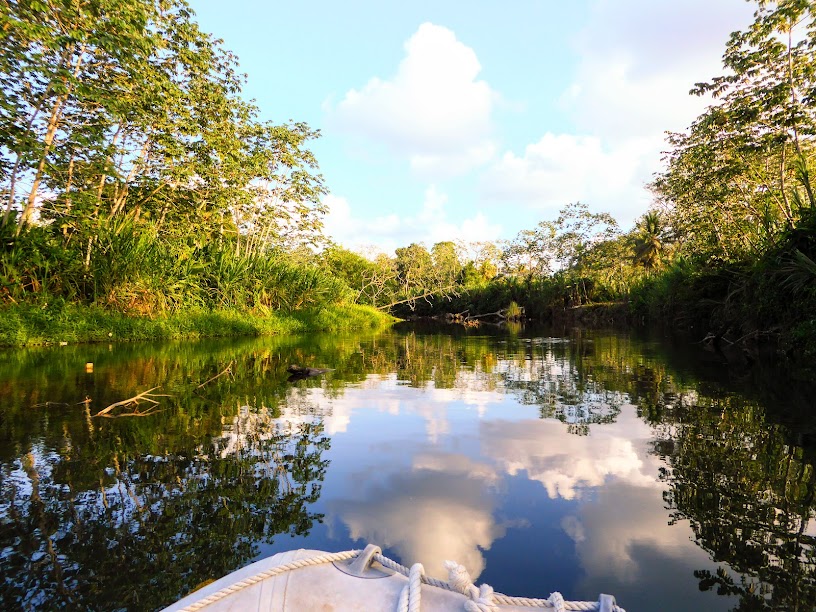
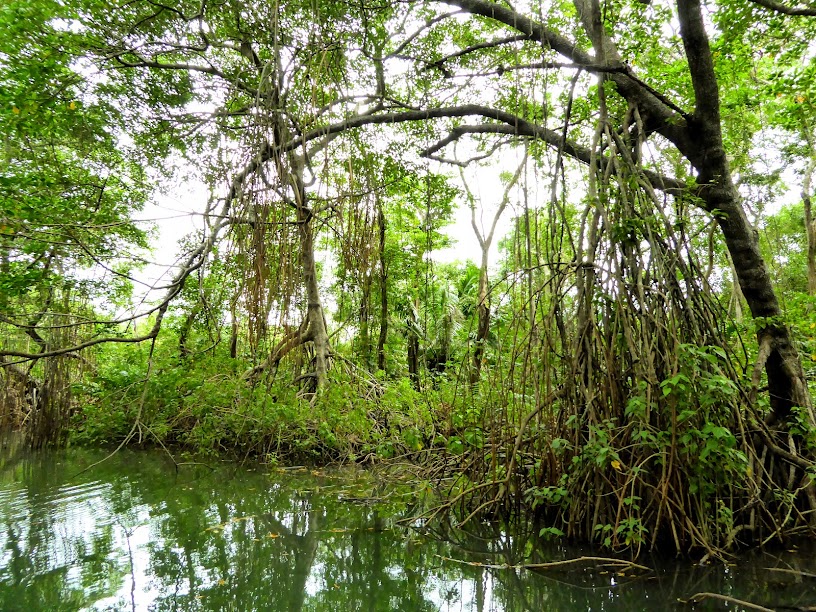
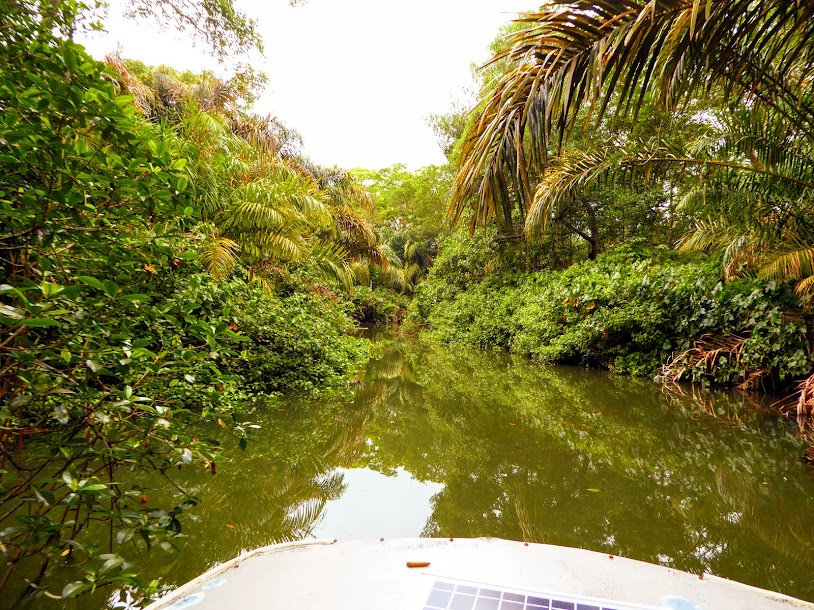
There were several inland rivers nearby, so Scott lowered the Aluminum Princess for some extreme exploring. He traveled miles up the up the Mandinga River, lined thick with jungle vines. It became quite narrow in places, and almost blocked his way in others.

He fought his way past the dead wood coming out of the river, which offered more sandy banks along it’s route.

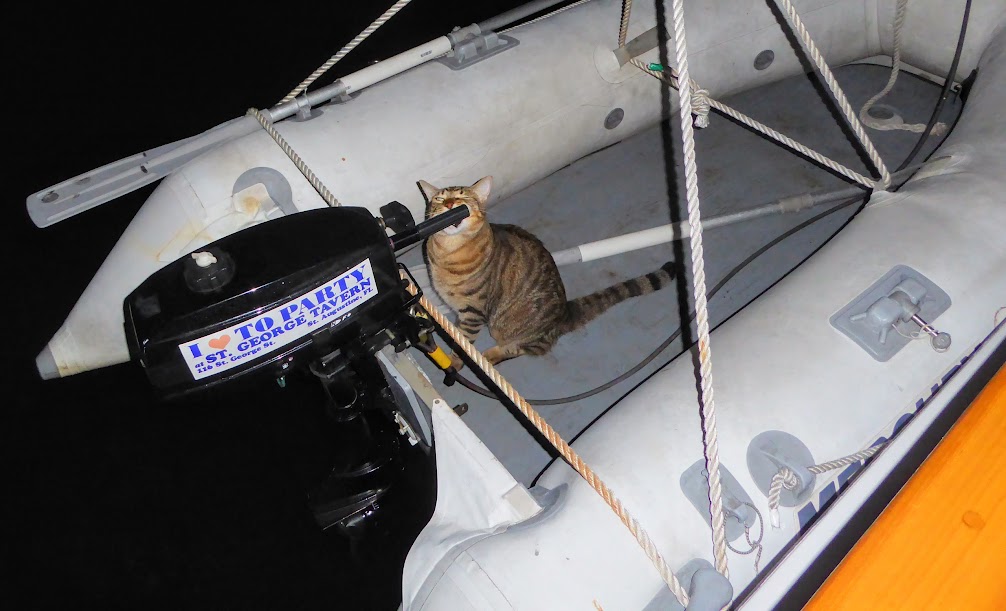
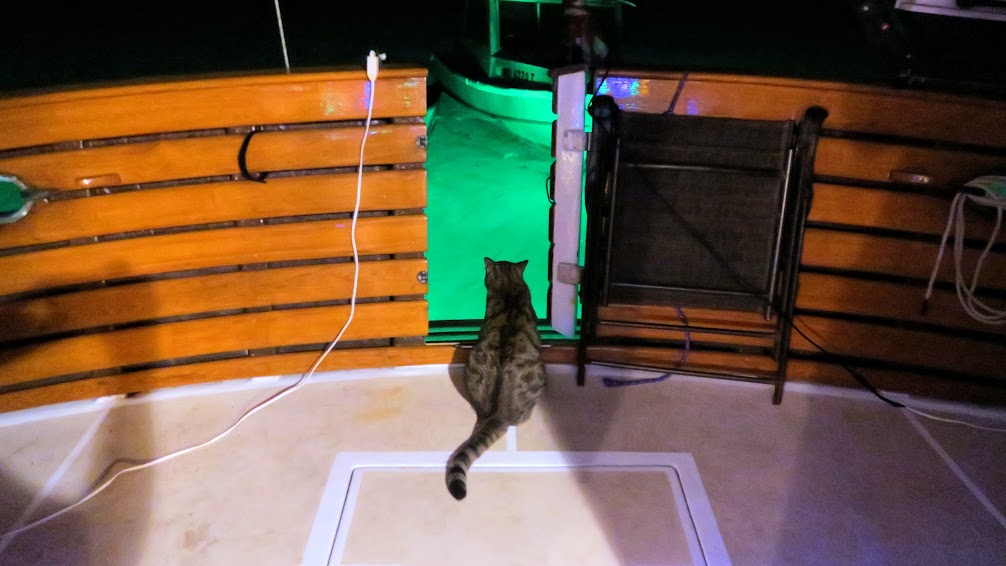
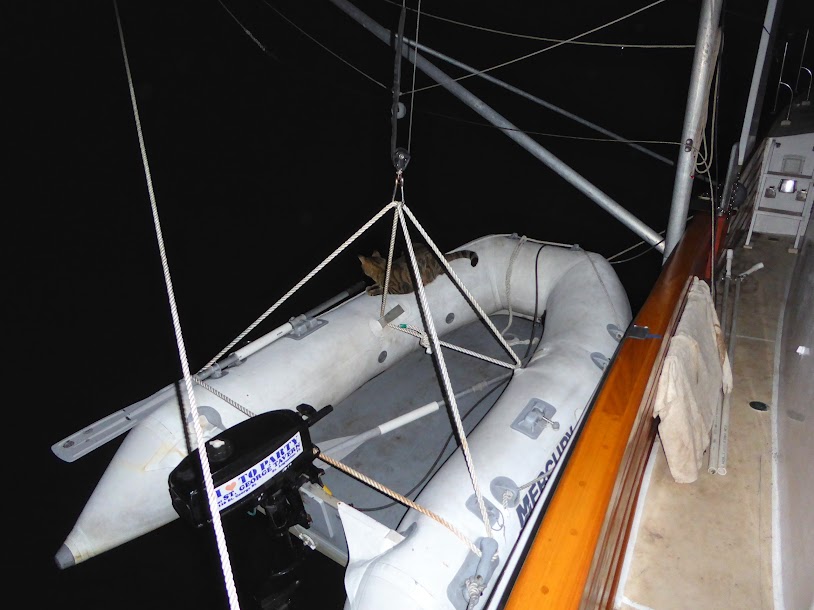
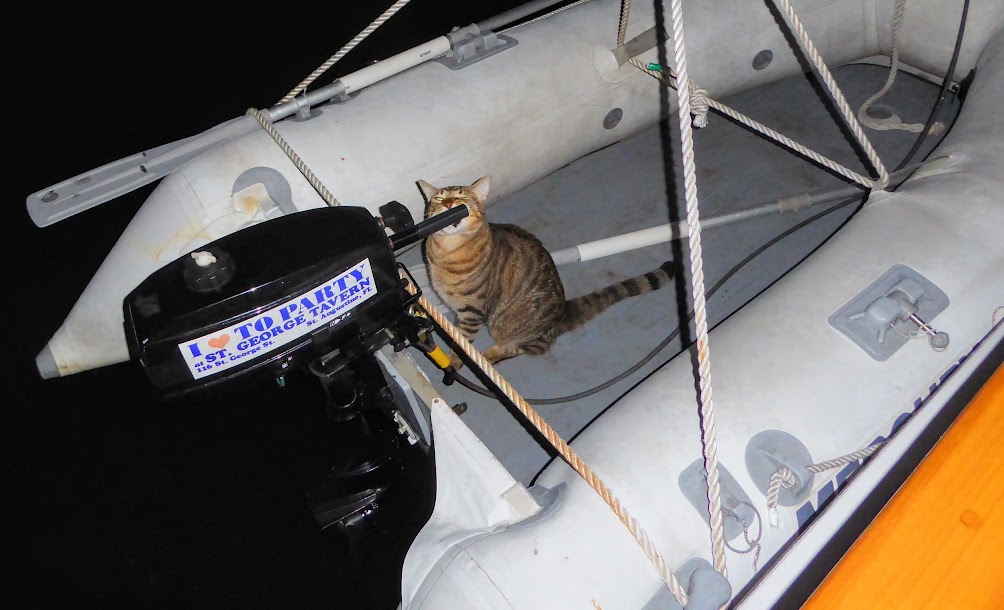
Howard enjoyed the anchorage here as well, and the many smells coming from land close by. When Scott lowered his green LED light into the water each evening, Howard would go right out to the swim platform, for a look at the fish below. However, he also enjoyed waiting for the fish to jump, from the inflatable dinghy, that spent evenings hanging from our port side.

Scott tolerated this surprisingly well, but became pretty peeved when Howard decided that the tiller for the dinghy’s motor made a good chew toy.

Aside from the sound of people talking in passing ulus, or children playing on the islands, it was quiet, and very peaceful. Being close to the mountains, it was cooler here at night, and the smell of smoke from the villages came gently through our stateroom hatch. It was like we were camping, with the smoldering campfire just outside our tent. These things filled in for the feel and smell of fall, that we miss. Here are more photos.

“Shells Sink, Dreams Float. Life’s Good On Our Boat!”


Here are more photos.

“Shells Sink, Dreams Float. Life’s Good On Our Boat!”
Dinner And Drama

We enjoyed getting to know Michele, who was visiting our friends Dani and Tate (s/v Sundowner), so before she left to go home, Scott and I wanted to have the three of them aboard Sea Life for dinner. Unfortunately, when date night came around, Dani wasn’t feeling well, so Tate and Michele joined us as a twosome.

The four of us enjoyed dinner, and Howard amused us all with his usual antics. He tends to burn off his evening energy by racing around the decks like a maniac, before jumping from the cockpit, to the rail, onto the grill, and then launching up to the flybridge. Because we had guests on board, he was extra wound up, and had too much momentum going from the rail to the grill. Instead of landing on it, he sailed past….and into the water.

Luckily, Scott and Tate were outside, and realized that Howard had gone overboard. They began to try and locate him in the water, while I yelled to them to get a towel (A cat can grab the towel with his claws, and hang onto it as you pull him in. We used this tactic on one of the three times Howard went into the Baltimore harbor).

Scott and Tate spotted Howard swimming off of our port side. On top of it being 10pm and dark (why do things like this always happen in the dark?!?), there was a bit of current running through the anchorage. With the Bengal breed being part of his make-up, Howard is a good swimmer, but Scott was concerned that the current would be an issue. As I was still yelling to get a towel, he thrust his hand into the water, hoping to pull Howard back on board.

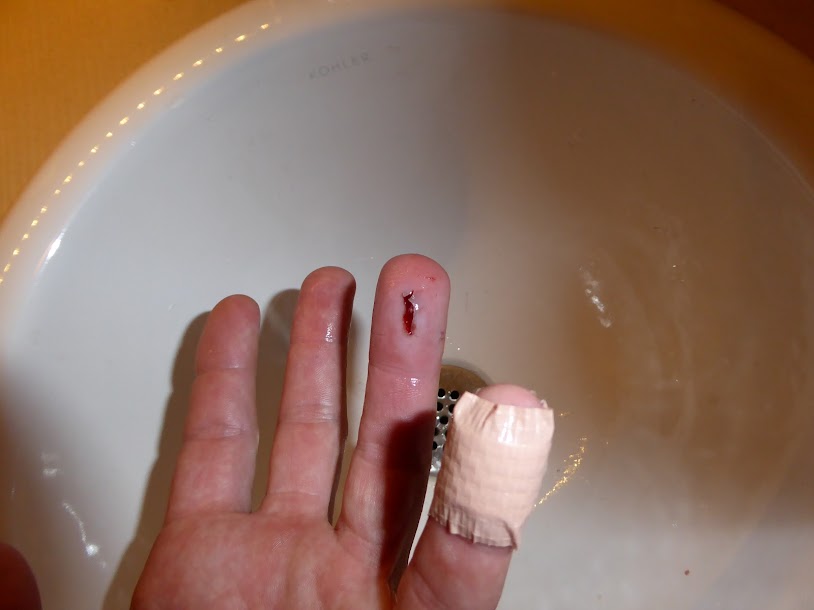
As Scott reached toward him, Howard bit right into the last two fingers of his right hand, puncturing the pinky, and tearing through the ring finger. With his bloody finger, Scott was still trying to help Howard, who was now attempting to get hold of our inflatable dinghy. Realizing that his finger needed immediate attention, Tate took Scott inside to help wrap the wound.

By now, I was out on the swim platform, and Howard had made his way around to the back of the boat. As he bit at one of our fenders hanging in the water (we later realized that he popped it; jaws of steel), I realized that Howard had not intentionally bitten Scott. He was just desperately trying to grab hold of anything he could with his teeth, to get out of the water as he swam. Howard grabbed right onto the towel that I threw in the water, and I was able to pull him up onto the swim platform and into my lap.

Michele tossed me another towel, and Howard stayed in my lap as I began to dry him off. Once he’d caught his breath, we moved inside, and I went over his fur with “kitty wipes,” so he wouldn’t ingest too much salt as he continued to dry himself off.

Meanwhile, Tate had helped Scott wrap his finger, and was now attacking drops of blood on the saloon rug with hydrogen peroxide (It took the spots right out, along with those on Scott’s shirt; a nice little trick to remember). He suggested that Scott immediately start taking an antibiotic, so I unearthed a bottle of Cipro from our stash of drugs.

Not fifteen minutes after coming out of the water, Howard was crying for food. He wolfed it down, followed by some water (Maybe he was trying to get the taste of salt water out of his mouth?). Once things had settled down, Tate and Michele headed back to Sundowner. Tate was a huge help, and Michele went home with quite a story!

The next morning, being concerned about a cat bite in salt water, I suggested that we try and raise our friends Ted and Barbara (s/v Rosa dos Ventos) on the vhf. They are both doctors, and I wanted to make sure that we treated Scott’s wound correctly.

We were able to reach Ted and Barbara, but because they were several islands away, and our vhf antenna is not nearly as high in the air as that of a sailboat, it was a very, very hard to hear them through the static. Fortunately, our friend Judy was anchored nearby (s/v Chinook). She heard our struggling conversation, and stepped in to relay the conversation for us through her vhf radio; this was a huge help.

Both Barbara and Ted asked Scott several questions, gathering information about the wound. They instructed Scott to add 1500 milligrams of Amoxicillin per day, to the 500 miligrams of Cipro that he was already taking. The two drugs together helped fight any possible infection in a more broad spectrum. In addition, Scott was told to soak the finger twice a day with a diluted iodine solution, and to not fully close the finger up for several days. This would allow the iodine soak to really clean out the wound.

Barbara and Ted suggested that Scott may need a few stitches to close the wound on day three or four. This posed several questions: Do we make the costly trek to a hospital in Panama City, head back to Nargana, and have it stitched at the clinic there or take our friend Chris (s/v Mr. Mac) up on his offer to close the wound (Between our two boats, we had everything needed for this.)? Of course, Scott was voting for option three. Chris had only stitched up lab animals, but skin was skin….right??

Thankfully, we didn’t need to put any of the options in play. Judy came over to take a photo of Scott’s finger on day three (which I had still not looked at…gross). When she sent it to Barbara and Ted, they said that the finger looked great, and instead of stitches, Scott could get just use a sterile-strip to close the wound (thank you to our friend Maria, who is a nurse, and stocked us up on many emergency items before we left home!).

Of course this meant Scott was out of the water for at least two weeks, something he was not happy about. However, during his entire “sentence,” the winds picked up and it was mostly cloudy, which somewhat softened the blow. Scott’s finger healed beautifully, and he and Howard are still friends…for now.

Groceries In The San Blas Islands

As you may imagine, keeping stocked on groceries and supplies in the San Blas was challenging, to say the least. Although we were glad that Howard’s trip to the vet in Panama City resulted in no real issue, it gave me the chance to stock up on groceries and such. As long as the round trip by water and land was already in motion (to the tune of $200.00+ dollars) it was smart to fill the car and get my money’s worth!

With the trip to Panama City being logistically and time challenging, as well as costly, cruisers usually find other ways to get what they need.

There are several larger islands that have tiendas, or stores, on them. They offer a limited selection of canned items, rice, boxed milk and juice and produce that is more shelf-stable, such as onions, carrots, eggs (not refrigerated here) and potatoes.

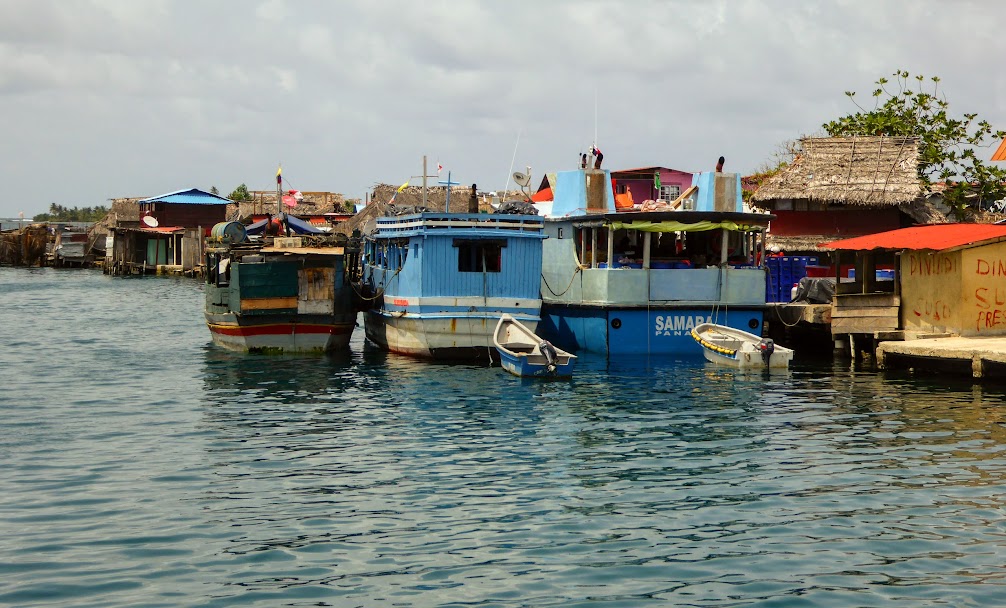
Boats from Colombia arrive with supplies for these stores at various times each week, bringing with them, among other things, fresh produce. Scott is amazed that these old, wooden boats (that have seen much better days) make the journey to and from the San Blas, without breaking apart in the big waters off of Colombia.

Unfortunately, the fresh stock is usually depleted within two days, so unless you happen to be very close by when the word gets out about a boat coming in, you’re out of luck.

Many out here use the chance to have things brought to them through other cruisers who may be traveling to Panama City, or through friends (or friends of friends) coming to visit. We have taken advantage of all three of these scenarios to restock on hard goods and groceries.

So….unless you are traveling near one of the larger villages when a shipment arrives, or have some form of Panama City connection coming to the area, the usual cruiser method for getting food (aside from fishing) is the veggie boat.

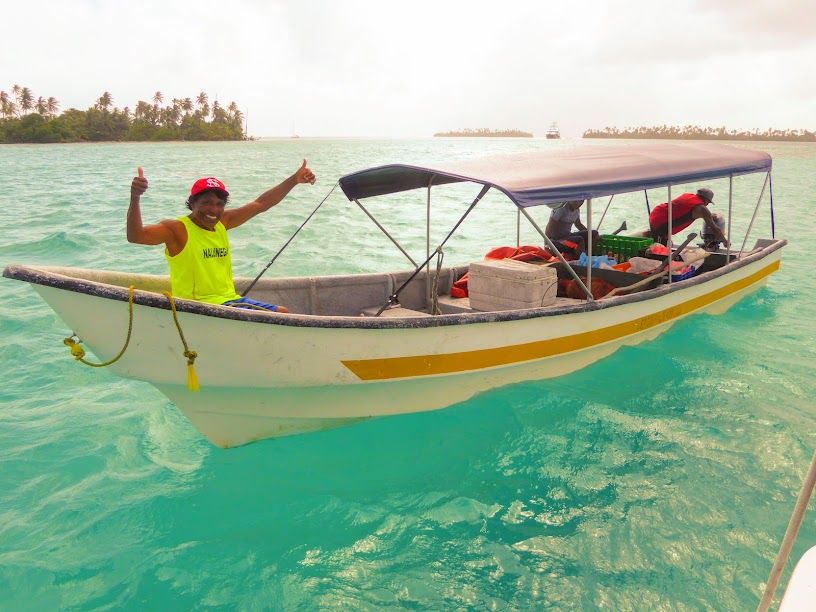
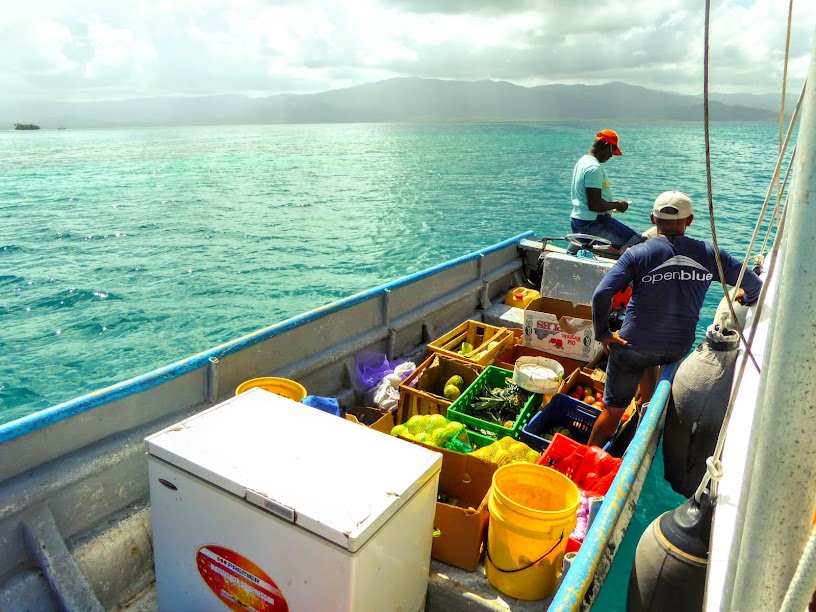
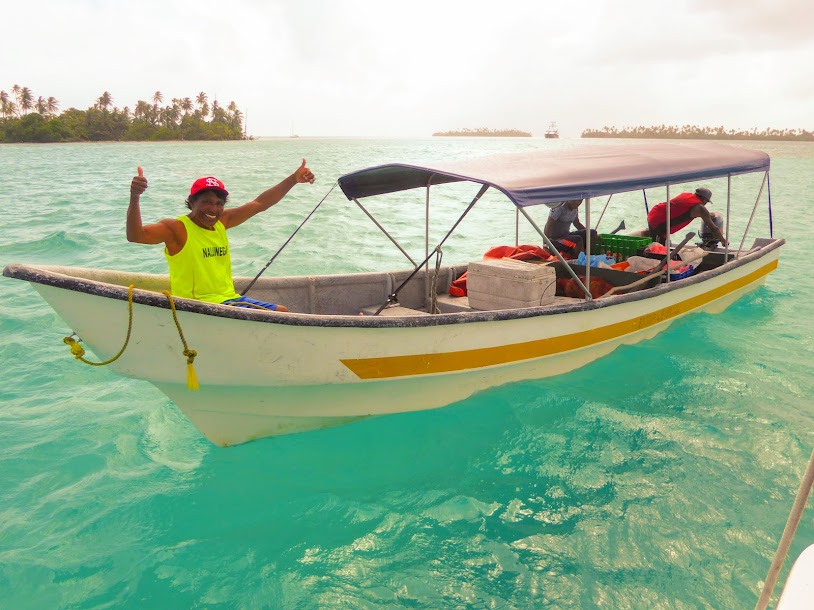
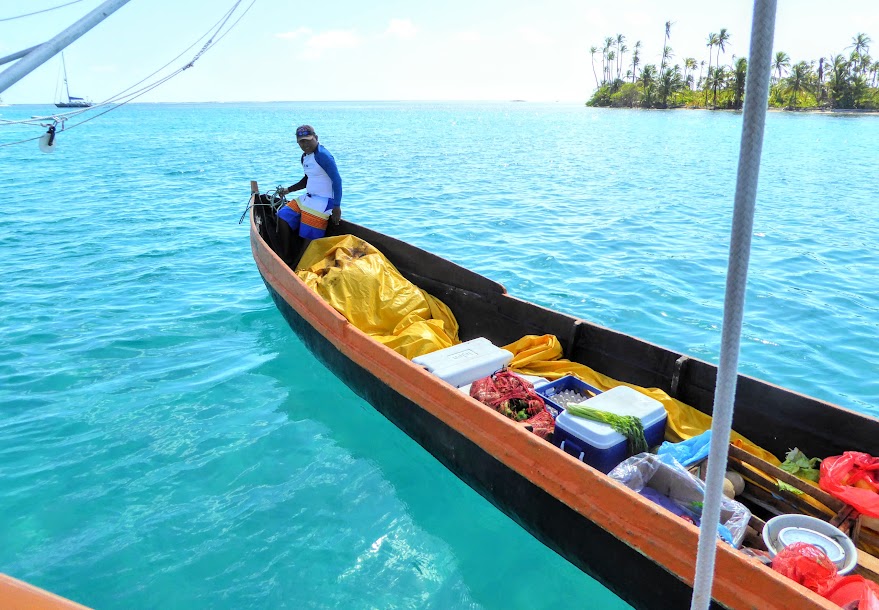
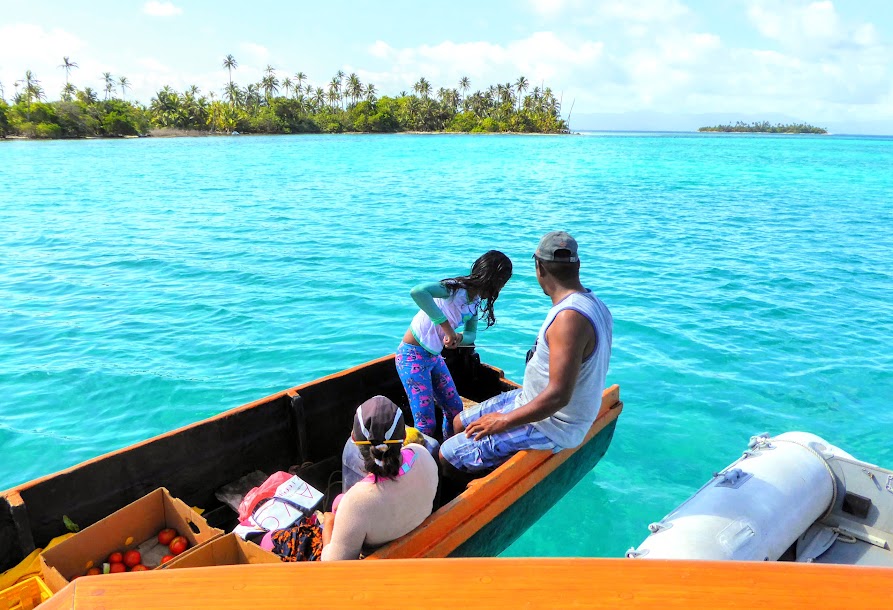
These pangas visit the many anchorages in the San Blas, bringing with them fresh veggies, fruit, beer, boxed wine, soda and sometimes meat and cheese. Their boats are filled with bags and crates of goods, and many also have “mobile” freezers, that may contain celery, parsley, chicken, cheese or butter.

Some items are weighed by a hand-held scale, and others are sold by piece. We (especially Scott) have become familiar with most words needed to communicate what foods we need. For the rest, we just point.

Word spreads of these traveling grocery stores’ arrival over the vhf radio. You may hear, “There’s a veggie boat in the anchorage!” or, “A veggie boat is just left Esnasdup, on it’s way to Green Island.” Some cruisers even have direct access to the boats by phone, and alert others as to when they will be coming to certain anchorages: “A veggie boat will be in the eastern Holandes early tomorrow morning, around 8am.” Knowing a boat is on the way gives you a heads up to stay put and be on alert, so as not to miss your chance at buying food!

In anchorages farther east, such the Holandes (swimming pool and hot tub), where we spent much time, the boats have to pass through stretches of open ocean, and come less frequently when strong winds are blowing. Between high winds and the holidays, we went almost three weeks without seeing one around Christmastime.

Now don’t get me wrong, we’re by no means in danger of starving here aboard Sea Life. We packed her to the gills with canned and dry goods before coming to the San Blas, along with plenty of soda and alcohol. However, you never shake the panic of not having convenient access to things, especially fresh food.

It has become more and more common for pangas to bring pre ordered groceries out to cruisers at anchor, especially to those who stay out for months at a time, or even year-round. Recently, these boats have even started to deliver diesel, gasoline and water…smart thinking!

The veggie boats usually stop first at cruisers who have placed an order, and then proceed to sell to the rest of the anchorage, usually starting at the front of the pack, working their way back. The excitement of spotting a veggie boat is quickly deflated by having it blow by you, and then watching and waiting for it to stop at all the other boats before coming to yours. Since we usually try to be toward the back of an anchorage, and away from any crowd of boats, we are typically one of the last ones “in line.”

This whole process is incredibly stressful for Scott. Once the panga has been spotted, and identified that it is indeed a veggie boat, he keeps track of it’s progress through the anchorage, eyes peeled through binoculars, trying to see how much is being taken at each stop. I commonly hear, “@#%*@#!, so-and-so just hauled up two buckets full of stuff onto their boat! They just got here yesterday, and we’ve been here a week! We’re going to be last, and there won’t be anything left but some rotten @#%*!

These veggie boats must smell interesting to Howard, because once they’re tied alongside us, he jumps up on the rail, or cries to be held, to see what’s going on. Most of the men were taken aback at first, as Howard is much larger than any island cat (he is in no danger of starving either). We hear…“Grande!” or “Mucho Gato!” Several boats have learned his name, and call out “HOW-arrd!” as he appears.

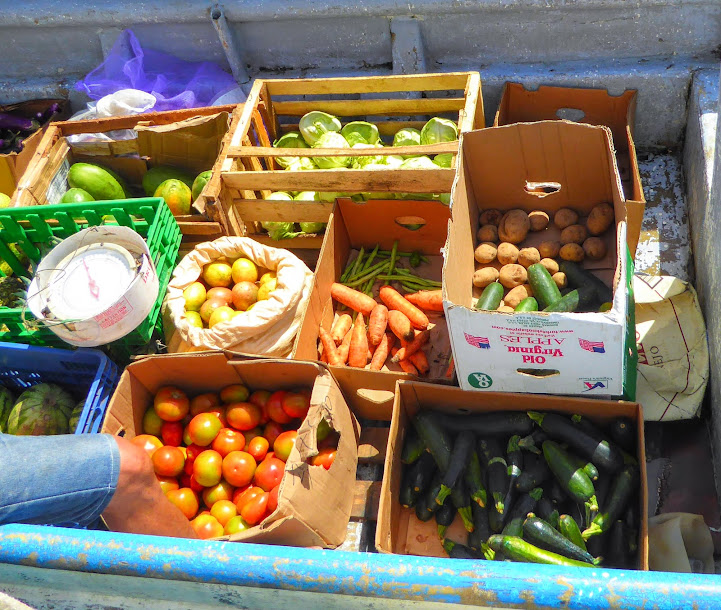
The usual veggie boat produce choices include: cabbage, iceberg lettuce, carrots, cucumbers, tomatoes, potatoes, zucchini, eggplant, and occasionally green beans.

Unfortunately, as you may expect, the quality of these items isn’t always the best. Tomatoes are hard, and very often more green than red. No matter how hard you try, they will not ripen, and instead rot pretty quickly if not used. Carrots and cucumbers can be gigantic, and sometimes bitter as a result.

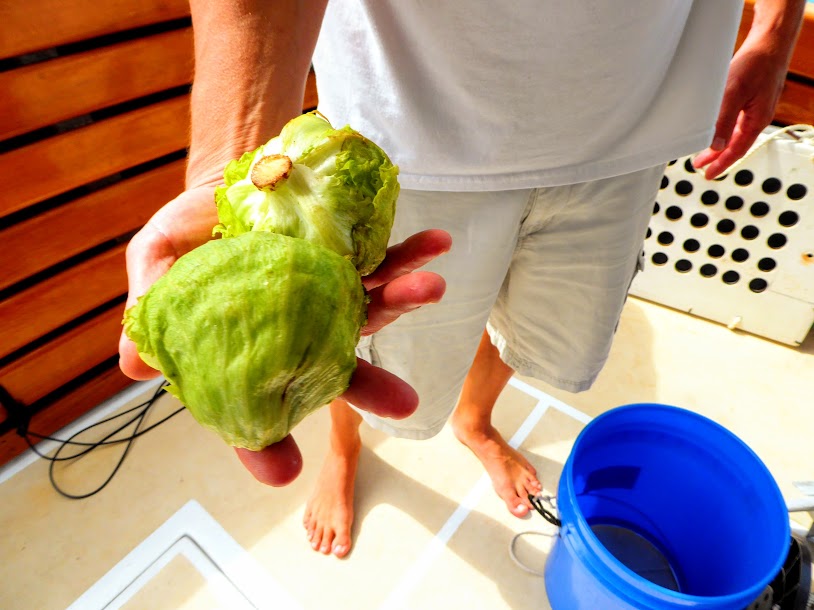
The outer leaves of cabbage and iceberg lettuce heads are usually peeled off when sold, to exposed the non-wilted, inner leaves. We were so desperate for lettuce after one “dry spell,” that we paid for these sad, little things….the tiniest heads of lettuce ever seen!

Fruit offerings usually consist of pineapple, papaya, apples, limes, oranges, grapefruit, bananas and mangoes (once, I got avocados). The pineapples have been decent, but not nearly as good as the candy-sweet ones we were getting in Bocas del Toro, and the poor apples that I’ve tried are just tart and tasteless. I’m not a papaya fan, and the mangoes are very stringy, making them hard to eat. The damned bananas stay green and hard forever, and then ripen and rot in just days. As a result, we have eaten many banana muffins!

I’ve mentioned before that we have discovered “limon mandarinas” during our travel in Panama. They are about the size of a mandarin orange, and usually beat up-looking on the outside. The inside is orange, but tart like a lime. However, they are a bit sweeter, and juicer than the tiny, key lime-like ones that are also offered, and we’ve come to like them much more. Here’s a quick photo I grabbed from the internet, as we are currently out of them.

Image result for limon mandarina

We’ve gotten good celery and parsley from inside the “mobile” freezer, and there’s almost always “culantro.” It grows wild in the area, and smells and tastes exactly like cilantro.

I once saw shredded cheese in the freezer, and have also heard of people getting butter from it as well.

On one occasion, we were told by a veggie boat that they had chicken (pollo) available. Scott indicated, by putting two fingers toward his eyes and then toward the freezer, that he wanted to “see” said pollo. Out came a whole, dead chicken, and I mean whole…no feathers, but head, beak, legs and feet intact. I was definitely not up for that remote island challenge, so we passed on the pollo.

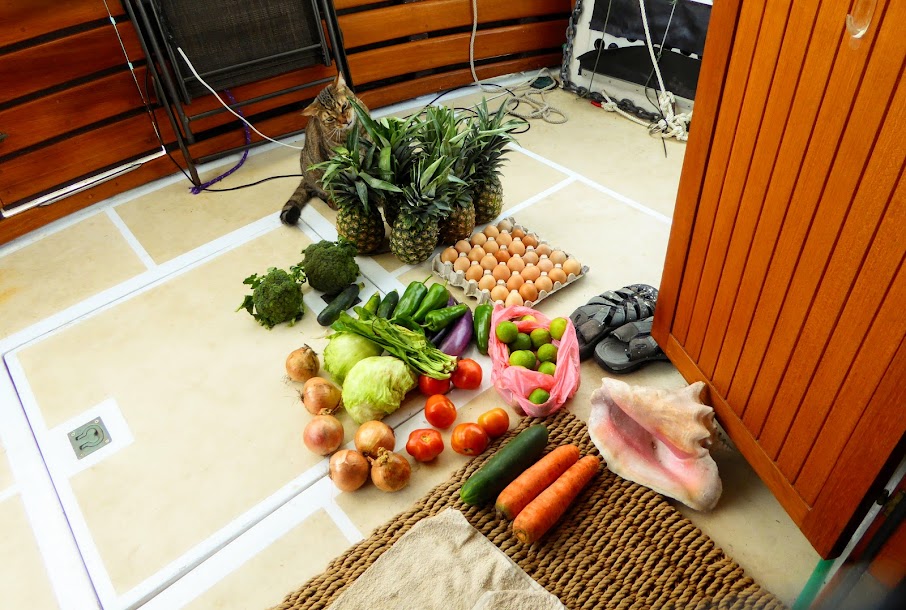
Overall, there are many more food choices than I expected to get here in the San Blas, and for the most part, we’re satisfied with what we get, and enjoy it. Here’s the result of a good veggie boat visit for us. Notice Howard getting right to work on his favorite…the pineapple tops.

Thankfully, Scott’s prediction of empty bins with only some rotten @*#! left, only happened to us once. There was almost always a decent choice of food left the in the boat when it arrived, and we’d live to eat another day.

“Shells Sink, Dreams Float. Life’s Good On Our Boat!”


Our First Visitor!!

Not long after we began our journey, and were spending the month of December in Key West, Florida, several friends visited us during our stay; a quick, easy trip, no customs and warm weather.

Of course, we had a great time with everyone who came to Key West, but we’ve been anxious to have visitors during our travels through Mexico and Central America. While these locations aren’t as developed with resorts, or easy to get to as more familiar locations in the Eastern Caribbean, the towns and anchorages we’ve been to, and their gorgeous surroundings are not to be missed.

We also looked forward to having friends on board, so they could experience a bit of our life at anchor. To date, we’ve been alone on our journey aboard Sea Life, but that was finally about to change!

Our friend Karen contacted us, wanting to visit in February, and I excitedly pitched her the idea of meeting us here in the San Blas. Aside from my sister, Sally (who has traveled on her own to many far-reaching locations, including New Zealand, Thailand, and most recently Antarctica), Karen is one of the most adventurous people we know, so I was sure she’d be up for the adventure. As expected, she jumped right on board with the idea, and would be our first “official” visitor!

Karen’s journey began with a flight to Panama City, where she took a day to explore a bit. Our friend and provisioning master, Emilio, arranged for Karen to see some historic sites of Panama City, as well as a visit to the Miraflores Locks at the Panama canal.

The next morning, Emilo arrived at Karen’s hotel with a carload of provisions for us. Karen had arrived with two bags in tow, completely filled with items we’d requested and ordered from home, carrying  just a backpack of things for herself (and a pair of flippers). Her bags were loaded in with our provisions, and she and Emilio were off to meet Nacho, who would then drive Karen across the mountains to the Carti docks.

During the drive, Karen re-channeled her high school Spanish, and with a bit of Google Translate help, she and Nacho chatted (he remembered driving me…”Oh, the cat!). Along the way, they stopped for a priest and a young man who were walking on the side of the road, hoping for a ride. Nacho turned to Karen and said, “Miss Karen??” It was Karen’s paid ride, so it was her decision whether or not to let them in the car. Not wanting to say no to a priest, Karen gave her ok, and the two additional passengers hopped in.

Once at the dock, Nacho helped Karen find her panga, which we had pre arranged. There was some initial confusion as to which boat was hers, but finally all bags and provisions were loaded aboard one of the waiting boats. Karen would be brought out to us in the Robisons. It meant a short panga ride (20-30 minutes), and a chance to see the rural Guna villages.

We’d been in touch with Karen since she arrived in Panama City, and also along her journey over the mountains, so as the approximate arrival time for the panga drew near, we kept our eyes peeled.

The expected time passed, and then some more time passed…and then some more time. Eventually, our cell phone rang, and it was Karen (we were shocked to have enough signal to receive the call!). She informed us that the panga couldn’t find our boat among the others, and the men wanted to take her back to the dock…what?!?

Clearly, the panga was in the wrong location, as we were one of only five boats in the huge anchorage, and the only one that wasn’t a sailboat! Scott quickly began listing off the islands near us (using both “English” and Guna names for them), and also nearby rivers, hoping that the men on the panga would realize where they needed to go.

When that didn’t work, he went into navigational/survivalist mode, asking Karen questions, trying to find out where she was…”When you left the dock, did you head right or left?”…”From which side of the boat were the waves coming at you”… “What side of your face was the sun on?” This proved challenging for all involved. Karen now had us on speaker phone, and we could hear the men yelling back and forth at each other in frustration.

After talk of leaving her on the island where they currently were (wherever that was), we were finally able to communicate our location using Bradeo’s name (Scott’s village tour guide). We hoped that there was only one Bradeo (and that it wasn’t a name like “Joe”), and Karen would be headed in the right direction.

It wasn’t long before we spotted what had to be her panga on the horizon, and were soon unloading Karen, her bags and all of our provisions; her 20-30 minute ride had taken almost 90 minutes. After a bathroom break, and a cold beer, we took some time to relax before our friend Ted (s/v Rosa dos Ventos) came over in his dinghy to take us over for a walk through the largest village near us.

We were not permitted to take photos in the village, but enjoyed walking among the houses and saying hello to some of the Gunas. Our long day ended with dinner on board and an early night. Things were so crazy, I failed to get any photos of Karen’s arrival.

Bright and early the next morning, we headed back to the Holandes. The wind forecast was predicted to be perfect for Karen’s stay, so we were headed for the swimming pool anchorage. Unfortunately, during our short passage between the reefs, in open ocean swells, Karen became sea sick while trying to check emails (the price for working during vacation!). After emptying her stomach over board, she retired to the guest stateroom, to sleep it off.

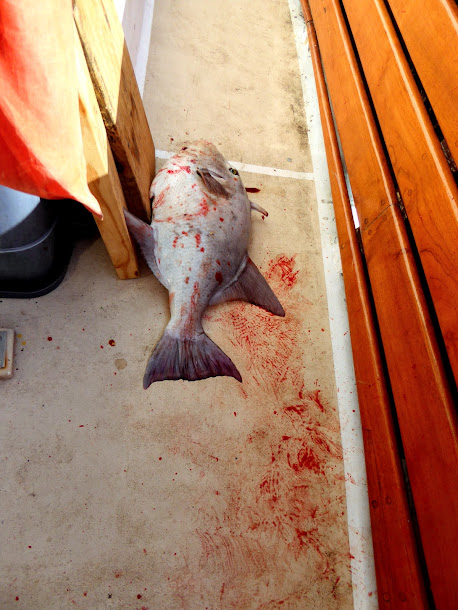
We arrived to a fully cloudy, rainy afternoon in the swimming pool, which never happens! However, Scott spotted a Triggerfish under the boat, and decided on an alternate form of entertainment for amusing Karen. While she kept an eye on the fish, Scott set up one of my frozen lobster tails in the water for bait (great). He speared the large Trigger from our swim platform…dinner and a show!

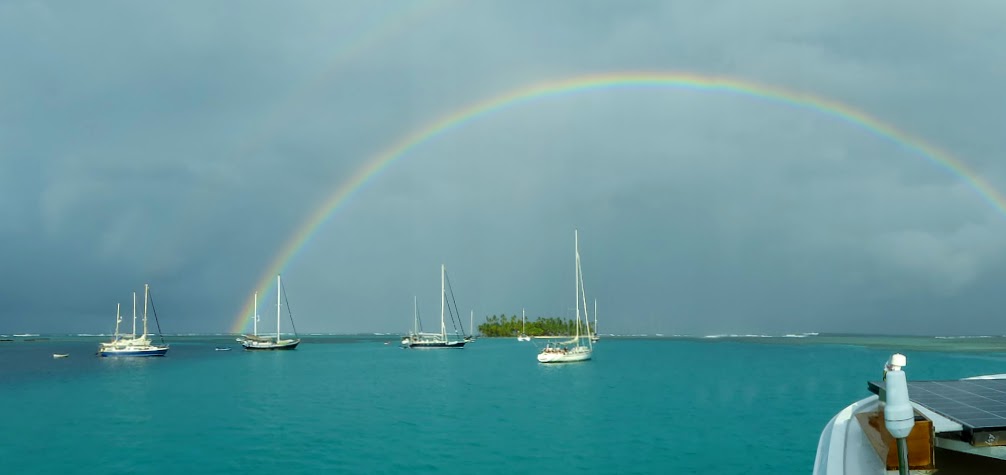
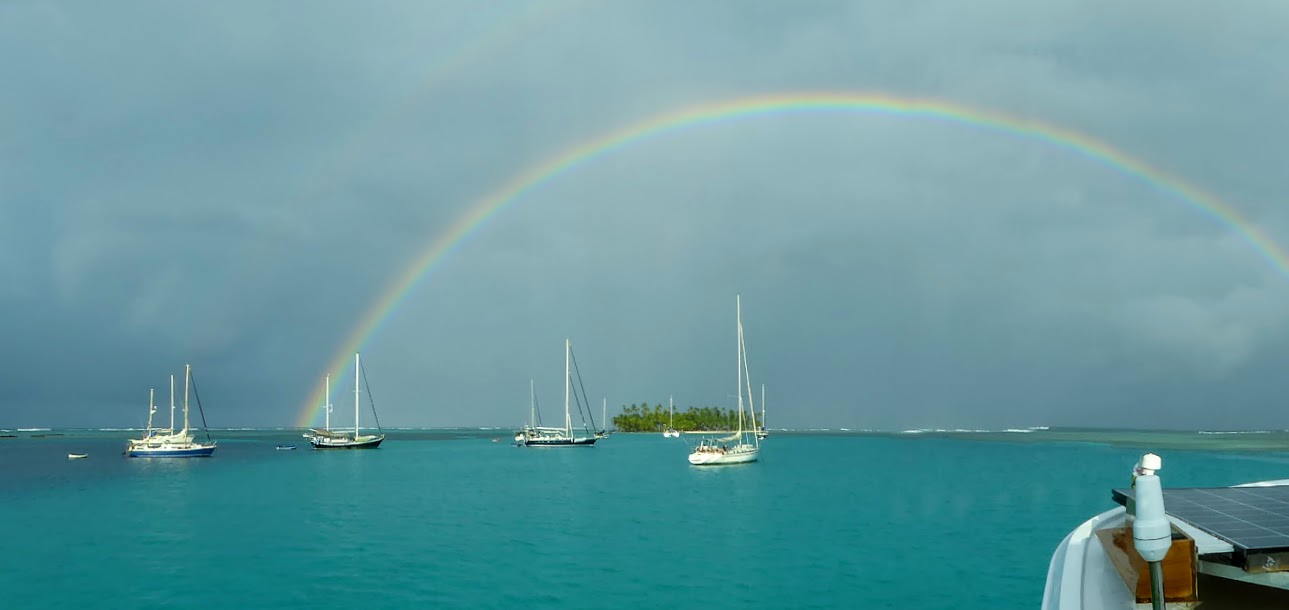
The rains finally ended, and we were treated to an amazing, full rainbow over the anchorage, that faded and then brightened again for quite a long time…welcome to the San Blas, Karen.

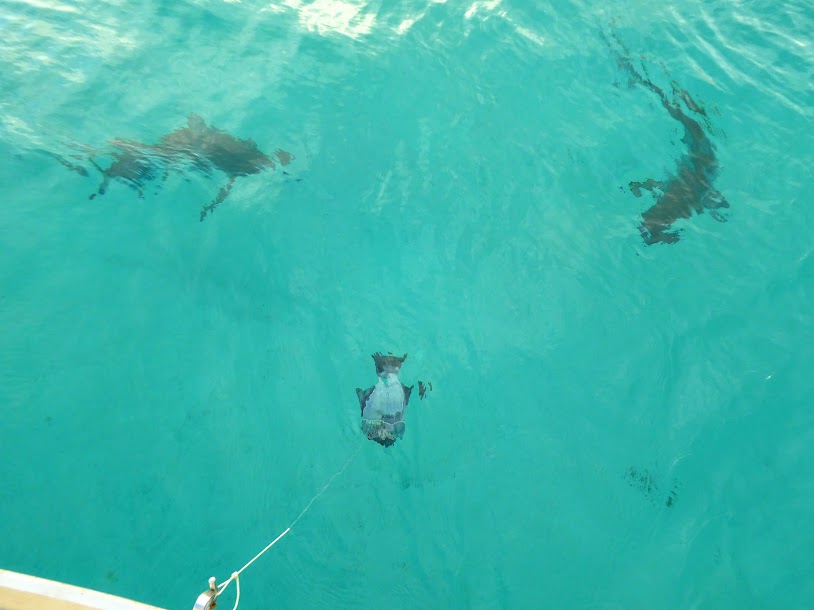
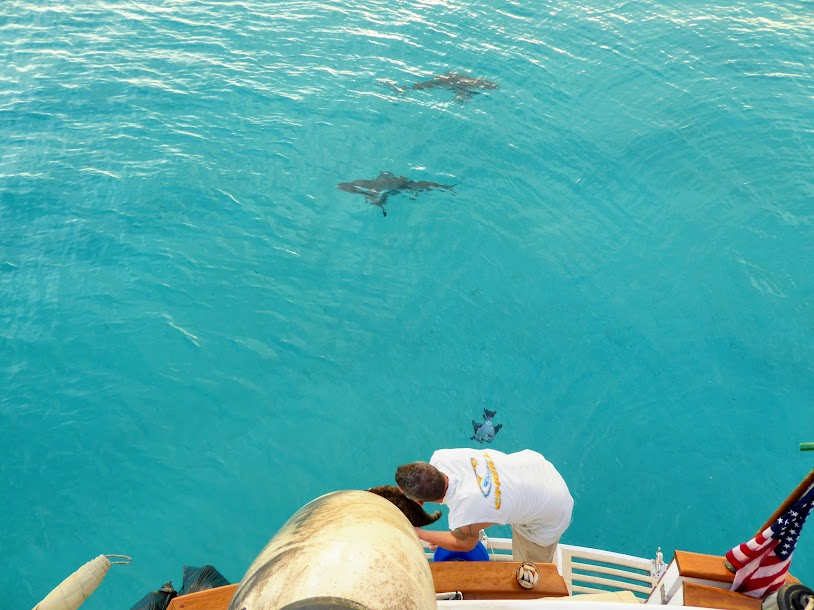
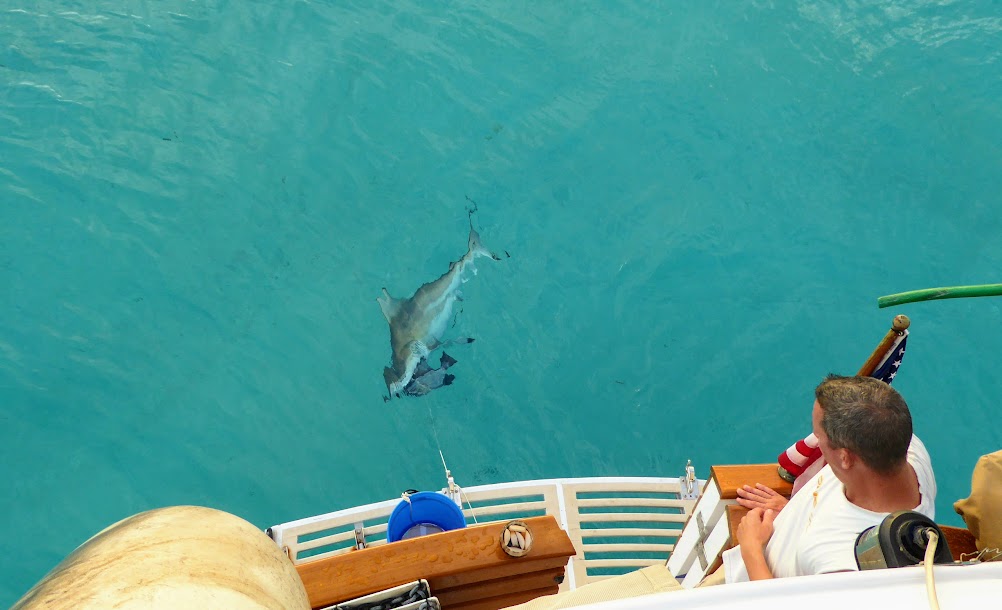
Keeping the underwater show going, Scott next lowered the Triggerfish carcass into the water, to see what it might attract. Karen and I were relaxing up on the flybridge, when I noticed Howard in front of me, leaning over so far that he was practically hanging by his toes. I went to grab him, and realized that we had company in the water below.

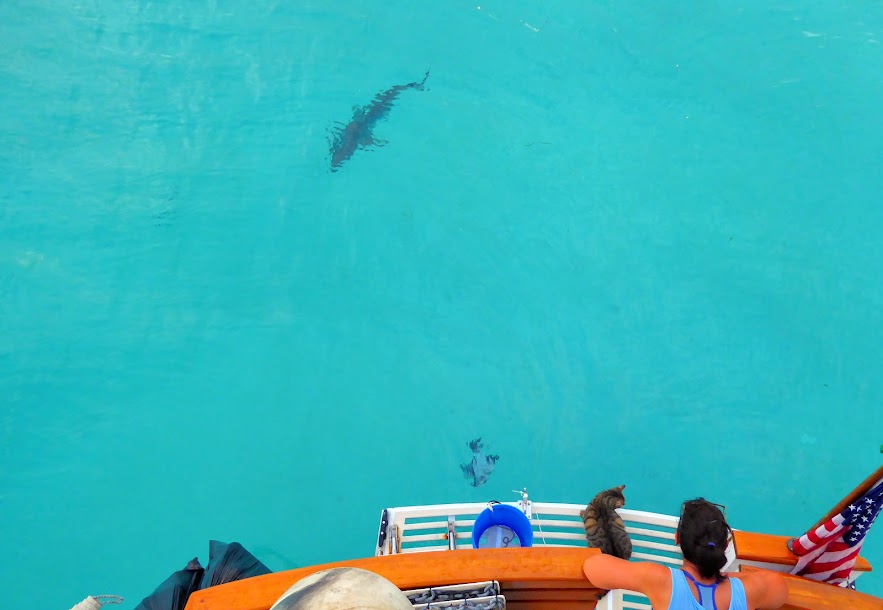
Two blacktip reef sharks had turned up to sniff out our offering. Howard moved downstairs, and out onto the swim platform for a better look. We quickly squashed his fun, not wanting him to be the second course!

The sharks were sizeable, approximately six feet in length. They would bite at the carcass, but were easily scared off by seeing us above.

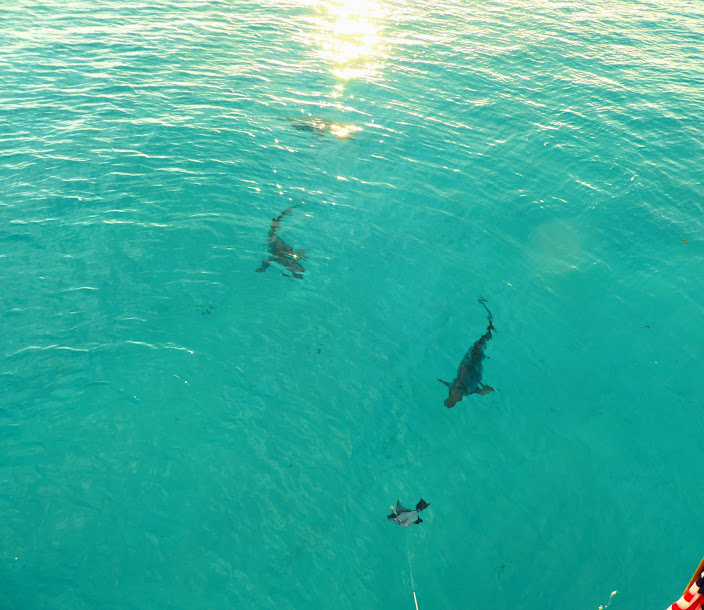
By dusk, a third shark had joined in, and we enjoyed a shark-filled sunset.

Check out our “friends” at the bottom of the photo.

Just before the sun set, one of the sharks finally mustered up enough courage to snatch the prize, and just as quickly as they came, they were gone.

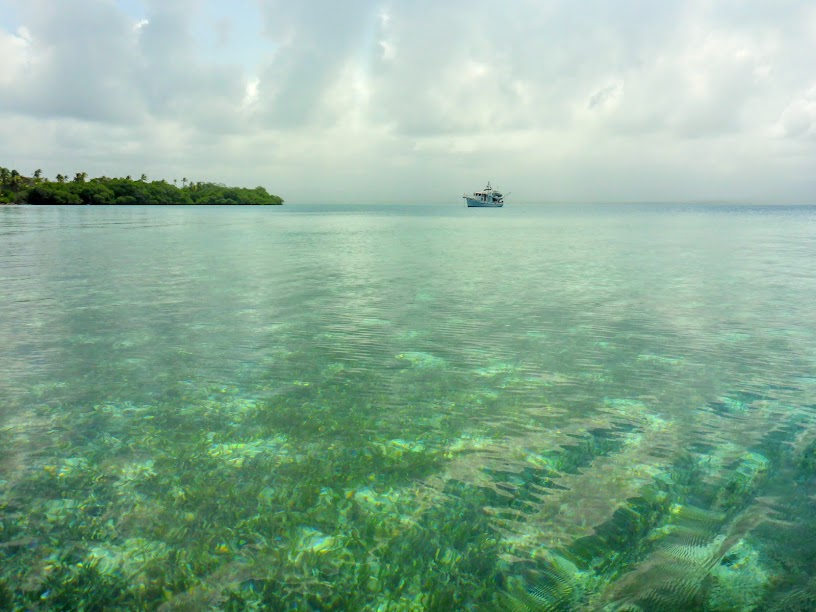
The next morning was sunny and bright, and the swimming pool was living up to it’s name; the visibility was insanely clear. We were anchored in ten feet of water, and I could easily see right over the side of the boat, down to the sea floor below, which was littered with sand dollars, conch shells and other interesting stuff.

Karen joined us in the dinghy, as I passed out baked treats to our friends in the anchorage, who we hadn’t seen for awhile. By the time we were through, Venancio, the master mola maker was coming through in a panga. He came aboard, and Karen took time to choose some of his work to take home. Much to Scott’s chagrin, I bought another beautiful mola for myself.

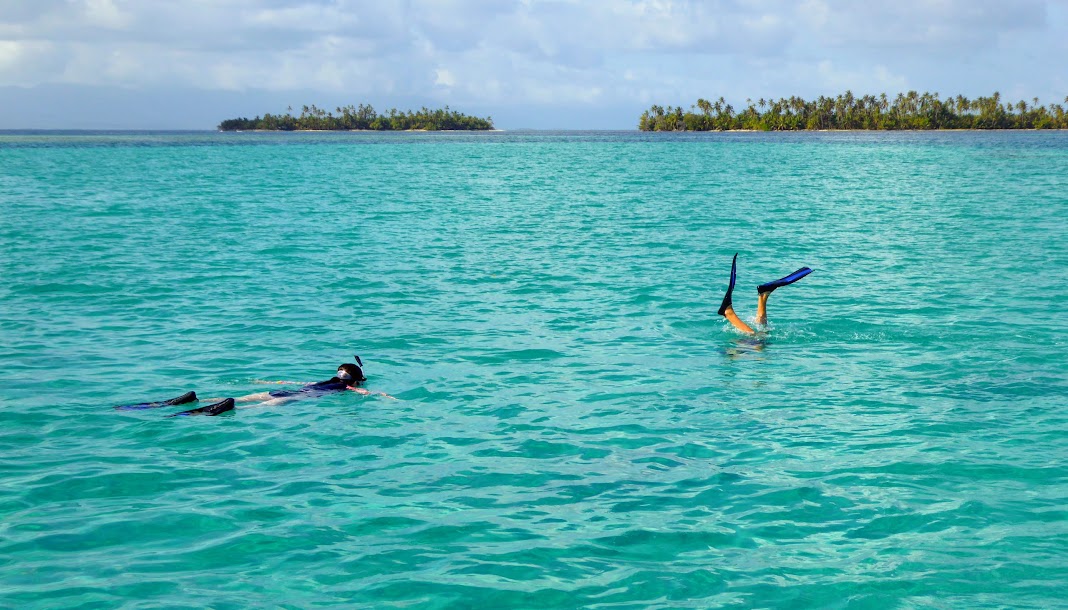
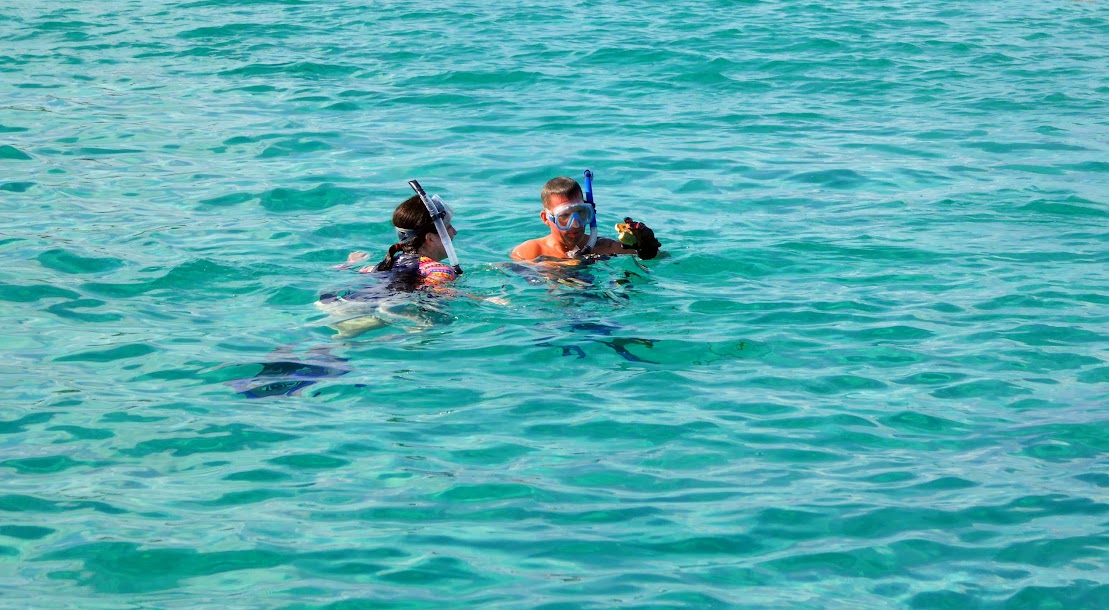
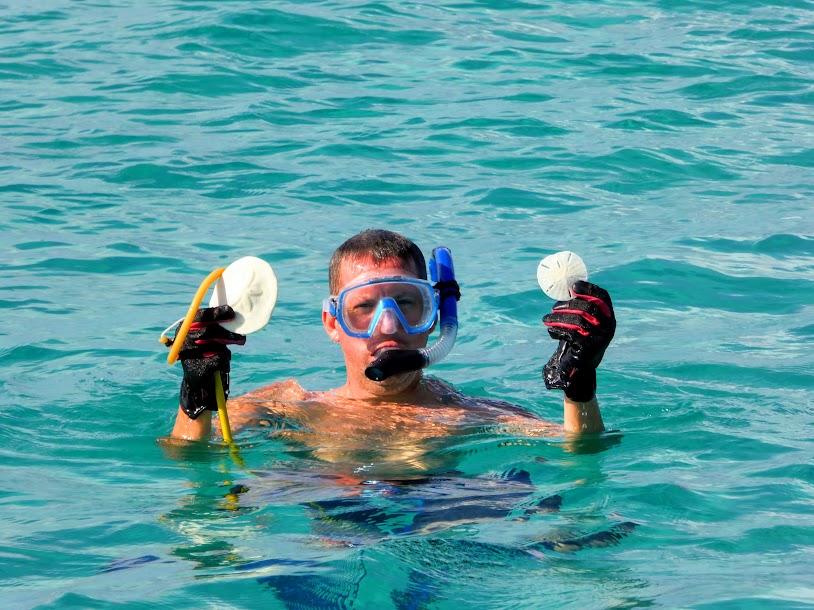
It was now time for water play! Scott took Karen snorkeling on the reef behind our boat. He’d find interesting things to show her along the way, and also snagged some trinkets from to floor below us.

Next, Scott took Karen to the outer reef, for a change of scene.

Karen and I enjoyed some time “bobbing” on our water loungers, and watched a large yacht at the back of the anchorage lower one of their several tenders down into the water. If only the Aluminum Princess had it so smooth and easy going up and down!

I’d rallied a gathering for cocktails and sunset on one of the nearby island beaches, and we headed over to our waiting friends.

Our friends were very welcoming to Karen, as cruisers are, and we all enjoyed a great evening.

Another beautiful sunrise over the anchorage brought a plan to change location.

With the calm wind forecast, we decided show Karen the Coco Bandero Cays, it’s beautiful island views and my favorite beach. Before leaving, we were lucky enough to catch a veggie boat coming into the anchorage..who came to us first!!! We hadn’t seem them before, but were glad for the chance to stock up before leaving. Their daughter swam around the panga while we shopped, and then practiced her motor-starting skills.

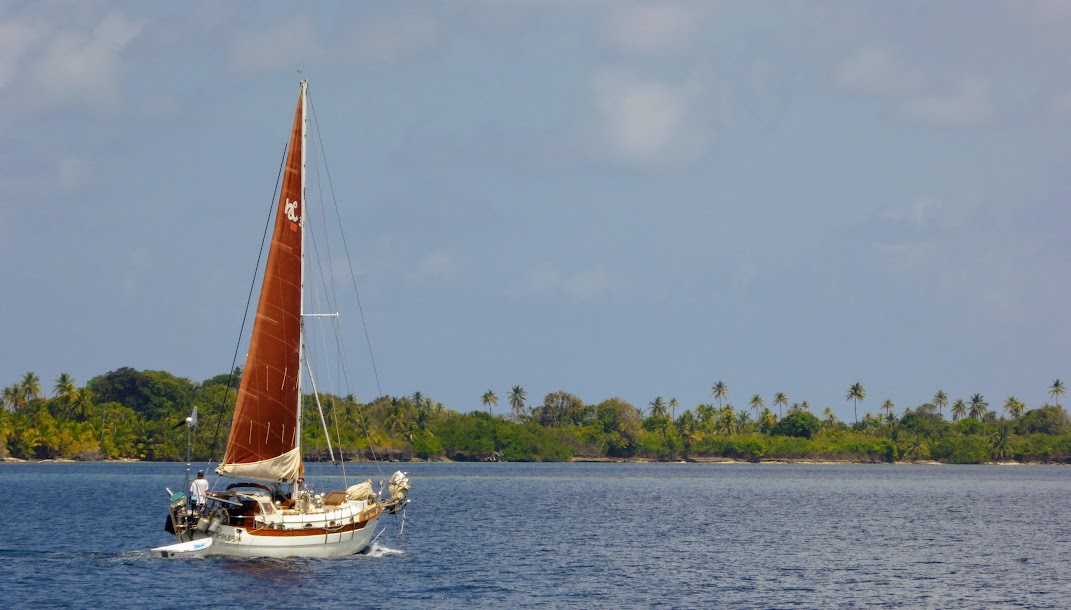
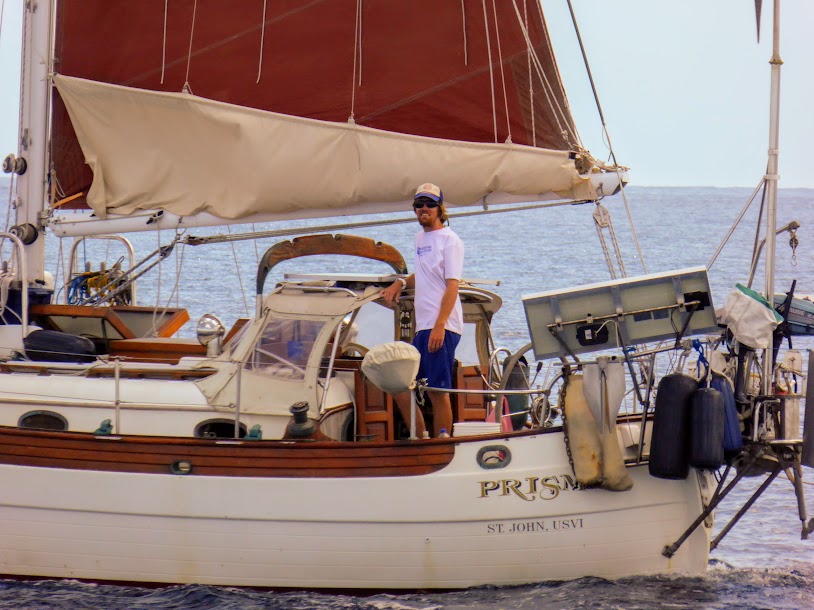
With fresh produce on board, we left the anchorage, bound for the Cocos. Just around the corner, our friends Jon and Shannon (s/v Prism) came into view, on their way back to the pool. We waved and snapped photos of each other as our boats crossed paths.

Karen stayed off of the internet, escaped sea sickness and we  enjoyed the scenic ride to the Coco Bandero Cays.

The next day, Karen and I spent the afternoon on my favorite beach, while Scott went out to hunt the reef. We had the beautiful little island all to ourselves.

There were more snorkeling outings, and we also took a dinghy ride around the area, passing over some massive coral. Aside from that, our last day together was spent walking the islands’ beaches and bobbing in the water. We also introduced Karen to the official cruisers’ game of Mexican Train dominoes!

After the crazy panga ride to the Robisons, we arranged Karen’s return pick up through Nacho, thinking that using a Guna driver to set up a Guna panga would work better. We also assumed that Nacho would keep things on time, to avoid waiting at the docks for Karen.

Nacho informed us that a panga would be at the boat to pick Karen up, in the Cocos, at 6am on Sunday morning. Scott thought this suspect, as the sun doesn’t even come up until 6:30am, and the area is much too full of coral for a panga to come out any earlier, even for locals. We expected to see the ride arrive closer to 7:00.

Seven am came and went, so Scott and Karen made their way in the dinghy to the beach behind us, for a cell signal to contact Nacho (Seriously, on board…no signal at all…just behind us on the beach…terrific. The only thing in between us and the tower?…a spindly island. Scott’s convinced that the palm trees here must be lead-lined).

As soon as they left, our friend Ted (s/v Rosa dos Ventos) hailed us on the vhf radio. There was a panga alongside his boat, and he was fairly sure they were looking for Sea Life, and Karen. I was afraid to ask where Ted was anchored, fearing that it was hours away, but he replied that they were in the nearby Western Cocos…whew!

I relayed to Ted where we were, and thanked him for sending the panga in the right direction. Hearing all of this on the portable vhf, Scott and Karen were already headed back to the boat. Ten minutes later, she boarded her ride for the mainland.

In just over an hour, the appropriate time for a ride from the Cocos, Karen was back at the Carti dock with no issues, and on her way over the mountains with Nacho. Aside from having to stop and wait for Nacho to get his breakfast, her trip went smoothly, and she arrived at the airport in plenty of time for the flight home.

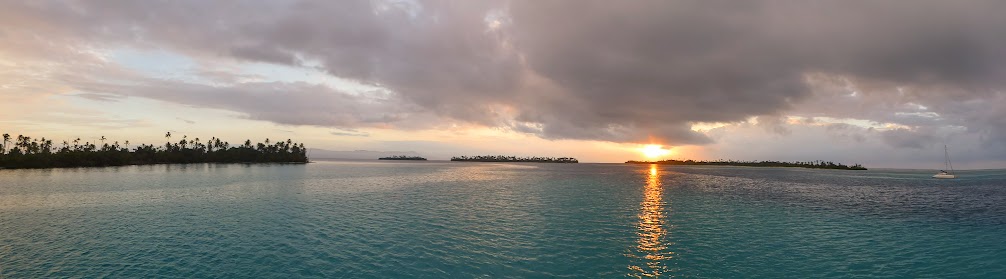
The crew on board Sea Life, including Howard, spent the rest of the day relaxing, and enjoyed another beautiful sunset.

So, I think all of the San Blas experience boxes were checked during Karen’s stay: seeing a Guna village; getting sea sick (could’ve skipped that); spearing fish; seeing sharks; eating fresh-caught lobster, fish and crab; snorkeling, hanging with cruisers at a beach gathering; bobbing; having a private beach day;  seeing a long-lasting, full rainbow on the water; purchasing molas, playing Mexican Train dominoes, buying food from a veggie boat and taking in lots of gorgeous views!

Karen quickly adapted to life at anchor with us during her visit, learning where things were, dealing with generator day, helping with laundry, tolerating Scott’s yes’s and no’s on board the boat (yes, you can take all the time you want choosing a beverage from the Engel cooler, but shut the refrigerator door immediately!), helping us prepare to get underway and  personally dealing with the Congresso, when they came for their monthly anchoring fee!

It was so great to see our friend, and have a “piece of home” on board for a bit. We greatly appreciate that Karen rose to the challenge of visiting us in such a remote location, and hope she survived to visit us again! Here are a few more photos.

“Shells Sink, Dreams Float. Life’s Good On Our Boat!”


Howard’s Trip To Panama City

In late January, Howard began showing symptoms of a urinary issue; many trips to the litter box, leaving just dribbles behind. Before we left Baltimore, I’d visited our home vet, Dr. T., to stock up on various medications that Howard might need, so luckily there were antibiotics on board for him.

After a week, Howard showed no sign of improvement, so at Dr. T’s recommendation, we doubled his dose, meaning getting two eye droppers full of medicine in him instead one….fun for all!

Almost three weeks later, Howard was just marginally better. He then began throwing up, and I couldn’t get him to keep anything down. After three days with no water, we were very concerned, and began to make a plan to get Howard to a vet in Panama City.

The glitch was, that we had cleared out of Panama in December. There is a checkpoint stop on the road to Panama City, and if you do not have a valid stamp, off to jail you go. Our hope was to appeal to immigration on the island of Porvenier. Recent laws prohibit checking in and out of Panama in the San Blas. Boaters who are cleared into the country are only able to visit Porvenier to renew their stamp for an additional three month stay.

We left our anchorage in the Coco Bandero Cays, and traveled four hours to Porvenier, with fingers crossed that we could plead our case. Scott sent me in alone, to deal with the immigration officer, since only one of us needed to travel to the city, and we may have better luck with a female pleading the case.

“Joe” was a bit miffed that we’d checked out of the country 45 days earlier, bound for Cartagena, and were still in the San Blas (cruisers often do this with no problem…until there’s a problem). Because we both had “time” left in the country when checking out in December, Joe told me that if we traveled back to Portobelo (14 hours by boat), the immigration officer there would be able to cancel our exit stamps.

We didn’t have the extra days that it would take to do this, and then get to the vet. There was also the issue of getting back to the San Blas, with winds expected to pick up. I explained that we’d had steering trouble, and were unable to get back to the mainland by boat (a big fib on my part).

After two hours of back and forth, with few words understood between us, many pictures drawn and tears on my part, Joe told me to have Scott come to the office. When Scott arrived onshore in the dinghy, I told him to relay that he spoke no Spanish (when in fact, he can get by quite well now), and brought him up to speed on the story inside so far.

Once we were both back in the office, there was more of the same back and forth, before Joe finally consented to canceling our exit stamp, marking next to them in Spanish that seas were not good for us to make it to Cartagena. He told us to come back to see him for Scott’s renewal stamp (mine was due much later, as I was re-stamped when flying back in from the U.S. in October), and then again to get stamped out of Panama.

Thrilled that our pleas had worked, we raised anchor, and made a quick hour-long run to an anchorage near the docks at Carti, which is on the mainland. I’d contacted Emilio, who we’d planned to use for provisioning, and asked him to help me arrange transportation to get Howard and me to the vet, as I had no idea how to proceed.

Howard was loaded into his carried, and Scott took us to the dock in the dinghy, where we hopped into a running, air conditioned suv. It was a three hour ride across the mountains, through a checkpoint at the border of the Guna Yala region, into the city and to the vet. The driver maneuvered the road like the car was on fire, hitting the many curves and potholes at full speed. I was shocked that the car’s axles didn’t snap. Howard endured the “Mr. Toad’s Wild Ride” like a champ.

As we came down the mountain road, and headed toward the city, the driver pulled into a gas station…presumably for gas. He stopped the car, with the engine running, and proceeded to take a nap! When I realized what was going on, I was both irritated that we’d stopped for this, with my cat needing to get to the vet, and glad that he had the good sense not to fall asleep at the wheel.

Deciding  that a ten minute nap was fair, I watched the clock, preparing to wake him up. He popped up on his own, after seven minutes, declared, “Good! and we continued on. We made our way into town, and I was delivered right to the door of the vet.

I didn’t have an appointment, and thankfully a young  man waiting with his own cat helped me to speak with the woman behind the counter. After a very short wait, Howard and I were in a room with a vet, who thankfully spoke English. She took Howard away, to use gas to relax him for testing. Howard is not a good vet patient. At home, there is a “caution” sticker on his folder.

In the meantime, Emilio arrived to sit with me, in case I needed help with translation. The vet spoke very good English, but Emilio did help me arrange a hotel for the night. With the “Carti” road closed at 7pm, there was no way to get back to the boat in the same day.

Howard’s initial tests: blood, urine, xrays and sonograms all came back clear. Hmmm. I arranged for him to stay overnight, wanting him to receive fluids.

Emilio then took me shopping, stopping first at Riba Smith, a large grocery store with many American items. I was in heaven, and loaded up on cream cheese, butter and other goodies from home. We then went to a nearby mall, where I was able to buy some magazines printed in English! I arrived at the hotel later that evening, with some McDonalds food in tow.

After turning the air conditioning down to a chilly 68, and watching some English channels on tv, I happily fell asleep in the comfy hotel bed. At 3am, I woke in a sweat. When I tried to adjust the thermostat, it crackled and sparks came out…not good.

I called the front desk, and they sent someone to “check” the thermostat, most likely thinking that I couldn’t manage to set the temperature on my own. After getting his own set of crackles…and some smoke, the man cried “Oh!…Bad!,” and called back down to the front desk.

I was told that they were happy to move me to another room, but unfortunately it was on a different floor. That didn’t bother me in the least, as I was determined to absorb as much air conditioning as possible, so I loaded up my backpack, and made my way down two floors at 3:30 am, barefoot and in my pajamas. There I resumed sleep, in a freshly cooled room.

The next morning, after enjoying the complimentary breakfast buffet (I am told that all hotels/B-n-Bs/inn, etc. are required to provide a free breakfast to their guests), I met Emilio and his friend, Gil, who sped me off for more provision shopping.

Our first stop was to Pricesmart, a membership bulk store owned by Costco. I loaded my cart with soda, bacon, lunch meat, cheese, vinegar (used for monthly toilet deep cleaning, and laundry) and various other things. The next stop was to a local bulk store, which offered some of my wish list items at better prices than Pricesmart, such as wine, rum and sprite.

I checked in with the vet, who said that Howard hadn’t eaten, but she didn’t expect him to while in a strange and stressful place. He’d been given fluids, and a shot of both antibiotic and something for his stomach. She declared Howard ready to leave, so we planned one more stop before heading over to pick him up.

Our last stop was one more visit to Riba Smith, where I purchased more cold items, and some bags to keep them cool for the journey back to Sea Life.

Emilio said his goodbyes, as he had another client to meet. Gil would be taking me to collect Howard and then to meet my ride back across the mountain. Emilio’s help had been invaluable, knowing where the stores were, which ones had the items I wanted and at the best prices. The process would have taken far longer on my own.

Gil and I arrived at the vet, where Howard was growling at anyone who came near him. He calmed when he heard my voice and received some petting in his carrier. I paid my bill of 180.00, which included the vet visit, overnight stay, xrays and sonograms of stomach and bladder, blood and urine tests, two injections each of antibiotic and gastro meds, iv fluids and some cat food for urinary tract health…much cheaper than US prices!

Nacho, the driver who would take us back to the Carti docks, was waiting outside a small local restaurant at the start of the mountain road. We loaded all of my things, and Howard, into his car, filling all but the passenger seat (the area behind the back seats was piled high, and the floors under both Howard and me were packed full).

Along the way, we stopped for Nacho to relieve himself behind the car, a much faster delay than the previous driver’s nap. At the Guna Yala checkpoint, the official who came to the car windown to check my passport was intrigued with Howard, waving over the other guards to see him, calling, “Howard, Howard!”

When we arrived at the Carti dock, I asked Nacho to help me get a panga ride back to the boat, as I hadn’t prearranged one. He loaded my things onto a panga, with several locals onboard waiting to depart. It took five trips of heavily loaded wheelbarrows to get my stuff onto the panga, and when I walked down the dock with Howard, to get on, the driver wasn’t happy. Apparently, Nacho had told him that I had only a few things. “Senora”, he said, “this is a supermarket!” In his defense, it was a huge amount of stuff.

After a short, five minute ride, we were back at Sea Life, where Scott was waiting to help unload my things. Howard was glad to be home, and seemed none the worse for wear. He immediately wanted food, ate plenty of it and then settled into a deep sleep in his taco, sporting his new haircut.


Scott was quite peeved that after the whole, logisticly-challenged ordeal, the vet had found nothing wrong with Howard. We think that his urinary issues were near done, and the gastro stuff had almost worked their way through; the injections may have also helped resolve both issues.

In the end, maybe Howard just wanted a few days away from the boat….and an adventure.

“Shells Sink, Dreams Float. Life’s Good On Our Boat!”
Exploring New Anchorages

After our stay in the eastern Holandes, anchored in the Swimming Pool and then Hot Tub, we were ready to explore more of the many anchorages here in the San Blas islands. Our friends, Dave and Sharda, (s/v Morgan) were anchored in Esnasdup, located in the southeast area of the San Blas, so we decided to head over and join them.

The Guna islands of the San Blas have very unique names. Many end in dup (pronounced “doop”)…Esnasdup, Miriadup, Salardup, etc. We’re told that “dup” means that there is a well located on the island.

More than one of these islands have the same name. There are several Banedups, Miriadups and Waisaladups, just to name a few. This can make trying to meet or locate friends challenging…”which Banedup are you anchored off of?” “Is that the Waisaladup in the western Holandes, or near Green Island?” Cruising is a constant state of learning and adjusting.

To get to the southeast islands, we had to come out from the protection of the reefs, and cross open water. We rolled across the large swells, and I was glad to have taken time to secure things for big water. Soon we were behind the protection of another reef, and in sight of Esnasdup. These islands are closer to the mainland of Panama, with views of the mountains in the distance.

In keeping with the multiple names theme, Esnasdup has a “pool” of it’s own, located between two islands, and just behind the reef. Dave and Sharda were anchored in the pool, and we dropped anchor there to join them. It was great to enjoy views of the reef off our bow, and still have the mountains in sight behind us.

As usual, the islands surrounding us were beautifully scenic, and we often saw the locals in their ulus, fishing in the area.

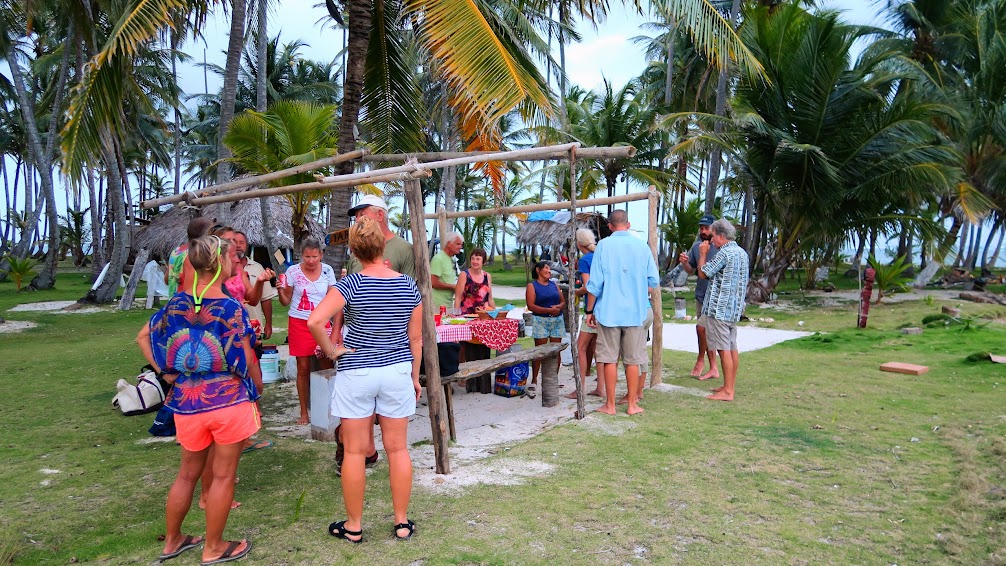
There was talk of a full moon trash burn on a nearby beach, so I spread the word to make it an appetizer pot luck as well. I wracked my brain to come up with some sort of table, because the alternative was for everyone to hold their dish in one hand and pass it around, drink in the other hand, while trying to eat at the same time (this has happened).

I came up with my own “MacGyver” idea, to fashion a table from items on board Sea Life: a piece of plywood we had under the couch cushions, and some milk crates that were being  used to store provisions…well done me!

As expected, Scott was less than thrilled to have to empty said milk crates of their contents, and to use his piece of plywood, but he helped me gather the stuff, and then hauled everything over to the beach. He also went over early in the day, to clear the sand of driftwood and other things, opening up more usable beach space.

Everyone was very happy to have somewhere to put the food, and the night was great fun. All trash was burned, and the moon was beautiful. I was busy talking and eating, so unfortunately, no moon photos.

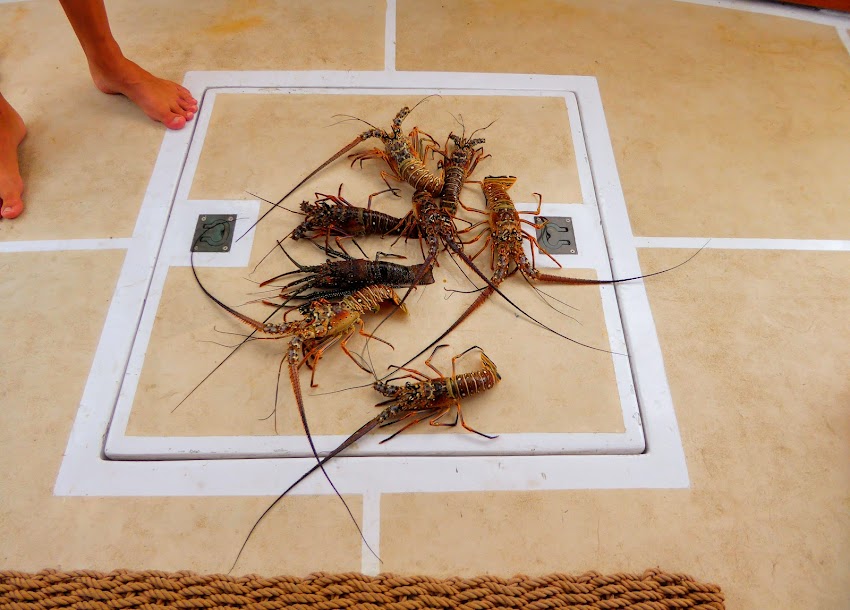
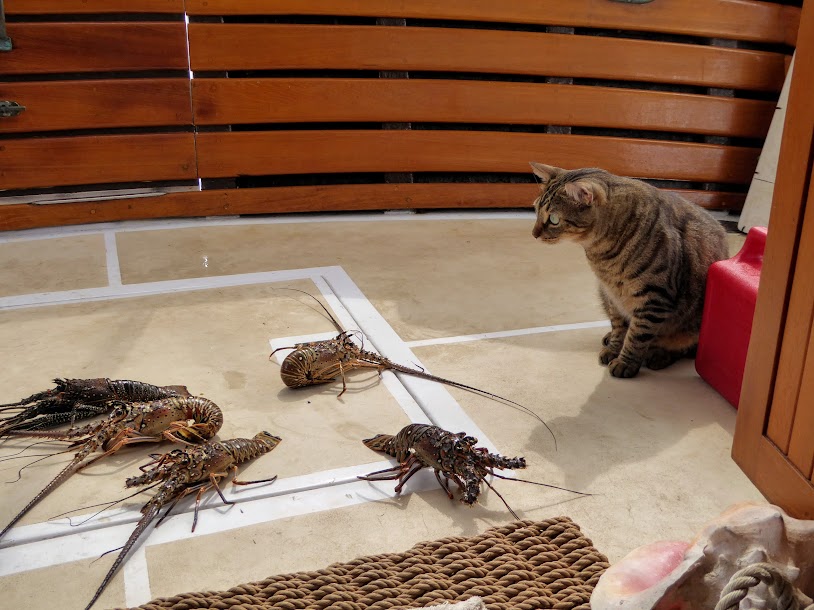
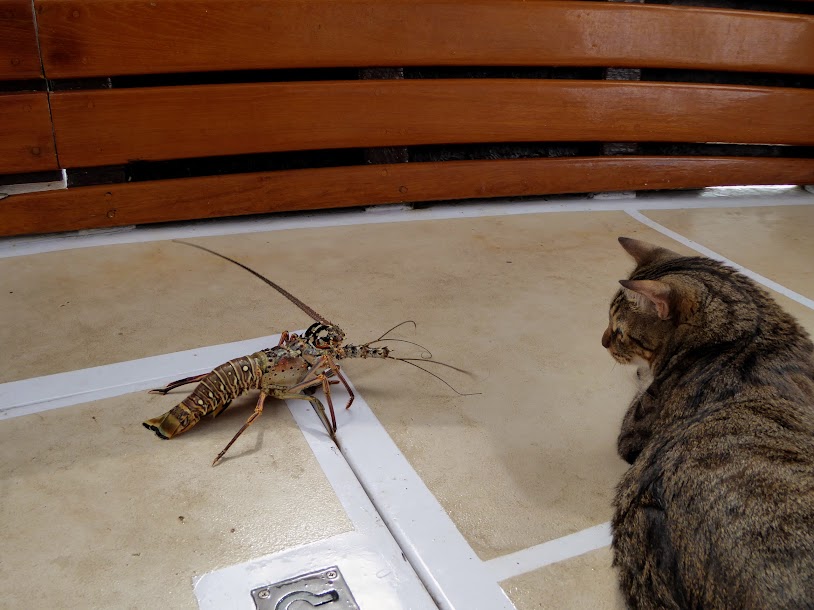
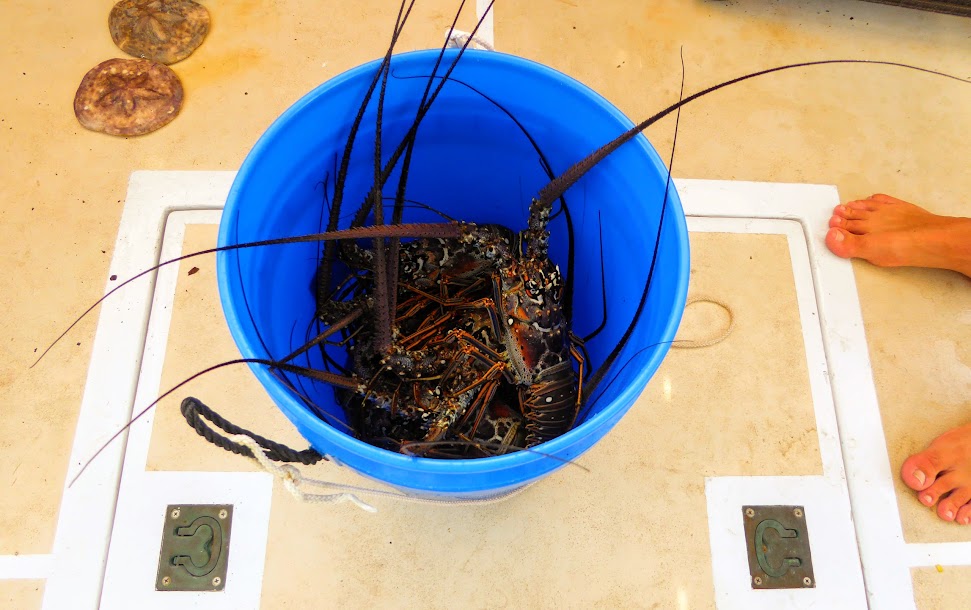
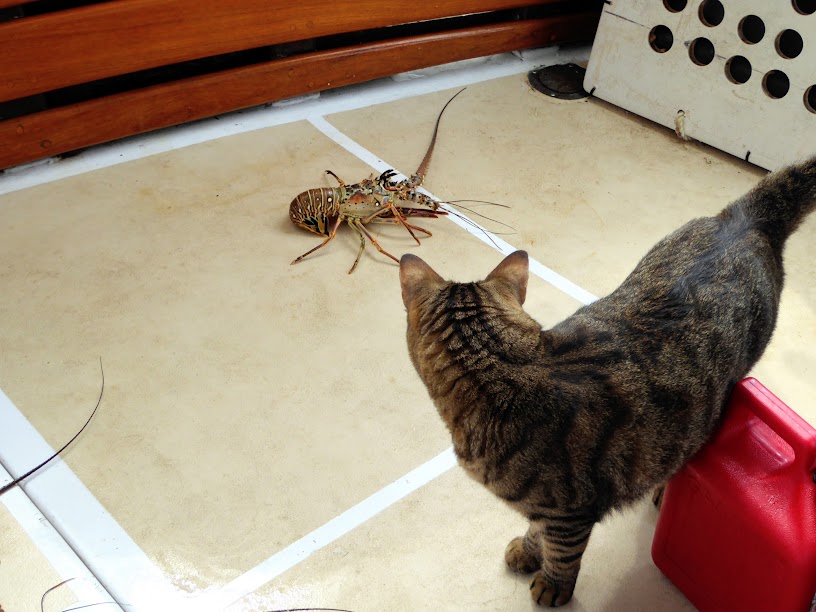
Scott came up empty for fish or lobster in the area around Esnasdup, so we purchased eight lobsters from a local fisherman…for 15.00! Howard has become very intrigued by lobsters, and he had quite a stare-down with one of this bunch.

With more windy days predicted, we decided to leave the exposed location we were in and head for an anchorage nearby, off of Green Island; there was also talk of very good internet there. We didn’t find the good internet (none at all, actually), but did find a scenic spot to anchor off of Kuigaladup (say that three times fast), near Green Island, still enjoying the mountain views behind us in the distance.

Scott took the dinghy over to Green Island, for a walkabout (not all of the islands are cleared well). It doesn’t take long to cover these small islands, but he had fun wandering around for a bit, and stretching his legs.

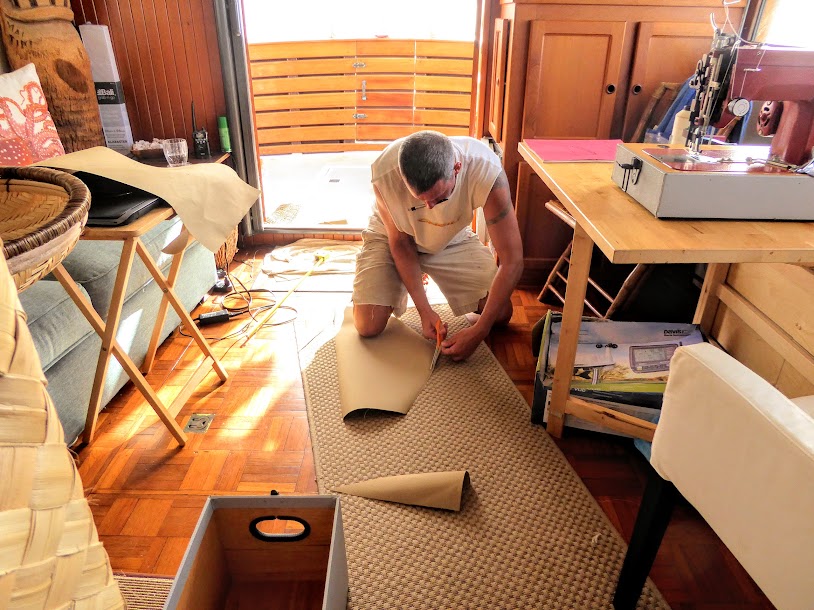
Scott burned our trash, and we took the time to sew up some canvass covers for our grill and the inflatable dingy motor; he cuts, I sew (Howard’s latest sleeping/fighting box is under the table).

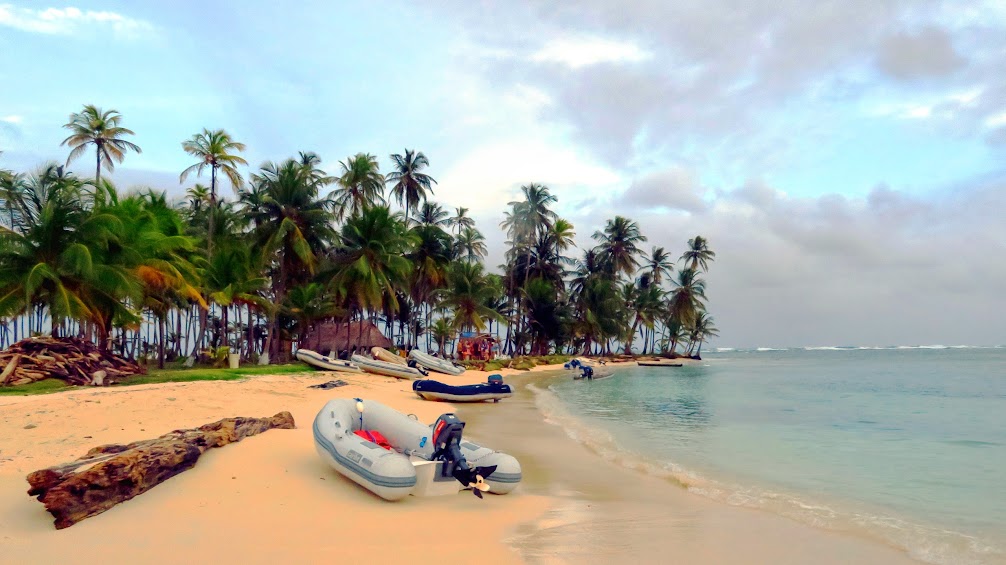
 After the winds subsided a bit, we headed back to our spot in the pool at Esnasdup. I talked up a gathering on nearby Gorgidup, a tiny little island with a gorgeous beach. Most everyone in the anchorage planned to go, this time sans food. Our friends Jack and Monique, on s/v Aloha, offered to take several of us on a short sail over to the island. It was a terrific way to arrive!
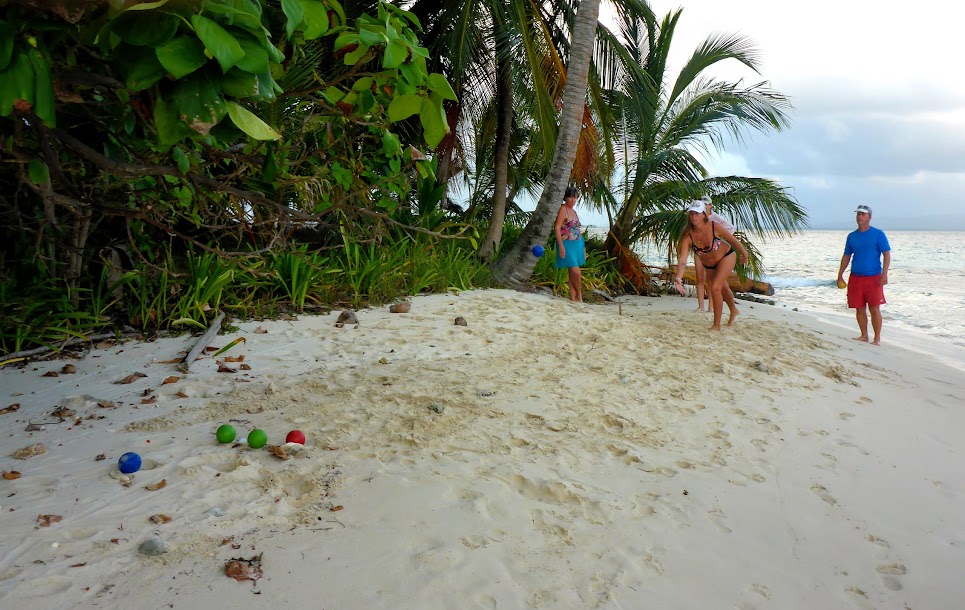
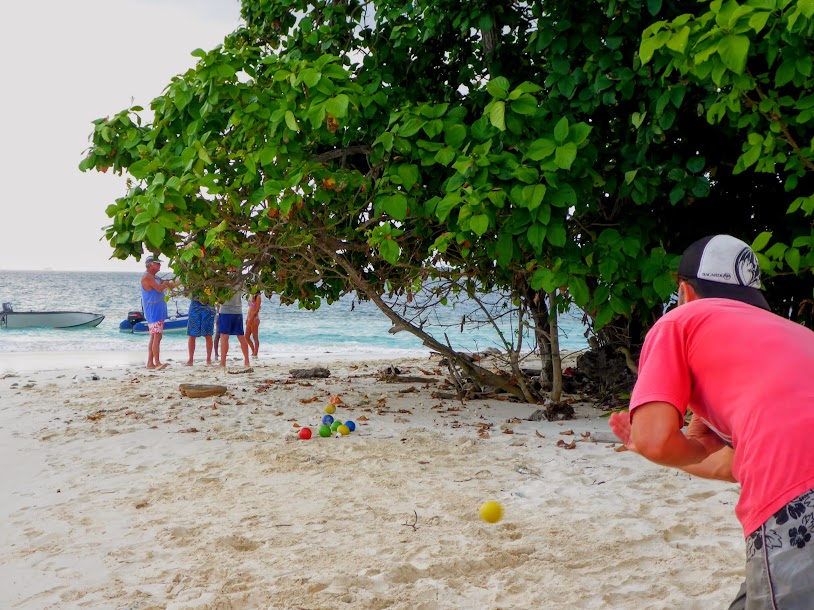
We enjoyed the afternoon on this beautiful island, and also had a pretty serious sand bocci tournament!
As the sun set, Aloha was waiting, to sail us back to our boats. It was a great day with our San Blas friends.
The coming forecast was for winds to nearly die off for at least four days, so we set our sights on the Coco Bandero Cays. The anchorage is pretty bumpy in most any wind, so with calm conditions coming, it seemed the perfect time to visit the islands. We approached the Cocos, and were immediately excited about them…what a beautiful sight!
There are five islands that make up the Coco Bandero Cays, and we anchored close to one with a “resort” on it. Overnight visitors were dropped off and picked up several times during our stay, which initially worried us. Thankfully, we hardly noticed or heard them.
The rest of the beautiful islands were uninhabited, except for a modest fishing shack used by local fisherman traveling through the area.
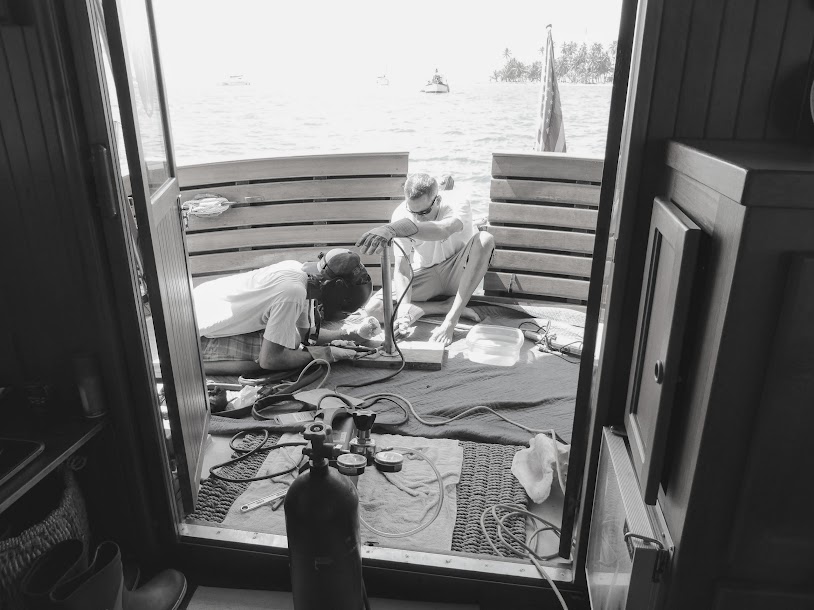
Our friends Jon and Shannon (s/v Prism) were anchored behind us, and Jon “shared” our generator power, to do a welding project for his wind generator. It’s definitely not the first time our cockpit has been used as a workshop!

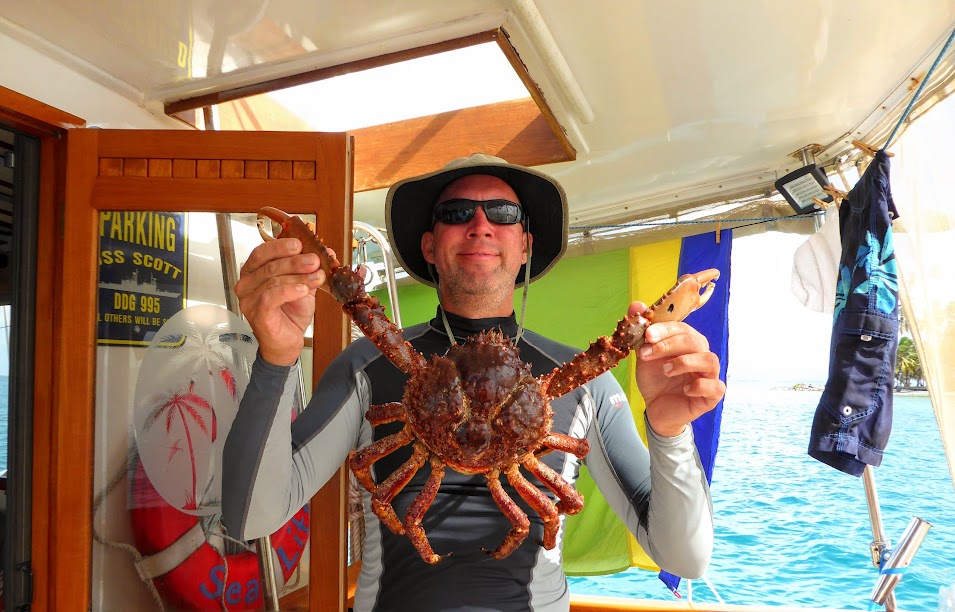
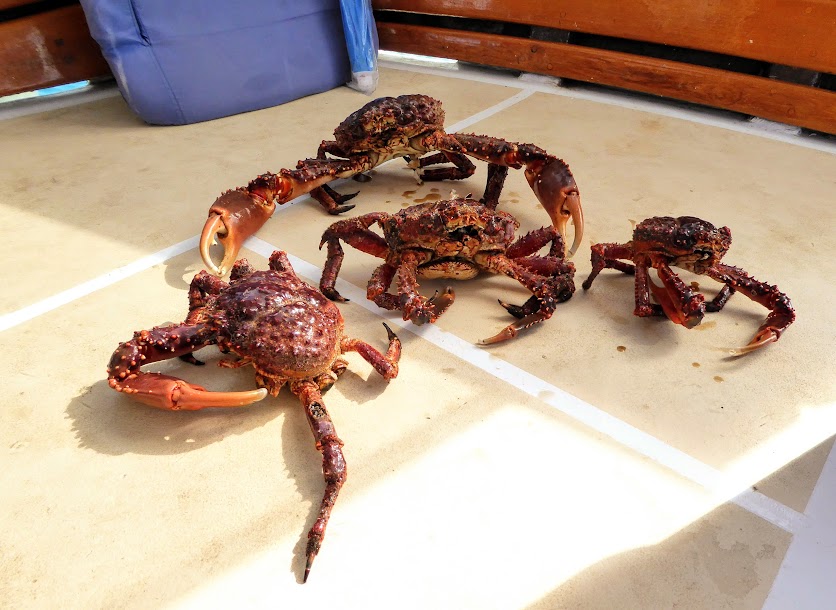
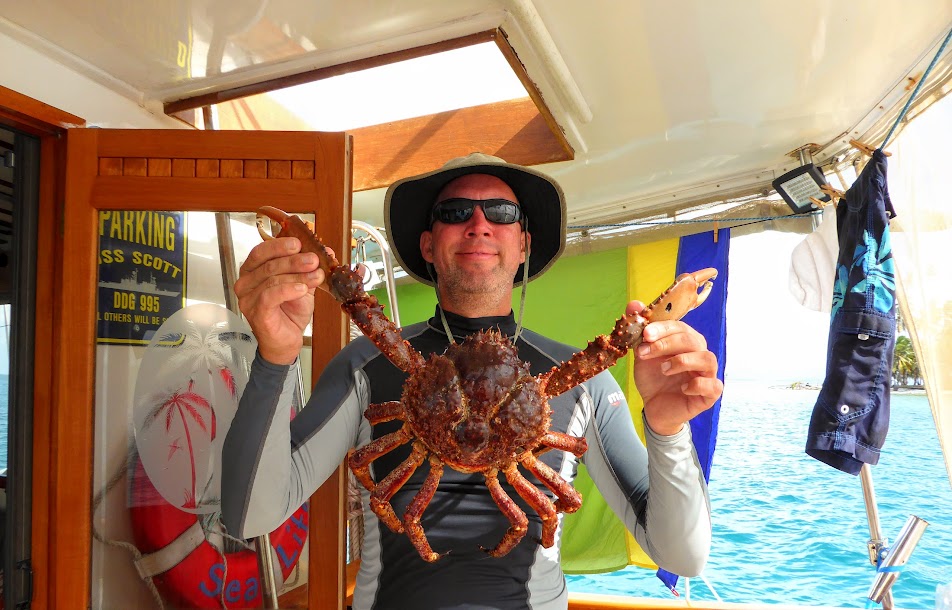
As usual here, after a few hours of work is done, it’s time for play, so Scott, Jon and Shannon headed out to the reef on a fishing mission. Shannon came back with a crab and a huge lobster, and Scott speared  more crab than we could eat!

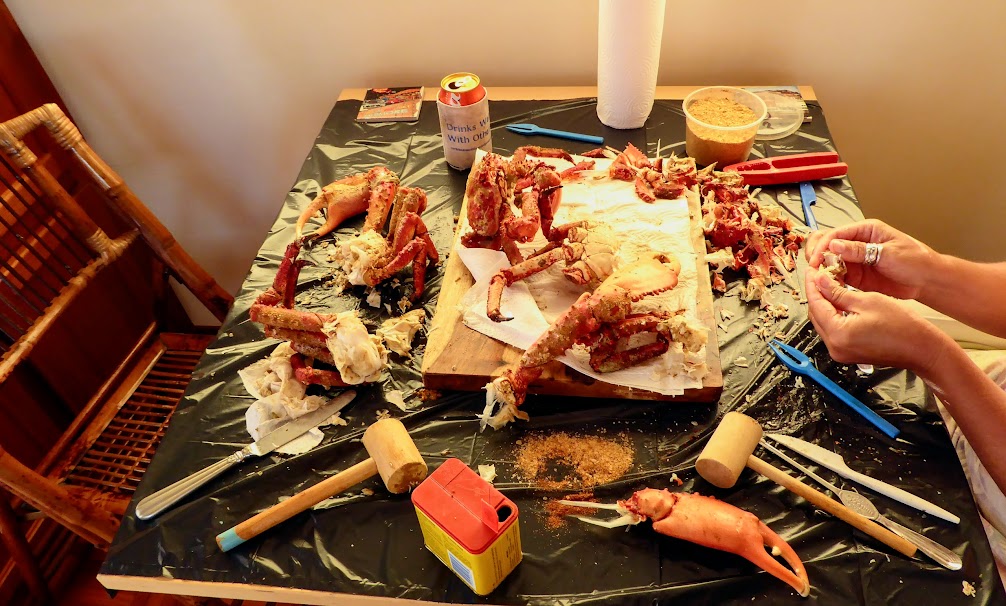
These big guys taste just like the blue crab that we get from the Chesapeake Bay back home, so of course, we ate them Baltimore-style! (fyi, the wooden mallets were not enough, so we had to break out the hammer from Scott’s tool box)

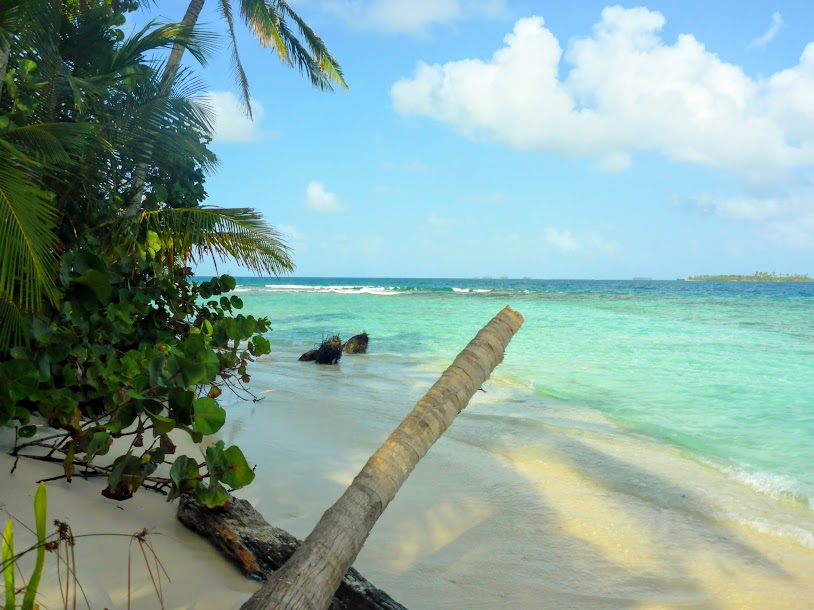
I spent two days on the beach of my favorite cay, while Scott explored the reef. The calm winds made it brutally hot, but the views were worth it; and, cooling off in that gorgeous, clear water was heaven.

I’m the first to say that our trip is much more of an adventure, than “living the dream,” but on days like this, with a beach all to myself, and the only sounds from nearby birds and gentle waves lapping at the shore, I definitely feel “dream” vibe.

We had another trash burn gathering on the beach with our friends, and then moved toward the back of the anchorage, allowing us to leave early the next morning, without having to worry about traveling through coral in the low light as we left the area.

Our overnight spot was just as scenic, and Scott enjoyed a snorkel on some nearby patch coral.

We loved our time in the Cocos, and are so grateful for the stretch of near flat wind while we were there, something very, very rare this time of year in the San Blas. Here are more photos.

“Shells Sink, Dreams Float. Life’s Good On Our Boat!”
Christmas And New Year’s Eve. In The San Blas Islands

We’re alive and kickin’, here in the San Blas islands! Internet service is more available than expected, but usually requires precise placement of a cell phone (used as an internet hot spot) at the highest outside point possible. It’s a familiar sight here, to see phones encased in plastic bags, hanging from, or being hoisted up a mast. At best, the service comes and goes, making uploading challenging, with the strongest hours coming in the middle of the night…oy! Some people have boosters installed on board, to up the strength of the signal. Others travel to anchorages that may have better service.

We do not have a booster, and are trying not to spend our time chasing the internet, so getting a signal worth doing anything, for any amount of time, is basically a crap shoot.

I’ve finally caved, and have spent several all-nighters (with nap breaks during weak service periods) while we’re in a location with decent service, to catch up a bit, and share what we’ve been up to for the past two months. Yes, I guess I could have written a post without photos attached, but that would just be mean.

We made our way from Linton Bay, on Panama’s mainland, to the eastern Holandes Cays in the San Blas islands, where we anchored in the Swimming Pool. Named for it’s shallow, clear blue water, the pool lives up to it’s name. The anchorage provides an nearly 180 degree view of the surrounding reef, and the breaking waves are easily heard day and night.

The views behind us were just as beautiful, with the colors of patch coral in the distance.

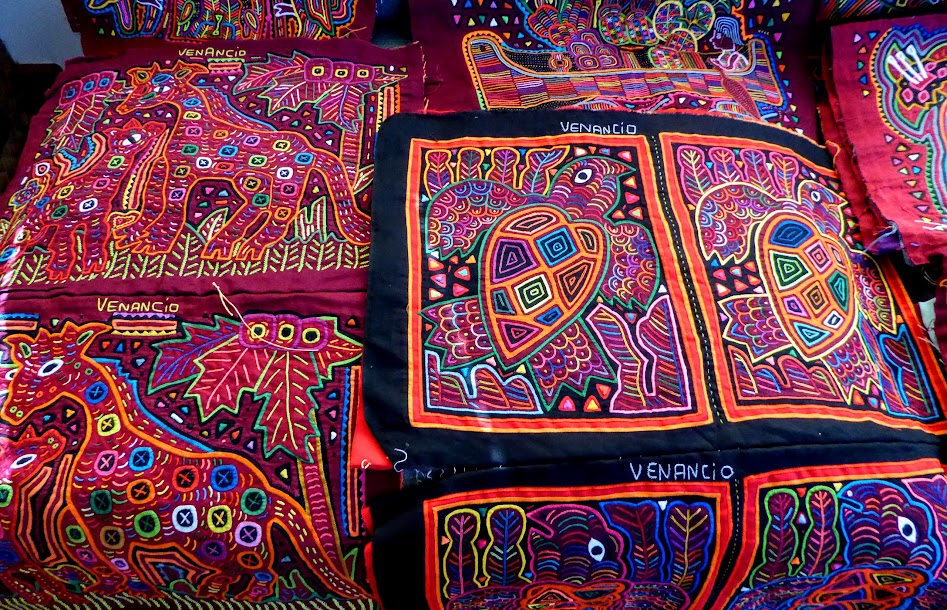
On our first morning at anchor in “the pool,”  we had a visit from Venancio, one of just a few master mola makers in the San Blas. We’d been told to keep an eye out for him, and were surprised to see him so far east.  Venancio told us that he makes the eight hour round trip to the eastern Holandes from the island where he lives, just once a week, so we were lucky to catch him.
Venancio came aboard with a trash can full of molas, and some beaded bracelets. He took each mola out, and explained it’s design as he laid them out for us to see. They were beautiful; full of color, and all hand stitched.

We chose several of our favorites, and then Venancio packed up his trash can, loaded it aboard the ulu (wooden canoe) and covered it well, protecting the molas from the salt air and spray.  Mola purchase in San Blas..check.

The week before Christmas, we heard a general announcement on the vhf that there was going to be a cruiser gathering on Barbecue Island, located at the front of the anchorage, just behind the reef. We were excited to meet the other cruisers in the anchorage, and arrived with an appetizer to share with the group. The weather was perfect, and we met many new friends. (photo courtesy of s/v Sundowner)

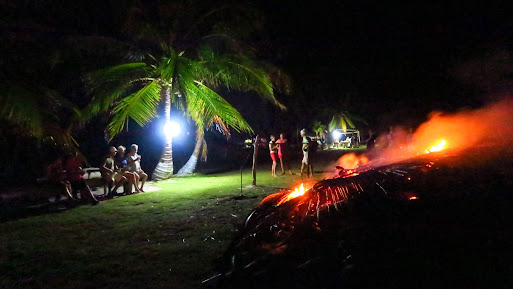
Once the sun set, locals on the island, who run a small “resort” (I use that term very loosely) lit a bonfire for us. Their fire starting was far from skilled, as we watched them spray the huge pile of wood and palm fronds with gasoline! (photo courtesy of s/v Sundowner)
As expected, Scott spent many hours in the Aluminum Princess, exploring the anchorage and the area around the expansive reef.

He always has his pole spear handy, as his snorkeling outing often turn into hunting expeditions…many times successful ones!

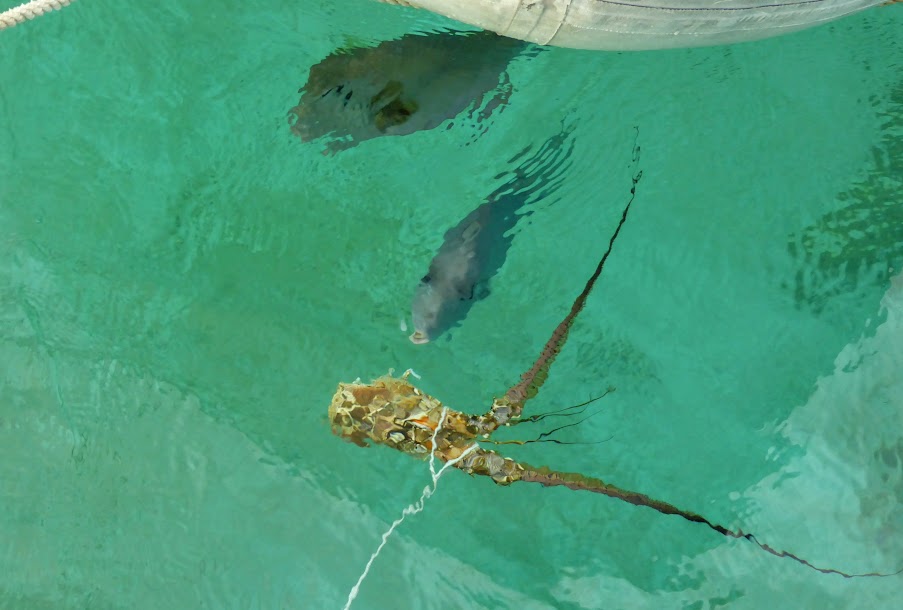
Scott dropped a lobster head into the water behind the boat, to see what might bite. It seems that Triggerfish find them pretty tasty. Regulars here in the San Blas refer to Triggerfish as “Bob.” Maybe because there are many in the waters here…not sure. Bob likes lobster.

On windy days, current would run through the anchorage at close to four knots, making swimming very challenging. Scott’s solution was to take the Princess to one end of the anchorage, tie himself to it with a 30 foot line, and drift along behind it, as the boat made it’s way back through the anchorage in the current.

He  caught quite a few very large conch like this, having just enough time to get to the bottom and grab them before being pulled along. Neither of us were up for the job of cleaning conch (eewww), so we shared them with some of our new friends in the anchorage…and joined them for some fresh ceviche as a thank you!

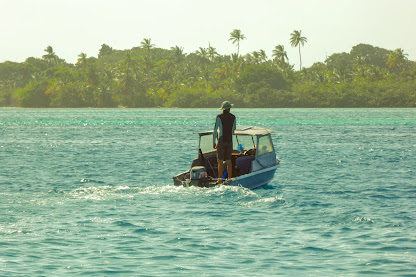
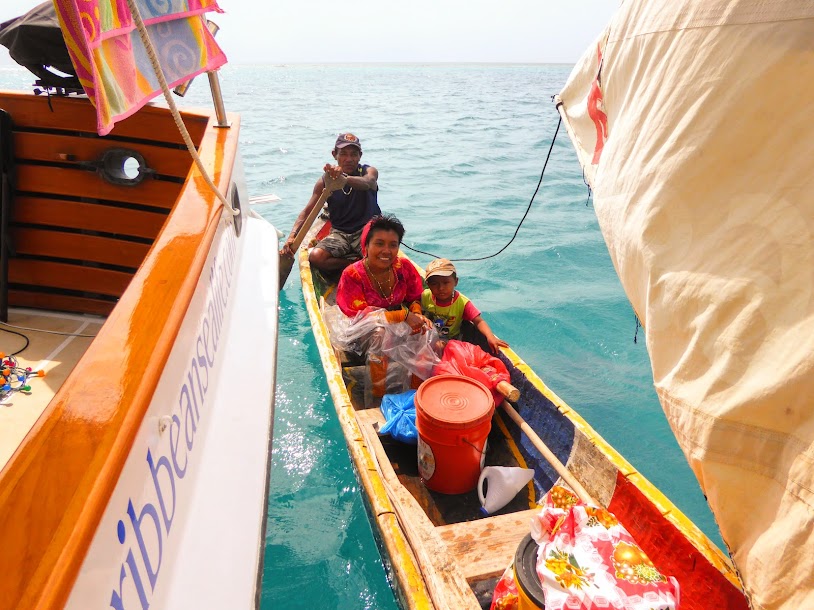
We would get regular visits from the Gunas, in their ulas (dugout canoes). They usually had molas and jewelry for sale. We already had more molas than needed, but were happy to fill their water jugs with fresh water, and occasionally a juice for small children. They also took our aluminum cans, to sell to the Colombian trader boats who recycle them.They both row and sail the ulas, and the women’s traditional dress is beautiful.

There is no trash removal service here in the San Blas. Bottles are broken into pieces (the theory is that the pieces will eventually turn into sea glass) and dropped overboard when in deep water (at least 150 feet), along with steel cans (anything that will rust away). This isn’t just practice reserved for the San Blas islands, the U.S Coast Guard has similar requirements for trash removal offshore.

All other trash here is burned. Being new to the San Blas, we weren’t sure which beaches were acceptable for this, as all of the islands here are owned by Guna families, whether they are inhabited or not. Until we learned the rules of trash burning etiquette, Scott improvised.

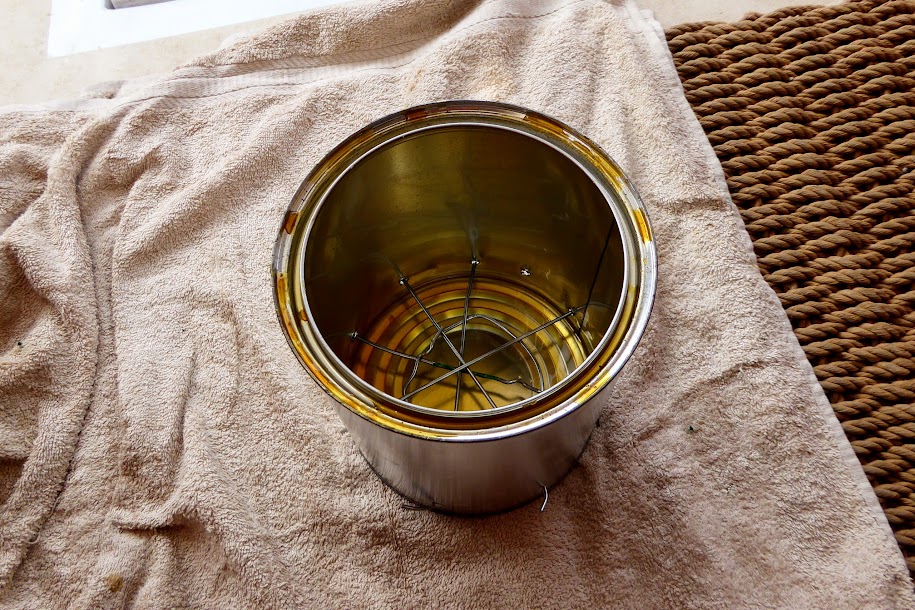
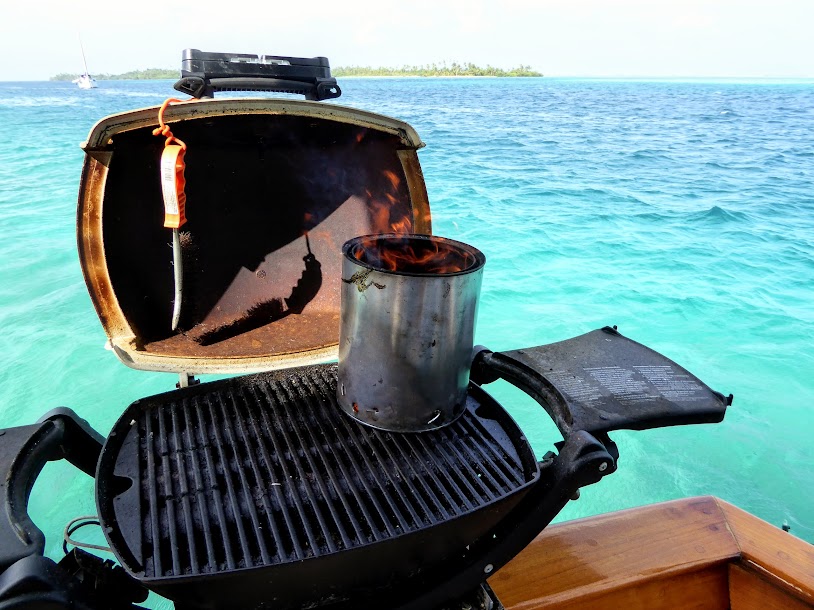
Channeling his inner “MacGyver,” Scott fashioned a rack from a wire coat hanger (I’m shocked that we had one on board, although he probably had it squirreled away for just such an occasion),and placed it in the bottom of an old varnish can. He punched holes in the bottom for air, and voila!, a burn can for the grill was born.

This would have been the perfect solution if we burned every day, or made less trash, but we do neither of these things. Instead, Scott would spent two hours or more burning everything from paper to an old pair of shorts.

Positive…our trash burned down to a tiny pile of  ash. Negatives..it took hours, and we had to close up the saloon, to avoid being choked out from the smoke.

Luckily, or new-found cruiser friends invited us to join them for a trash burn run. We followed them about 20 minutes from the pool, to a beautiful spot, where they meet to burn trash. Fires are made near the waterline, so that high tide will wash away the leftover ash.

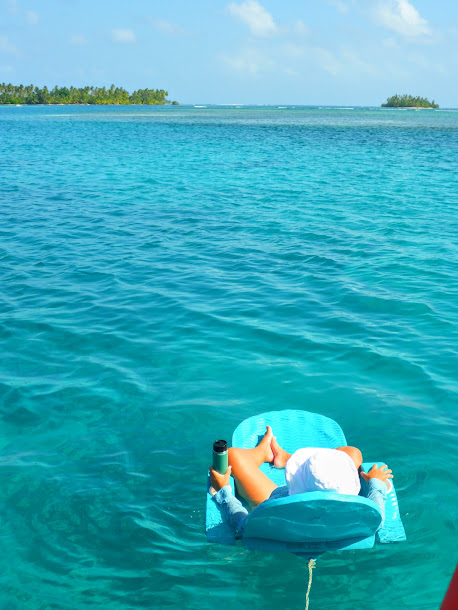
We soon realized that trash burning here is a social event. Once the trash has burned, and while we wait for the ashes to smolder and cool, it’s time for bobbing with drinks in the clear blue water; now that’s my idea of a day’s work!

By the way, wearing some kind of shirt is a must in the water here  (unless you’re our friend, Sharda, who is blessed with skin from Trinidad!). I learned this the hard way, frying my shoulders and back from the reflection of the hot sun off of the water.
When we first arrived, there were few boats in the anchorage  here, but during  the weeks of Christmas and New Year’s Eve. the numbers grew.
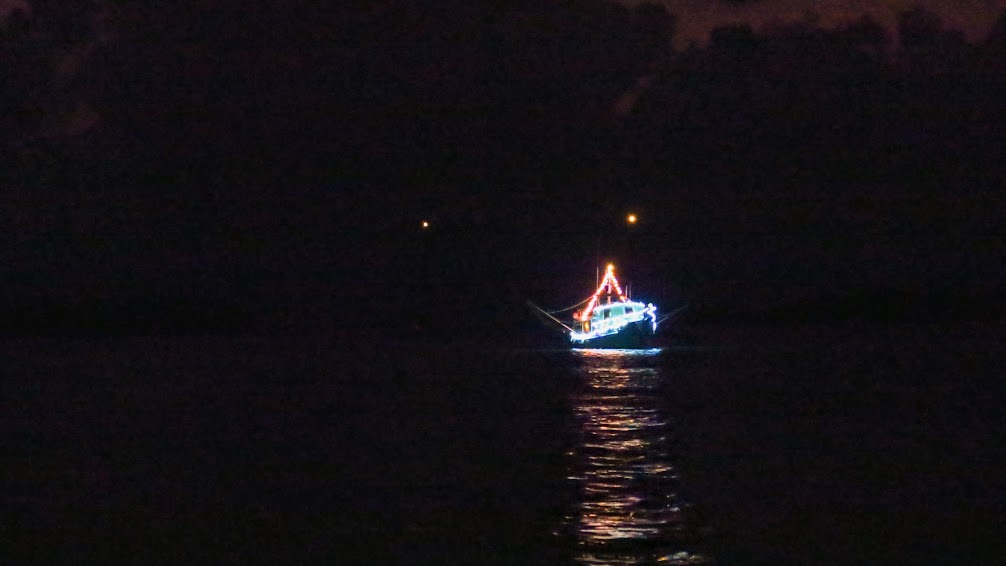
We enjoyed Christmas Day in two shifts. First, with dinner aboard s/v Sirena, and then dessert with friends on s/v Gris Gris. And of course, Christmas would not be complete without lights! We lugged along our holiday lights, and Sea Life was quite a festive sight in the anchorage (photo courtesy of s/v Sundowner).

Knowing no boat offered enough room for a group to gather for New Year’s Eve., I put out the word for all cruisers interested to gather on a nearby beach, to ring in 2017. As luck would have it, the location was in perfect view of a fireworks display, set off by a nearby superyacht for their charter guests.

After enduring a stretch of windy weather in the pool, with the accompanying currents and insane salt spray, we decided to change locations for the next go-round. After the new year, we headed around the corner to the Hot Tub (yes, from the pool, to the hot tub..tough times).

With more protection from the winds, the water in “the tub” is much calmer, and the current much less strong. In addition to more beautiful views, the water is supposed to be warmer than in the pool, hence the name. However, we found it to be much cooler…ahhhh, refreshing.

Scott found a great honey hole around the corner, for catching lobster and Lionfish. They are invasive, so he tries to kill them whenever he can. Lionfish are also good eating, but challenging to clean, due to their poisonous dorsal fins.

Once again, Scott used lobster tails for bait, and attracted a huge Bob! He grabbed his pole spear, and shot it right from the cockpit, without even getting wet. Unfortunately, Big Bob did not go down without a fight, flopping and bleeding all over the cockpit when Scott removed the spear tip.

Scott delivered this massive fish to our friends, Jon and Shannon, on s/v Prism. They were waiting for a new dinghy motor, requiring them to row everywhere.

In case you’re wondering, Howard is enjoying life in the San Blas. He keeps an eye on us from one of his favorite perches, up under the solar panels, and loves when the fish light goes in the water each night.

So our first few weeks in the San Blas were off to a great start. We made many new friends, and enjoyed the beautiful views. More to come, as we explore new anchorages. Here are more photos.

“Shells Sink, Dreams Float. Life’s Good On Our Boat!”