Guanaja Trivia

Here’s a little info. on Guanaja….

Christopher Columbus discovered the island in 1502, on his fourth and final voyage of discovery. He found excellent water (the island has its own fresh water source from mountain streams) and noted that he had, “never tasted water of better quality.”

Guanaja was so covered in pine trees that Columbus initially named it Isla de Los Pinos, Pine Island.  Sadly, most of the pine trees were destroyed by Hurricane Mitch in 1998. Mitch sat over the island for nearly two days, with sustained winds in excess of 200 mph.

Most of the approximately 10,000 people who live in Guanaja reside in the town of Bonacca. The two main settlements on mainland Guanaja are Mangrove Bight and Savannah Bight. There is only one bank on the mainland, and no ATMs.

You are hard pressed to find a place that accepts credit cards in Bonacca or on mainland Guanaja, cash is king. The local currency is the lempira, and the current exchange is 23.5 to 1.00. American currency can be used, but the bills must have no tears, wrinkles, etc. or they will no be accepted. We ran into this problem when buying gas, before we exchanged for local money.

As of 2006, there were only three cars on the island, but now it’s closer to 40 (oh the traffic!). While there is only one road (two miles long) from Mangrove Bight to Savannah Bight, the most common means of transportation are boats. A channel locally known as “The Canal” allows access from the south to the north side of the island, without having to go all the way around. Scott is eager to travel it with the Aluminum Princess.

Guanaja’s waters support an extensive coral reef that is part of the Mesoamerican Barrier Reef, second only to the Great Barrier Reef. There are also several waterfalls on the island, and they are also on Scott’s to-do list.

We look forward to exploring Guanaja, by both land and sea!

“Shells Sink, Dreams Float. Life’s Good On Our Boat!”

Bonacca, “Venice Of The Caribbean”

Bonacca sits a half mile off of the main island of Guanaja. More than 6,000 people live on this tiny cay, which is less than 100 acres. It was originally two islands, connected by a boardwalk, that was gradually (manually) filled in with rocks and sand to expand the town. I copied an aerial photo from the internet, to give you an idea of how populated it is.

The town has many small canals running through it, earning the name “Venice of the Caribbean.”  I mentioned previously that there are no real roads, only narrow, concrete walkways. As a result, there are no cars, scooters or bicycles in the tiny city, just foot traffic. Many of the homes and businesses are on stilts out over the water, some as high as three stories.

It seems like just about anything you might need can be found here, if you are willing to look or ask: hardware, groceries, fruits & vegetables, meats, fresh bread, cell phones, marine parts and clothing. Signage is almost non existent, usually just something small and hand made.

After waiting a day, we came back to town to see the port captain this morning, in hopes that our papers would be ready. Before we got to the office, he passed us on the street and told us to meet him in ten minutes. We visited some of the grocery stores, more about those later, and then went to see him.

We needn’t have rushed. When we arrived, he was working on paperwork for one of the commercial boats. “Copies” are made by using two forms, with a piece of carbon paper sandwiched between (I have no idea where you can even get carbon paper!).

The sandwich is then loaded into…wait for it…a typewriter. I’m not sure why he didn’t enter the information on his computer,which he has, and then print it out.

This typewriter wasn’t a “newfangled” electric one, but the good old fashioned kind. He had to stop at one point, to wind the ribbon, which had loosened. As he typed, he’d say the words out loud to himself in Spanish. I guess it was to keep from making mistakes, which must work, because he never reached for the white out.

I also noticed today that there was (again) an old style phone/fax on his desk. He uses the phone, but I’m guessing that the fax part doesn’t work, which must be why he used up all of the data on his cell phone.

After about thirty minutes, the commercial boat papers were finished, and the man was on his way. I guess commercial boats are exempt from this new faxing-the-mainland policy. It took less than ten minutes for him to communicate to us that our papers were good for all of the bay islands, and that they expire in thirty days. At the end of thirty days, we can get an extension, which we plan to do. Here’s hoping that there are no new policies by then!

The town of Bonacca is so unusual, unlike anything we’ve seen. We’ll visit again later in the week, as fresh produce arrives on Thursday mornings, and look forward to enjoying a beer with the locals. Here are some more photos of our day in town.

“Shells Sink, Dreams Float. Life’s Good On Our Boat!”

A Challenging Customs Experience

We’re having a much different check in experience here in Honduras than in Mexico….

Yesterday morning, we moved Sea Life to a spot behind town, and out of the swells coming from the southeast. This would make our dinghy ride to town for clearing customs more comfortable, as we hadn’t yet unloaded the Aluminum Princess.

We took our inflatable dinghy to the fuel dock. Friends told us that the guys working there are very friendly, and will let you tie up at the dock while clearing in. The man working was very friendly. He told us that it was no problem to leave our dinghy, Scott got a bit of gas for it and we were able to get rid of some trash as well.

We then made our way into town. The “streets” are narrow, concrete walkways, with houses and stores on either side. The buildings are very close together, and finding our way to the port captain’s office was a bit like maneuvering through a maze at times, but we managed it.
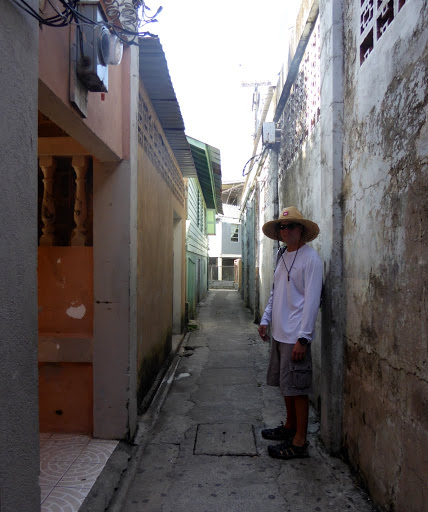
The port captain told us, in very very broken English, that we had to see immigration first. As we came out of the office, a man named Mario offered to take us there. We’d heard that men will approach you, offering help getting to customs, stores. the bank, etc., and will ask for a fee in return. Originally, we’d planned to maneuver the town by ourselves, but it was proving quite a puzzle, so we agreed. When asked his price, Mario responded that we could give “whatever we wanted.”

We weren’t at immigration long, but needed to have a copy made in order to finish with them. Mario took us to a store where we paid for one copy, a water for Scott and a juice for Mario. We returned to immigration,  handed over the required paper and headed back to the port captain.

Mario came in handy here, because as I mentioned before, the port captain spoke very little English. He stopped helping us several times to answer and talk on his personal phone, and had  trouble filling out the form that we needed. It was in both Spanish and English, and you’d think it was something he’d have done many times, but Scott had to help him fill it in, and correct mistakes that he made. All of the information was on the paperwork we gave him, but he entered several things in the wrong place.

Mario decided to interrupt, and tell Scott that he’d need 20.00 US dollars for helping us. Scott replied that it was a deal, if he took us to the rest of the stops we needed and showed us back to the fuel dock.

The port captain finally finished, and we were told to go and pay our “fee.” We asked if we needed to bring back a receipt, and he said no. After we paid the fee, and got that receipt for our own records, we’d be done…great! Mario led us to a lady who took 10.00 US dollars per person, for an environmental fund, and we were through clearing in.

From there, our next stop was a phone store. We’d purchased a smart phone in the Bahamas, planning to have it unlocked and use if for internet data as we traveled. That backfired, so we wanted to start again. We were sold a phone for much more money than expected, or than we’re used to (we usually pay much less for new phones, when upgrading through our cell phone providers). Thankfully, the internet plan was very affordable.

As we waited for the man to set up our phone, the port captain came in. I don’t know how he knew where we were, unless Mario mentioned the phone store stop in Spanish at some point. He told us that we needed  to come back to his office. It was unclear why, but we told him we’d return when our phone was ready.

Before we could finish and go, another gentlemen came in to tell us that the port captain needed us back (I’m thinking he wanted a tip). We told him that we already knew, and he wandered out.

Back at the office, we were told that our papers had to be faxed to mainland Honduras. It was confusing to us, to Mario and, it appeared, to the port captain. He took our copies back, and rattled on about it again, in Spanish. Again, Mario told us that the papers had to be faxed. Ok, but why did our copies have to be faxed?

After much more unclear conversation back and forth via Mario, we were told that we could put our Honduras courtesy flag up, and to come back later in the afternoon for the papers. O..kay…what time this afternoon?? The port captain said to come at 3pm, and asked where our boat was, so that he would be able to look at when we returned (not to board it, just to see it).

Scott was miffed about the whole situation. We’d planned to re-anchor in a new location once we were cleared in, because it offered more protection from the east winds that were predicted to blow for the next week. So not only did we now have to come back to town, we also had to wait to re-anchor.

Scott has been battling a bad cold since we arrived. He felt better as we made our way to town, but was now wiped from walking through town in the heat, and what little patience he has was spent.

Having no choice but to come back later, Mario took us to an ATM machine, showed us some stores in town that we may need and also a few restaurants. We then went to buy ice. After asking for four bags, the woman returned with four half gallon-size bags of frozen water….ha!

Scott asked if it was purified to drink. The woman responded yes, but when we cut the bags open to dump the frozen blocks into our cooler, they each had a dirty, brown center. We were concerned about drinking it, but our cruising friend Elizabeth has since told us not to worry. I think Scott’s want for ice in his drink will win out over his concern for some brown color!

Finally, Mario led us through many left and right turns, eventually leading us back to the dinghy. We thanked him for his help and headed back to Sea Life, so Scott could rest and we could get some lunch.

Scott headed back into town at 2:30. A French boat had anchored right near us, took their dinghy to town, and came back shortly thereafter. We assumed that they were told to come back after lunch as well, so Scott wanted to get ahead of them.

When he arrived, Mario was there to take his dinghy line. He thanked Scott for the money we’d paid him. He’d bought rice, beans and meat for his mother with it, but ran out of gas as he was cooking the meat, so he wanted more money to buy some. He told Scott that he’d help him later for it. Scott replied that he’d paid Mario for helping us, that we didn’t need anything more and that he was sorry, but wasn’t just going to give him anymore money.

Then, the man who’d come to the phone store to tell us that we had to return to the port captain’s office (even though we’d already been told) asked Scott for money for a juice. He wanted money because he’d spoken to us…???  Scott offered him 10 lempira, and was told that it wasn’t enough for a juice. It was only about .45 cents, but we had no reason to pay him anything.

When Scott got to the office, there were already four people waiting, which quickly grew to nine, including Scott. Apparently, they were all told to come back at 3:00. Luckily, one person in the group spoke Spanish well. She relayed to Scott and the rest that faxing the papers to the mainland seems to be a new procedure, so they can keep track of boats coming through the area.

The group waited, as the port captain took photos of papers with his phone. It seemed crazy that there was no other way to get copies of this stuff to mainland Honduras. No fax machine or scanner? The port captain then got up to leave, mumbling something in Spanish. The designated translator told the group that he was leaving to go add data to his phone….good grief.  I cannot believe that Scott didn’t have to be flown off the island with a brain aneurysm at this point.

During this customs circus, Scott learned from a British couple also waiting that this was day three of them of trying to get papers. The port captain returned, and after some more time told everyone to come back tomorrow…or the next day (again, shocked at no aneurysm). Some stayed, but Scott returned to the boat so we could get re-anchored before the winds were stronger, and get a good spot before others arrived.

So that’s where we stand. We have no papers, but are told that “we’re good.” There’s no telling how long it will take to get said papers, and that’s incredibly frustrating. Our biggest gripe is that we had papers in hand, and they were taken away. To quote the band Genesis, “It’s no fun, being an illegal alien!”

However, once settled back at the boat, we remembered that some of our cruising friends have taken days to clear into countries. They’ve also had to travel back to customs offices much farther away, involving taxis and ferries, for missed items or details, so it could be worse.

We are a short dinghy ride from town, and the port captain. The winds won’t be favorable to head to another anchorage for almost a week, so we’ll take the time to explore the area, as there is much to see and do on this side of the island. Not such a terrible situation after all, I guess!

“Shells Sink, Dreams Float. Life’s Good On Our Boat!”

Our Passage To Honduras

As the sun rose on Thursday, we left the anchorage in Isla Mujeres to begin our passage to Honduras. We were headed to the bay islands, and Guanaja (gwa na ha) would be our first stop. As we rounded the corner out of the harbor, we said a quiet, and somewhat sad goodbye to our friends in the fleet.

We estimated the trip to take between 60 and 70 hours, allowing for slower speeds in the current off of Mexico’s coast. The current did not disappoint. Even though the winds were light and variable, we rolled through large swells and confused seas.

Our first day was rough in other ways as well. I was getting over a cough, and battling allergy symptoms from something that found it’s way up my nose at dinner the night before. As I was trying to squash my itchy, watery nose and eyes, Scott was fighting some stomach discomfort. On Friday, Howard joined the fun, and threw up several times, before finally using his litter box for the first time in two days. We were a sad bunch.

Late Thursday afternoon, a Mexican navy ship appeared on the horizon, and proceeded to make a distant, but complete circle around us. Scott was sure that they were going to come closer, or make radio contact (God forbid, want to board us). I guess they deemed us uninteresting, because eventually they headed away from us and to the north.

Scott threw his fishing lines in, hoping to catch something. He didn’t have to wait long before something LARGE pulled on his line. The pole bowed from the weight, and the line flew out like it wasn’t attached at all. Whatever it was grabbed the lure, began to dive aggressively, and then let go.

After getting over the surprise of how large the mystery catch was, Scott wondered  what it could have caused it to come off the lure. He worried that his hooks aren’t as sharp as they should be; one is beginning to rust.

As he went on about how large and  heavy the mystery catch must have been, I realized that we had nowhere to put it! With our compressor issue, we are working with less freezer and refrigerator space. So sadly, fishing was shut down.

Things calmed a bit by Friday afternoon, with both the sea state and the crew. As we neared the south end of Mexico, and the Belize border, the current weakened and we were finally into more settled waters.

As I came on for my evening watch, we were still traveling slower than we’d have liked, but our ride was great. It was a quiet night for me. We were traveling approximately 80 miles off of the coast, so something showing up on radar was extremely rare. I only saw two large boats in 8  hours, both passing us at a great distance away.

When the sun came up, I went down to catch some sleep, and left Scott on watch. Of course, that’s when a large pod of dolphins decided to visit! There were many more than in this photo, but Scott couldn’t get them all in one shot.

They are “blurry” looking due to the fact that they were ten feet under the surface (some deeper)….clear water!

Because things had gotten so much calmer, I actually slept in our bed. During a passage, I have gotten in the habit of sleeping on the couch in the saloon, where things are usually more stable than up toward the bow. When I woke up, I couldn’t hear the motor from up in our stateroom (ear plugs also a factor). Things were so smooth and quiet that I thought Scott had anchored while I was asleep.

I came up to find that the seas were now glassy-calm. So much so that we could see the birds hanging down from our paravanes. They were clearly visible, fifteen feet down.

By this time, Howard was done with traveling, and just wanted food. I’m guessing he thought that lying in the galley would get his point across.

When lunch wasn’t served in a timely fashion he gave up and retreated to the guest stateroom for a nap, nestled among beer and laundry detergent.

The glassy waters made a beautiful setting, as Guanaja appeared on the horizon. It’s the first mountainous island that we’ve visited on this adventure, and the views were exciting to see.

We anchored between mainland Guanaja and the town of Bonacca, where we’ll go to clear into the country. Bonacca is built entirely over water. More on this later, as we explore the town.

We’ll head to a more protected anchorage, but that isn’t allowed until we after we clear in (not really sure why).

For now, we’re happy that our journey took less time than expected…only 52 hours! We’re also very grateful that most of it was smooth, which meant less stress and more rest! It was certainly a welcome change from our trip to Isla Mujeres from the Dry Tortugas. Maybe passages can be enjoyable!

Here are some more photos from our passage….we’re in Honduras!

“Shells Sink, Dreams Float. Life’s Good On Our Boat!”